Tuesday, 3 March 2020

American Graffiti


Thoughts on the film directed by George Lucas

Watch it as you might watch a "Star Wars" movie; as an adventure populated by alien cultures and customs that are fascinating to us precisely because they're so different from our own. The past here is not a foreign country, but a distant planet drifting in orbit. The planet Americana.

Against a twilight blue sky, the neon lights of Mel's Drive-In restaurant take on the appearance of a flying saucer. A vast space station giving refuge to weary rebels battling, not across the stars, but along the two-lane blacktop of suburban California. They stop here to refill and refuel, making connections, getting into fights, before climbing back into the leather-lined cockpits of their supercharged land cruisers, to speed away into the night.


American Graffiti [George Lucas, 1973]:

Like Lucas's later film, Star Wars (1977), American Graffiti taps into something mythical. The story, a loosely connected series of character-based vignettes set over the course of one night and the following morning, is slight; its characters not so much having to grow and develop, but merely overcoming a particular obstacle that in its own way will have a profound impact on their still young lives. However, it's also loaded with symbolic connotations relating to the idea of "home"; to the themes of responsibility, honour, heroes and disillusionment. The kind of disillusionment that only comes with age and experience.

Many consider the film's perspective on the 1960s to be a symptom of nostalgia. I'm not sure I agree. While Lucas and his co-writers, Gloria Katz and Willard Huyck, present the time and place without criticism, they don't sugar-coat the period in expressions of sentimentality. By using documentary techniques, observing and recording the interactions between characters as if creating an anthropological study on a culture facing its inevitable extinction, Lucas allows the toxicity of the period to settle on the surface. The sexism and crass dismissal of sexual harassment, the one-upmanship between men and the general ignorance of social, political or environmental issues facing the wider world, are not endorsed by the filmmakers, but merely observed. They're symptomatic of the culture and environment that Lucas is evoking, and a key reason why this world that the film depicts and preserves, frozen as it is here in time, has subsequently vanished.

It is in this aspect of the film that American Graffiti once again parallels the experience of Star Wars, and why Lucas's depiction of 1960s Californian adolescence feels as alien to many of us as scenes taking place on the planet Tatooine, or on the observation deck of the Death Star. Even by 1973 when Lucas directed the film, he could recognise that the culture he was depicting had already disappeared into memory. Changing attitudes, war, cultural revolution, technology and other factors, had brought an end to the kind of lifestyles and experiences that American Graffiti depicts.

In this sense, the film is as much about the destruction of a universe as the interplanetary space-battles of the "Star Wars" saga. Because the world depicted here is the universe in miniature; its impending destruction is evoked throughout by the small moments of desolation and emptiness that Lucas depicts; the kind of apocalyptic, void-like existence of the small town and the lives trapped in cycles of repetition broken only by moments of madness. The air of encroaching tragedy that awaits not just these characters but the country itself, is reflected in the dead-end presentation of the world - the way nothing seems to exist outside of the perimeter of this town and its main street, highways and surrounding scrublands - and in the cynicism of those closing title cards, which end the film on an intentional note of disappointment.


American Graffiti [George Lucas, 1973]:

At no point does the world of the film feel connected to the wider world that exists outside it. Televisions provide a literal window onto current events, but beyond this the characters are preserved within the void, as if like relics to a forgotten civilisation, trapped beneath the glass of a museum-piece display.

Lucas's career as a director is defined by two individual trilogies. The second is the "Star Wars" prequel trilogy, consisting of the films: Star Wars: Episode I – The Phantom Menace (1999), Star Wars: Episode II – Attack of the Clones (2002), and Star Wars: Episode III – Revenge of the Sith (2005). Here, Lucas weaves a self-contained saga that nonetheless connects back to his earlier films, but can be watched individually. Seen without wider context, the three films tell a moving, intelligent and cohesive story about innocence corrupted and destroyed, about political manipulation and abuses of power, about the manipulations and machinations that lead to war and about the destruction that war brings to civilisations trapped within the cycle of it.

The first trilogy however is not sustained but is spread out across three separate films that each maintain a thematic connection. This "trilogy", in the loosest sense, begins with Lucas's debut feature-length film, THX 1138 (1971), continues through to American Graffiti, and ends with the original Star Wars (later subtitled "Episode IV – A New Hope"). Each of these films is about the end of innocence (or more specifically the end of ignorance), about the growing consciousness of the world and what the world really is, and about characters imprisoned by the worlds that they inhabit.

The characters in Lucas's early work are oppressed but often don't realise it until much later in the film. They yearn for escape, but also recognise that they've become so enmeshed within the fabric of their society that the choice to remain or flee becomes something close to life or death. From here, the films, each with their own style and their own appeals to individual genres, go off in different directions, but they're united throughout by the struggle of each character to survive. For the character of THX and for Curt in the film in question, survival is simply getting out; finding the wherewithal to cut the ties that bind, to strike a blow for freedom and emerge into the blinking sunlight of the following day.

However, there are also several smaller but no less important details that connect these films and reinforce the idea that each of these narratives are now depicting alien worlds divorced from the everyday reality that we live, creating a kind of echo that perpetually reverberates from the past into the future.


Star Wars [George Lucas, 1977]:

In Star Wars, the journey of Luke Skywalker effectively begins when he sees a beautiful young woman relay a message that he can't understand. In attempting to find this woman, he's caught up in an adventure far greater than himself.


American Graffiti [George Lucas, 1973]:

The same thing happens to Curt in American Graffiti, although the context is slightly different.


Star Wars [George Lucas, 1977]:

The aerial procession of the X-Wing fighters as they drift through the blackness of space seems a logical continuation of...


American Graffiti [George Lucas, 1973]:

...machines of a different nature, where lines of cars cruise through the night-time streets in search of adventure. Also: note the licence plate on the hot-rod and its obvious nod to Lucas's previous film.

In each of these three films, Lucas is interested in the theme of disillusionment; in the way the myths and traditions that we accept and embrace as part of our early experiences eventually turn out to be deceits or manipulations. The way Star Wars breaks apart its mythmaking is too complex to go into here, unfolding as it does across its two subsequent sequels, Star Wars: Episode V – The Empire Strikes Back (1980) and Star Wars: Episode VI – Return of the Jedi (1983), but think about how the very foundations of Luke Skywalker's life and the conception of who he is and where he comes from is completely turned around by the course of the trilogy.

In both THX 1138 and American Graffiti, it's more a pulling back the curtain to reveal the truth behind the legend; something reminiscent of a certain scene in the eternally influential The Wizard of Oz (1939). This is most apparent in Curt's visit to the radio station and interaction with the mythical DJ "Wolfman" Jack. Throughout the film, the teenagers speculate on the origins of the mysterious Wolfman, who becomes a symbol of generational identity, authenticity, the counterculture and rock and roll rebellion. However, as Curt wanders into the radio station after hours, he's confronted not by the myth, but by the reality. Not a legend, but a man like any other.


The Wizard of Oz [Victor Fleming & King Vidor, 1939]:

In The Wizard of Oz, the revelation that the wizard is not some all-knowing supernatural overlord but a flesh and blood human-being manipulating events via the use of a machine, resonates with the ultimate unmasking of the villainous Darth Vader; revealing how the legend or mythology surrounding the character had been carefully cultivated in order to instill fear, authority and control. We see a prelude to this in the scene between Curt and the character eventually revealed to be "Wolfman" Jack.

While much of American Graffiti bursts with a restless energy, buoyed throughout by an almost constant soundtrack of 60s pop, doo-wop and rock music, the scene between Curt and the "Wolfman" has an eerie stillness to it. It allows the film to slow down, to step back from the hot rods and the hijinks, the comic misunderstandings and the larger than life vignettes, and take a moment. By allowing the pace to slow and the atmosphere to become silent with anticipation, the scene immediately strikes the viewer as significant, and it is. It represents a coming of age moment for Curt; the yellow brick road has led him to this apparent Emerald City situated on the edge of town. He wants to meet the Wizard, to ask him questions. But getting a glimpse behind the curtain to the reality of who the character is, awes him. The mythology is gone, chased away like shadows by the rising sun. The dream is over.

Here, Lucas and his camera operator film Curt as a reflection on the glass surface of the recording booth. At this point his own transparency and the transparency of the rock and roll myth that he and his friends have constructed is revealed. We're able to see through Curt, literally and figuratively. We see through his insecurities, his fear of leaving behind this world that has defined his life and his sense of self since birth, as well as leaving behind the state of innocence, or ignorance, that the town and its isolation from the wider world has instilled.


American Graffiti [George Lucas, 1973]:

Looking back on 1962 from the perspective of 1973, Lucas knew that the potential future of this world was bleak. From here, the hermetic naiveté of the American dream (let's not call it a state of "innocence", as many of these characters are toxic, their attitudes unsympathetic) was about to be exploded by the realities of presidential assassinations, Government corruption, a groundswell of support for African American activism, the women's movement, and opposition to America's involvement in the war in Vietnam.

In American Graffiti, the distillation of the country and culture was able to manifest itself in the depiction of a small American town. By the 1970s however, this was no longer the case. The world became bigger, more complicated, presenting not just one experience, but a multitude of experiences from people of different races, cultures, genders, backgrounds, persuasions and histories. The planet Americana would cease to exist. We start to see this shift occurring in Star Wars, with Lucas acknowledging that the hermetic worlds of both THX 1138 and the film in question were being replaced by something bigger, less homogenous, less defined by a solitary cultural identity. To put it plainly, the future of Star Wars only reinforces the perspective of American Graffiti as something belonging to the past. Even by 1977, the writing was on the wall.

It's here where I think the implications of the title become clear. By titling his film American Graffiti, Lucas is equating both the film and the period it depicts to a hieroglyph; something that has been expressed by a previous age, generation or cultural epoch, that exists now as a remnant scrawled or scratched onto the brick wall of history. As the world continues to grow and develop, changing so much through advancements of technology, through debasements of war, through travels and settlements, the vanished world of American Graffiti seems small.

Fired like a distress beacon from a planet facing obliteration, the film, like primitive cave paintings, Egyptian pictograms, street art or initials written in once-wet cement, seems intended to say that this generation was here; that they existed.

Saturday, 29 February 2020

Shanghai Express


Thoughts on the film by Josef von Sternberg

The history of the cinema is defined by two icons of industrial engineering: the train and the bridge. In the oldest surviving fragment of film, Traffic Crossing Leeds Bridge (1888), photographed by the mysterious and enigmatic French film pioneer Louis Le Prince, the bridge itself becomes a symbol. Not just a geographical setting chosen for narrative purposes, but something more significant.

Conventionally, the bridge is a link between places and people, allowing individuals to travel outside of their own location, and to experience something different and new. However, a bridge can also provide a theoretical link between psychological and sociological states, such as the before and after. For Le Prince, his bridge linked the pre-cinema to the post-cinema worlds, marking the point at which this new medium, as then still in its infancy, connected us to new cultures, ideas and expressions.

After the bridge came the train and with it the journey; this vessel that transports ideas, characters and emotions, moving like a narrative from a beginning to an end. The brothers Auguste and Louis Lumière would film The Arrival of a Train at La Ciotat Station (1896); the first blockbuster. The arrival of the train was like a heralding for the coming of cinema; or more specifically, the becoming of cinema; this medium that had the potential to show us the world as we'd never seen it before; to instil feelings of shock and awe; to transform and transport us through a succession of moving pictures.

A few years later, the English filmmaker George Albert Smith would direct A Kiss in the Tunnel (1899). Here, the phantom ride of a camera attached to the front of a train prowling along the tracks on its journey to somewhere, is intercut with a scene of a heterosexual couple inside a carriage, stealing a chaste kiss as the train enters the titular void. In figurative terms, the tunnel itself is like a stand-in for the cinema; a darkened space with a light at the end. The light glows bright as we approach it, like the light of the screen. However, it's the innovation of the film and its early use of narrative cutting that makes Smith's work significant.


A Kiss in the Tunnel [George Albert Smith, 1899]:

From here, trains would be a significant feature of the early cinema. From John Ford's The Iron Horse (1924) to Buster Keaton's The General (1926), and beyond, the two innovations would reflect one another, becoming mirror twins. Both trains and the cinema are communal activities; we share these journeys with other people. Both are passive; we remain in our seat and watch the world turn. Both can create a feeling of anxiety, discomfort or inertia, and both can offer a room to dream.

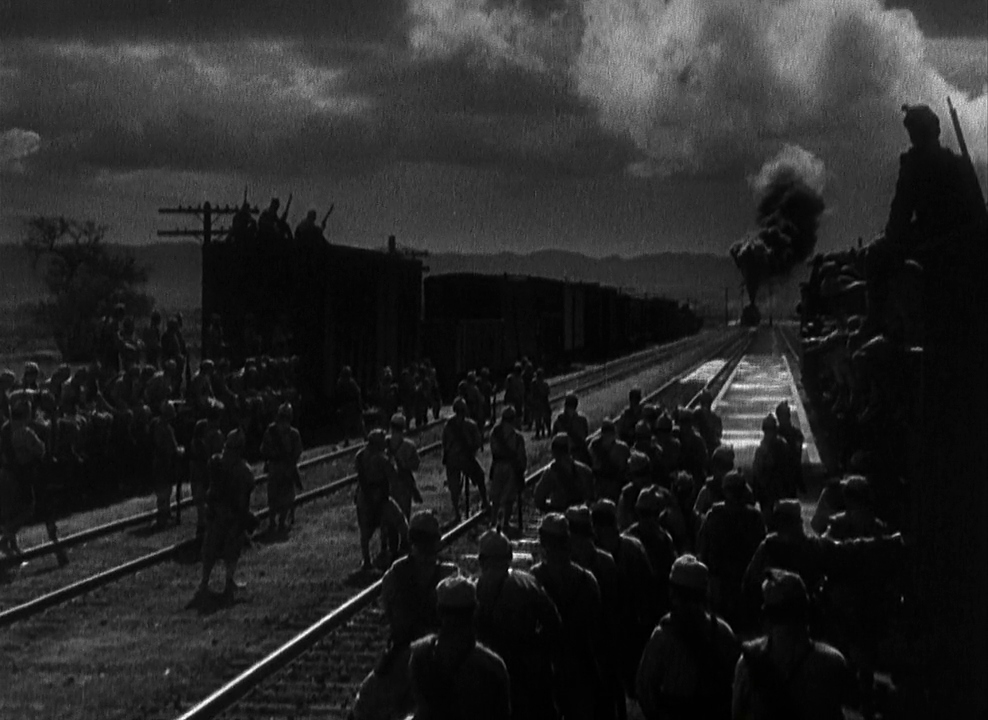
In Josef von Sternberg's Shanghai Express (1932), this relationship between trains, the cinema and the experience of dreams, finds the perfect expression. Set mostly aboard the titular locomotive as it attempts its journey from Peking to Shanghai, the narrative of the film mirrors the progression of a train along the tracks. As the journey is diverted or draws to a halt, so too does the film. When the train reaches its conclusion, the film ends.

If the narrative is a mirror to the journey of the train, then the train is a mirror to society. Its passengers, representing a broadchurch, become a microcosm of one faction of society. Among them we find different social classes, hinting at the layers of this culture, the hierarchy and the inequality of wealth. We have soldiers and entertainers, staff and travellers, the frail and even religion. In this context, they become merely representative. Rather than depict conventional character traits, their roles within the film exist to embody certain principles or political characteristics, stating their position and ideologies through dialog, the way protagonists in theatrical plays often do.

Thrown together, these characters will be tested by a subsequent turn of events, which works to upend and debase the social order that the earlier scenes dictate.


Shanghai Express [Josef von Sternberg, 1932]:

As a work of narrative cinema, Shanghai Express is more than adequate. The story is well paced and well developed, introducing relationships, back-stories and characteristics that are each carried through and "paid off" in the final act. The twists in the plot are surprising and help introduce political themes, intrigue and a moral complexity that it might otherwise have lacked. In short, it's engaging, balancing serious themes, hints of violence and contrasting witty banter in a way that feels cohesive.

However, where Sternberg's film is more remarkable is in its iconography, its aesthetics, and in the symbolic or metatextual elements of its construction. To this, Shanghai Express is a film of symbols; a narrative wherein each development of the plot expresses not just a narrative function but a projection of the characters' psychological states. The film is almost specifically constructed around these elements; every facet of its story, from the setting, to the backdrop, to the train itself, facilitating a means for these characters to make sense of their own emotions, turning the film into a genuine psychodrama.

That the film is set during the period of the Chinese Civil War connects less with history than it does with the idea of a divided territory; not just geographical, but psychological. The China as depicted in the film is an occupied territory, but occupied not just by the political rebels, colonialist agitators or the decadent and the damned passengers that define its narrative, but occupied in the same sense that thoughts, fears and desires might occupy our daily existence. These characters are in a state of conflict, and as such, "occupy" a state in conflict; making the catastrophes and the debasements that occur along the way not just literal but figurative as well.

Like The Silence (1963) directed by Ingmar Bergman, Shanghai Express is a dream play. The characters, both here and there, are trapped in a physical space that becomes a kind of psychological limbo. Fittingly, The Silence begins with a train journey through a heightened, almost surrealist landscape of war and devastation; another occupied territory. Is the war real or metaphorical? Is it something that occurs outside the perspective of these characters or within? Is it a projection of their own fear, their trauma or the state of anxiety that holds them captive, or is it simply a dream; a conjuring of the unconscious mind?


The Silence [Ingmar Bergman, 1963]:


Shanghai Express [Josef von Sternberg, 1932]:

Unlike Bergman's film, the backdrop of civil war in Shanghai Express has a historical context. It relates to actual events, but its function within the unfolding melodrama of its characters is no less vague and enigmatic than the fictional wars that Bergman depicts, both in The Silence and in his later film Shame (1968). It is still, to some extent, a vague projection unfolding through the windows of a train. The characters react to it, but mechanically, as if function compels it. They exist always as if sleepwalking through another person's existence.

It's here that I'm reminded of a later film that took great influence from Sternberg's work; Lars von Trier's post-war allegory Europa (1991). Like Shanghai Express, Europa's drama is connected to a train that becomes both an embodiment of the structured narrative and a microcosm of the world in miniature. Its characters are political or philosophical representations that exist to present sides of a specific argument relating to the Second World War, culpability, innocence and the state of post-war Europe. Both films treat historical conflict as psychological conditions; their respective destinations less geographical realities than a state of mind. Both films are coded, stylised and have a dreamlike feeling where characters are robbed of personal agency.


Europa [Lars von Trier, 1991]:

Trier and his co-writer Niels Vørsel make their intentions explicit by creating a framing device around hypnosis. Their film physically takes place while in a state of trance. Sternberg and his screenwriter Jules Furthman are less literal, but the results are nonetheless the same. The atmosphere of the film is stilted, deep and thick; its characters like sleepwalkers moving without recourse; somnambulists lost in some nigh time enchantment that plays out through the window/screen.

In keeping with this, Sternberg's film has the feeling of an endless night. It isn't; bookending sequences are set during the daytime. But it's the impression of the film as something existing within the twilight between sleep and waking, the dreamlike artificiality of the performances, the expressionist gestures of the cinematography and the psychodramatic aspects of the narrative as some internal conflict that the central characters must overcome in order to find a kind of peace, that leave the greatest impression.

Viewed through the prism of Europa, it's much easier to read Shanghai Express on a similar, more expressionist or psychological level. Trier's cynicism means that he ultimately desires to destroy his train, and to destroy the bridge that allows it to travel between two worlds. Sternberg is less cynical. His film reaches a conclusion befitting the films of this period; reaffirming the intentions of characters and moving towards a kind of happiness or hope. Even though the war is still raging, and lives are being lost, it doesn't matter; the war, in this context, always existed as a projection of the inner conflicts within the lives of these characters.

Just as the tunnel in Smith's film provided a necessary function in allowing its two protagonists to share a romantic moment, so too does the civil war of Shanghai Express. Does this make the film weaker, or more exploitative? I couldn't say. However, I found the experience of the film more fascinating, emotionally engaging and beautiful in its design and direction for the way it unfolds in this world of night time shadows; this nocturnal suspension of actual time, wherein characters are trapped, forced to engage with a projected narrative that facilitates a form of emotional transcendence.

Monday, 24 February 2020

The Year in Film 2019 - Part Four


Happy as Lazzaro [Alice Rohrwacher, 2018]:

Watched: May 04, 2019

The furious social commentary of the film put me in mind of an old quote attributed to the filmmaker Jean-Luc Godard; or more specifically, to Godard's character in his own great masterpiece, First Name, Carmen (1983): "When shit's worth money, the poor won't have assholes." The sentiment reverberates throughout Happy as Lazzaro, where the saintly nature of the central character, held, along with the rest of his fellow villagers, in a perpetual cycle of poverty and subservience, like hostages to their own employers, gives an added weight to the film's condemnation of capitalist exploitation. Like M. Night Shyamalan's much maligned but brilliant The Village (2004), Happy as Lazzaro plays with the perception of time and the idea of characters imprisoned, not by lock and key, but by manipulation; by the intentional withholding of information by those in positions of power. In both films, the subsequent revelation as to the true nature of events hits the audience like a sucker punch. It breaks the spell of the film's earlier, more pastoral or otherworldly sequences, and has the potential to leave its audience disarmed and disoriented, unsure of where we are or what we're seeing. Supernatural elements surface as the film does something extraordinary with its central character, the titular Lazzaro, who, like his near-namesake, rises literally from the dead to become a living mirror to the heartlessness of people, and the unending cruelty that defines us as a species. With Happy as Lazzaro, writer and director Alice Rohrwacher announces herself as a clear descendant to filmmakers like Pier Paolo Pasolini and Robert Bresson; finding an analogous push/pull between unscripted naturalism, bordering on the documentary, and something more artificial, stilted and austere.


Us [Jordan Peele, 2019]:

Watched: May 04, 2019

Like the director's first film, the zeitgeist capturing horror commentary Get Out (2017), writer and director Jordan Peele's second feature, Us, never really betters its amazing prologue. Finding a balance between contemporary horror movie cliché and social satire, this opening sequence creates an atmosphere that is unnerving and pervasive, perfectly evoking a feeling of plausible suburban dread, both in its fairground setting – itself a kind of self-aware acknowledgement of the film as "thrill ride" – and in its observation of the family dynamics; the curious child, the distracted parents and the constant threat of something insidious existing just beyond the frame. The sequence is also necessary in establishing many of the key themes and characteristics that develop throughout the film. The hall of mirrors, set as it is in the façade of a fairytale kingdom, connects back to everything from "Alice's Adventures in Wonderland" (1865) and its follow-up "Through the Looking-Glass, and What Alice Found There" (1871), to films like The Lady from Shanghai (1947) and Orphée (1950); that notion of the 'magic mirror' that transports a character to a literal underworld, as well as the usual connotations to self-reflection, identity and duality of the mind. While the subsequent home invasion sequences and the third act twist into something more elaborate if far-fetched are clever and brilliantly executed, they pale in comparison to this opening scene. With Get Out, I thought Peele's ideas, both in his subversion of conventional genre iconography and his engagement with the current politics of identity, were brilliant, but the film was let down by a bland, televisual aesthetic. Working here with cinematographer Michael Gioulakis, best known for his excellent work with directors David Robert Mitchell and M. Night Shyamalan, ensures that Peele's imagery is now as powerful as his ideas. Despite some obvious flaws, Us is a bold and singular experience, confirming Peele's reputation as an exciting and ambitious new voice in American genre cinema.


Unicorn Store [Brie Larson, 2017]:

Watched: May 05, 2019

In a year when Brie Larson would go on to achieve enormous pop cultural significance with her starring role in the blockbuster superhero movie Captain Marvel (2019), it seems especially incongruous to be discovering her first feature-length work as director; the small and defiantly unusual Unicorn Store. Representing a complete creative antithesis to the kind of cinema typified by Marvel's flashy, big-budgeted CGI adventure, Unicorn Store is an intimate, heartfelt, visually creative comedy drama film that combines genuine twenty-something existentialism with more fantastical or magical realist elements. Scripted by Samantha McIntyre, Unicorn Store captures something of the millennial experience in a way that feels genuinely authentic, at least in regards to the experience of middle-class suburbanites who leave the supposedly liberating institutions of college and university only to find themselves back at home, living with parents, and struggling with low-paying temp jobs that offer little outlet for the kind of creativity and expression that childhood promised. As a contrast to much of the current crop of American independent cinema, which is blandly shot and unremarkable, looking more like television movies than something directed with personality and style, Larson's film has a bold visual aesthetic that practically bursts with glitter and rainbows. The stylization extends from the personality of the central character, the struggling artist Kit, meaning that in this instance the content dictates the form. However, the result is still a confident and exciting work that suggests Larson could have potential to be a bold new voice in American cinema. I found the film both funny and moving, connecting with the character's sadness, her sense of failure and disillusionment, and her eventual move towards something approaching hope and self-acceptance. Ultimately, it's a film about belief and the need to believe in something greater than the world around us; about having a purpose, no matter how personal or irrational it might seem, which draws and connects us to other people.


The Usual Suspects [Bryan Singer, 1995]:

Watched: Jun 06, 2019

It's hard to believe there was ever a period when films like this would dominate the cultural discourse. In a world where hundred-million-dollar blockbusters are expected to gross billions in revenue, and predictably lead to the creation of an actual franchise of follow-up installments that run and run until the series exhausts itself, only to then be remade and rebooted as the process begins again, it seems entirely alien that a film that cost $6million to produce and grossed only $34million world-wide, once impacted the popular culture as significantly, if not more so, than The Avengers (2012), Wonder Woman (2017) or Joker (2019). While the creative success of the film and its legacy has been largely tainted by the separate sexual assault allegations leveled at both director Bryan Singer and the film's co-star Kevin Spacey, The Usual Suspects nonetheless holds up as a fantastic piece of comic book noir. From the very first frame the film grips the audience with a sense of mystery as we find ourselves faced with a seemingly senseless crime, conflicting timelines, an unreliable narrator and a character who acts as a surrogate for the audience, piecing together the clues. The screenplay by Christopher McQuarrie is brilliant; it's clever without being conceited, and compelling without becoming unnecessarily convoluted, always finding the right balance between tone, story and the playful manipulation of the audience. In the presentation of the mysterious Keyser Söze there is a touch of Dr Mabuse: the criminal mastermind created by Norbert Jacques and made famous in three films directed by Fritz Lang between 1922 and 1960. This similarity works to connect the film to the influence of German expressionism and by extension the legacy of the American film noir.


The Coming of Sin [José Ramón Larraz, 1978]:

Watched: Jun 15, 2019

The inference of the title, The Coming of Sin, creates an inherent tension within the presentation of the narrative and in the relationship between its three central characters. By seeking to personify "sin" as a characteristic in the flesh and blood form of a living person, co-writer and director José Larraz succeeds in taking his story out of the literal reality and creates instead a figurative representation that suggests something symbolic, almost mythical. By turning "sin" as a concept into a physical harbinger, Larraz cuts the film free from the restrictions of conventional drama and instead suggests something closer to the psychodrama. In this sense, it's a film in which characters become representations; where the struggle that exists between the protagonists is meant to externalise an internal point of view. Like his earlier film, Vampyres (1974), The Coming of Sin is a work that straddles the line between the arthouse and the grindhouse, proving itself to be another hard sell for both factions as it appears too salacious or leering for high-brow audiences, and too esoteric or languorous for the populists. On one level, the film is filled with scenes of soft-focus, softcore erotica, suggestive of analogous works by other European provocateurs such as Walerian Borowczyk and Tinto Brass, and films like The Immoral Tales (1974) or Salon Kitty (1976), where sex and depravity were treated as selling points, but packaged with creative cinematography and appeals to historical or psychological depth. The Coming of Sin undoubtedly takes great pleasure in depicting its lengthy scenes of sex and nudity, but it also features intelligent themes, strong emotions and an emphasis on smaller, observational scenes, which establish the world of the film and the relationship between the characters. The psychological subtext is as rich here as anything found in a film by Ingmar Bergman.

Friday, 21 February 2020

The Year in Film 2019 - Part Three


El patrullero (Highway Patrolman) [Alex Cox, 1991]:

Watched: Mar 17, 2019

If one filmmaker dominated 2019 for me, it was Alex Cox. Earlier in the year I read his 2008 memoir, "X-Films: True Confessions of a Radical Filmmaker", and greatly enjoyed its informative and always self-deprecating approach. I purchased two more of Cox's excursions into the literary world, his 2017 book "I am (Not) a Number: Decoding the Prisoner" and 2009's "10,000 Ways to Die: A Director's Take on the Spaghetti Western", and found both to be of a similar value. Inspired by the books I was also watching and re-watching Cox's films. Of those that were new to me, his films The Winner (1996), Revengers Tragedy (2002), Searchers 2.0 (2007) and Bill the Galactic Hero (2014) are either excellent or better than their reputations suggest, however one film stood out as a definite highlight. Filmed in Mexico following Cox's departure from Hollywood, El patrullero – or Highway Patrolman as it's commonly known – ties with Walker (1987) as the absolute pinnacle of the filmmaker's career. Scripted by Lorenzo O'Brien, El patrullero takes the mythos of the American western – where the lone lawman attempts to remain moral and just as he fights corruption and criminality in a lawless border town – and contrasts it against the conventions of the road movie. The tone is anarchic, carefully mixing between scenes of broad comedy, character development and gritty violence, while the filmmaking is ambitious and creative. This was the period when Cox was shooting his films "plano secuencia", meaning every scene is filmed in a single, carefully choreographed take. The result is a complete masterpiece of narrative, theme and aesthetics, and one of the absolute great films of the 1990s.


Phantom Lady [Robert Siodmak, 1944]:

Watched: Mar 24, 2019

The title hints at something supernatural, putting us in mind of certain analogous Val Lewton produced horror films, such as The Leopard Man, or The Seventh Victim (both 1943), but this isn't the case. Instead, Phantom Lady could be described as a "proto-giallo"; a film noir that predicts many of the conventions and practicalities that would go on to define that particular sub-genre of Italian murder mysteries so popular during the 1960s and 1970s. While it doesn't have the black-gloved serial killer or the stylised death scenes, there is nonetheless something about this story of a bystander taking on the role of amateur-sleuth to investigate a grisly murder, as well as the subsequent confession of the killer, whose grip on sanity has unraveled into tortured exposition, that recalls the practicalities of later films by directors like Mario Bava, Dario Argento and others. Films like The Girl Who Knew Too Much (1963) and Deep Red (1975) specifically, which capture something of a similar atmosphere, as well as 'cat and mouse' scenes of the "hunter" becoming the hunted. While not as powerful in its emotional drama or as inventive in its storytelling as his later film, The Killers (1946), the imagery of director Robert Siodmak is at its peak here, as the film blends the mystery and procedural elements with a thrilling descent into a third-act psychodrama.


Pirates of the Caribbean: Dead Man's Chest [Gore Verbinski, 2006]:

Watched: Mar 26, 2019

Dispensing with plot to an even greater degree than the original film, the likable but otherwise thinly-sketched Pirates of the Caribbean: Curse of the Black Pearl (2003), director Gore Verbinski's first sequel to the long-running franchise builds on its greatest strength (i.e. Johnny Depp as the irrepressible Captain Jack Sparrow) and runs with it, creating a narrative that exists for no other reason than to place its central characters into situations that allow for much comic misunderstanding, stunts and orchestrated suspense. The result, a non-stop cavalcade of action and comedy, feels less like a Hollywood blockbuster than something possessed by the cinematic spirits of Jackie Chan, Harold Lloyd and Buster Keaton. It's a film that places the emphasis on spectacle; upping the ante on what the first film was able to achieve and creating a series of visuals and set-pieces that are thrilling, original and brimming with imagination. For me, "Dead Man's Chest" is the absolute pinnacle of the first three "Pirates" films, and is a work that marks the beginning of Verbinski's run as a genuine "termite artist"; a filmmaker working within the mainstream that is nonetheless able to invest his films with ideas, images and scenarios that are subversive, eccentric, or defiantly anti-mainstream. In its scope, ambition and pure force of vision, it's a definite precursor to Verbinski's subsequent fantastic oddities, The Lone Ranger (2013) and A Cure for Wellness (2016).


Dumbo [Tim Burton, 2019]:

Watched: Apr 08, 2019

The experience of the film for me was like the world in miniature; the big-top reverie of the American experience distilled to its key essentials. The real pleasure of the film was not limited to the story and its presentation, but more redolent in what the film was able to suggest between the lines of blockbuster expectation. In its tone and intentions, Dumbo is capitalism and candy floss. It's the triumph of the broken, the different, the "other", struggling against uncertain odds. It's maudlin sentimentality. It's love, both between the child and its mother, but also at first sight. It's the struggle of the independent cinema against the unstoppable Disney machine. It's escapism. It's a circus train moving across the landscape in-time to the clamour of musical instruments. It's prejudice and persecution, pre-packaged in such a way that its message will be understood by young children, but not lost on the parents and adults also in attendance. It's a film about understanding. So many of the current crop of "live-action" Disney remakes are films made without style or personal aesthetic. They exist first and foremost as product; the imagery is there to illustrate the story and little else. Dumbo is not only defiantly beautiful as a piece of cinema, its alive with themes and ideas. While the anti-corporate, anti-big business subtext might seem disingenuous given that the film is a product of the Disney™ brand, it's another example of Burton as the "termite artist", biting the hand that feeds him. The small circus becomes a metaphor not just for the family (extended, as in the 'community') but the independent cinema. "Dreamland" as an obvious Disneyland surrogate, represents the mainstream, with its profit driven incentives, callous treatment of artists and emphasis on merchandising. The film even ends with an image of the cinema as a symbol of the great spectacles to come.


Cloud Atlas [Lilly Wachowski, Lana Wachowski & Tom Tykwer, 2012]:

Watched: Apr 14, 2019

The earnest nature of its message and the eccentricity of its delivery invite ridicule. After all, this is a film that casts recognisable superstars and has them speak in a variety of contrived, even fictional dialects, buries them under heavy prosthetic effects, and even at times indulges in the more controversial practices of gender and race-bending. To see Halle Berry portraying a white character, Hugo Weaving imitating a woman and Jim Sturgess playing Chinese isn't perfect, but it's practical, and plays into one of the more important components of the film; specifically the idea of a small group of "souls" inhabiting different variations of the same characters throughout history. Covering six different timelines and a variety of locations, from the Chatham Islands in 1849 to a post-apocalyptic future world in the year 2321, Cloud Atlas is by far the most ambitious Hollywood film of the past decade. Here, its three directors' cross countries and continents, cross boundaries of style and genre, and even cross the lines of convention and common-sense, delivering a film that for all its fantasy and imagination is focused on a human story of love and perseverance. Like Sense8 (2015-2018), the mostly brilliant TV series that Tkwer and Wachowskis would go on to helm a few years later, Cloud Atlas is a story about connections. Individual narratives find parallel lines that tangle and enfold, while music, words, images and characters echo across time and space. At close to three hours in duration there are many that would argue the film is too slight and simplistic in its message to justify the level of indulgence, but I found it genuinely moving. That the message can be regarded as "prejudice is bad and we should live as better people" was not a flaw for me. I found it beautiful, moving and admirably humanist in intentions.

Schalcken the Painter (1979)

Schalcken the Painter [Schalcken the Painter [Leslie Megahey, 1979]: This is a film I first saw around four years ago. At the time I found...