A Viewing List for Twenty-Thirteen
A continuation of the same theme as last year's list, "A Year in Film", subtitled "Twelve in Twenty-Twelve." This year I'm hoping to take the list in a
slightly different direction, breaking it down into four parts and covering all
the significant titles that I watched, or re-watched, during the course of the preceding
months. Last year, I narrowed my final
list down to only twelve titles, consisting of the ten greatest films I saw for
the first time, one film that came close to actual greatness and one film that
most benefited from a 2012 reappraisal.
Originally, I'd intended to do a follow up list, including an additional
twenty titles (Twenty in Twenty-Twelve, etc), but
by the time 2013 had edged into the summer months and the project was still nowhere
near to completion, it became increasingly clear that the intended "sequel"
was never going to occur. To safeguard
against this same failure for the current year, I've been directing all my
efforts to completing the list in its entirety.
All other posts have been added to the backlog to create additional time
to focus my attentions here.
As a result of the
"Key Films" project, I've already written at length about several of
the titles contained in this compendium.
As such, some of the reasons and justifications posted below will
regrettably be re-written modifications of these original posts. However, as the list progresses through the
later installments, I'll be making a concentrated effort to include several
additional titles that are otherwise new to the blog. The "Key Films" series
unfortunately lost momentum towards the end of the year. This was largely the result of a technical
issue (owing mostly to a broken internet connection) and the heavy burden of
work. There was also a desire to get
back to the kind of film criticism that I find to be the most satisfying and
rewarding. The posts where I take
specific images from films and create an analysis; pushing my own unashamedly
subjective and often foolish interpretation as far as it can go. This particular effort to study the frames
and the film itself currently holds a much greater appeal, at least more-so
than writing conventional reviews or just translating an opinion into text.
As with last year's list,
this current installment of "A Year in Film" is not intended to be a
catalogue of films released in 2013 (I still need to see at least seventy more
titles before embarking on such a thing), but a list of films seen in
2013. A kind of scrapbook of
experiences, not necessarily intended to function as "proper reviews"
or anything more definitive, but just an attempt to capture something of the
experience and why these films, more than any others, have remained a constant,
throughout. This particular part of the
list includes film seen between the very end of December 2012 and the beginning
of March 2013 and will hopefully be followed by 'Part Two' sometime before the
close of the subsequent week.
____________________________________________________
Come and Go [João César Monteiro, 2003]:
Initial viewing, 30th of December, 2012. Return viewing, 28th of December, 2013.
This one's a bit of a cheat, since the film wasn't initially a
2013 discovery. However, its position as
a first time viewing unfortunately fell between the completion of last year's
list, Twelve in Twenty-Twelve (in which I acknowledged the presence of Monteiro's
1999 film, The Spousals of God, as a personal favourite), and the beginning of
the 'viewing log' project (in which I discussed, in brief, the same director's
1989 feature, Recollections of the Yellow House). This, as an omission, was especially
infuriating, since Come and Go was perhaps the finest film I saw during the
entire course of 2012. Just to make it
legitimate, I re-watched the film this past December (almost exactly a year
later) and found the second experience to be even more affecting, amusing and
immersive than the first.
As the title suggests, Come and Go is a film of encounters,
stops and journeys. The central
character, the intellectual but irrepressible João Vuvu (a protagonist not
entirely dissimilar to Monteiro's notorious alter ego, João de Deus), rides the
bus across Lisbon on his way to meet a succession of old friends and
acquaintances. The daily rituals here establish
a particular structure; one in which the journey by bus seems intended to link
the lonely but decadent home life of the central character (as defined by his
often hilarious efforts to find and eventually seduce a replacement for his malingerer
maid) to the social engagements that punctuate his passage through the rest of
the film. Here, the character and his various
companions indulge in lengthy conversations about life and their experiences,
as if already anticipating the finality of their own individual days.
Characteristic of late Monteiro, Come and Go is a work both
contemplative and episodic in presentation.
An observational film, where the use of those long-held, static
compositions, seem designed to transform the interactions, conversations,
arguments and events into moments of living theatre. However, it is in the film's final scene (staged
beneath a giant cedar tree in the Principe Real Garden), that Monteiro performs
his greatest miracle. Here, the tree
itself - age'd and alone, but with deep roots that connect it to this place;
this park that first appeared in the director's second film, He Who Awaits Dead
Men's Shoes Dies Barefoot (1970) - becomes symbolic of the character's own
place within the infinite. A fitting backdrop
to this final dance of light, as reflected in a ghostly eye.
____________________________________________________
On the Beat [Robert Asher, 1962]:
Initial viewing, 25th of January, 2013.
I'm not entirely sure how well-known Norman Wisdom is outside
the UK, but his early films - in particular those in which he played a
variation on his sympathetic and proudly proletariat 'Pitkin' persona - made the
comedian a national treasure. I watched
several of his early films during the summer of 2012 and enjoyed them to the
greatest extent; so much so that I eventually bought a budget-priced Norman
Wisdom box-set containing twelve films that would effectively see me through into
the following year. While most of the
films contained in this set were very good - especially Trouble in Store
(1953), One Good Turn (1954), Man of the Moment (1955) and the satirical The
Square Peg (1958) - it is the film in question that seems to me to endure as
the definitive Wisdom benchmark.
The best of Wisdom's work most often played to the social
limitations of the performer. Characteristically,
his Pitkin protagonist - the weedy, well-meaning and defiantly working class
naïf - finds himself the butt of the joke when removed from the comfort of his
own social stratum and placed within an environment that necessitates a certain
level of order, privilege and efficiency.
This juxtaposition between the character's own unashamedly unaffected demeanour
against the more "hoity-toity" attitude of his new surroundings,
provides the film with its comic set-up.
As the initial narrative draws cheap laughs from the havoc and disruption
caused by Pitkin's well-intentioned buffoonery, it is the over-the-top reactions
of indignation of the supporting characters that ultimately turns the joke
against these oppressors. The film
exposes, through the mistreatment of Pitkin, the often cruel and discriminatory
exploitation of the layperson by any close-minded establishment, be it
government, industry or military.
The physical comedy, which throughout the film makes full use of
Wisdom's near-acrobatic ability to run, jump and hurl himself recklessly
through moments of pantomime-like silliness, is genuinely unsurpassed in its
invention, but really, it's the personal context of the film that gives the
slapstick a greater emotional weight. In
On the Beat, the hope and longing of the central character to become a
celebrated policeman like his father before him, propels the narrative, but
also gives purpose to these extended set-pieces, the madcap plot and the "Walter
Mitty-like" fantasy sequences that establish the character as a hopeless dreamer. It infuses the comedy with a delicate sadness
that only adds to the other elements of romance and whimsy, which in turn, categorise
and define the typical Wisdom approach.
____________________________________________________
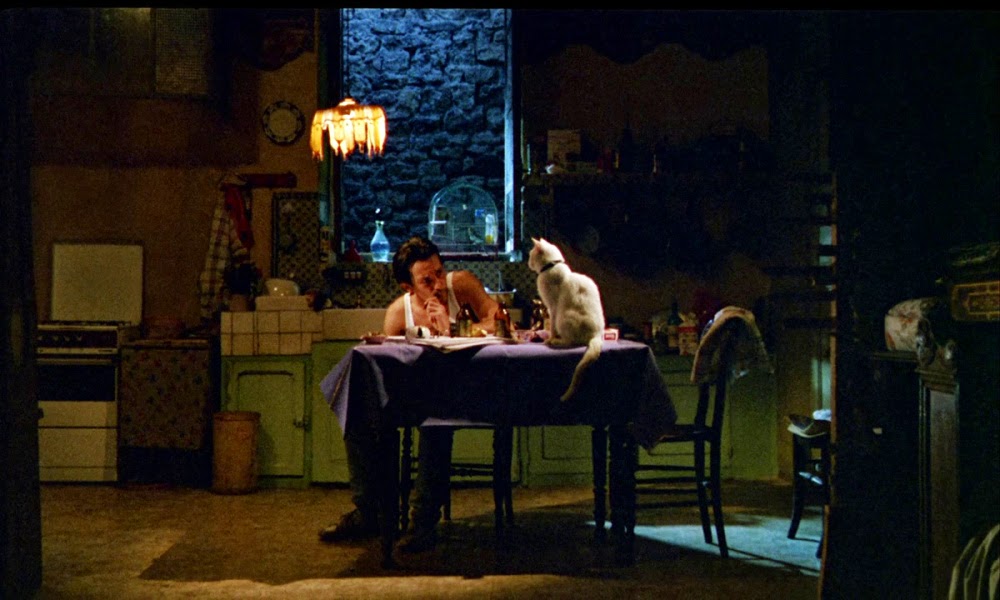
Roselyne and the Lions [Jean-Jacques Beineix, 1989]:
Initial viewing, 29th of January, 2013.
In 2012, I was finally able to tick-off one of those obscure "Holy
Grail" titles that had long since eluded me. The film was Moon in the Gutter (1982) by
Jean-Jacques Beineix. This year (2013),
I repeated the same feat by experiencing another of those longed-for titles
that had otherwise remained unseen. The
same director's forgotten masterpiece, Roselyne and the Lions. While I enjoyed Moon in the Gutter as both an
oddity and an expression of what Godard once called "pure cinema", the
film was ultimately too alienating (by design) to have any greater impact beyond
the surface of its ornate and often dazzling production design and impeccable
cinematography. With
"Roselyne" however, there was no such issue with commitment. The allure of the work was instantaneous!
Throughout the film, Beineix uses the exhibition of lion taming
as a metaphor for the often destructive impulses that drive the modern relationship. This is a courtship where anger, jealousy,
passion and pain threaten to obliterate the bond that exists between two
people, driven close to insanity by their obsessions and insecurities. The spectacle of the film - where the 'tamer'
and 'trainer' attempt to control these wild beasts that stalk and prowl the
barred perimeter of the cage - works as a visual representation of the
characters' love for one another. A mad
love, or impetuous love, that is all-powerful and all-consuming. A dangerous and destructive love that seems volatile
enough to spill out into violence or to blossom, flower-like, into something more
rich and beautiful. A display of chaste
emotion, which, in its graceful theatricality, becomes art.
Viewed in its complete, 180 minute director's cut, the
experience of Beineix's film and the work of the actors when face-to-face with
these ferocious lions that respond and perform to their every command, is breathtaking
in its authenticity. The combination of
this reckless, dazzling demonstration of technique, in contrast with the more
intimate, character-driven story, moves as much as it enthrals. In a year defined by the CGI excess of films
like The Desolation of Smaug, Gravity and Pacific Rim, it seems increasingly
more difficult for an audience to actually believe in what they've seen. The thrill of "Roselyne" is as such
in its legitimacy. Like the best work of
Werner Herzog, this is a film that exists as an effort to film the un-filmable. To capture something real and miraculous
on-screen.
____________________________________________________
Nouvelle vague [Jean-Luc Godard, 1990]:
Return viewing, 18th of February, 2013.
This was something I've returned to recently. I first saw it a long time ago - 2006, maybe
- when I was still at university. I
remember borrowing it from the campus library on a badly damaged video
recording and finding it almost impossible to make sense of the subtitles
through the worn-out tracking of the VHS.
As far as the memory goes, I recall more than anything being transfixed
by Godard's framing and camera movements and by the beauty of Domiziana
Giordano - who I recognised as the actress from Tarkovsky's masterpiece
Nostalghia (1983) and from Neil Jordan's blockbuster Anne Rice adaptation Interview
with the Vampire (1994) - even if many of the more subtle or intellectual nuances
of the film itself were eventually lost in translation.
I still enjoyed the film a great deal. I'd already become a fan of Godard in 2002
when I saw A Woman is A Woman (1961), Le Mépris (1963) and Éloge de l'amour
(2001) almost back to back during the course of the school holidays. I wouldn't become a true Godard "fanatic"
until early 2008, but this was undoubtedly the start of the journey. Returning to the film now, with a greater
comprehension of its author's work, I understood the intentions of the film a
little clearer and could see through the more inscrutable or elusive aspects to
the themes and emotions beneath. On the
surface, Nouvelle vague seems suitably impenetrable; awash as it is with
quotations, references and attempts to dismantle the narrative or the
connection between the audience and the work through disruptive and
experimental filmmaking techniques. This
is the snare of Godard's iconoclastic methodology that tends to turn the more casual
viewer away. However, the elliptical and
poetic nature of the work is worth persevering with, if only to savour the
hypnotic grandeur of its sounds and images, or the expressions of its actors
and its text.
In persisting with the film and approaching it on a level where
every cut, sound and image is expressive of something greater, the sentiments
and ideas of the film become clear.
Though there are further allusions to class and the economy, and the
presentation of the house itself, with its various layers and hierarchical
structures as a microcosm for society in general, it is the story of the couple
in crisis that really gives the film its reason for being. As is characteristic of Godard, the couple is
symbolic - their inability to meet, literally and metaphorically, speaks to a
greater inability that goes beyond the narrative intrigues of the film - but this
aspect exists without diminishing the
pain, passion and confusion that makes their relationship so affecting and true.
____________________________________________________
The Howling [Joe Dante, 1981]:
Initial viewing, 19th of February, 2013.
In last year's equivalent of the end of year list, I incorrectly
dated the re-watch of Gremlins 2: The New Batch (1990) as the 11th of March,
2012. It was actually the 11th of
December. The date is significant,
because it was in seeing Gremlins 2 for the first time since childhood that I was
able to perceive Dante's work in a richer, more enlightened context. It set me off on a journey of rediscovery
that has continued throughout the subsequent year. This reclaiming of Dante's work reached
something of an apex back in February, when I watched and then re-watched three
of the director's greatest films: Matinee (1993), Homecoming (2005) and the work
in question. These three films, when
seen in the context of Gremlins 2, confirmed Dante's reputation as one of the
great subversive pop-artists of the last four decades.
While The Howling functions primarily as a homage to the werewolf
genre - its quotations from The Wolf Man (1941) and The Curse of the Werewolf
(1961) for instance establishing a certain self-awareness of tone that predates
the analogous genre deconstructions of Quentin Tarantino by more than a decade
- there is still so much more to the film than a simple play of
references. In establishing their
narrative, Dante and his screenwriter John Sayles use the idea of lycanthropy
to effectively explore the concept of "the beast within"; creating a
context for the film in which the initial attacks are perceived by the media to
be the work of a vicious sex-killer, and where the film's primary setting, "the
colony" - a riff on the then-cultural trend for health spas and communal retreats
- is used to lampoon the very conservative idea of repression, both emotional
and psychological, as it pertains not only to the subversion of the werewolf
mythology, but to the often transgressive nature of the horror film in general.
However, it is in the film's last minute descent into full-blown
Looney Tunes satire that The Howling reaches a level of genuine
transcendence. As the werewolf begins
its graphic and harrowing transformation during the broadcast of a live TV news
bulletin, Dante cuts to the reactions of a stunned audience watching the scene
from the safety of their respective living rooms. The full range of responses are intended to
mirror the reactions of the movie audience when faced with the same scene (some
are shocked, others laugh at the absurdity, while others can't believe their
eyes). In this penultimate moment, the
filmmaker seeks to question the authenticity of the recorded image. The idea that seeing is no longer believing
for an audience worn down by the exploitations of the global media age.
____________________________________________________
The Oak
[Laila Pakalniņa, 1997]:
Initial viewing, 24th of February, 2013.
The first
image of the film introduces the idea of the oak as "protagonist"; a
central figure, observing; connected to everything. A short on-screen caption then informs us
that the tree in this village (in the Seja region of Latvia, where the film
takes place) is seven-hundred years old.
As would occur in Pakalniņa's later film, Teodors (2006), a living
symbol of age and wisdom is being presented as the silent witness to the daily
struggles and encounters of a small village almost forgotten by the modern
world. In Teodors, the witness was the
film's title character; an elderly man who watched the various comings and
goings of his small village from a bench outside the local bus stop; the
visible scars of age and experience marked as the wrinkled crevices upon his face.
The presence
of Teodors - his existence as a relic, out of step, out of time - worked to
connect the past to the present; his own continuing subsistence as a reminder
to these people of the things that came before.
In The Oak, the tree - this still "living" thing, which has
existed for centuries, ever present - fulfils the same social and narrative
function as the age'd man. It has
weathered the march of time. It
perseveres - remains standing, stoical - out-lasting the lives of others. It is a genuine part of this community and as
such effected by the same hardships and sorrows faced by its citizens, albeit,
in a less tangible way.
In creating
the film, the intention of Pakalniņa is essentially to document the daily lives
and experiences of these characters who struggle to survive in a place where
work is limited and even a warm cup of coffee or a hot bath have become a
luxury that few can afford. In having these
people introduce themselves - establishing the context of life in the village,
their stories and experiences - Pakalniņa is connecting the setting to its
inhabitants. However, she's also presenting
the tree as the eternal symbol of resolution and continued existence in order
to create a point. Times may be hard for
these people (here documented by Pakalniņa's attentive, sympathetic camera,
which transforms moments of actuality into frames of vivid still life), but the
preservation of this tree - as an emblem of personal endurance - provides hope.
____________________________________________________
How I Won the War [Richard Lester, 1967]:
Initial viewing, 26th of February, 2013.
It took me several months to clarify what I wanted to say about
Lester's film. Not necessarily because
it's a challenging or even difficult film to make sense of (although certainly it
"flouts" narrative convention), but because so much of its ability to
provoke a response from the audience results from the often difficult to define
juxtaposition of horrific, real-life stock-footage of second world war atrocity
with scenes of ironic pastiche, comic parody and a filmmaking approach that is
intended to break the fourth wall at every conceivable opportunity. To put it into a more understandable context,
think of it like this... What if the
Monty Python team were to update Lewis Milestone's All Quiet on the Western
Front (1930) to a WWII setting and used the film to offset their own
characteristically surreal sense of humour with a solemn anger and serious bitterness
that sought to express a genuine sense of outrage at the way the war had been
exploited by institutions looking to turn the suffering and sacrifice of
soldiers into sensationalism and profit.
The image posted above sort of gets to the point of what Lester's
work is suggesting; depicting, on the one hand, a very real and very disturbing
tragedy of a soldier maimed in combat, but presenting it in a way that is almost
absurdly matter-of-fact. Throughout the
film, the violence (both factual and fictional) is depicted in a way that is no
less shocking than any other motion-picture on the same subject and theme, but
instead of adorning such sequences with a melodramatic bombast or hand-wringing
sentimentality equivalent to that of the films of Oliver Stone or Steven
Spielberg, the scenes are frequently treated by characters as nothing more than
a mild inconvenience. Soldiers even
return from the dead and continue fighting as colour-coded revenants; their
entire bodies painted garish colours as if to suggest that death is the only
way to break free of the conformity of the uniform, but also giving these
characters the same appearance as one of those miniature plastic toy soldiers
made famous as supporting characters in the John Lasseter film, Toy Story
(1995).
It could be said that Lester's film exaggerates the absurdity of
war in order to create a political commentary, but this is only partly
true. What the film does, more
specifically, is exaggerate the absurdity of the war film, or anti-war film, as
both a genre and approach. In using
humour to cut through the solemnity of the subject matter and to create a sense
of over-the-top, almost 'cartoonish' insanity, Lester and his screenwriter
Charles Wood are taking apart the clichés of the war movie that they find to be
the most appalling and disingenuous.
This is why Lester often referred to the film as an "anti anti-war movie"; the
distinction making explicit the idea that the film was not intended to make fun
of war, or to diminish or devalue the struggles and sacrifices of those that
fought it, but instead attempting to reveal the insincerity and the hypocrisy
of the way war is often depicted through the media, and in the cinema
especially.
____________________________________________________
The Territory [Raúl Ruiz, 1981]:
Initial viewing, 4th of March, 2013.
The Territory is a work that I'd been eager to see ever since I
first heard about it in relation to Wim Wenders' The State of Things
(1982). The story goes that the Ruiz film
ran out of money. Wenders was visiting some
friends who were working for Ruiz and in order to keep the crew from leaving
decided to make a film of his own. Using
the cast and crew assembled by Ruiz, Wenders made a film that commented
directly on the situation - in which a group of actors and technicians are left
stranded at a resort in Portugal after their producer makes off with the cash -
while also adding a more personal subtext that sought to express his own
frustrations with producer Francis Ford Coppola during the making of the
ill-fated Hammett (1982).
As my knowledge of Ruiz and his work began to grow, my obsession
with seeing this phantom film became even greater. In finally seeing the film this past March, I
was happy to confirm that the experience was exactly what I'd hoped it would
be. The Territory is as mysterious,
maddening and magical as one might expect from the director responsible for
films like Hypothesis of the Stolen Painting (1978), City of Pirates (1983) and
The Nucingen House (2008), with the same elaborate style, hypnotic atmosphere
and puzzle-box narrative used to enliven what initially seems to be no more
than a standard exploitation movie.
At its most direct, the narrative of Ruiz's film involves a
group of young professionals on a camping holiday who become lost and
disoriented in a forest that eventually takes on an almost supernatural quality
(leading to a psychological deterioration that is intended to function on a
level of social satire). One can draw
obvious parallels with a more mainstream film, such as Deliverance (1972), or
even the overt-horror iconography of Friday the 13th (1980), however the real subtext
of Ruiz's work is essentially much closer to that of Jean-Luc Godard's Weekend
(1967), where the descent of its characters into savage cannibalistic
aggressors becomes expressive of both the decline of western civilisation and
the madness of the modern-age.
____________________________________________________
I Confess [Alfred Hitchcock, 1953]:
Initial viewing, 10th of March, 2013.
At the time I first saw Hitchcock's perhaps most underrated
masterpiece, the mordantly titled I Confess, the 'Viewing Log' series was
already reaching an end and was about to merge with the 'Key Films' project,
and in the madness of all that nonsense the intention of writing about the film
was seemingly lost. I tried to come back
to it again in October, but by this time the impetus had gone. The best I could do was a veiled reference in
the title of another post... It was
unfortunate, since I Confess both moved and enthralled me more so than any
other film directed by Hitchcock, including his iconic masterworks, such as Rear
Window (1954) and The Birds (1963). The
film has all the trademarks of the director's greatest work - the peerless
filmmaking, the tension, the ambiguity - but with a solemnity and an austerity that
made the theatrical and largely sombre development of the drama feel like a departure.
Though some will no doubt balk at the suggestion, the film for
me evoked the spirit of Hitchcock by way of Robert Bresson. It wasn't just the religious aspect of the
narrative or the questions raised on the notions of piety, conviction and guilt
that seemed to circle back to a film like Diary of a Country Priest (1951) or even
the subsequent Pickpocket (1959), but the tone of the film. The comparatively more restrained and static
approach, which at first seems to work against the immediate expectations of
what a Hitchcock film "is" or should achieve, but eventually allows the
director to better engage the audience, not least in the characteristic scenes
of anxiety and suspense, but in the emotional life of his protagonist and in the
moral dilemmas that occur as a result of his plight.
In approaching the film as a work of suspense, it is the
blamelessness of the character (and his numbing sense of conviction) that
becomes the literal "bomb under the table." The audience is aware of his innocence from
the very first scene, but the characters that populate this world are
unconvinced. They read and misread past
experiences and statements made with the intention to protect until they became
like the ever tightening noose around the neck of this man whose faith binds his
words in silence. As the viewer becomes
further invested in the life and sacrifices of this character and in his
unwavering belief (in the face of such hideous lies and accusations), we yearn,
with all honesty, for a last minute reprieve; a confession, from anyone still
willing to do the right thing; to intercede in the absence of God, on behalf of the innocent.
____________________________________________________
Wanda Gosciminska, a Textile Worker [Wojciech Wiszniewski,
1975]:
Initial viewing, 12th of March, 2013.
This was the first of two films by Wojciech Wiszniewski that I
saw during the course of the last twelve months. The other, ABC Book/The Primer (1976), was
also a work of extraordinary vision and originality and could have easily made
the list were it not for the more significant experience of the film in
question. What elevated Wanda
Gosciminska, a Textile Worker above the other Wiszniewski film was ultimately
the clarity of its ideas (at least in relation to its strange and often
provocative imagery) as well as the more personal or emotive feeling that its
subject enthused. Unlike the subsequent
film - which often felt like a series of disconnected sketches, which, when
viewed in totality, evoke a specific point - the work in question has a
markedly more graspable and definable narrative as communicated by its central
character.
The film chronicles the life-story of its protagonist - this
determined worker, who, through the course of her reminiscence, becomes the
prevailing symbol of not just socialism, but a personification of the industrial
revolution - however, it does so in a highly imaginative and unconventional
way. As such, defining the work of
Wiszniewski, as a filmmaker, is difficult.
His films purport to be documentaries, but are presented in a highly
stylised and cryptic approach, using intense stylisations. The places, people, statistics and ideas put
forth in these films are factual and true, but are embellished and exaggerated
through the process of filmmaking in an effort to create a greater level of social
commentary. While conventionally such
stylisations would deny the film its authenticity, the direction actually makes
Wiszniewski's point more clear and precise.
By reducing Wanda's life and her experiences to a series of
representations, the filmmaker creates a form of narrative criticism that
functions on the same level as the illustrations in a children's book. It's not merely a case of providing a diagram
to the memory of the film's events, but instead interpreting these events and
creating a visual adaption that is larger than life and as such expressive of
something even greater than the reality.
Through this particular stylisation, Wanda Gosciminska becomes a film where the images "speak"; communicating through the
surface of the thing (which is surreal, captivating and symbolic in
presentation) a particular dilemma; a condition, both moral and socio-political. Through exaggeration, the
film is able to find the satirical subtext of the presentation, without turning
the efforts of its protagonist, real or fictitious, into a joke.