Showing posts with label Fritz Lang. Show all posts

Sunday, 2 February 2020

Human Desire


Thoughts on the film by Fritz Lang

The characters, like trains in perpetual motion, are on a collision course, unable to change track. The lines of the iron girders that form this interconnected network of railroads and tramlines, become like the bars of a prison cell, encircling and ensnaring these characters from the outset.

Pertinent visual metaphors abound in Fritz Lang's late melodrama, which adapts the 1890 novel "La Bête humaine" by Émile Zola, and in the process translates it into the language of the American film noir.

Better writers than me have touched upon this emphasis on trains and train tracks, which dominates the iconography of Lang's film to such an extent that it seems pathological, rather than aesthetical. These are characters moving headlong in the same direction, their guilt, complicity and desperation propelling them on along this journey to a (final) destination that can only end in bloodshed or desolation. Criminality is the train that these characters board and the question throughout is whether any of them will have the foresight or the resilience to get off before it's too late.


Human Desire [Fritz Lang, 1954]:

I once outlined an essay in which I argued the history of cinema was trains and bridges; that the birth of cinema was defined by the two. The train in particular is an appropriate metaphor for narrative cinema; something that progresses in a straight-line from point A to point B. This connection is something that Alain Robbe-Grillet recognized in his masterful post-modern meta-film, Trans-Europ-Express (1966).


A characteristic film noir motif: the silhouette of the venetian blinds becoming an onscreen signifier of the unlawful; the bars of a prison cell, or the criminal act itself. But is the character here outside the law or imprisoned by their own emotions, or the world they inhabit?

While the subtext here is intelligent and lends the work a certain depth, Human Desire (1954) is nonetheless one of the weakest of Lang's films for me. As a melodrama I found it inert and unconvincing. Glenn Ford is too old to play the protagonist, who should've been a guy in his early twenties, naive and quick to please.

In films like Blue Velvet (1986) and Lost Highway (1997), David Lynch proved that these dangerous love triangles work best when the guy in the middle of it all is some dumb young sap blinded by his lust for an older woman. Ford was almost forty here and looks older. That his character spends many of his earlier scenes flirting with a supposedly eighteen and interested Kathleen Case, makes his sudden seduction by fading goodtime girl Gloria Grahame all the more unlikely.

However, what's really missing from Human Desire is Lang's incredible formalism. While it's intelligently made and has some attractive imagery, it feels bland and safe in comparison to Lang's greatest films, which were often loaded with expressionist lighting, dreamlike sequences and dynamic shot compositions. Compare the film in question to more masterful works, such as Spies (1928), The Testament of Dr. Mabuse (1933), Hangmen Also Die! (1943), Secret Beyond the Door (1948), The Big Heat (1953) and The Thousand Eyes of Dr. Mabuse (1960) to name a few, and we see not only a weaker emphasis on cinematic style, but a much less rich and well-developed psychological or self-reflexive element to how the story is constructed and unfolds.

While not a terrible film, Human Desire feels like a work that could've been directed by any anonymous studio practitioner. It feels somewhat generic, lacking the mesmeric, somnambulistic quality of Lang's great expressionist psychodramas, and feeling especially weak in comparison to analogous crime/noir classics like In a Lonely Place (1950), Strangers on a Train (1951), I Confess (1953), Kiss Me Deadly (1955) or Touch of Evil (1958).

Tuesday, 29 January 2019

A Year in Film Pt. 3


A Viewing List for Twenty Eighteen


Moulin Rouge! [Baz Luhrmann, 2001]:

Watched: Jul 06, 2018

In the back of my mind there is a memory of having seen this film before. Perhaps as a young teenager, or maybe even before that. In watching the film again, as an adult, I could still recall specifics of the plot; certain images that had the power to astonish and enthral, as well as the use of particular songs, which have endured in the memory, though largely because they remain iconic reminders of late-twentieth century pop-culture. However, I didn't recall how intelligent the film was in its self-reflexive presentation of fictions within fiction; the clever mirroring between the "in-film" audiences' relationship to what's on stage with the real audiences' relationship to what's on screen. There is also an incredibly rich inter-folding of narrative layers, as the creation of the show within the film - as written by the central character - becomes a commentary on the film itself. The combination of both high and low-brow elements - that post-modernist hotchpotch of influences (from opera, to Bollywood, to MTV), as well as the extended commentary on the nature of stories to express a reflection of something that can't otherwise be said - are genuinely bold and invigorating; placing the film's daring deconstruction of form and the layering of images upon images, sound against sound - moods, emotions and themes all crashing into one another - closer to the innovations of the avant-garde than any conventional Hollywood production. Moulin Rouge! is effectively a kaleidoscope of a film, where the techniques, the assemblage of influences and the presentation of events, each finds the perfect equilibrium between content and form. It's an engaging work that is brazen in both its romanticism and in its appeals to the bohemian "idyll", but there are still parts of the film that actually resonate quite profoundly with the recent discussions around the #MeToo movement, and how such scenes relate to the idea of systemic abuse. One subplot in particular involves an actress being effectively prostituted by her manager to a wealthy patron who exploits his position of power. You have to wonder if the filmmakers were trying to warn us about Harvey Weinstein. That such grim realities are allowed to permeate the otherwise escapist melodrama of the story adds an additional layer of depth to the film; one that illustrates how the casual dismissal of Luhrmann's work as empty spectacle feels pretty wide of the mark.


Fantastic Beasts and Where to Find Them [David Yates, 2016]:

Watched: Jul 14, 2018

2018 was undoubtedly the year that I stopped worrying and learned to appreciate J.K Rowling. Having never read the Harry Potter books I don't have the same attachment to her "wizarding world" that many others of my own generation seem to maintain. As such, a film like Fantastic Beasts and Where to Find Them didn't really bother me in its blithe way of loosely cashing-in on the earlier franchise's long-lasting success, or even in its simultaneous attempts to "retcon" potential discrepancies within the series chronology as a whole. Instead, I found myself appreciating the film for its emotional subtext, which was sensitive and compelling. While the main storyline of Fantastic Beasts is undoubtedly imaginative and incredibly entertaining - filled as it is with all the strange creatures, action and adventure that audiences, for better or worse, now accept as "cinematic" - it was the personal themes and the film's unconventional deviations from the accepted blockbuster formula that felt genuinely thrilling. In terms of the film's subtext, Fantastic Beasts is essentially a story about how prejudice and abuse can create a level of harm and violence, which, if suppressed, can manifest in ways that are entirely self-destructive. This thread is most clearly realised in the character of Credence, whose arc is far more interesting and emotionally compelling than that of the boy wizard character in the author's other, more successful series of works. Through Credence - abused by his fundamentalist mother, raised in poverty and used by an older male character with nefarious intent - Rowling engages with a very real sense of exploitation; finding in it a way to explore deeper, more emotional themes (e.g. trauma) through the lens of magic and mystery. This is a device that Rowling has used to great effect before, disguising elements of autobiography and social commentary through a surface-narrative of pure fantasy (for instance, think of the way the evacuation of the infant Harry from the dark lord Voldemort mirrors Rowling's own escape with her young daughter from a potentially abusive partner; or how the Dementors become symbolic of mental illness), even if this is an aspect of her writing that only began to make sense to me last year. If we combine the moving and transformative arc of Credence with the film's positive commentary on conservation and its focus on heroic characters that are unconventional in their traits (pacifistic, inarticulate and socially-awkward), then we find in Fantastic Beasts, not just a film of great spectacle, but a work of compassion, imagination and genuine depth.


Serpent's Path [Kiyoshi Kurosawa, 1998]:

Watched: Jul 18, 2018

Although far removed from the influence of the supernatural, Serpent's Path - Kurosawa's twisting and perverse film about revenge and accountability - seems to exist within the same ghostly, uninhabited universe as many of the director's better-known horror films; specifically Cure (1997) and Pulse (2001). Like those films, there is a similar emphasis on long-held observations of decaying industrial spaces, where the rundown construction sites, abandoned lots, warehouses and factories provide a kind of external mirror to the ruined lives and broken nature of the characters' psyches. Shot back-to-back with the similarly themed Eyes of the Spider (1998) - both films produced quickly and cheaply with the same cast and crew - the success of Serpent's Path is a great testament to Kurosawa's continued ability to transform material that many would consider disposable or derivative, and instead imbuing it with something almost thought-provoking, even mythical. In this sense, he's comparable to many of the great B-movie studio filmmakers of 1940s and 50s; Robert Siodmak, Fritz Lang, Jacques Tourneur. Cinematic formalists who cast a light into the darkened corners of society, and through an impeccable control of sound and image, took stories and subject-matter that could've been dismissed as generic-schlock, and elevated them with an intelligence or seriousness that is always mesmerising. Serpent's Path could've easily become as problematic as other revenge films, such as Death Wish (1974), Man on Fire (2003) or Death Sentence (2007), where there was an element of celebration to the violence; the filmmakers manipulating the audience emotionally, until the argument for vigilantism seemed sound. Kurosawa goes beyond this by creating a world that feels removed from reality. Life for these characters is like an unending purgatory, where they find themselves trapped in a cycle of violence and haunted by the pain of an unspeakable act. As a piece of cinema, it's ultimately more Michael Haneke than Michael Winner, with its focus on detached observation, video monitors and VHS tapes as shorthand for recorded memory; all seeming in some way reminiscent of a film like Benny's Video (1992) or the later Caché (2005), as well as other works by the film's screenwriter, Hiroshi Takahashi, for instance the horror masterpiece Ring (1998).


Universal Soldier: Day of Reckoning [John Hyams, 2012]:

Watched: Jul 29, 2018

Having no great regard for the 1992 Roland Emmerich-directed original, nor its initial 1999 straight-to-video sequel, I was nonetheless pleasantly surprised by director John Hyams's first instalment in the UniSol franchise - the knowingly sub-titled Universal Soldier: Regeneration (2009) - when I first saw it on television back in 2011. Seeming to take its influence more from video games, such as the Call of Duty series (specifically the first game's battle of Stalingrad level) and Fallout3 (the abandoned factory-setting suggesting something almost post-apocalyptic), Hyams brought a gritty, stripped-down sensibility to the action and fight choreography, which grounded the film in a more authentic sense of physicality. Emboldened perhaps by the success of Regeneration on the home-cinema market, this sequel, Day of Reckoning, finds Hyams broadening his creative palette; pushing the narrative arc more towards a "Heart of Darkness" style descent into the depths of madness, where self-realisation and self-destruction go hand-in-hand. It's a film that seems designed to baffle and alienate many of its target audience, indulging in lengthy monologues of pop-psychology about the nature of existence, accountability and what it means to be human, while bludgeoning the audience into submission with a highly sensory audio-visual approach more suggestive of filmmakers like Gaspar Noé and Nicolas Winding Refn; specifically works such as Enter the Void (2009) and Drive (2011). If Regeneration took its template from John Carpenter's cult-classic Escape from New York (1981), then Day of Reckoning is more Apocalypse Now (1979); with Scott Adkins taking on the role of the Captain Willard character (effectively on a mission up-river) and Jean-Claude Van Damme as its Colonel Kurtz (shaven-headed and spouting philosophy as he commands an army of renegade soldiers). The result is a more subjective, hyper-real experience than its predecessor, infused as it is with bold neon lighting, stroboscopic sequences and a pulsating soundtrack, all in the service of a bleak and elliptical story about manipulation and revenge.


A Quiet Passion [Terence Davies, 2016]:

Watched: Aug 04, 2018

"This is my letter to the world that never wrote to me. The simple news that Nature told, with tender majesty. Her message is committed, to hands I cannot see. For love of her, sweet countrymen, judge tenderly of me." - The words spoken by the character, after death, are accompanied by a time-lapse image of the author's portrait as it dissolves between the three faces of Cynthia Nixon, Emma Bell and finally Dickinson herself; presenting the poet at the two stages of life as depicted in the film, against the reality of the woman, whose words provide the epitaph. As a final moment, this sequence seems to encapsulate the film's central themes of time, permanence, identity, death and transfiguration; connecting it, as both poetic gesture and visual leitmotif, to an earlier sequence, in which a similar dissolve, from youth to middle-age, occurs before a portrait photographer's camera; a self-aware reference to the ability of the cinema itself to capture and record moments in time. Throughout his career, writer and director Terence Davies has cemented his reputation as one of the cinema's foremost formalists; his meticulous approach and controlled mise-en-scene always conspire to present moments as if they were expressions of still life. However, I would also argue that he's one of the cinema's preeminent humanists; his films are always concerned with the experiences of those marginalised by society; his focus on the repressed, the downtrodden; his style intimate, but somewhat reserved. In the lead role Cynthia Nixon is a revelation and I could listen to her speak Dickinson's poetry for the rest of eternity. Combine this with the sensitive aesthetic of Davies (a poet very much in his own regard; but a poet wielding a camera as opposed to a pen) and the result is one of the most beautiful, heartbreaking and emotionally complex films of the current decade. A masterpiece that is at once a biographical drama, a character study, a feminist or 'queer' statement on independence, as well as an ode to the solitude of those overwhelmed by the experience of living.


The Woman in the Window [Fritz Lang, 1944]:

Watched: Aug 4, 2018

In the more than half-century since The Woman in the Window was first released, much of the critical discussion regarding the film has centred on the struggles of the filmmakers to appease the strict censorship regulations of 1940s Hollywood; specifically, how best to negotiate what should've been a fairly bleak and downbeat ending (in keeping with the film's general tone of pitiless desperation), when the necessity of the time was for a more sanitised conclusion. While it's easy to recoil at the audacity of how Lang and his screenwriter and producer Nunnally Johnson manage to get around these creative restrictions - engineering a last minute narrative rug-pull that is entirely manipulative, if not plainly illustrative of the idiom: "having one's cake and eating it too" - I personally found the film's ending enriched and deepened the overall experience; wrestling the film away from the more conventional thriller territory - best typified by the analogous films of Alfred Hitchcock - and instead suggesting something more analytical, if not genuinely Freudian. Without wishing to give too much away, the final twist here is somewhat reminiscent of that of David Lynch's great masterpiece Mulholland Drive (2001), albeit, with the perspectives reversed. In this sense what we're seeing is effectively a projection; a sort of extended "what-if" scenario, but a what-if designed to pick apart the desires and neuroses of the central character, as the story itself becomes a personification of his own conflicted mind. There is an element to this that is also predictive of Stanley Kubrick's final film, Eyes Wide Shut (1999), wherein the entire narrative becomes a kind of nocturnal odyssey triggered by the central character's fragile ego and his crippling feelings of complacency and sexual inadequacy against a threat of infidelity. Lang's visual direction of The Woman in the Window is as brilliant as one would expect from the man behind such masterworks as Metropolis (1927), The Testament of Dr Mabuse (1933) and Hangmen Also Die! (1943), as he reduces the film's complex themes of death, desire and objectification to a series of bold, iconographic images, which again suggests the influence of German Expressionism.


American Psycho [Mary Harron, 2000]:

Watched: Aug 14, 2018

The film succeeds, not just in its parody of 1980s corporate culture, but in presenting a world defined entirely by the subjective viewpoint of its lead protagonist, the New York City investment banker Patrick Bateman. The events depicted in American Psycho are not the reality of some brazen serial killer; the scenes of carnage and violence, while no less shocking than the average horror film, are not simply there to scare, but to provide a window into the neuroses and anxieties of a man eaten away by narcissism, apathy and self-doubt. Bateman's flights of fancy have a touch of Billy Liar (1963) about them, in the sense that they're an escape from the mundane; a rebellion against the order and conformity that his environment dictates. That "yuppie" lifestyle with its uniform of sharp suits, expensive haircuts, or the going-through-the-motions interactions with highbrow culture; not because it's enjoyed, as a genuine pursuit, but because it makes for a "better" person; it elevates, as an indicator of wealth and taste. However the violent fantasy of Bateman's private life is also an exploration of his very obvious narcissistic personality disorder, which becomes the prism through which the character views himself, and which in turn distorts his perception of the world around him. Much of this deconstruction of fragile masculinity, the satirical commentary on Wall Street conformism and the culture of 1980s excess, comes verbatim from the book by Bret Easton Ellis, but it's nonetheless brilliantly adapted by director Mary Harron and her co-writer Guinevere Turner. Their approach to the film is occasionally reminiscent of that of fellow Canadian filmmaker David Cronenberg, in the sense that American Psycho has a slightly distant, antiseptic quality to it, which exaggerates the emptiness of Bateman's world. The tone throughout is off-kilter; interactions are generally stilted and certain scenes play-out with a kind of unreality to them; further blurring the line between what is "real" and what is an invention of the Bateman character. Later moments tip over into outright absurdism, which is startling, but it's all part of the character's projection of himself as defined by the influences of consumer branding, beauty regimes, tacky pop music, violent exploitation, dumb action movies and pornography. While much of the controversy that surrounded both the book and film was centred on the moments of extreme violence (or at least the suggestion of it), I think such critics missed the irony of Harron's adaptation (or even the book itself), and how brilliantly the film works as both a genuine character study and as a darkly-comic caricature of the kind of attitudes and behaviours that we would now recognise as somewhat "Trump-like"; or at the very least suggestive of someone who's a victim to their own delusion of masculinity.


A Ghost Story [David Lowery, 2017]:

Watched: Aug 24, 2018

I posted a short note about this film back in August under the title 'I Get Overwhelmed'; a nod to the title of the song by Dark Rooms which features extensively in the film; becoming a kind of surrogate voice for a character made silent through death. Ordinarily, I try to avoid publishing my immediate response to a film, preferring instead to let it settle for a period, until a fuller picture becomes clear. However, the experience of A Ghost Story was so overwhelming, so emotionally engaging and so thought-provoking in its themes and aesthetics, that I felt the necessity to share it with someone; even if that someone was just an ephemeral presence passing through the pages of the blog. Perhaps because so much of the film is about the intangibility of human connection - the loneliness of a modern world that has reduced us all to spectres; haunting and clinging to spaces and possessions, because it's where the memories are kept - that the need to express (on the blog of all places) was entirely appropriate. At the time of first seeing the film I wrote the following: At once a metaphorical examination of a relationship in collapse. The man can't come to terms with the potential loss of his "other", so he clings, as a literal ghost, to the memory of a place and to the grief of the one who left him. This is fine, as a general concept, but it's the way the film expands and unfolds into something deeper, more existential, that makes the film a masterwork. That later hallucinatory death-dream of a past, present and future is profound.


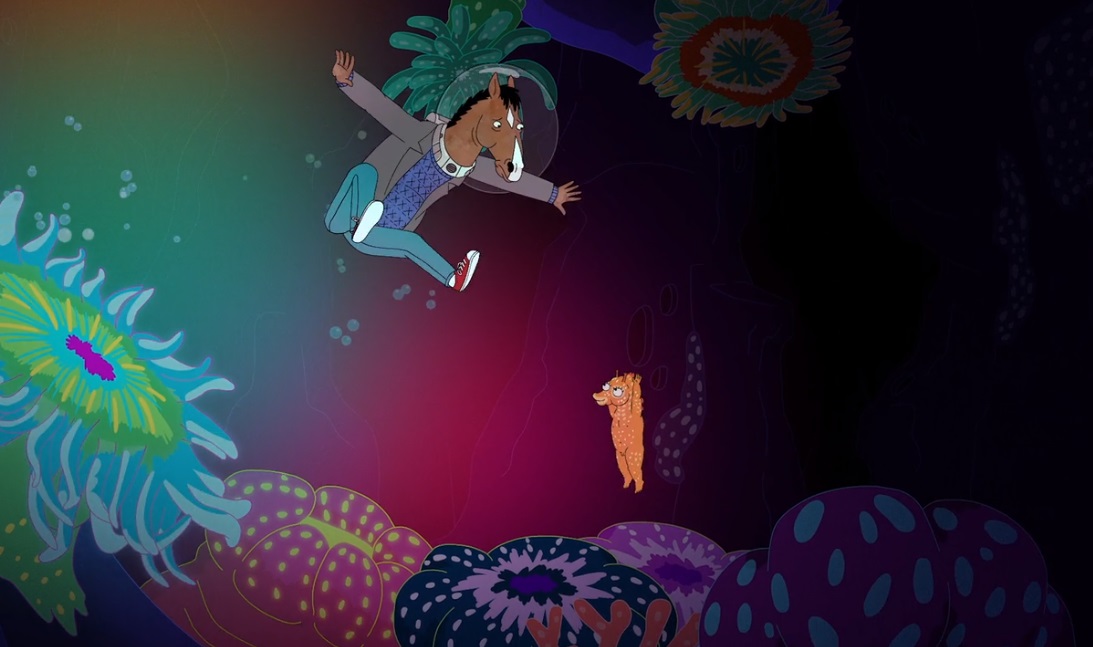
Fish Out of Water (BoJack Horseman, Season 3, Episode 4) [Mike Hollingsworth, 2016]:

Watched: Sep 18, 2018

I was slow to see the appeal of "BoJack Horseman", at least over the course of its first dozen episodes. For me, it wasn't until the second season that it began to deepen into something that could generally be categorised as more than just mildly entertaining. In terms of its humour and maturity, I still think it falls somewhat short of the bar previously set by a show like "The Simpsons" (at least during its classic-period) or even the related "Futurama", but I do like the way the writers sustains a narrative; maintaining long-running jokes and supporting characters from season to season, while frequently managing to balance moments of broad comedy with scenes of a genuine pathos. The show is never afraid to present its characters as flawed or even unlikable, but still remains entertaining, if not insightful. However, the fourth episode of season three, Fish Out of Water, is something else entirely. Presented without dialog for the most part - and featuring as its centrepiece a dazzling, almost surreal sequence of music, light and colour - it encapsulated everything the show does right; elevating its unique animation style even further than usual and expanding the world of the show in the best possible way. Along with Part 8 of David Lynch's Twin Peaks the Return (2017), as well as the key moments from the Wachowski's Sense8 (2015) in which the characters first synchronise, this particular episode stands out as one of the best and most startling examples of "pure television " (as an alternative to "pure cinema") that I've recently seen.


Kubo and the Two Strings [Travis Knight, 2016]:

Watched: Sep 22, 2018

The two strings of the title are literal, but also symbolic. Firstly, they relate primarily to the two broken strings of the title character's shamisen; an instrument that plays (no pun!) an important role in the developments of the plot. However, they also have a more figurative meaning, referring to 'strings' as shorthand for 'ties', or 'threads'; as in: the all important ties that bind and connect us to a specific place; to family, or to our own sense of self. With this in mind, the "two strings" are illustrative of the mother and father, and the influence that these characters will have on guiding their son - our protagonist - on his quest; binding and connecting him, not just to his ancestry - his heritage - but to a kind of destiny. It's this ability to read the film on different levels that really defines Kubo and the Two Strings as a small masterpiece; a film that mixes second-hand Eastern philosophies with the familiar tropes of "the hero's journey" (as defined by Joseph Campbell), but elevates them through a combination of impeccable stop-motion imagery and the pure emotions that are expressed, not just through the dialog and the performances of the voice actors, but through the film's extraordinary visual design. For me, I loved the way the later developments and set-pieces of the narrative become a mirror to the story told by the young Kubo to the villagers at the start of the film. It creates an element of self-reflexivity, where the filmmakers suggest a subtle level of uncertainty as to how much of the story is real, as a literal adventure, or simply a way for the child to make sense of their own disconnection and the tragic circumstances of his young life (that aforementioned need for stories to explore emotions, fears and concerns). While I loved the film for its more conventional storytelling, its imagery and its characterisations, it was the way the filmmakers explore the theme of overcoming grief, as well as the necessity to challenge violence, not through combat, but through understanding, that really impressed me.

Tuesday, 15 January 2019

A Year in Film Pt. 2


A Viewing List for Twenty Eighteen


Married to the Mob [Jonathan Demme, 1988]:

Watched: Apr 16, 2018

Once again, it's the personality of director Jonathan Demme that enlivens and enriches the experience of the film. From his eclecticism - that bold mishmash of colours, fashions, music and settings, so vibrant and diverse - to the unwavering humanism already evident in previous films, such as Citizens Band (1977), Melvin and Howard (1980) and the preceding Something Wild (1986), the attitudes and relaxed stylisations favoured by the filmmaker succeed in charming the audience at every conceivable turn. Even when his characters are shady, or when the social milieu is suggestive of a particular threat of violence and criminality (as it is here), there's always a resolve and determination to these people, which is infectious. As such, the film becomes a celebration, with Demme allowing his actors the space to define and develop their characters through an expression of their own individual personalities; their quirks and idiosyncrasies on full display. The ensemble cast is incredible throughout, with standout turns from Michelle Pfeiffer as the film's strong-minded protagonist Angela, Dean Stockwell as the slimy mob boss Tony 'The Tiger' Russo, and Matthew Modine as Mike; a boyish FBI agent-cum-love interest.


Ghost Stories [Andy Nyman & Jeremy Dyson, 2017]:

Watched: Apr 19, 2018

Pitched in its promotional materials as a kind of horror anthology - a film in the same tradition as Dead of Night (1945), Spirits of the Dead (1968) or Tales from the Crypt (1972) - the eventual presentation of Ghost Stories soon expands into something far more character-driven and cohesive. Framed around the attempts made by a paranormal investigator to debunk three supernatural cases that led to his former mentor's disappearance, the individual vignettes presented by the investigation soon begin to suggest a different type of story; one that eventually propels the film towards its revelatory third-act twist. While the general nature of the three cases and the over-reliance on conventional jump-scares does initially seem to promise only modest thrills, it's the film's later sequences - and their clever dismantling of the fourth-wall between the supernatural and the psychological - that opens the film up to a more emotional interpretation, as well as moments of genuine surrealism. Co-written and co-directed by lead actor Andy Nyman and the former "League of Gentlemen" collaborator Jeremey Dyson, Ghost Stories is a film that riffs on the well-worn clichés of the horror genre; playing with the language and iconography that we've come to expect from other supernatural works - from The Shining (1980) to The Sixth Sense (1999), etc.  - but distinguishing itself through a kind of post-modernist deconstruction. It's a film rich in atmosphere, visually inventive and one that creates a palpable sense of fear throughout. However, the most disturbing aspect of Ghost Stories is the sense of loneliness that comes to define the character's journey as the film draws to a close.


Force of Evil [Abraham Polonsky, 1948]:

Watched: Apr 27, 2018

The film noir as art film; elusive, inscrutable and rich with allegorical interpretation. The two brothers representing Cain and Abel; a descent into subterranean worlds as a kind of figurative "Dantean" inferno; Faustian pacts and capitalism as a literal black death. The love story seems like an afterthought, but it's the performances, heightened and emotional, like the great American theatre, and the dialog, which has a kind of poetry to it, that are entirely gripping. Most movie dialog is merely perfunctory. It attempts to evoke naturalism; finding in its construction the awkward pauses, lack of cadence and layman's vocabulary that define the ordinary, or the everyday. Force of Evil however presents something far more interesting in its use of dialog. There's an "ornate" quality to the language here; a certain grandeur, though a grandeur that belies an undercurrent of violence and betrayal. In this sense, one could argue that the film is something of a precursor to the work of the American playwright David Mamet. Like Mamet's best writing, the dialog of Polonsky's screenplay has a rhythmical, almost musical quality to it. It has repetitions and reiterations that continually shift the emphasis from word to word; changing the subtleties and meanings of sentences in a profound way; finding subtext and insinuation; expressing everything and nothing simultaneously. The direction and cinematography are also incredible, utilising the full creative arsenal of post-German expressionist cinema to create a world full of atmosphere and emotion.


Secret Beyond the Door [Fritz Lang, 1948]:

Watched: May 1, 2018

Unfurling with an inscrutable dream-logic rife with visual symbolism, Lang's enigmatic, proto-Lynchian mystery, ties the Gothic intrigues of classic novels like "Jane Eyre" and "Rebecca" - with their similar presentations of lost girls, damaged men and figurative allusions to rooms that are off limits - to something comparatively more modern in its psychology and approach. From the very start of his career, Lang's cinema seemed preoccupied with matters of the subconscious. Think of the vengeful inventor Rotwang in Metropolis (1927), driven insane by grief, or the titular master criminal at the dark heart of The Testament of Dr Mabuse (1933), casting his insidious influence over the city, like a veritable plague. Using the bare necessities of his routine genre assignments to explore more interesting ideas perhaps closer in presentation to the form of the psychodrama, Lang's greatest works frequently dealt with this conflict between the inner and outer self. This is most apparent in the film in question. While considered a poor effort by many critics, Secret Beyond the Door is nonetheless a film where Lang takes his Freudian/psychoanalytical interests to the absolute limit. The entire film has an internal quality to it, where the use of voice-over monologues establish the notion of a character looking back on their own experiences. Not merely 'from the past', in the conventional sense, but as if suspended; hovering above the narrative, trancelike; as if recalling events through a form of hypnotic suggestion. It's a film full of mirrors and mirror imagery, suggesting ideas of replication, doppelgängers, self-reflection and the fragmentation of the self. It's also one of Lang's most visually inventive and expressive films.


The Girl Who Leapt Through Time [Mamoru Hosoda, 2006]:

Watched: May 16, 2018

As with Blade Runner 2049 (2017), this is another film that I didn't manage to make any notes on after my initial viewing. As such, I'll try to extract from memory the things that most impressed me, though again, I feel it's a film I'll need to return to in the not-too-distant future. Nonetheless, the animation here is stunning. Unlike American animation, which is often loud and hectoring - an endless blur of action, colour and movement that always seems to be in a great rush to get to the next big set-piece - Hosoda's film is quiet and reflective. While there's a definite high concept at work here - a presentation of time travel and repetitions of chance and coincidence that seems to owe a debt of influence to the film Groundhog Day (1993) - The Girl Who Leapt Through Time doesn't allow its science-fiction elements to boil over into action or spectacle. Instead, it remains focused on the relationship between its characters; the moral concerns and personal considerations, which are engaging throughout. It's a film that seems content to focus on the small, seemingly inconsequential daily routines and activities that define the lives of these characters. The emotions are overwhelming.


Harry Potter and the Deathly Hallows: Part 2 [David Yates, 2011]:

Watched: May 20, 2018

Harry began the story as an innocent. During the course of his childhood a war breaks out. As a result, the youth must radicalise; preparing themselves for battle and the uncertainties ahead. As the series drew to a close I was struck by how much this parallels the experiences of its own audience. Those that came of age with the franchise: roughly speaking, millennials, or "Generation Potter"; these children of Marvel and J.K. Rowling. Like Harry, these kids would've experienced the relatively more colourful adventures of The Philosopher's Stone (2001) in a state of complete innocence. As the fall of the Twin Towers brought terrorism and tyranny on a global scale, the subsequent instalments - beginning perhaps with The Prisoner of Azkaban (2004) - saw the battles at Hogwarts coincide with the conflicts in Iraq and Afghanistan; the books' subtext of 'in-world' prejudice (the slurs against the "mud-bloods") or the characters displaced by war, connecting with the grim realities of the migrant crisis, racial intolerance and an overwhelming climate of fear. This probably sounds intensely pretentious, but I couldn't help seeing a connection. As the film's final moments found its characters framed against a landscape of death and destruction - ruined buildings and the soil still black from war - I felt the films had somehow become a mirror to the experiences of a generation, and the wider cultural events that surrounded their formative years. Not in the sense of the themes being inspired by these events- which would be impossible, given that the books predate both the films and the political climate - but adapted in response to them; giving this culmination to the seemingly disposable film series an incredible weight and depth.


Lunacy [Jan Švankmajer, 2005]:

Watched: Jun 16, 2018

Combining a number of possible inspirations - from two texts by Edgar Allan Poe, "The Premature Burial", and more significantly, "The System of Doctor Tarr and Professor Fether", to the writings of the Marquis de Sade - Švankmajer's fifth feature-length film, Lunacy, is perhaps best surmised by the well-known idiom: "the lunatics have taken over the asylum." Set mostly within the walls of a decaying psychiatric hospital, the early scenes of Švankmajer's film are a bizarre and sometimes alienating experience. As an audience we witness these early scenes through the eyes of our protagonist, Jean; a young man that has been suffering from night-terrors following the death of his mother. We share his bewilderment and sense of disbelief as he's initially taken in by a man who claims to be the embodiment of the aforementioned de Sade, and who allows the patients at his hospital to run riot as a part of some bizarre form of behavioural therapy. However, as the film progresses and more revelations become clear, we begin to recognise where the influence of "The System of Doctor Tarr and Professor Fether" is eventually leading us. Without giving too much away, the satirical crux of Lunacy is a depiction of society under both the left and right-wing systems of government; a political commentary that feels somewhat relevant to the world of 2018, in which the perception of society is now torn between the two extremes of the modern left, with its social-constructs, micro-aggressions, identity politics and safe spaces, and the modern right, with its rhetoric of intolerance, ignorance and hate. For Švankmajer's, both systems are inherently flawed. Too much order leads to oppression, censorship and abuse; no order at all leads to chaos. As such, the argument of the film seems to be this: that to find true freedom one must accept a compromised middle-ground between the two extremes of anarchy and totalitarianism. It's a bold and provocative supposition, but one that is intelligently conveyed.


The Tree, the Mayor and the Mediatheque [Éric Rohmer, 1993]:

Watched: Jun 19, 2018

Conversational to the point of didacticism, Rohmer's extended rumination on the political divides of a small village and its questions of commerce and redevelopment in the face of a changing cultural identity is exhausting, but also quietly adventurous. While much of the film is presented in the characteristic manner that one associates with Rohmer's work - familiar as it may be from earlier or even subsequent films, such as The Aviator's Wife (1981), Pauline at the Beach (1983) and A Tale of Springtime (1990) - there are nonetheless several bold deviations from the typical "Rohmerian" aesthetic. These deviations include 1. moments of actual documentary - comparable to some extent to similar sequences found in the filmmaker's earlier and no less brilliant Four Adventures of Reinette and Mirabelle (1987) - 2. a sub-plot that feels more befitting of a Hollywood romantic comedy, and 3. a later sequence that can only be described as a kind of folk-musical. The last of these deviations was the most surprising, not least because it broke from Rohmer's typically relaxed sense of naturalism; aligning the work instead to the stylised historical opera of something like Moses und Aaron (1973) by Jean-Marie Straub and Daniele Huillet. Arriving at the end of what is otherwise a kind of dry cinematic discourse on the themes aforementioned, this coda felt entirely remarkable; connecting the film, in some small way, to the legacy of one of Rohmer's most bold and unconventional earlier efforts, the masterful Perceval le Gallois (1978).


The Whispering Star [Sion Sono, 2015]:

Watched: Jun 19, 2018

If we were to attempt to simplify the experience of the film, then The Whispering Star is essentially The Man Who Fell to Earth (1976) remade by Andrei Tarkovsky. Again, it's a simplification. However, like The Man Who Fell to Earth, The Whispering Star involves a non-human character who travels to our planet to fulfil a specific task - in this instance, delivering packages to the scattered pockets of civilisation - and invariably becomes a kind of witness to the folly of mankind. Aesthetically, it's more modern - if not post-modern - than any of Tarkovsky's films, particularly in its transformative final scenes, but nonetheless, the film shares an affinity for Tarkovsky's contemplative tracking shots, monochromatic  imagery, ruined locations that suggest the collapse of civilisation, and an interest in the elements; the rain, wind, sand and fog. Apparently filmed in and around the district of Ōkuma - the site of the 2011 Fukushima nuclear disaster - the authenticity of the film's desolate locations and its depiction of humanity clinging to the last semblances of contemporary existence while poverty and desperation take hold, is quite extraordinary. Like Jia Zhangke's brilliant Still Life (2006), a film where the writer and director set a fictional relationship against a real backdrop of the village of Fengjie - at the time being destroyed by the building of the Three Gorges Dam - the placement of the science-fiction story into this particular setting suggests a clever blurring of the line between fiction and documentary. It also gives an added weight to the central character's observations on human experience, perseverance and survival.


Amour Fou [Jessica Hausner, 2014]:

Watched: Jun 21, 2018

Hausner's control of the formalist elements of the film are impeccable. In terms of the aesthetics - the art direction, costume design, cinematography, etc. - Amour Fou is a complete work. However, there is much more to the film than just stylisation. In telling the story of the relationship between the writer Heinrich von Kleist and his lover Henriette Vogel - a courtship that resulted in the pair committing to a murder-suicide pact in the winter of 1811 - Hausner views the events through a modern lens; inviting an element of irony (even cynicism) into this retelling of history in order to challenge the audience's perceptions of Kleist, German Romanticism and the myth of the male genius. In keeping with this ideological approach, the film's depiction of Kleist is not that of the romantic dreamer, the sensitive soul or even the vulnerable adult beset by crippling neuroses, but a cold, aloof, ineffectual figure; a man-child who doesn't so much die as an attempt to express some fatalistic sense of devotion, but instead, selfishly kills Vogel and then himself out of a state of manic depression. In presenting the story in such a way, Hausner creates an intentional indictment of Kleist and a sardonic dismissal of romanticism in general.

Thursday, 12 July 2012

One-Hundred Favourite Films - Part Seven

Ongoing response to The Dancing Image "100 (of Your) Favourite Movies" meme-that's-not-a-meme, presented here in a loosely alphabetical order. I'm posting the series in reverse formation in an attempt to maintain the original continuity, from A to Z.


Mauvais sang
Directed by Leos Carax - 1986

With some films, the experience cannot be explained, only felt. As much as I try to put into words some semblance of what these films are about, how they work and why I love them as much as I do, there is always that struggle to do justice to the true experience, which is personal, and difficult to define. With Mauvais sang, I could talk about its ambition and imagination; the gestures towards the poetic realism of filmmakers like Epstein, Vigo and Grémillon; the combination of B-movie noir and impressionist science-fiction (which recalls the Godard of Alphaville (1965) in its presentation of love in a world where the physical act of love has been made unattainable); or the feeling of it: the progression between scenes that are either funny, astounding, romantic or moving.

However, to describe the film in such a way would not do justice to the real feeling that is experienced. The recollections of a relationship, however vague, inform every scene, every word and every movement. The film as a work - as a physical object - reminds me of my own amour fou - mon "Petite Lise" - who loved its bursts of movement, its folly and its declarations, almost as much as I; who saw in it something that brought to mind our own sadness and embraced it, like the characters on-screen. To see the film now is to re-experience that affection in every expression of these characters, their actions and reactions, and in the film's sweeping gestures, which capture a feeling of what it is to love and to be loved.


Metropolis
Directed by Fritz Lang - 1927

In its construction, the city presents the two ideological perspectives established by the film's socialist-leaning epigram, which reads: 'Head' and 'Hands' need a mediator. The mediator between 'Head' and 'Hands' must be 'the Heart.' The city of the film is, in its design, a manmade barrier between these two spheres of society, ensuring that 'Head' and 'Hands' are forever separated, physically, by the structure of the thing; those divides of class, gender and generation made explicit in the very foundation of the world. Through the inadvertent actions of its two protagonists - Freder, son of Fredersen, and the enigmatic Maria - a link between the two words is finally forged, turning the city itself into the beating heart that drives both factions of this so-called Metropolis; this labyrinth of the mind.

However, the vision of the city is not only a mediator for its inhabitants, but inevitably becomes a kind of mediator for its own creators; a link between the politics of Thea von Harbou and the spectacle of Fritz Lang. If writer von Harbou saw the drudgery of the workers as something deplorable, director Lang transforms it into something truly terrifying. A vision of hell, where the workers feed a machine that becomes, in the eyes of the protagonist, like a monster, devastating in its ferocity. While the political aspects of the film are still relevant, it is the pure storytelling of Metropolis that leaves the greatest impression; the manifestation of this world that Lang and his technicians so vividly create is still, after almost a century, a genuine sight to behold.


Mother Küsters' Trip to Heaven
Directed by Rainer Werner Fassbinder - 1975

We contemplate the question: Why does Herr Küsters run amok? As a quotation, it sounds like the start of an appalling joke (and in many respects it is!) though one necessary to draw a line of influence from this film to an earlier one, also associated with Fassbinder, which ended with an explosion of fury and devastation that seemed to anticipate the unseen act of violence that begins the film in question. What is most cruel about the construction of the film is the way Fassbinder has his characters - this small family of aged mother, doting son and imperious daughter-in-law - just going about their usual domestic activities, oblivious to the terrible tragedy taking place on the other side of town.

The film reinforces Fassbinder's reputation as one of the great 'exploitation' directors. Not so much in his technique - which has little in common with filmmakers like Joe D'Amato or Larry Cohen - but in his continual interest in the manipulation of characters too vulnerable or trusting to recognise when the forces of a system far beyond their comprehension is conspiring against them. In Mother Küsters' Trip to Heaven, Fassbinder uses the story of this elderly woman's bleak descent into loneliness, resentment and eventual criminality to condemn the German culture of the 1970s; taking aim at the ineffectual left-wing intelligentsia, armchair terrorists, tabloid press and his own generation's ignorance and greed in contrast with the quiet stoicism and questionable loyalty of the martyred matriarch of the title.

It is easy to see the crime of Herr Küsters and the reactions to it as a comment on how the Germany of Fassbinder's generation had distanced itself from the sins of the father(land); refusing to acknowledge the atrocity of the holocaust on a human level, ignoring it, and therefore allowing the opportunity for history to repeat itself; a fear implicit in the violent conflicts taking place between left and right-wing political groups throughout the 1970s. In the absence of the "father", Mother Küsters becomes the real culprit, the only link to a man that can no longer be held accountable, and as such - a scapegoat? - shunned and ignored, denied any sympathy; guilty by association. Her downfall, chronicled throughout, is shattering to see.


Mulholland Drive
Directed by David Lynch - 2001

For Lynch, there is the surface, the thing that is presented as 'truth', and then there is the world beneath the surface, the dark despair that exists at the wounded heart of everything. In the opening sequence of his earlier film Blue Velvet (1986), Lynch illustrated this idea with a vivid montage of small-town suburban life - a world of fixed-grins, picket fences and saccharine '50s pop - cut-short by the sight of an elderly man falling to the ground in the throes of a violent seizure, and a slow malignant tracking shot through the undergrowth, revealing the writhing worms, festering maggots, and a severed human ear.

In some ways, the narrative of the film in question could be seen as a continuation of this earlier sequence, where Lynch establishes a surface projection of how things appear, or need to appear, and then the reality beneath. The two 'realms' offer two sides of a single story, where failure and disappointment are transformed in the mind of a central character into a waif's dream of Hollywood stardom, full of mystery and adventure. In this sense, the film is an obvious continuation of the same territory explored in Lynch's other great films, Twin Peaks: Fire Walk with Me (1992) and Lost Highway (1997), where a significant event in the lives of his characters causes a literal psychological metamorphosis; turning the story into a series of figurative gestures that hide the clues to an unfortunate chain of events. While the two preceding films are undoubtedly great works, there is a noticeable process of refinement in the development of Mulholland Drive, where the games played with the narrative and the usual interjections of horror, slapstick and soft-core erotica are not used to obfuscate or to confuse the audience, but to reveal hidden depths.

On the surface, the film is of course a captivating mystery; a genuine modern-day noir built around its two unlikely heroines who traverse this frequently sun-dappled Hollywood playground in search of the clues to an arcane conspiracy, and finding instead the hollow bones of a terrifying affair. And yet beneath the surface, the film is a heartbreaking psychological study; one that exposes emotions and ideas that never merely adorn the more characteristic moments of surrealism, but transcend them; turning what could've been a cheaply provocative and transparent experiment in self-reference into a genuine work of art.


Muriel
Directed by Alain Resnais - 1963

Subtitled 'The Time of a Return', Muriel is a film about memory, or more appropriately, about the past as something pervasive, like a shadow walking in-step with each character; something that we're unable to escape. Though other aspects of the work are just as intriguing, it is the film's continual emphasis on time and recollection - and how these concerns can be related through the power of the moving image to capture and record - that Resnais and his scriptwriter Jean Cayrol return to; creating a film where the formalist experiments - the editing and the placement of the camera - attempt to disarm the viewer; showing the capacity for the medium to manipulate and mislead, but also to suggest hidden truths.

The 'Muriel' of the title is not the lead character, as we might expect, but a name that haunts the character's stepson Bernard; a young man still traumatised by his experiences during the conflict in Algeria. In this sense, the scars of war - the lingering traces of it - becomes another great theme of the film; explicit in the battle-marked ruins of Boulogne-sur-Mer where the story takes place and implicit in several interactions between characters, who throughout the film seem to hide behind a facade of middle-class contentment, as if trying to maintain a sense of pre-war normality; almost as if life before the war had continued, uninterrupted.

When Cayrol and Resnais eventually reveal the true story of 'Muriel' - this character that seems to embody, in memory, the very spirit of the film and its restless observations on the themes aforementioned - the effect is truly devastating. The film itself - in its necessary contrast between sound (Bernard's painful confession) and image (a montage of 8mm footage of soldiers languishing between battle) - becomes a eulogy to this young woman, but also a means of expressing the great suffering of those made mute by the ravages inflicted by this stonewalled deceit. This is a film that offers a profound comment on the nature of atrocity, how we live with it, and how the attempt to ignore it, or to put it to one side, is the greatest indignity of all.


My Darling Clementine
Directed by John Ford - 1946

In the broadest terms, the story of Wyatt Earp and the Gunfight at the O.K. Corral doesn't interest me, and yet this is what the film appears to be about. However, beneath the surface of this historical fiction, there is a film about loss; about the loss of a brother. As an only child I've often envied those with close ties to their siblings and that sadness felt by Wyatt Earp after the death of his brother during the first act of the film is something that I can almost relate to. The feeling of wanting something but never having it is sometimes equal to having something and then losing it. The film, in its mood and sense of momentum, is haunted by this loss - the loss of a brother but also the loss of innocence, or an ideal - turning even the burgeoning love story between Earp and the character of Clementine Carter into something charged with the anticipation of a tragedy.

This same feeling of grief is inherent in Ford's direction, with the staging of scenes and the framing of shots, compositionally, emphasising a certain abstract stillness; where interactions between characters are turned into ghostly encounters, intrusions and stolen moments, caught like images from a phantom documentary, "of the period" (though no such documentary could exist). It is the authenticity of these images, the dirt and the grime and the sense of lives being lived, that creates this feeling of something credible, emotionally and cinematically, even if the story is pure fabrication.


Nostalghia
Directed by Andrei Tarkovsky - 1983

Any discussion of the themes behind the film should really begin with the title, which establishes upfront the overwhelming feeling of loss and the personal displacement that hangs above the lives of these characters, suspended, like the sword of Damocles waiting to drop. However, this is not a film about 'nostalgia' in the sense of being a 'nostalgic work' - like for example Amarcord (1973) or Radio Days (1987), where specific memories of places and people are exaggerated on screen as they are in the mind - but rather an attempt to understand the feelings behind this nostalgia. The loneliness, disruption and dissatisfaction that compels these characters to take shelter in a crumbling Italian village, where each relic of a past existence uncovers deep reminders of their own tragic despair.

The character in Tarkovsky's film is, like the filmmaker himself, in exile. Unable to return home, this character finds himself haunted by past recollections; memories of figures framed within a desolate landscape, an old house and a shroud of fog, like the fog of memory, obscuring everything. These images suggest some possible clue to deciphering the true feelings of this character, which, as ever with Tarkovsky, seem impossible to define. For this is a poet's impression of his own great sorrow, suggested throughout by the solitude of the village, the dust and decay, and his own dealings with characters similarly haunted; consigned to their fate, like the defiant 'mad man' Domenico, or like Eugenia, desperate for an escape.

The tone of the film throughout is sombre and pensive. At times, the imagery suggests a continuation of the oppressive, post-apocalyptic misery of the director's previous film Stalker (1979) - or even a precursor to the genuine fear of atomic annihilation featured in his final work, The Sacrifice (1986) - but it's always the feeling of the film, the emotions of it, that draw us in. The emphasis on long takes - where the camera moves about these characters, observing them, presenting each shift between reality and fantasy, past and present, as a genuine movement between worlds - turns the experience of the film into a waking dream. A dream of home shared by each protagonist (and by the audience as well) that is impossible to define and even more difficult to reclaim.


Notre musique
Directed by Jean-Luc Godard - 2004

A film composed of three movements, like a symphony; the association reflecting the greater connotations of the title: the voice, a means of expression and communication: "our music?" Each movement of the film is a representation of a different argument on the nature of war, presented by means of a specific cinematic approach. The three movements - montage, dramatisation and allegory - act as interpretations of the three kingdoms of Dante's the Divine Comedy - Hell, Purgatory and Paradise - creating a single narrative. One that develops like a series of unconscious thoughts, moving, like characters through the rubble of places or the ruin of existence; never acting, but reacting as everyday people might when faced with the reality of war; the injustice of it.

In its rolling montage of violence and devastation - and with the burnt ruins of Sarajevo still standing as a solitary witness to the last great horror of the 20th century - Godard asks the question: "how can we live?" The audience responds: "with our fingers in our ears and our eyes tightly closed." The inquisitive nature of the film is never aggressive or didactic, like the Godard of the 1960s, but gently probing. The aim is to evoke emotions and ideas through sounds and images, creating something that moves between moments of poetic abstraction, wicked satire and affecting psychological study; presenting the atrocity of war and the folly of terrorism without condescension, but also gesturing lightly towards something hopeful; a vision of paradise, tranquil but exclusive, pastoral but closed-in...

The final movement, which acts as a kind of free adaptation the final act of Godard's earlier Week End (1967) - turning that film's depiction of violence and immorality in the Garden of Eden into an Eden of autocratic efficiency - uses this beautiful bucolic setting to create a contrast between something natural and pure and something corrupt; a system built on control and segregation, like the world itself. Although stunning in its presentation, this coda, both satirically and sympathetically, shows us the paradise that awaits these martyrs, and in its own subtle way shows us where the folly of terrorism ultimately leads. A dream of heaven as a place where nothing ever happens.


One from the Heart
Directed by Francis Ford Coppola - 1982

I suppose it makes sense that a film about romantic folly has itself become known as the great romantic folly of its director's career. While Coppola's film may have yet to shed its reputation as the wildly ambitious extravagance that tarnished his reputation and almost destroyed his career, it remains, for me at least, one of the director's greatest films.

On the surface, One from the Heart is as pure a work of cinematic imagination as one could ever hope to see. A vivid extravaganza, full of expressive colours, dazzling sets, theatrical transitions, musical numbers, circus routines and a poet's portrayal of love that finds even the most personal or intimate of feelings transformed into a spectacle of old-Hollywood-style decadence or Cocteau-like verse . However, beneath the surface of this display of magic mirrors, high-wire acts and allusions to MGM musicals there is a story about failure and disappointment, about spent-time and lost chances. A film about the difficulty faced by this couple in their attempts to understand one another; to look into the eyes of the other and see the reason why they first fell in love, and not just a sad reminder of their own disillusionment staring back at them.

Through this contrast between the stylisation of the form and the coarseness of the protagonists, Coppola's film becomes more than just a frivolous fantasy, but a moving and intelligent deconstruction of a relationship; where the carnival spirit and decadent glamour of the world created only reinforces the emptiness shared by these characters, the lack of excitement and adventure. In this respect, Coppola's film is ultimately about the pursuit of love as a physical space. In the arms of another we can accept our situation, or at least find beauty in the world around us, as opposed to dreaming of impossible things.


Onibaba
Directed by Kaneto Shindô - 1964

What I'm always left with is the impression of scenes; the heat, the closeness, the sense of space. Although the story is certainly engaging, it is the feeling of the film - the energy of it - that for me makes the experience so extraordinary and difficult to describe. The atmosphere of the location, barren and claustrophobic, is defined by the imprisoning blur of the marshland, with its tall reeds, which - when presented across the full-width of Kiyomi Kuroda's mesmerising 'scope frame - become like a wall that exists, literally or figuratively, between two realms. A wall that divides these characters, closing in on them, trapping them emotionally, physically and psychologically between the world of the living and the world of the dead.

Everything that happens in the film unfolds as if these characters are in-limbo; each moment held or suspended, like a scream of agony, or one of ecstasy? Although terrifying in its ferocity, the film is also surprisingly sensual. That heat and the closeness of the bodies within the frame, half-naked and wet with sweat, creates the feeling of something primal, even erotic! A heightened emotional state that turns the film into a prolonged nightmare, suggesting an interpretation of lust and jealousy that is almost supernatural.

Schalcken the Painter (1979)

Schalcken the Painter [Schalcken the Painter [Leslie Megahey, 1979]: This is a film I first saw around four years ago. At the time I found...