Showing posts with label Josef von Sternberg. Show all posts

Monday, 13 April 2020

Morocco


Thoughts on the film by Josef von Sternberg

I wasn't as taken with Morocco (1930) as I was by the later collaboration between actor Marlene Dietrich and director Josef von Sternberg, the masterful Shanghai Express (1932).

While essentially similar in their themes, tones and intentions, Shanghai Express seemed to have a lot more going on beneath the surface; not merely connecting its melodrama to ideas of war, displacement, clashes of culture, and the self-reflexive relationship between the train journey that defines the narrative and the conventions of the narrative cinema itself, but having those elements become a part of the psychology of its characters. The themes, the backdrop of civil war, the divided country, the clashes between people, weren't simply plot devices, they were an external expression or projection of the internal, elemental dramas that the characters faced.

By contrast, Morocco seems far more straightforward. While one could argue that the titular setting, the backdrop of the Rif War and the surrounding issues of colonialism and white/western exploitation, fulfil a similar function as the Shanghai setting of that later work, I felt there was a much greater disconnect here between these elements and the more conventional melodrama that rests at the heart of the film.


Morocco [Josef von Sternberg, 1930]:

While Shanghai Express felt mysterious – its band of characters, some sinister, others played for comic relief, keeping the development of the plot compelling through their dialogues and interactions – Morocco feels locked into the relationship between its three central characters; the narrowed scope creating a more stifling and hermetic atmosphere that for me was never entirely engaging.

Adapted from the play "Amy Jolly" by the writer Benno Vigny, Morocco feels comparatively more theatrical than Shanghai Express. In keeping with its origins and ambitions, the film plays with themes of performance, voyeurism, objectification and the role of the characters as individuals hiding behind masks, uniforms and personae, while keeping the drama contained to specific, single locations that facilitate easy introductions, providing a place for several characters to meet at once.

The nightclub at the start of the film is a good example of this. As well as explicitly connecting the film and Dietrich's role to the actor's first collaboration with von Sternberg, The Blue Angel (1930), the initial setting becomes a self-contained world; a microcosm, much like the fantasy Morocco that the filmmakers evoke, that becomes the center stage for this drama to be enacted.


The Blue Angel [Josef von Sternberg, 1930]:


Morocco [Josef von Sternberg, 1930]:

The theatricality of the film, its "staginess" or artificiality, isn't necessarily a criticism. Many great films have drawn on theatrical limitation to powerful effect, from Peter Brook's adaptation of The Persecution and Assassination of Jean-Paul Marat as Performed by the Inmates of the Asylum of Charenton Under the Direction of the Marquis de Sade (1967) to films like Rope (1948) by Alfred Hitchcock, Twelve Angry Men (1957) by Sidney Lumet and Dogville (2003) by Lars von Trier, among others. However, Morocco is so stiffly mannered and bluntly expositional in its emotional entanglements, that the staginess becomes a barrier to engaging with the emotions of the film.

The effect is almost Brechtian; jarring the audience out of the film's romantic or dramatic reverie, creating a distancing effect that is most likely unintentional. Rather than depict a functioning human being, the characters become embodiments of specific roles, professions, or personifications of class. In short, they have a symbolic function, representing ideas rather than presenting fully rounded characters. Their dialogue tells us what these individuals are thinking at all times, announcing emotions in blunt, declarative statements, not like human beings, but like actors in a play.

In this aspect of the film's construction I was reminded of one of my favourite filmmakers, Rainer Werner Fassbinder. Fassbinder would effectively remake von Sternberg's earlier, aforementioned The Blue Angel, with one of his final works, Lola (1981), but it was in seeing Morocco that I realized where much of Fassbinder's later aesthetic was born.

Finding elements of von Sternberg's work in everything from Despair (1978) to Berlin Alexanderplatz (1980) and through to his final film Querelle (1982), the influence was undoubtable. The same complex system of blocking, the moving camera, the mirror symbolism and its resultant themes of projection and self-reflection, are consistent between the two filmmakers' works. Similarly, the instances of characters confined and imprisoned by set-design, illustrating the way these same characters have been ensnared by a world and its responsibilities, creating a further shorthand for themes of possession, desire and objectification.


Lola [Rainer Werner Fassbinder, 1981]:


Querelle [Rainer Werner Fassbinder, 1982]:

Fassbinder's work, particularly from the middle-to-later period of his short career, stands as superior to a film like Morocco, able to go deeper into the same themes of sadness, disenchantment and the cruelties of exploitation and pity that human beings are capable of, without being constrained by the necessary and unambiguous morality that films of Morocco's period were expected to promote. Regardless, we should respect the influence and the legacy that von Sternberg's work clearly had on Fassbinder's greater films.

Despite my muted response to Morocco, at least in comparison to other related works, there is still much to admire about the film. Two aspects of its characterization and direction stand out as incredibly progressive. These elements transcend the weaker aspects of the film and elevate it as both an important and historically significant work within the context of still topical discussions on sexuality and genderfluidity in the contemporary cinema.

In an early introduction to Dietrich's character, the disillusioned nightclub singer Mademoiselle Amy Jolly, the actor appears dressed in a man's tuxedo. Challenging notions of femininity verses masculinity, Dietrich commands the stage as she performs a musical number, directly provoking the mostly male audience that gather in the nightclub, and in turn, gathered within the cinema. As the sequence progresses, she even kisses another woman; a bold gesture in the context of 1930s Hollywood cinema, and one that would have been rendered unthinkable after the implementation of the Hays Code a few years later.


Morocco [Josef von Sternberg, 1930]:

As a sequence, it remains a key moment in the history of film; one that might have been the focus of this entire essay had it not been endlessly written about and discussed by writers and critics far more insightful and significant than me.

The use of the costume and what it represents, along with the lesbian kiss, say so much about ideas of gender, sexuality, identity as a performative role, and the imbalance of power that exists between men and women. In donning the clothes conventionally thought of as male, Dietrich's character takes on traits that are now identified as being related to notions of hyper-masculinity, or male privilege, exerting a sexual dominance and control over another woman in an unwanted and aggressive way. At the same time, she presents an image that is at once defiantly feminist while remaining still outside of the conventions of gender, presenting the initial image of a woman that is both confident and in control.

While the stylized Moroccan setting, created on a Hollywood soundstage, is inauthentic and perhaps insensitive in its reduction of a living culture and its people to a level of props and glamorized exotica, these other aspects of the film still feel progressive and ahead of their time.

Saturday, 29 February 2020

Shanghai Express


Thoughts on the film by Josef von Sternberg

The history of the cinema is defined by two icons of industrial engineering: the train and the bridge. In the oldest surviving fragment of film, Traffic Crossing Leeds Bridge (1888), photographed by the mysterious and enigmatic French film pioneer Louis Le Prince, the bridge itself becomes a symbol. Not just a geographical setting chosen for narrative purposes, but something more significant.

Conventionally, the bridge is a link between places and people, allowing individuals to travel outside of their own location, and to experience something different and new. However, a bridge can also provide a theoretical link between psychological and sociological states, such as the before and after. For Le Prince, his bridge linked the pre-cinema to the post-cinema worlds, marking the point at which this new medium, as then still in its infancy, connected us to new cultures, ideas and expressions.

After the bridge came the train and with it the journey; this vessel that transports ideas, characters and emotions, moving like a narrative from a beginning to an end. The brothers Auguste and Louis Lumière would film The Arrival of a Train at La Ciotat Station (1896); the first blockbuster. The arrival of the train was like a heralding for the coming of cinema; or more specifically, the becoming of cinema; this medium that had the potential to show us the world as we'd never seen it before; to instil feelings of shock and awe; to transform and transport us through a succession of moving pictures.

A few years later, the English filmmaker George Albert Smith would direct A Kiss in the Tunnel (1899). Here, the phantom ride of a camera attached to the front of a train prowling along the tracks on its journey to somewhere, is intercut with a scene of a heterosexual couple inside a carriage, stealing a chaste kiss as the train enters the titular void. In figurative terms, the tunnel itself is like a stand-in for the cinema; a darkened space with a light at the end. The light glows bright as we approach it, like the light of the screen. However, it's the innovation of the film and its early use of narrative cutting that makes Smith's work significant.


A Kiss in the Tunnel [George Albert Smith, 1899]:

From here, trains would be a significant feature of the early cinema. From John Ford's The Iron Horse (1924) to Buster Keaton's The General (1926), and beyond, the two innovations would reflect one another, becoming mirror twins. Both trains and the cinema are communal activities; we share these journeys with other people. Both are passive; we remain in our seat and watch the world turn. Both can create a feeling of anxiety, discomfort or inertia, and both can offer a room to dream.

In Josef von Sternberg's Shanghai Express (1932), this relationship between trains, the cinema and the experience of dreams, finds the perfect expression. Set mostly aboard the titular locomotive as it attempts its journey from Peking to Shanghai, the narrative of the film mirrors the progression of a train along the tracks. As the journey is diverted or draws to a halt, so too does the film. When the train reaches its conclusion, the film ends.

If the narrative is a mirror to the journey of the train, then the train is a mirror to society. Its passengers, representing a broadchurch, become a microcosm of one faction of society. Among them we find different social classes, hinting at the layers of this culture, the hierarchy and the inequality of wealth. We have soldiers and entertainers, staff and travellers, the frail and even religion. In this context, they become merely representative. Rather than depict conventional character traits, their roles within the film exist to embody certain principles or political characteristics, stating their position and ideologies through dialog, the way protagonists in theatrical plays often do.

Thrown together, these characters will be tested by a subsequent turn of events, which works to upend and debase the social order that the earlier scenes dictate.


Shanghai Express [Josef von Sternberg, 1932]:

As a work of narrative cinema, Shanghai Express is more than adequate. The story is well paced and well developed, introducing relationships, back-stories and characteristics that are each carried through and "paid off" in the final act. The twists in the plot are surprising and help introduce political themes, intrigue and a moral complexity that it might otherwise have lacked. In short, it's engaging, balancing serious themes, hints of violence and contrasting witty banter in a way that feels cohesive.

However, where Sternberg's film is more remarkable is in its iconography, its aesthetics, and in the symbolic or metatextual elements of its construction. To this, Shanghai Express is a film of symbols; a narrative wherein each development of the plot expresses not just a narrative function but a projection of the characters' psychological states. The film is almost specifically constructed around these elements; every facet of its story, from the setting, to the backdrop, to the train itself, facilitating a means for these characters to make sense of their own emotions, turning the film into a genuine psychodrama.

That the film is set during the period of the Chinese Civil War connects less with history than it does with the idea of a divided territory; not just geographical, but psychological. The China as depicted in the film is an occupied territory, but occupied not just by the political rebels, colonialist agitators or the decadent and the damned passengers that define its narrative, but occupied in the same sense that thoughts, fears and desires might occupy our daily existence. These characters are in a state of conflict, and as such, "occupy" a state in conflict; making the catastrophes and the debasements that occur along the way not just literal but figurative as well.

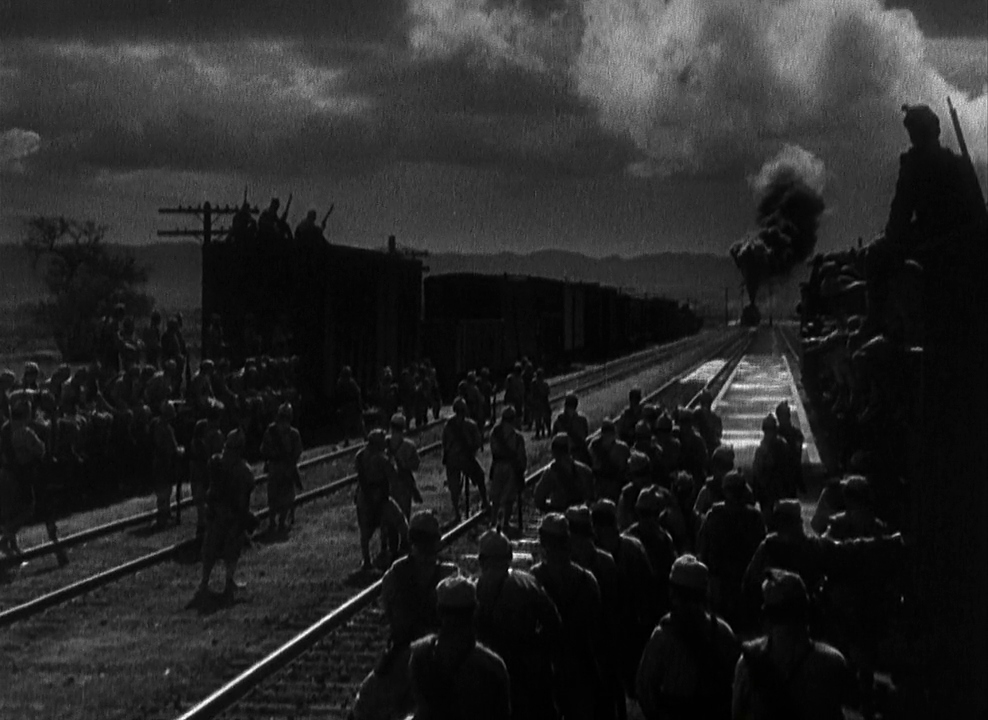
Like The Silence (1963) directed by Ingmar Bergman, Shanghai Express is a dream play. The characters, both here and there, are trapped in a physical space that becomes a kind of psychological limbo. Fittingly, The Silence begins with a train journey through a heightened, almost surrealist landscape of war and devastation; another occupied territory. Is the war real or metaphorical? Is it something that occurs outside the perspective of these characters or within? Is it a projection of their own fear, their trauma or the state of anxiety that holds them captive, or is it simply a dream; a conjuring of the unconscious mind?


The Silence [Ingmar Bergman, 1963]:


Shanghai Express [Josef von Sternberg, 1932]:

Unlike Bergman's film, the backdrop of civil war in Shanghai Express has a historical context. It relates to actual events, but its function within the unfolding melodrama of its characters is no less vague and enigmatic than the fictional wars that Bergman depicts, both in The Silence and in his later film Shame (1968). It is still, to some extent, a vague projection unfolding through the windows of a train. The characters react to it, but mechanically, as if function compels it. They exist always as if sleepwalking through another person's existence.

It's here that I'm reminded of a later film that took great influence from Sternberg's work; Lars von Trier's post-war allegory Europa (1991). Like Shanghai Express, Europa's drama is connected to a train that becomes both an embodiment of the structured narrative and a microcosm of the world in miniature. Its characters are political or philosophical representations that exist to present sides of a specific argument relating to the Second World War, culpability, innocence and the state of post-war Europe. Both films treat historical conflict as psychological conditions; their respective destinations less geographical realities than a state of mind. Both films are coded, stylised and have a dreamlike feeling where characters are robbed of personal agency.


Europa [Lars von Trier, 1991]:

Trier and his co-writer Niels Vørsel make their intentions explicit by creating a framing device around hypnosis. Their film physically takes place while in a state of trance. Sternberg and his screenwriter Jules Furthman are less literal, but the results are nonetheless the same. The atmosphere of the film is stilted, deep and thick; its characters like sleepwalkers moving without recourse; somnambulists lost in some nigh time enchantment that plays out through the window/screen.

In keeping with this, Sternberg's film has the feeling of an endless night. It isn't; bookending sequences are set during the daytime. But it's the impression of the film as something existing within the twilight between sleep and waking, the dreamlike artificiality of the performances, the expressionist gestures of the cinematography and the psychodramatic aspects of the narrative as some internal conflict that the central characters must overcome in order to find a kind of peace, that leave the greatest impression.

Viewed through the prism of Europa, it's much easier to read Shanghai Express on a similar, more expressionist or psychological level. Trier's cynicism means that he ultimately desires to destroy his train, and to destroy the bridge that allows it to travel between two worlds. Sternberg is less cynical. His film reaches a conclusion befitting the films of this period; reaffirming the intentions of characters and moving towards a kind of happiness or hope. Even though the war is still raging, and lives are being lost, it doesn't matter; the war, in this context, always existed as a projection of the inner conflicts within the lives of these characters.

Just as the tunnel in Smith's film provided a necessary function in allowing its two protagonists to share a romantic moment, so too does the civil war of Shanghai Express. Does this make the film weaker, or more exploitative? I couldn't say. However, I found the experience of the film more fascinating, emotionally engaging and beautiful in its design and direction for the way it unfolds in this world of night time shadows; this nocturnal suspension of actual time, wherein characters are trapped, forced to engage with a projected narrative that facilitates a form of emotional transcendence.

Schalcken the Painter (1979)

Schalcken the Painter [Schalcken the Painter [Leslie Megahey, 1979]: This is a film I first saw around four years ago. At the time I found...