Showing posts with label Tim Burton. Show all posts

Friday, 21 February 2020

The Year in Film 2019 - Part Three


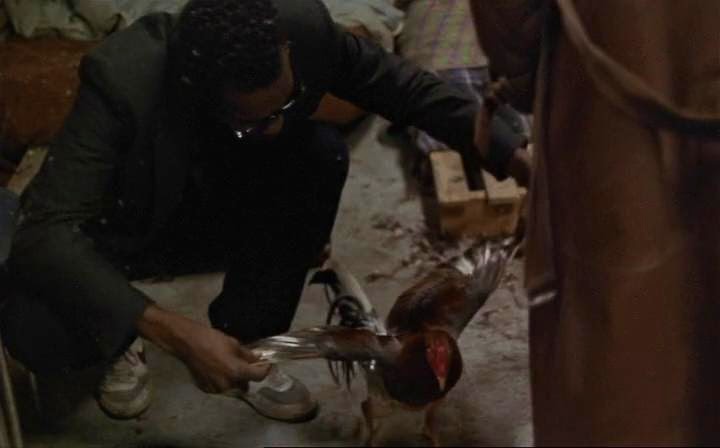
El patrullero (Highway Patrolman) [Alex Cox, 1991]:

Watched: Mar 17, 2019

If one filmmaker dominated 2019 for me, it was Alex Cox. Earlier in the year I read his 2008 memoir, "X-Films: True Confessions of a Radical Filmmaker", and greatly enjoyed its informative and always self-deprecating approach. I purchased two more of Cox's excursions into the literary world, his 2017 book "I am (Not) a Number: Decoding the Prisoner" and 2009's "10,000 Ways to Die: A Director's Take on the Spaghetti Western", and found both to be of a similar value. Inspired by the books I was also watching and re-watching Cox's films. Of those that were new to me, his films The Winner (1996), Revengers Tragedy (2002), Searchers 2.0 (2007) and Bill the Galactic Hero (2014) are either excellent or better than their reputations suggest, however one film stood out as a definite highlight. Filmed in Mexico following Cox's departure from Hollywood, El patrullero – or Highway Patrolman as it's commonly known – ties with Walker (1987) as the absolute pinnacle of the filmmaker's career. Scripted by Lorenzo O'Brien, El patrullero takes the mythos of the American western – where the lone lawman attempts to remain moral and just as he fights corruption and criminality in a lawless border town – and contrasts it against the conventions of the road movie. The tone is anarchic, carefully mixing between scenes of broad comedy, character development and gritty violence, while the filmmaking is ambitious and creative. This was the period when Cox was shooting his films "plano secuencia", meaning every scene is filmed in a single, carefully choreographed take. The result is a complete masterpiece of narrative, theme and aesthetics, and one of the absolute great films of the 1990s.


Phantom Lady [Robert Siodmak, 1944]:

Watched: Mar 24, 2019

The title hints at something supernatural, putting us in mind of certain analogous Val Lewton produced horror films, such as The Leopard Man, or The Seventh Victim (both 1943), but this isn't the case. Instead, Phantom Lady could be described as a "proto-giallo"; a film noir that predicts many of the conventions and practicalities that would go on to define that particular sub-genre of Italian murder mysteries so popular during the 1960s and 1970s. While it doesn't have the black-gloved serial killer or the stylised death scenes, there is nonetheless something about this story of a bystander taking on the role of amateur-sleuth to investigate a grisly murder, as well as the subsequent confession of the killer, whose grip on sanity has unraveled into tortured exposition, that recalls the practicalities of later films by directors like Mario Bava, Dario Argento and others. Films like The Girl Who Knew Too Much (1963) and Deep Red (1975) specifically, which capture something of a similar atmosphere, as well as 'cat and mouse' scenes of the "hunter" becoming the hunted. While not as powerful in its emotional drama or as inventive in its storytelling as his later film, The Killers (1946), the imagery of director Robert Siodmak is at its peak here, as the film blends the mystery and procedural elements with a thrilling descent into a third-act psychodrama.


Pirates of the Caribbean: Dead Man's Chest [Gore Verbinski, 2006]:

Watched: Mar 26, 2019

Dispensing with plot to an even greater degree than the original film, the likable but otherwise thinly-sketched Pirates of the Caribbean: Curse of the Black Pearl (2003), director Gore Verbinski's first sequel to the long-running franchise builds on its greatest strength (i.e. Johnny Depp as the irrepressible Captain Jack Sparrow) and runs with it, creating a narrative that exists for no other reason than to place its central characters into situations that allow for much comic misunderstanding, stunts and orchestrated suspense. The result, a non-stop cavalcade of action and comedy, feels less like a Hollywood blockbuster than something possessed by the cinematic spirits of Jackie Chan, Harold Lloyd and Buster Keaton. It's a film that places the emphasis on spectacle; upping the ante on what the first film was able to achieve and creating a series of visuals and set-pieces that are thrilling, original and brimming with imagination. For me, "Dead Man's Chest" is the absolute pinnacle of the first three "Pirates" films, and is a work that marks the beginning of Verbinski's run as a genuine "termite artist"; a filmmaker working within the mainstream that is nonetheless able to invest his films with ideas, images and scenarios that are subversive, eccentric, or defiantly anti-mainstream. In its scope, ambition and pure force of vision, it's a definite precursor to Verbinski's subsequent fantastic oddities, The Lone Ranger (2013) and A Cure for Wellness (2016).


Dumbo [Tim Burton, 2019]:

Watched: Apr 08, 2019

The experience of the film for me was like the world in miniature; the big-top reverie of the American experience distilled to its key essentials. The real pleasure of the film was not limited to the story and its presentation, but more redolent in what the film was able to suggest between the lines of blockbuster expectation. In its tone and intentions, Dumbo is capitalism and candy floss. It's the triumph of the broken, the different, the "other", struggling against uncertain odds. It's maudlin sentimentality. It's love, both between the child and its mother, but also at first sight. It's the struggle of the independent cinema against the unstoppable Disney machine. It's escapism. It's a circus train moving across the landscape in-time to the clamour of musical instruments. It's prejudice and persecution, pre-packaged in such a way that its message will be understood by young children, but not lost on the parents and adults also in attendance. It's a film about understanding. So many of the current crop of "live-action" Disney remakes are films made without style or personal aesthetic. They exist first and foremost as product; the imagery is there to illustrate the story and little else. Dumbo is not only defiantly beautiful as a piece of cinema, its alive with themes and ideas. While the anti-corporate, anti-big business subtext might seem disingenuous given that the film is a product of the Disney™ brand, it's another example of Burton as the "termite artist", biting the hand that feeds him. The small circus becomes a metaphor not just for the family (extended, as in the 'community') but the independent cinema. "Dreamland" as an obvious Disneyland surrogate, represents the mainstream, with its profit driven incentives, callous treatment of artists and emphasis on merchandising. The film even ends with an image of the cinema as a symbol of the great spectacles to come.


Cloud Atlas [Lilly Wachowski, Lana Wachowski & Tom Tykwer, 2012]:

Watched: Apr 14, 2019

The earnest nature of its message and the eccentricity of its delivery invite ridicule. After all, this is a film that casts recognisable superstars and has them speak in a variety of contrived, even fictional dialects, buries them under heavy prosthetic effects, and even at times indulges in the more controversial practices of gender and race-bending. To see Halle Berry portraying a white character, Hugo Weaving imitating a woman and Jim Sturgess playing Chinese isn't perfect, but it's practical, and plays into one of the more important components of the film; specifically the idea of a small group of "souls" inhabiting different variations of the same characters throughout history. Covering six different timelines and a variety of locations, from the Chatham Islands in 1849 to a post-apocalyptic future world in the year 2321, Cloud Atlas is by far the most ambitious Hollywood film of the past decade. Here, its three directors' cross countries and continents, cross boundaries of style and genre, and even cross the lines of convention and common-sense, delivering a film that for all its fantasy and imagination is focused on a human story of love and perseverance. Like Sense8 (2015-2018), the mostly brilliant TV series that Tkwer and Wachowskis would go on to helm a few years later, Cloud Atlas is a story about connections. Individual narratives find parallel lines that tangle and enfold, while music, words, images and characters echo across time and space. At close to three hours in duration there are many that would argue the film is too slight and simplistic in its message to justify the level of indulgence, but I found it genuinely moving. That the message can be regarded as "prejudice is bad and we should live as better people" was not a flaw for me. I found it beautiful, moving and admirably humanist in intentions.

Wednesday, 5 December 2018

Ways of Seeing


Thoughts on the subjectivity of film viewership:
Using, as examples, a discussion of the films Porco Rosso (1992)
and Miss Peregrine's Home for Peculiar Children (2016)

Mild SPOILERS

This past weekend, I attended a screening of the Hayao Miyazaki film Porco Rosso (1992). It's a work that I've seen several times before, with the initial viewings stretching as far back as my late childhood/early adolescence. It's also a film that I carry a great deal of affection for, despite its somewhat lesser status among aficionados of Miyazaki's work. This time however, seeing the film with an audience of friends and discussing the experience with them immediately after viewing, I was struck by a moment of self-realisation that made me question my own response to the film, and even my approach to film-viewing in general.

It was a question of perception, really: how much of a film exists on-screen - as a readable, definable subject that is understood through the interaction between the characters and the plot - and how much of it exists in the heart and mind of the individual viewer, who interprets the scenario and its iconography, creating for themselves their own meanings and significances, which, over time, defines for us what the film is effectively about?

I've spoken in the past about the subjective nature of film (and film criticism); how films are essentially dead objects that an audience gives life to by enlivening the characters and situations with their own personal thoughts, feelings and recollections. However, this past year, I've become increasingly cognisant that my own interpretation of films is not only personal to the point of impenetrability, but often invisible to anybody looking at the film from a different point of view.

To preface this, I wanted to share a short note I wrote last year about the Tim Burton/Jane Goldman adaptation of Miss Peregrine's Home for Peculiar Children (2016). Writing on MUBI, I surmised the film as follows: "The subtext is incredibly sad. A wounded boy disappears into a story told by his grandfather; a child of the Holocaust who saw men become monsters. In this story, dead children killed by war remain frozen in time. The narrative then becomes an attempt by the child to reconcile with his grandfather's own experiences through an interaction with the old man's memories and his own encounters with death..."

While I acknowledge that Miss Peregrine's Home for Peculiar Children is a flawed work, far below the standard of Burton's greatest efforts – such as Ed Wood (1994), Big Fish (2003), Sweeney Todd: The Demon Barber of Fleet Street (2007) and the animated Frankenweenie (2012) – it was the themes and subtext of the film that struck me as so profoundly moving that I was willing to overlook any discrepancies in its creative delivery. However, other people that I've spoken to about the film not only failed to respond to it on this same kind of a personal level, they didn't even recognise such elements as being present in the actual work.


Miss Peregrine's Home for Peculiar Children [Tim Burton, 2016]:


Porco Rosso [Hayao Miyazaki, 1992]:

The experience of discussing Porco Rosso with friends brought me back to this same relationship between 'text' and 'subtext'; what Jean-Luc Godard, in A Letter to Freddy Buache (1982), further clarified as the distinction between 'a film on' and 'a film about.' So the question is this; do we see a film first and foremost as a kind of passive illustration – a story of characters attempting, through action, to achieve a specific goal – or do we see it as a means of exploring, through the relationship between those characters and the world the filmmakers create, issues of politics, history, sociology, identity, etc? In short, "narrative" or "theme"? Does a  film necessarily have to succeed on both levels in order to be considered of great merit, or can we choose to elevate a film with a thrilling or provocative subtext, even if the basic storytelling is perhaps flawed or weak?

Unlike the example of Miss Peregrine's Home for Peculiar Children, I would never call the storytelling of Miyazaki's film flawed or weak; quite the opposite in fact. The film is engaging, amusing and enlivened throughout by a combination of breathless action and adventure, broad slapstick comedy and scenes of a genuine pathos. Nonetheless, the film certainly plays fast and loose with its own fantastical mythology; it leaves space for the audience to question and interpret the predicament of its central character (and their relationship to the plot) by effectively refusing to provide closure or clarification.

For the uninitiated, Porco Rosso tells the story of a former WWI fighter pilot, Marco Pagot, carving out a post-war career as defence against rampaging 'sky pirates' in the Adriatic. The twist here is that the pilot has been afflicted by a magical curse that has left him with the head of a pig. Friends seeing the film for the first time were left frustrated by the film's lack of answers about how the curse worked; the background of it, the particular context, the resolution, etc. While the curse is mentioned in the dialog, it's never really explained. There are playful fairy-tale like allusions throughout about the curse being broken by a kiss, but unlike the presentation of the similar porcine-related curse cast upon the young Chihiro's parents in the subsequent Miyazaki-directed masterwork Spirited Away (2000), the film in question doesn't really concern itself with the finer points of the who, what, why or how.


Porco Rosso [Hayao Miyazaki, 1992]:


Spirited Away [Hayao Miyazaki, 2000]:

From my own perspective, there's never been any mystery regarding the true nature of the pig's curse, or the inference at the end of the film that it may have been broken by the character's own actions following the course of the narrative. For me, Marco's appearance was always directly related to his loss of humanity; a literal loss of face. Even as a child I took it as granted that the curse - as presented by the filmmaker- was in part a metaphorical gesture; one that felt explicitly connected to the film's anti-war/anti-fascist commentary, and the character's own betrayal of his innate sense of human decency following his experiences in battle.

Attempting to explain how I came to such a conclusion I pointed to a specific scene. Midway through the film, when asked how he became a pig, Marco retells an otherwise unrelated story to his young companion - the budding mechanic and aeronautics engineer Fio - about an experience he had during the war. Following an especially vicious mid-air dog fight, Marco found himself the last remaining pilot. His plane, lost within a skyscape of desolate cloud, just drifting into the white void. Here the film stops for the first time; the breathless action and colourful adventure replaced by a moment of odd but transcendent serenity. Now Marco, like the audience, is compelled to watch as the other pilots, both friends and enemies, float away into some celestial cosmic procession of an afterlife transfiguration; or is it a less literal expression of the true cost of war personified by this trail of dead souls?


Porco Rosso [Hayao Miyazaki, 1992]:

It's by far the film's most beautiful moment. An eerie, ethereal encounter with a world or phenomena both greater than our own conception; rendered with the same sense of awe and wonderment that Miyazaki brought to his better known fantasy films - such Nausicaä of the Valley of the Wind (1984) or Howl's Moving Castle (2004) - which works to both deepen and enrich the overall experience of the film and its carefully interwoven commentary on loss, responsibility and regret.

While the seeming significance of this scene and the connection between the idea of war, as a genuine tragedy, and humanity as something easily lost or corrupted (like innocence, or the sense of self) had always been central to my own enjoyment and understanding of Porco Rosso, the friends I watched it with didn't see it quite the same way. For them there was nothing in the film to make this connection explicit, or to even suggest it as a possible explanation of events. I began to question how I might have arrived at this particular interpretation; what had led me to blindly accept that this character had been cursed with the physical form of a pig because of his own self-hatred following the perception of his actions during the war; or that breaking the curse was a way of reconciling those experiences, regaining his sense of self and in a way being able to recognise that for all the shame and guilt, there was still an inherent humanity present in his actions? Had I read something that pushed me in this direction? An old article or review from some long-since forgotten publication of my youth? Had the director himself suggested it in an interview once? Was it something I'd read online? The answer to this question is: I don't know.

Am I guilty of projecting ideas onto the film that were never really there to begin with? Have I become like the kid in M. Night Shyamalan's brilliant and perpetually underrated Lady in the Water (2006); reading signs on cereal boxes? Finding patterns in things that don't really exist? Again, I couldn't say. My response to the film still feels authentic to me, but the prevailing emotions of the film, which had always been so strong and profound, now seemed somewhat muted. Seeing the film with friends and experiencing it, to a small extent, through their own uninitiated perspective, did make me wonder how much of the film's emotional and philosophical weight, or my long-held interpretation of the text, had been a figment of my own invention; something that no one else is able to see.

Monday, 6 October 2014

Top Ten: 1990


Ranking the Decades
A Year in Film List + Image Gallery


Gremlins 2: The New Batch [Joe Dante, 1990]:


Edward Scissorhands [Tim Burton, 1990]:


Trust [Hal Hartley, 1990]:


Close-Up [Abbas Kiarostami, 1990]:


Innisfree [José Luis Guerín, 1990]:


Nouvelle vague [Jean-Luc Godard, 1990]:


The Comfort of Strangers [Paul Schrader, 1990]:


No Fear, No Die [Claire Denis, 1990]:


Miller's Crossing [Joel & Ethan Coen, 1990]:


Dick Tracy [Warren Beatty, 1990]:

Above, arranged in order of preference, my personal top-ten best films of the year (from what I've seen), accurate at the time of writing.

Wednesday, 1 October 2014

Top Ten: 1994


Ranking the Decades
A Year in Film List + Image Gallery


Three Colours: Red [Krzysztof Kieślowski, 1994]:


Ed Wood [Tim Burton, 1994]:


Three Colours: White [Krzysztof Kieślowski, 1994]:


The Hudsucker Proxy [Joel & Ethan Coen, 1994]:


Through the Olive Trees [Abbas Kiarostami, 1994]:


Bullets Over Broadway [Woody Allen, 1994]:


Take Care of Your Scarf, Tatiana [Aki Kaurismäki, 1994]:


Pulp Fiction [Quentin Tarantino, 1994]:


Sátántangó [Béla Tarr, 1994]:


Ashes of Time + "Redux" [Wong Kar Wai, 1994-2008]:

Above, arranged in order of preference, my personal top-ten best films of the year (from what I've seen), accurate at the time of writing.

Tuesday, 12 November 2013

Key Films #27

Greetings [Brian De Palma, 1968]:

In a key scene, Robert De Niro's budding filmmaker Jon Rubin persuades a young woman to take part in an art project that he's been developing.  He claims that it's an installation on the subject of still life.  In truth, the project consists of De Niro's character filming the young woman through an open doorway as she readies herself for bed.  As the woman undresses (and amusingly over-acts the part of the unconscious starlet, unaware of this intrusion) the camera becomes De Niro's eye and the eye of the viewing audience.  As it records, unmoving and unbroken - observing the woman as if not even there - the voice of De Niro continues on the soundtrack, directing; leading the actress through this "private moment" (as Rubin calls it), which culminates in a clear act of seduction.  In doing so, De Niro's character breaks the fourth wall of his own conception; stepping into the frame, literally, in an effort to claim the beauty that is captured, physically, within the texture and the grain.  It's an important scene in the context of the film, which throughout makes explicit references to the authenticity of the image in relation to the assassination of JFK and the general disparity between the image of youth-culture being sold as a vibrant commodity against the entirely less vibrant reality that is depicted, as well as the more conventional misuse or manipulation of images for the purpose of creating propaganda; in this instance, both for and against the war in Vietnam.

However, the scene is even more important in establishing a thread of continuity that will be further refined and developed through the evolution of De Palma's career.  The voyeurism, misogyny and exploitation that the director has frequently been criticised for is already beginning to take shape.  The "private moment", filmed here by De Niro's 'Rubin', will find a further expression in later films, such as Hi, Mom! (1970), Sisters (1973), Body Double (1984) and even Carlito's Way (1993), just as the nods to Blow-Up (1966) by Antonioni in Gerrit Graham's obsession with investigating the Zapruder footage will eventually meld with De Palma's own interest in the power of the filmmaking process to find the truth behind the lie (a concept quite evident in the director's subsequent masterpiece, Blow Out, 1981).  The film is full of relics that point to the direction of later De Palma works, from the counter-culture themes that would reoccur in the aforementioned Hi, Mom! (itself a continuation of the Rubin sub-plot) to the mock-newsreel footage of the conflict in Viet Nam, which suggests, on an obvious level, the same era and setting as the markedly more conventional Casualties of War (1989), but also the post-modern, mixed-media approach used in the no less political Redacted (2007).  In this sense, Greetings is perhaps more of a retrospective introduction to the world of De Palma than a film for the uninitiated; where the time-capsule look at '60s America ultimately says more about its director; his fears and obsessions laid bare.


Profound Desires of the Gods [Shôhei Imamura, 1968]:

The film deals with the usual Japanese concerns - loss of tradition, dishonour, the influence of the west, etc - but presents them as part of a grand tapestry; a collage of conflicting influences - including elements of melodrama, allegory and adventure story - all meshed together; the separate elements blurring, vividly, into one.  In approaching the film - this tribal study, which, in essence, seems to question the resolve of the pre-war Japanese mentality as it thrives in a forgotten enclave of the country as yet untouched by the vulgarities of the modern world - Imamura daringly combines a documentary-like emphasis on the everyday running of the community - this island where the film takes place - with a more colourful phantasmagoria; an air of fantasy, or magical realism, which, on occasion, threatens to metamorphose into genuine terror as superstition and retribution cause panic and eventual unrest.  The anticipation of violence is prominent throughout, suggested not just by the natural progression of the narrative but by the atmosphere of the setting - this island left behind by the modern world - with the filmmaking techniques creating a heightened feeling of sweltering conflict and claustrophobia; the isle itself becoming a kind of prison system; a paradise, but also a living hell.

Staggeringly, the narrative itself unfolds, not just as a conventional sequence of events, but supernaturally, from the legends of a legless minstrel, both colourful and vague.  This works against the more documentary influenced intonation of the direction, creating a parallel between the mythic story of these Gods and their downfall and the more intimate social dramas taking place within the frame.  The approach lends the film a fable-like theatricality, where the minstrel becomes a kind of orator, and where the words of his song become the story unfolding on screen.  This story - the legend of a family marked by years of hardship; their indiscretions, including sacrilege and incest, having cursed the island to an uncertain future - entwines with the eventual story of the island itself.  Throughout the film, Imamura observes the politics and daily lives of the island's inhabitants and the moral dilemmas of the "cursed" family with an unflinching intimacy, though he juxtaposes this closeness with a number of epic wide-shots of the imposing landscape, where the beach and the mountains again seem to suggest the idea of characters trapped, not just geographically, but psychologically as well.  Through this, Imamura and his co-writers are almost critiquing the way tradition can become a kind of weapon; a way to punish or persecute those who submit to their most base and animalistic urges, without acknowledging that the violent prejudice implicit in this supposedly civilizing creed is itself an affront to the way people live.

This hypocrisy is best defined by the film's third act conflict, in which the supporting characters rise up against the cursed family and descend into a fierce, tribal reckoning.  The tonal "shift", in contrast with the film's more contemplative coda, once again seems intended to present an image of the traditions of Japan as both corrupt and self-destructive.  A cultural time bomb that would inevitably make possible the country's submission to western consumerism, spiritual emptiness and capitalist greed.  If Imamura charts the decline of this culture, he's also suggesting, somewhat provocatively, that if such traditions were to be celebrated from a historical standpoint, then it is the violence, superstition and persecution that makes this culture what it is.  It is to the credit of the filmmaker that even when the film disintegrates into ancestral retribution, the audience is never forced to judge these characters, or to see them as either justified or malevolent in nature.  Instead, Imamura suggests that this story (as spun from the minstrel's tale) is as much an allegory for the present day.  By placing the main narrative in the past, as a reflection, Imamura seem to be contrasting the beliefs and prejudices of an earlier time with this image of twentieth-century modernity; making the connection between something that happened before with our own impending fate.


Sweeney Todd: The Demon Barber of Fleet Street [Tim Burton, 2007]:

Another Burton film with a hidden subtext; a surface of ornate stylisation that belies a more serious objective; a purpose of commentary and critique.  If Dark Shadows (2012) could be read as a thickly veiled industrial satire on the plight of the family-run business against the influence of a more powerful conglomerate, and Alice in Wonderland (2010) could be interpreted as a psychodrama exploring the horror of third world genocide and the damage left by war, then Sweeney Todd: The Demon Barber of Fleet Street is about the exploitation of the working classes.  The iconography of the world, as well as the progression of its central character(s), seems, in this respect, almost explicit.  The backdrop of the film - a stylised re-creation of Victorian London - is a world of squalor and darkness.  The black cobbled streets, chimneys and smokestacks (pumping smog into the dismal air) seem to emphasize the reality of a world without hope; a world of toil, hard work and suffering, where the struggle of characters seems both incessant and unspeakably cruel.  The stylisations of the film - its musical theatricality and its own self-aware use of influences (from Hammer horror to the period of German expressionism) - don't undermine the grittiness of this subtext.  Instead, the look and style of the film exaggerates the cruelty of the reality, as it perhaps existed at the time.  Like the purpose built Wales of John Ford's How Green Was My Valley (1941), the impression of the place - the memory distorted by time - is somehow more "real", emotionally, than if it were to be experienced as a documentation, firsthand.

Creating an air of mystery, the film begins with the protagonist returning from sea, haunted by the past.  The back-story of this character is tragic; one of abuse and sorrow at the hands of a corrupt system that has everything, but still feels entitled enough to take from those with less.  Through the context of the flashback, Burton illustrates, visually, the psychological damage inflicted by the malice of these circumstances and the effect that such exploitation has had on this character's worldview.  The golden glow of the past, or the recollection of it, is now replaced by a dark, monochromatic malaise; a gloom that swallows up all sense of hope; the light of life painted over with a blackness and decay.  As the character himself laments in verse: "There's a hole in the world like a great black pit / and the vermin of the world inhabit it / and its morals aren't worth what a pig could spit..."  The sung verses express, much like the design of the film, a reality - a level of observation - but also express a psychological projection.  It presents the world as the character sees it; a world turned sour and bitter by experience; a world without light, without reward.  The darkness of the world mirrors the darkness of the character's wounded heart; the loss felt when all that he'd worked for was robbed by a fraudulent system; the Judge as personification of corruption on a wider level; the violence as a metaphor for the moral and ethical destruction that this personal exploitation begets.

Wednesday, 30 October 2013

The Journey of a Life


Thoughts on a film: Alice in Wonderland (2010)


The iconography is significant from the outset.  A young woman, approaching adulthood; her attitude defiant, even insolent.  She refuses to conform to social conventions; questions the 'status quo'; longs to dream and to be moved by dreams as an alternative to the dreary life, with its loneliness and routines.  The loss of her father hangs heavy.  His influence, as a dreamer (like herself), is in part responsible for her refusal to placate her mother's wishes and to play the part of the elegant young belle.  These characters - both mother and daughter - are on their way to a marvellous party, itself a signifier of a celebration of some personal milestone (birthdays, anniversaries, etc), though at this stage the young Alice is still oblivious to her mother's true intentions.

As the carriage makes its way down the woodland road, the journey of the vehicle becomes almost momentous.  Though she doesn't yet know it, this Alice is on the way to meet her potential future husband; the son of a neighbouring Lord.  Therefore the journey, as often in such films, becomes a literal passage between worlds.  The world of class and privilege - a better life, a more secure life - and her own world of comfortable-enough middle-class affluence; an existence, but one with uncertain possibilities.  It's also, more importantly, the journey between the worlds of childhood - or late adolescence - and her own burgeoning adult life.


Alice in Wonderland [Tim Burton, 2010]:

The deconstruction of the iconography continues from this point on.  Alice, still seeing things with the matter-of-fact practicality of a child, is shocked by the compromise and the sobriety of this adult world.  Her would-be suitor sees her as a commodity and little else; her brother-in-law is caught cavorting with another woman while her sister defends his honour; her spinster aunt becomes a chilling warning against her own capricious ways and of where this life of celibacy might lead her in a society fuelled as it is by barriers of gender and a barely disguised misogyny and chauvinistic contempt.  Overwhelmed by these betrayals and demands, she falls through a hole in the narrative, into a dream that acts as an imaginary psychodrama; a means of making sense.  Here she must drink a potion that will make her small, so as to enter into the memory that holds the key to a possible future...


Alice in Wonderland [Tim Burton, 2010]:

Again, the symbolism of this is palpable.  Before she can become a "grown-up", she must deem to be little; to be a child again.  She leaves through a doorway into a landscape, both vivid and surreal.  A land beyond reality, or at least beyond the reality we know.  The character has been here before, she's told, though she doesn't remember it; but there is something at the back of her mind that suggests the contrary.  An inkling, or the recollection of a dream?

From this point on, the story - for the most part - continues in a fairly perfunctory manner.  Foes are introduced; characters speak in terms of exposition; the action draws us in.  However, there is something else, more remarkable around the corner.  A revelation towards the end of the second act - a "twist" perhaps - in which a flashback deconstructs the unreality of the film, showing it to be a façade; a delusion.  The entire memory - this dream of "Underland" as "Wonderland" fantasia - has been built upon a misinterpretation.  This is the reason why Alice has repressed the memory of her earlier encounters, convincing herself that it was all a dream; even a nightmare.  As ever, the reality is at odds with the fantasy, at least as far as the individual can recall it.

The child Alice saw this world from her own perspective as both vast and wondrous.  The people, strange and colourful; the activities fun and enchanting.  It was all so different to her own world - the reality, with its strict schooling, family and commitments, bereavement and disillusion - where only the bedtime stories and the dreams that they inspired could provide an escape.  But the reality of this place is essentially that of a world marked by tragedy and unrest; a world of violence and civil war.  The people are impoverished, enslaved, driven mad by their own suffering and persecution.  Their activities, though engaging and wonderful to the child, were sad and dehumanising; enforced labour; painting the flowers red to announce the reign of an evil queen.


Alice in Wonderland [Tim Burton, 2010]:

This is how the child survives; by transforming the atrocity through the power of imagination, convincing herself that it's all a dream, a fantasy.  The power of Burton's film is therefore in this idea that the action and excitement of the narrative - as it is presented via the typical 'Burtonequse' stylisations - is really a mask to hide the more painful reality.  This chimera - this abstract reimagining of life itself - is how a child in Nazi Germany might have perceived the Night of Broken Glass, or how the children of Northern Ireland, who lived through the turbulence of The Troubles, might have interpreted the destruction that was left as piles of rubble on the roadside.

Here, as in life, the gaze of the child succeeds in turning the horror and the violence into something beyond reality.  Atrocity as a scene of children playing soldiers; bombs becoming fireworks; the war itself personified as a black-winged creature; a monster, literally breathing fire.  All these things are attempts to rationalise through the power of imagination, if only as a way to survive.


Untitled image of 'The Troubles' [Source BBC/Getty Images]:


Alice in Wonderland [Tim Burton, 2010]:

As ever with Burton, the film presents a variety of conflicting layers.  There is the standard surface of ornate stylisation, decadence, fairy tale whimsy and comic imagination full of references to other things.  However, beneath this surface there is a story with a very real and very relevant subtext.  Strip away the multi-coloured veneer and we're left with a film closer to the work of the Dardenne brothers or Ken Loach.  A subject matter with more in common with a film like Land and Freedom (1995) or The Wind That Shakes the Barley (2006) than the colourful phantasmagoria of Disney's earlier adaptation of the same text.


Alice in Wonderland [Geronimi, Jackson & Luske, 1951]:


Land and Freedom [Ken Loach, 1995]:


Alice in Wonderland [Tim Burton, 2010]:

Although initially as beautiful and pastoral in presentation as that earlier animated version, Burton's own impression of this Wonderland environment is eventually revealed to be one both physically and emotionally transformed by the ravages of war.  Its characters are as such broken and embittered, unable to fight back.  This subverts the intention of the earlier, animated film - which is almost presented as a flashback, rather than a prequel - by showing it to be nothing more than an illusion; a child's misconception of the real.

In this respect, the film is less an adaptation of Carroll than a deconstruction of the idea of childhood wonder, in which this Alice - the one on the cusp of emotional maturity - must face the reality of a place in an effort to confront the responsibilities of her own adult life.  Through this, Burton and his screenwriter Linda Woolverton are able to create a fairly remarkable treatise on the idea of accepting the often cruel practicalities of life - which are here exposed to the eyes of the growing adult, no longer shielded by childhood escapism - but also of refusing to be worn down by them.

However, the darkly subversive implication of the final scenes - following the inevitable liberation of this Underland/Wonderland as third world 'red zone' - goes even further than that.  At the end of the film, the Alice of Burton's vision is independent enough to take charge of her own existence, rejecting the conventions of an outdated society as more than just an adult rebellion, but daring to express herself; to stand out.  As a denunciation of the standard "Disney princess" monomyth - wherein the character shockingly discards the conventional love and commitment in the arms of the dashing and wealthy prince in order to find her own way in life, independently - the outcome of the drama is almost audacious.

The character doesn't so much develop through the course of this narrative as find a way to exist.  She doesn't need the charming prince - here stripped of all positive attributes - but instead becomes her own woman; entirely in control of her destiny.  Burton illustrates this transformation visually, ending his narrative with another close-up of the young Alice, no longer the innocent child with the golden ringlets seen earlier in the film (again looking off into the middle-distance, into the face of an uncertain future), but visibly hardened, even scarred, by the experiences of war.


Alice in Wonderland [Tim Burton, 2010]:

Earlier in his career, Burton was in many ways the natural heir to the throne of Joe Dante.  He made Hollywood movies that were imbued with a B-movie sensibility and which revelled in the deconstruction of genre conventions, conservative politics and even good taste.  His work was 'termite art' on the most profound and imaginative level - darkly satirical, sometimes even disturbing - but along the way this anarchic personality seemed to stray.

However, with this particular riposte to Carroll and the characters of his enduring masterwork, Burton has once again created one of his most radical and rebellious films.  The implications of the ending - which, without wishing to soil the character's progression, finds Alice becoming a kind of "colonialist entrepreneur"; setting sail for China in the hope of exploiting affordable labour against a backdrop of the infamous Opium Wars - seems to suggest that her own Wonderland adventure has seen her influenced more by the exploitation of The Red Queen (and her own terrible dictatorship) than the well meaning revolution of the markedly more positive Mirana of Marmoreal.

That Burton suggests this ending in a work primarily aimed at children is an example of the same anarchic spirit once found in films as varied as Pee-wee's Big Adventure (1985), Beetlejuice (1988) and the masterpiece Batman Returns (1992).  Films in which the director was able to work within the confines of the Hollywood system, but still created personal portraits of sympathetic monsters, the malice of contemporary society and the suffering of the tortured grotesque (usually while rejecting the conventional narrative structure in favour of a more loose and disorganised approach).

The ending of 'Alice' is consistent with this same ideology, but also with the subtext of civil war and the corruption of innocence, as well as the subtle implications of that aforementioned final shot.  The weight of this image illustrates the effect that this battle has had on the still young protagonist.  Like the citizens of Wonderland, Alice herself has been transformed by the atrocity of war and the abuse of The Red Queen.  Her defiance and independence (so obvious in those opening scenes) may have found a usable outlet to free her from a potential future of domestic servitude as Ascot's trophy wife, but it has also left her both cruel and cold.  The journey, in this sense, is not only one of accepting the brutal reality of the world for what it is, but a story of tragedy and of innocence lost.

Schalcken the Painter (1979)

Schalcken the Painter [Schalcken the Painter [Leslie Megahey, 1979]: This is a film I first saw around four years ago. At the time I found...