Showing posts with label Robert Bresson. Show all posts

Sunday, 8 April 2018

Crime and Punishment


A note on a film: Crime and Punishment (1983)

In a particularly impressive stroke, Kaurismäki's film - his first as director - begins with a scene taking place in some anonymous Helsinki slaughter house. In close-up, an insect crawls across a blood-splattered plinth. Almost immediately, a cleaver comes down and cuts the bug in two. Ominous music begins to overwhelm the soundtrack as we're subjected to an onslaught of emotionless, repetitive slaughter; a montage of drab, impassive young men in overalls cleaning meat from bone, sawing through sinew and hosing down pools of blood collected under a procession of strung-up animal carcasses.

This first scene introduces us to our central character, Rahikainen; a former lawyer turned butcher, still haunted by the loss of his young fiancé some several years before. However, it also introduces us to the theme of murder, central to both Kaurismäki's film, and the 1866 novel by Dostoevsky on which it is based. More specifically, it introduces us to the idea of murder as somehow existing to sustain balance; the order of murder, as it moves down the chain, from human, to animal, to insect, etc. It also introduces us to Kaurismäki's characteristically ironic and deadpan sense of humour; as he illustrates, in mundane miniature, the very essence of what the film - and, by extension, its esteemed source material - is effectively about.

Like the novel, Kaurismäki's modernised interpretation of Dostoevsky focuses on the attempts made by its central character to kill a principle. Not a specific person or target, but a concept; an ideology. Rahikainen's eventual murder of a seemingly anonymous businessman at first seems divorced from the more conventional justifications we might associate with the crime; such as vengeance and retribution. It doesn't seem motivated by anger or hatred, but instead seems an almost philosophical or moral provocation; an attempt to challenge the societal or evolutionary order of things, as the character sees it.

In this respect, the film predicts certain elements from Krzysztof Kieaelowski's startling Dekalog-spin off, A Short Film About Killing (1988), which probably owes some of its own influence to the work of Dostoevsky. Both films focus on young men cast adrift and unable to connect to a society that seems both cold and colourless, while both films share a thematic preoccupation with the correlation between crime and punishment itself.


Crime and Punishment [Aki Kaurismäki, 1983]:


A Short Film About Killing [Krzysztof Kieaelowski, 1988]:

The similarity feels obvious from the start. While Kaurismäki begins his film in a fully-functioning slaughter house, Kieaelowski famously begins his own film with the image of a dead cat hung from a railing (further accompanied by the sound of children running away in fits of mischievous laughter). Both films evoke the crime of murder, first in miniature, and as a precursor to later events, and both use these crimes against non-human entities to exemplify the loveless nature of the society that these characters are caught up in (Kieaelowski and his screenwriter Krzysztof Piesiewicz go one further by predicting the method of execution that will eventually be favoured by the state; turning their first image into both a personal and political foreshadowing.)

Similarly, the world created by both filmmakers is ugly and dehumanising. Kieaelowski and his cinematographer Sławomir Idziak favour grotesque colour filters that plunge areas of the frame into total darkness, while saturating the remaining image in a wash of green and yellow hues. Conversely, Kaurismäki favours heightened minimalism. His framing is flat and perfunctory, with shots and inserts used sparingly to provide illustration. He focuses on naturalistic location shooting to present an inherent drabness, or dreariness, that seems to suggest something about his protagonist; his lack of prospects and direction; the void of hope.


A Short Film About Killing [Krzysztof Kieaelowski, 1988]:


Crime and Punishment [Aki Kaurismäki, 1983]:

There's also something of Robert Bresson to Kaurismäki's particular aesthetic; not just here, but as it would subsequently develop through his later, better films; such as Ariel (1988), Drifting Clouds (1996) and The Man Without a Past (2002). The presentational nature of the imagery, the use of insert shots, the pace of the editing and the very flat, mannered, almost emotionless delivery of the actors, can't help but evoke Bresson's legacy of works, from Pickpocket (1959) through to L'argent (1983). Pickpocket specifically is said to have been inspired, in-part, by Dostoevsky, and the ending of that particular film is appropriately echoed here.


Pickpocket [Robert Bresson, 1959]:


Crime and Punishment [Aki Kaurismäki, 1983]:
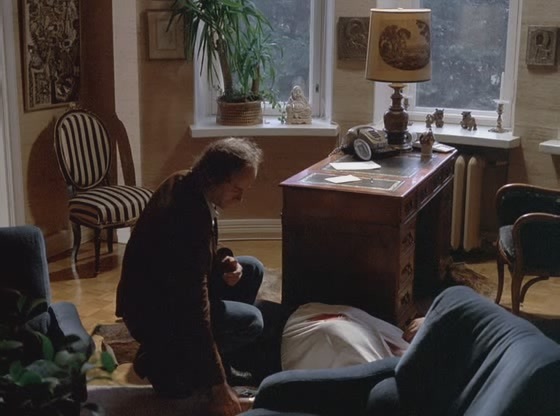
At the end of Pickpocket, the character Michel - the titular thief - finds a kind of spiritual transcendence through incarceration. In this sense, Bresson's film probably has a touch the "existential" about it, as the character intentionally sets in motion a chain of events that will see about his own personal downfall, or a kind of punishment for some perceived weakness or failure. This, as a conception, recalls Dostoevsky, but it also evokes some of the ideas found in Jean-Paul Sartre's Being and Nothingness (published 1943) and the predicament of the character Meursault in Albert Camus's The Stranger (published 1942). Here the notion that "existence precedes essence", and the idea of a character committing a crime as almost primal scream (as well as an attempt to re-establish some kind of emotional balance within his own personal universe) seems to inform the philosophy of Bresson, and by extension, the philosophy of the film in question.   

As a debut, Crime and Punishment lacks much of the nuance and personality that would become characteristic of Kaurismäki's later cinema; which would really come into its own with the release of his third feature, Shadows in Paradise (1986). Subsequent works would take a similar approach to the one seen here, incorporating the same influence of Bresson and the milieu of socio-economic hardship as a backdrop to a more conventional filmic narrative, but would punctuate the deadpan humour and the mannered performance style with a sensitivity seemingly plucked from the quiet melodramas of Yasujirō Ozu (note the appearance of the red kettle in one of the screen captures featured above as an early nod to Ozu's cinema.)

Nonetheless, the film still provides a fascinating insight into Kaurismäki's early approach, his creative vision, and his particularly sardonic sense of ambition (a cavalier approach to adapting literary classics that would eventually carry through to his later, similarly modern and satirical adaptations of Shakespeare - Hamlet Goes Business, 1987 - and Henri Murger - La Vie de Bohème, 1992 - respectively). Crime and Punishment is a film very much worth experiencing, both in its own right, and as a way of introducing the rough essence of what an Aki Kaurismäki film is before approaching his subsequent, more interesting endeavours, such as those aforementioned.

Thursday, 14 January 2016

A Year in Film (Part Three)


A Viewing List for Twenty-Fifteen


The Red Spectacles [Mamoru Oshii, 1987]:


Oshii manages to corral the influences of '60s Godard (post-modernism) and '80s Godard (poetic ennui) alongside elements of Seijun Suzuki and Jerry Lewis; finding a middle-ground between the pop-art sci-fi reportage of Alphaville (1965) and the comical-philosophical patchwork of Keep Your Right Up (1987) or King Lear (1987). For those that find the director's later (and for me no less essential) films to be largely humourless, self-serious ruminations on tired cyber punk concerns, The Red Spectacles is a work of genuine comic brilliance, both deadpan and slapstick; albeit, with a mystical, vaguely metaphorical climax that questions the nature of reality, existence, perception, etc. It also works as a fairly successful if academic experiment in cinematic stylisation analogous to what von Trier would attempt in films such as The Element of Crime (1984), Epidemic (1988) and Europa (1991); in short, a gnomic synthesis between genre deconstruction, social commentary and self-referential critique.


Song of the Sea [Tomm Moore, 2014]:


A poetic, intensely lyrical family drama, which, like the greatest works of Studio Ghibli, has been sold as a conventional children's adventure story, but in reality seems a far more penetrating examination of deeply human concerns - such as bereavement, grief, abandonment and the end of childhood innocence - which will only be truly felt by an older, more sensitive audience. The imagery throughout is rich and magical, beautifully designed and animated with great imagination, but always relevant to the central story of the two children and their familiar disconnection. From the old woman transformed by the fearful children into the image of a great owl, to the lonely giant turned into a mountain by his sorceress mother so as to stop him from drowning the world in an ocean of tears, the flights of fancy only deepen the metaphorical interpretations of the work.


The Canterbury Tales [Pier Paolo Pasolini, 1972]:


Pasolini as the figure of Geoffrey Chaucer gives the film a more tangible through-line than his earlier, similarly picaresque but looser exploration of Boccaccio's The Decameron (1971). Here, the same medley of stories - which run the gamut from satirical swipes at politics and religion to bawdy "sexcapades" and Chaplin pastiche - are tied together by the presence of Chaucer as self-reflexive surrogate for Pasolini; casting his critical eye not just over a medieval burlesque but its reflection on the modern world. The films' third act depiction of Hell as a surreal Hieronymus Bosch-like fantasia elevates the work above the level of the "merely great" to the realms of absolute genius! One of the most bizarre and inventive sequences Pasolini ever filmed. Lyrical, funny and disturbing in equal measure.


3 Women [Robert Altman, 1977]:


Altman's strangest film. A pre-Lynch take on Lynchian themes of dissociation, identity, alienation, the blurring of perspectives. Nods to Persona (1966) escape the curse of empty "Bergmanesque" imitation by being delivered in Altman's unique and characteristic approach; the camera drifting nomadically across complex scenes; picking out startling shots, strange objects, moments that seems inconsequential but make sense on reflection. A haunting and hypnotic work that rivals the director's earlier psychological study, Images (1972).


Nymphomaniac: Vol. I & II (Director's Cut) [Lars von Trier, 2013]:


1. Joe fashions a story from the ephemera of Seligman's room. Why? Is she telling her own story or something else? The framing device gives credence to the more preposterous moments; creates a context for Joe to indulge in fantasy but also for Seligman to interject; to deconstruct the material. In this sense the film is not just a thesis on the themes herein, but a self-reflexive study on von Trier's own methodology. 2. Joe's story about the paedophile suggests hidden implications at the end. Why is she telling these stories to Seligman? What response is she looking for and does she get it? Is the film a chronicle of one woman's self-destruction/transfiguration through sexual experience or a cruel game of deception and entrapment? I would say both. The subtleties of the ending introduce a profound degree of potential reinterpretations. 3. A pornographic variant on The Princess Bride (1987) with all of the same self-reflexive dialogues about the relationship between 'author' (Joe as surrogate for von Trier) and 'spectator' (Seligman as surrogate for the audience). However, the film is also the clearest, most penetrating iteration of the filmmaker's recent themes; depression, self-destruction, gender identity, the cruelties of nature, etc. A revelatory masterwork for von Trier.


Mr. Holmes [Bill Condon, 2015]:


While the concept of a logical Holmes encountering the one thing beyond his understanding (actual human emotion) could have been played for cheap sentimentality, Condon's film hits somewhat harder. As an investigation into memory as an effort to understand what it is to be hurt by something beyond rational comprehension, the film ably touches on issues of war, genocide, failure and grief in a profound and hugely compelling way; deconstructing the notion of the procedural (or, more plainly, the detective story) until it becomes a penetrating and insightful rumination on age, memory, experience, repentance and the inability to let go.


Welcome to New York [Abel Ferrara, 2014]:


A fearless political commentary disguised as psychological examination. Ferrara uses his Strauss-Kahn facsimile as personification of both the financial crisis and the attitude of those in positions of power; here protected by laws that leave them free to use and abuse the lowest rung of society. The character, like the condition itself, becomes a wild animal; pawing and groping his way through the culture made flesh; consuming everything. The resulting arrest and trial is like an indictment against the city itself; that inbuilt corruption of money as something above the safeguarding of actual human experience that allows all other levels of corruption to be maintained. Anchored by Depardieu's grotesque, violent performance, and a series of penetrating dialogues that hint at the true circumstances at play, Welcome to New York is arguably Ferrara's most powerful and necessary work.


Phantom of the Paradise [Brian De Palma, 1974]:


De Palma buries a personal commentary on creative freedom and the exploitation of the artist beneath a post-modern blend of Goethe and Leroux, camp B-movie horror and exaggerated glam rock. Peppered with additional nods to silent comedy, Hitchcock (naturally) and Welles - to say nothing of a frenzied, faux-reportage climax that deconstructs the line between fiction and reality, and reminds the viewer of the counter-culture experimentation of the filmmaker's earlier, much underrated Dionysus in '69 (1970) - the film works both as a vicious music business satire and as a dazzling phantasmagoria, full of heightened emotions, bold imagery and clever storytelling. The intelligent, self-reflexive soundtrack by Paul Williams is without question one of the films greatest assets.


The Strange Case of Dr. Jekyll and Miss Osbourne [Walerian Borowczyk, 1981]:


Here, lurid exploitation meets art-house exploration, blending slasher movie tropes and soft-core/soft-focus sexuality with deeper philosophical questions regarding social identity, transgression and the 'beast within.' The atmosphere is evocative of the adult fairy tales of Rolin and Argento, such as The Iron Rose (1973) and Suspiria (1977) to name just two, but taken to a level of frenzied sexuality and heightened violence that only compliments the films' rich psychological themes. The combination of the baroque and the brutal is no less beautiful and atmospheric than in a film like Neil Jordan's later masterpiece of 80s meta-horror, The Company of Wolves (1984); another mesmerising and unsettling work of dreamlike psychosexual surrealism.


L'argent [Robert Bresson, 1983]:


A film less about 'money' or its power to corrupt or debase, than a film about actions and their consequences. A good man is very gradually turned into a criminal by the dishonesty and villainy of the world around him. As such, the man is less an individual than a reflection of his own society. Bresson's characteristically austere approach is perfectly suited to this story of dehumanisation; where even a third act atrocity is presented without sensationalism or melodramatic excess. As political commentary, the film very subtly communicates the ironies of criminality; that those who initiated the chain of events receive little to no punishment, while those on the bottom rung of society are forced to suffer a genuine humiliation, speaks volumes. More than anything, Bresson's masterpiece embodies the philosophy of Godard's 'Uncle Jeannot' character from his First Name, Carmen (1983); "when shit's worth money, the poor won't have assholes." A work of art.

Schalcken the Painter (1979)

Schalcken the Painter [Schalcken the Painter [Leslie Megahey, 1979]: This is a film I first saw around four years ago. At the time I found...