Showing posts with label Mike Leigh. Show all posts

Saturday, 4 October 2014

Top Ten: 1992


Ranking the Decades
A Year in Film List + Image Gallery 


Céline [Jean-Claude Brisseau, 1992]:


Chasing Butterflies [Otar Iosseliani, 1992]:


Twin Peaks: Fire Walk with Me [David Lynch, 1992]:


Antigone [Danièle Huillet & Jean-Marie Straub, 1992]:


Lessons of Darkness [Werner Herzog, 1992]:


Light Sleeper [Paul Schrader, 1992]:


A Sense of History [Mike Leigh, 1992]:


Dream of Light (aka The Quince Tree Sun) [Víctor Erice, 1992]:


Candyman [Bernard Rose, 1992]:


The Crying Game [Neil Jordan, 1992]:

Above, arranged in order of preference, my personal top-ten best films of the year (from what I've seen), accurate at the time of writing.

Tuesday, 8 April 2014

Top Ten: 2004


Ranking the Decades
A Year in Film List + Image Gallery


Notre Musique [Jean-Luc Godard, 2004]:


The Village [M. Night Shyamalan, 2004]:


Tropical Malady [Apichatpong Weerasethakul, 2004]:


Moolaadé [Ousmane Sembène, 2004]:


With Blood on My Hands: Pusher II [Nicolas Winding Refn, 2004]:


2046 [Wong Kar Wai, 2004]:


The World [Jia Zhangke, 2004]:


To Forget [Adrian Thomas Pennington, 2004]:


Vital [Shin'ya Tsukamoto, 2004]:


Vera Drake [Mike Leigh, 2004]:

Above, arranged in order of preference, my personal top-ten best films of the year (from what I've seen), accurate at the time of writing.

Sunday, 13 December 2009

Nuts in May

In an earlier post regarding the DVD release of the Mike Leigh at the BBC box-set, I described this particular film, Nuts in May (first broadcast January 13th, 1976), as "loose and rambling"; a two word pairing that not only underlines the direction that these characters take throughout the course of their literal journey through the English countryside as defined by the plot, but in the practical, presentational way in which Leigh allows his story to unfold and eventually develop. In what has now become fairly characteristic of the director's individual approach to cinema, Nuts in May is an intelligent if somewhat fairly broad character-study enlivened by moments of keenly observed social-satire; where the elements of conflict, drama and humour central to our engagement with the film are created by the endearingly awkward interactions between each member of the cast, and the often uncomfortable, or sometimes absurd situations, to which they're confined.

Although it is a much lighter film in disposition than the majority of Leigh's work, either before or since, the general thematic development of Nuts in May is nonetheless an essential example of Leigh's particular ability to create moments of conflicting drama from even the most honest and basic of situations. These situations could (and indeed do) include anything from the pitching of a tent or the excavation of a centuries old fossil, to the more reflective, interpersonal moments, of which the vast majority seem drawn from the small-scale spectacle of everyday life. In taking these two characters and introducing them as a married couple, eventually revealing the minute details of their lifestyle and pursuits through the wry dialog and the interaction of the characters, Leigh is able to create something that works on several levels; not simply as a character study, or as a wider satire on a particular subculture or general ideology, but as something that establishes a number of themes germane to the broader parameters of Leigh's cinema: chiefly, the ideas of conflict and co-existence.

Despite being set within the midst of the beautiful rolling-green countryside of Dorset, on the south-west coast of England, Nuts in May has enough similarities to later films like Grown Ups (1980) or Meantime (1984), in which the domestic disputes and disagreements of different characters attempting to get along with one another is used to explore deeper, more complex themes pertaining to the basics of human psychology. In fact, Leigh himself has stated that his intention with Nuts in May was to produce an urban drama in a rural setting, so that the contrasts between characters from numerous walks of life attempting to co-inhabit a particular shared space - like the cramped living rooms and kitchens that one might find in the suburbs, or on a council estate - could be used as a springboard for the purposes of discussing more universal themes or ideas not necessarily related to plot.


As something of a departure for Leigh, not just in terms of its setting or in the basic concept of characters on the road (so to speak), Nuts in May could be seen as an attempt at filtering its drama (in both structure and approach) through two very different and distinct filmmaking forms. Most obviously, the situation comedy, or in fact, more specifically, the English situation comedy, as typified by the likes of The Good Life (1975) or The Last of the Summer Wine (1973) - in which eccentric if well-meaning characters are established and then placed into a recognisably, every-day situation - and the road movie: as our two characters become almost like guides to this strange shambolic trek around the English coast, bringing us along, as if passengers on a journey, and allowing us to share in the ups and downs of their experiences. As ever, Leigh captures this action in a way that is mostly unobtrusive, observing these characters, either in a very reserved, almost documentarian approach, or shooting hand-held from the back of the couple's car (which continues that notion of the audience as part of the drama; the brought-along hitchhiker, caught up in the narrative and along for the ride).

It is in the relationship between the two central characters that the basis for the various emotional responses to both the comedy and the drama are formed; with the obvious contrasts of background and attitude - as one character's quirks or preoccupations are played off against another wildly different character - being used in order to trigger personal associations in an attempt to make the situations more real and our response to these characters, as they move from laughable to sympathetic, all the more authentic. Unlike many of Leigh's others films for television, the characters from Nuts in May were pre-existing, with the film created around two characters that Leigh had originally developed for an earlier theatre production, in which the domestic-life of the central couple was documented in a kind of two-act, interior-set comedy of manners - more in keeping perhaps with the director's follow-up film, the highly successful and now fairly iconic television play, Abigail's Party (1977). In adapting these characters for the cinema, Leigh opens the drama up; taking his characters on the road, removing them from their protective domestic setting in which their traits and eccentricities were freely accepted, and turning them loose on the world, so that these same characteristics can be observed by both the audience and the supporting cast to better contrast the deeper psychological implications of their actions.


In this sense, the title of the film, as ever with Leigh's screen titles, has certain hidden implications, here relating back to the traditional children's rhyme: which establishes a certain generational background and the notion of a pairing between the male and female protagonists (and also, you could argue, the male and female characters that will later appear on the fringes of the narrative). However, the title can also work as a fairly obvious though no less amusing pun; the idea that the nuts in season are actually the two central characters; nuts, as in "oddballs", on holiday in the month of May (with May relating to the May Day celebrations, or the May Bank Holiday, when families often plan weekends away). The film opens with the screen title rendered in a cheerful font - brightly coloured in an almost picture-postcard parody to better make light of that once most curious of English pursuits: the countryside camping holiday - superimposed over a shot of the ferry as it arrives in Dorset with the two main characters in tow. On the soundtrack our jovial protagonists Keith (Roger Sloman) and Candice-Marie (Alison Steadman) sing their own self-composed folk song about an escape to the country, in which the improbably twee-lyrics and the yearning sense of innocence as expressed in the song's particular worldview, seems to underline the broader aspects of their relationship and the general dynamics of the trip itself.

I want to get away she said
I want to get away
I'll take you on a trip he said
We'll have a holiday
We'll be with Mother Nature
And laugh and sing and play
I want to get away she said
I want to get away

I wonder where we'll go, she said
I wonder where we'll go
I'll look around the world, he said
I'll search both high and low
The prettiest is Dorset, it has so many charms
We'll walk across the hills and dales
And look at all the farms


The contrast between these two forms, with the characters singing their song with a dual guitar and banjo accompaniment over a travelogue of images shot from the back of the couple's car, creates that perfect evocation of the escape to the country - the get-away, as it were - where couples would leave behind the toil and the strife of the suburbs or the big city and get back to nature. That Keith, in his self-composed lyric to the song, expresses an urge to walk across the hills and dales "looking at all the farms" is in complete contrast to Candice-Marie, who corrects his lyric, claiming that "linking each other's arms" is the more emotionally expressive dénouement to the pastoral evocation that they're creating. Keith's natural reaction is to dismiss the suggestion - "that doesn't scan!" - seems to illustrate right from the very beginning the sense of order and efficiency that Keith strives for; setting their holiday to a strict day-to-day timetable and preplanning every facet of the trip, right down to the most effective footwear for clambering on rocks or walking the footpath to the beach.

As the relationship develops, and the correlation between the two characters becomes more clearly defined, we can question the subtleties of this introduction, or what it says about our protagonists. When Candice-Marie sings "I want to get away", are we to see this simply as a yearning for the open road, fresh air and countryside, or is it instead a subtle hint to her dissatisfaction with the strict, know-it-all Keith? We can take it either way. Likewise, in the later scene, when the couple perform their song about London Zoo, which has the same melody, chord structure and rhythm as the song from earlier in the film, the phrasing of the lines "I want to see the zoo, she said, I want to see the zoo" / "I want to take you there, he said, I want to go with you" could hint at the fact that despite his bluster and need to get his own way, it is actually Candice-Marie who wears the trousers in the relationship, and without her, Keith would effectively be nothing. If we choose this interpretation, then the relationship between Candice-Marie and their campsite neighbour Ray (Anthony O'Donnell) takes on a different quality, as she seems to be generally interested in the young man, even coercing her husband into taking a picture of the two of them together. It also, to some extent, explains the sexless relationship that the married couple share, with the particular association between them seeming at times to be more like that of the teacher and his student. He is full of his own stuff and nonsense, older than his years. She works in a toy shop and sleeps with a purple kitten-shaped hot water bottle named Prudence.


The brilliance of Nuts in May is that it allows these characters to develop and evolve naturally, without relying on the usual melodramatic superfluities, intrusion of plot twists or creative editing to make the process more direct. The narrative builds gradually, introducing the two central characters, placing them in a situation, allowing them the time to interact with the situation, to use it as a means of developing their own characters in more detail, before another character is introduced into the situation to cause a conflict that drives the narrative further towards its natural resolution. With the arrival of Ray, and later the brash and jubilant couple Honky and Finger (played by Sheila Kelley and Stephen Bill), Leigh creates a natural chain of events that will push the characters to the very edges of their patience, once again illustrating that idea of co-existence, or the neighbourhood power struggle that he would return to in Grown Ups, or Home Sweet Home (1982).


Although the issue of class, so often crucial to much of Leigh's wok, and particularly of these early television films, such as Hard Labour (1973) or Abigail's Party, is mostly absent from the development of Nuts in May, it does find a certain parallel with the way Keith and Candice-Marie are seen by the locals, who can smell their suburban back-to-nature bullshit from a mile off. It's particularly palpable in the scenes between our central couple and the pig farmer, who seems to get an enormous amount of pleasure from informing Keith that the filed in which they wish to spend the night doesn't have a toilet, and the policeman, who, in one of the most cruel scenes in the film, stops the couple and penalises Keith for having obscured the rear-window of his car with camping equipment. There is also some hint to the nastier side of Keith, who, in angrily confronting Honky and Finger, screams to them to "get back to [their] tenements", which cuts through the audience with all the ferocity of a particularly violent racial slur. However, such moments simply add depth to the characters, never turning them into caricatures, as is the usual criticism of Leigh's work, but simply offering the different shades and aspects of a personality that makes up the greater whole.

As is often the case with Leigh's work, the richness of these characterisations and the work that he and his actors put into the creation of these fully-functioning individuals - with full back stories and carefully drawn relationships - seems to push the viewer into becoming an armchair psychiatrist, trying to "understand" these characters, their actions and their motivations. However, to read too directly into these sketches could easily take away from the immediacy of the drama, or the sheer entertainment value that comes from witnessing these perfectly nuanced performances, where those involved act and react to the situations, or to the other characters, and make it seem entirely without effort. Although plagued by eccentricities and at times downright exasperating traits, we never find these characters repellent or repulsive. We enjoy the company of Keith and Candice-Marie, even though they're irritating, or occasionally self-righteous. Even with Keith, all well-meaning arrogance and authoritative tone, attempting to force his lifestyle on the various other characters encountered during the course of his journey, and condescending in his approach to his own wife, who in turn is skittish and naive, peeking out from beneath an oversized bobble-hat and national-health glasses, and speaking in a slow, monotonous drone, each sentence posed as a question, we nonetheless feel something for these characters, and can offer empathy and understanding when the film ends on a note of quiet desperation.

In a recent interview with the broadcaster Mark Lawson for the BBC (to coincide with the release of this particular box-set), Leigh claimed that his preferred ending for the film would have had Keith and Candice-Marie camped out atop the enormous phallic erection of The Cerne Abbas giant - which would, in his mind, have been the perfect ironic critique of the couple's central relationship - but the lack of funding made it impossible. As it stands, the current ending is just fine. There's no shot of the ferry to end the film, or to wrap up this disastrous journey, so we're left with the suggestion that this closing scene, tranquil enough, but also fairly tragic in its own way, will just continue, with Candice-Marie happily strumming out a song about the need for conservation, as Keith pops behind the pigpen with a roll of toilet paper, giving some vague reference to what would have been Leigh's original title, "Eaten By A Pig".

Friday, 26 June 2009

Hard Labour

Released this past month as part of the Mike Leigh at the BBC box-set, Hard Labour (first broadcast, 12th March, 1973) was the now-highly acclaimed director's second feature length work and his first for the company's long running Play for Today series, to which he would later contribute the more highly-regarded films Nuts in May (1976), The Kiss of Death (1977), Abigail's Party (1977) and Home Sweet Home (1982). As with his debut feature, the stifled, claustrophobic chamber piece Bleak Moments (1971), Hard Labour is a strictly downbeat affair, with the usual characteristic Leigh sense of humour, so brilliantly developed in films like Grown Ups (1980), Life is Sweet (1991) and Happy-Go-Lucky (2008), being in the formative stages throughout.

Although the humour is mostly absent, the recognisable emphasis on the day-to-day comings and goings of characters living and working through these various situations is as bold and affective as it has remained, thirty-years on; with the natural talent of Leigh as a filmmaker, preoccupied with the minute details that make up the greater whole managing to bring these separate elements together in a way that is intelligent and completely affecting. It is a film that, at its most basic and recognisable, offers us a simple story, or, more specifically, a window into the world of its central character, the middle-aged cleaning lady Mrs. Thornley (Liz Smith). While the character is deliberately refused a first name by the filmmaker, we can nonetheless recognise certain character traits that mark her out as is an even more bedraggled forerunner to the titular Vera Drake; with the poor posture and the softly-spoken voice, barely audible over the constant of family arguments or the distant ambience of the industrial working-class milieu, defining a tone that permeates every second of the drama; from the seemingly pointless conversations to the quiet moments where characters sit and think in stone-faced contemplation.

From this initial set up, Leigh is able to maintain his drama through the continual interaction between the characters; as these scenes of dialog, or the quieter instances where the camera simply holds on a actor's face and they share a moment, bleak or otherwise, are used to suggest deeper, more universal themes that go beyond the characters presented on screen and suggest something recognisably human and relevant to the world in which we live. It's subtle, even without the use of humour to distract us from the otherwise crushing sense of despair, while the development of the characters and the situations they've found themselves in feel very authentic; especially in regards to the world of the film and the motivations of the characters.


As one might expect given the usual implications of the title, Leigh's general approach to the film is to show and then contrast the working life with the family life; opening with a series of short scene-punctuations that perfectly establish the various drab, everyday rituals that make up the routine of this galley of protagonists, as the camera, static and composed, observes in great detail the general running of this dysfunctional lower class family at the start of an average day. These early sequences establish a particular rhythm, with the obvious reiteration of things, as the character asks twice for her husband to lift his feet as she runs the small vacuum cleaner past the chair, across the faded floral carpet - and almost immediately we wonder how many times she's asked and asked again for her husband to shift his legs while she performs this crushing, domestic rite. Back and forth over the carpet with the vacuum cleaner while the husband, weary from work or back from an afternoon of heavy drinking, barks orders or chips away at the character's already tattered self-esteem.


These sequences are captured, like much of the film, in a characteristically loose, narrative-vignette approach that highlights Leigh's continual emphasis on character and observation as a means to explore the deeper, more expressive themes at work beneath the surface. In keeping with such a notion, the film is, in essence, concerned, or obsessed (?), with the little close-up details that make up the bigger picture. Just as the natural accumulation of one day to the next, month on month, year on year, creates the endless spiral of existence as it unfolds, so too does the repetition of scenes that suggest so perfectly that sense of a life in-progress that survives beyond the parameters of the film's frame - beginning and end, opening title to closing credits - creating the sense that the world has turned and continues to turn long after the screen has faded.

Although the film grants an equal amount of screen-time to several characters, both within the family and on the periphery of the drama, it is the perspective of Mrs. Thornley as the family's quiet matriarch who dominates the proceedings; either as a kind of facilitator, offering the characters a chance to meet and interact - bridging the gap so to speak through her job and her commitments between work and home, the suburbs and the sink estate - or simply observing the conflicts and drama, quiet and dignified, though her face, with the sunken eyes and hollowed mouth, revealing everything. The rest of the characters exist around her, and their attitudes and interactions, both in regards to her and the characters around them are largely filtered through this quiet perspective of a character watching from the corners of the frame.


Throughout the film, Leigh cuts back and forth between scenes of Mrs. Thornley at work - polishing the silverware or struggling to carry large bundles of clothes up and down winding carpeted stairs - and the domestic scenes, as she dotes on her chauvinistic husband Jim (Clifford Kershaw), a night watchman who complains endlessly about his bad back and uncomfortable shoes between loveless putdowns and perpetual scowls, and her two grown-up children, Ann (Polly Hemmingway), who still lives at home, though very much has a life of her own, and Edward (Bernard Hill), a car mechanic getting comfortable in one of those new council estates with his bossy young wife Veronica (Alison Steadman). The integration of these characters, as they meet over lunch or Sunday dinner, or during the general progression of an average day, creates the usual clashes of generation, class and personality that we've come to expect from Leigh's cinema; as the petty squabbles and sometimes deep-seated jealousies and anxieties are revealed through the scenes of passive-aggressive confrontation, as one character instinctively taunts the other character to breaking point, either deliberately, or simply because it's possible and part of the natural interaction between characters within a family environment far too comfortable in the company of one and other.


In such sequences, we can see the Leigh of Who's Who (1978), or Meantime (1984), or High Hopes (1988) and even the comparatively recent Vera Drake (2004), and all of these strands passing back and forth through the previously mentioned Abigail's Party to the presentation of scenes herein; scenes in which characters from both ends of the social spectrum are thrown together and allowed to contrast and conflict in a way that not only reveals something about themselves, as characters, but also about the world (this world or Leigh's?) in which they continue to exist.

Though there are several other themes explored in the film, the real emphasis here is on the coexistence of these characters under the broader classification of "the family". Immediately, we can recognise this as a key theme in Leigh's work, in which the differences between these people, connected, but nonetheless at odds, becomes magnified; as that accumulation of time as defined above, exaggerates each characteristic tic or quirk until the idea of simply being in the room with these people is like negotiating a particularly cluttered minefield. As ever with Leigh, the point of such scenes isn't merely the exterior level - the things said between two characters under the pretence of conversation - but the things implied by these sequences - the things going on beneath the surface. Are they really relevant, these discussions of what kind of cheese to get from the precinct or a pair of boots one size too small, or can such conversations fill in the blanks about the relationships between these various characters; their approach to life and, more importantly, their approach to one another?

Take the brief scene between Mrs. Thornley and her daughter at the outdoor-market as one single example. A scene lasting no more than a minute or two of screen time in which the two women sift through piles of half-price underwear on a cluttered weekend market stall. Again, is it important that Ann wants the purple bra? Does it move the narrative forward in a way that creates compelling, exciting drama? No, of course not! But it establishes the contrasts between the mother and her daughter, showing a young woman who exists in a world of fashion and sexuality - a world where sex is a recreational pursuit, to be enjoyed - and a world away from the generation of Mrs. Thornley, where the closest thing to intimacy or affection is being pawed by a husband looking for a drunken post-pub leg-over. The sad desperation of those early evenings, pretending to be asleep to spare her the agony of another awkward assault, as the husband moans and gropes and writhes around beneath the sheets because, in the days before women's lib or god-given-notions of equality, that was his right.


There are the little things too, like the relationship between Ann and her sister-in-law Veronica, both of the same background and generation, who were most probably school friends before Veronica was wooed or pursued her best-friend's (?) brother and now makes life difficult for everyone by projecting her own middle-class aspirations onto this surrogate family, expecting them to reach some higher level of living through economic gain, social-status, and those all important outward appearances. As ever with Leigh, we can view these as the typical concerns with class, which still dominate much of British art and British attitudes, as we glorify the working class, pity those who have achieved some worth in a middle-class sense, though obviously not enough to rank as highly as the smart-set, who we pretend to hate, but really hold enthral. Nonetheless, this class emphasis is really just one of Leigh's many devises, like satire or character improvisation, that is used to map the psychology of characters, developed to a staggering degree from months of intricate pre-production meetings and rehearsal workshops until the creation of a completely functioning character, from birth until the moment that they appear on screen, is formed.

This interest in mapping out the parameters of his characters also extends as far as the world that Leigh creates, which, in a number of ways, seems exactly like the world in which we live, and yet even then there is some process of stylisation or creative abstraction, which is unavoidable. Though many critics continue to cite Leigh as a social-realist, lazily comparing him to the much more socially aware and politically motivated Ken Loach, his work has much more in common with filmmakers like Yasujirō Ozu, Maurice Pialat or Rainer Werner Fassbinder; with the emphasis on looking, observing, sometimes dethatched, but concerned with the outcome of these characters; letting the little details of the rooms and the way they're captured tell a story. The small, cramped, two-bedroom house with its outdoor toilet and kitchen too small to move around in; the flowery wallpaper and radios offering nameless songs that could recall seaside romance but instead mock the soot-lined streets and drudgery that waits around each corner; 30p an hour, 3 hours and five mornings, polishing silverware while the lady of the house looks you over, eagle-eyed behind those horn-rimmed spectacles.


With Hard Labour, Leigh creates a rough-around-the-edges film that not only manages to operate in a storytelling capacity - presenting the usual look at character concerns and intricate personal-relationships - but one that also manages to say a great deal about the time and place in which it is set. That particular evocation of the cobble-stone streets and cluttered back alleyways where dogs wander, catching a scent and then off again, bringing to mind the desolate existential landscapes of Tarkovsky or Béla Tarr; with the grit and the grime and the overcast skies recalling a film like Stalker (1979) or Damnation (Kárhozat, 1988). But this isn't science-fiction or expressionist-noir, but the real life dramatisation of a specific time and place; chiefly, Salford, Greater Manchester, in the early 1970's. A changing world, captured so vividly in Morrissey's controversial song Bengali in Platforms from his debut solo album Viva Hate (1989), and in turn the world of The Buddha of Suburbia, with the character of Naseem (Ben Kingsley) and a seemingly secondary sub-plot about back-street abortions, making the relationship with Vera Drake an explicit one, while giving weight to Ann's all-of-a-sudden interest in the particulars of child-birth and her mother's sage advice; "you have to suffer to bring children into the world."

We can recognise these characters, just as we can recognise that sense of domestic drudgery; from the banging on the ceiling with the broom-handle to stir the old-enough-to-know-better daughter, to the "shut up/no you shut up" exchanges of dialog; as dad puts the world to rights through a mouthful of soggy toast. The natural repetition of these scenes repeated, breakfast, lunch and dinner, as Mrs. Thornley, desperate to please, let's her dinner go cold on the table as her husband and daughter shovel it down and ask for more. We can recognise the disappointment of this life from the very first scene, but it is only as the film edges towards its closing moments, and in particular the penultimate scene, that we realise Mrs. Thornley feels it too.


In perhaps the most famous scene in the film, the character attends her Sunday morning confession and reveals to the priest that her dissatisfaction with life and her inability to love or connect with the people around her has become too much to bear. In true Leigh form, this scene, which is brilliantly performed by Smith and shot by the filmmaker with a direct, uncomplicated precision, is emotionally honest and just the right side of painful; as the inability of Mrs. Thornley to express her problem is greeted by half-hearted 'Hail Mary's' and again, that attitude of chauvinism, as yet another man fails to recognise the pain of a woman boxed into a corner and unable to escape. However, in this very obvious mocking of religion, with its agendas and advice that goes nowhere, Leigh actually succeeds in creating a moment that is wickedly funny, if, again, no less painful. Although I maintain that the usual Leigh sense of humour is lacking here, the last-minute reveal of the Priest, flicking through his Sunday newspaper as Mrs. Thornley bares her soul as best she can, does hint at the direction that much of Leigh's work would take following the liberation of the subsequent Nuts in May and the later emphasis on comedy (often black-comedy, or the comedy of everyday life) to undercut the more harrowing moments of personal pain.

These are themes that will become more important as the progression of Leigh as a filmmaker continues on, with the idea of the family and the emotional split between the husband and wife in particular reminding us of the dysfunctional relationships and quiet, inarticulate characters in films like Secrets and Lies (1996) and All or Nothing (2002); where the simple process of sharing a moment over the kitchen table when resentments and anxieties get in the way of our natural instincts to care for one another becomes a form of hard labour in itself. In this respect, the title of Leigh's film not only expresses the daily grind of the character's life as she is forced to care for and pick up after her family and the snobbish middle-class housewives whose posh, Mock-Tudor houses she cleans for a living, but also the notion of life, and in particular married life, as a kind of prison sentence.

Sunday, 10 May 2009

Bleak Moments

The title, Bleak Moments (1971), is as accurate a two-word description of the general feeling and tone of the finished film that one could ever hope to find; expressing, at its most basic, the feelings of hopelessness and desperation that accumulate throughout the course of the film as these characters simply pass the time in their cramped, domestic living-spaces, looking out at a world in the hope of finding the warmth and colour of everyday life, only to find instead the sad rejection and emptiness of their own situations reflected back at them. It is the endless spiral of social anxiety presented at its most unforgiving, as each attempt to break out of this kind of self-imposed purgatory and confront the boundaries of life head-on leads only to more embarrassment and failure; where the only respite is those brief moments when the characters find the time to take their minds off the gruelling responsibilities or anticipations of life and just think.

Described on its initial release by Roger Ebert as a "new kind of movie", one that "considers, with almost frightening perceptiveness, the ways people really behave towards each other", Bleak Moments would mark the arrival of the now-highly acclaimed director Mike Leigh, who developed the film - his first film for cinema - from his earlier stage-production of the same name. Although one could argue that as a complete picture this debut film lacks much of Leigh's later creative subtly and that sense of the sweetness of life to undercut the more uncomfortable feelings of quiet desperation so central to the lives of his characters and the various situations that they have been placed in, we can at least recognise the typical Leigh aesthetic in the mining of everyday life to create the parameters of engaging drama, or perhaps in the entirely convincing performances of his actors, who embody these roles, largely because they were able to develop them alongside the director, living these lives and drawing on their own experiences to make the actions of the characters and the pain that they feel all the more believable.

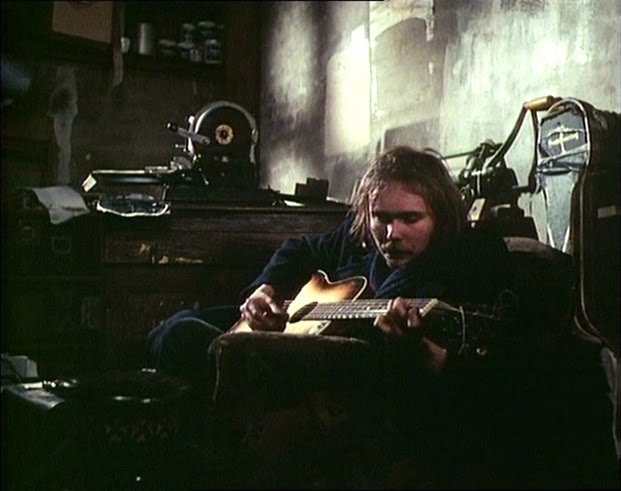
In keeping with the greater emphasis on character interaction the plot is incredibly straightforward. Essentially a brief snapshot into the life of Sylvia (Anne Raitt), a lonely secretary who shares her suburban home with a disabled sister, Hilda (Sarah Stephenson), who she is expected to offer round the clock supervision to, often at the expense of her own happiness or social satisfaction. Her downtime, if any, is spent entertaining her ditzy friend and co-worker Pat (Joolia Cappleman) or, if possible, attempting to forge a relationship with the shy grammar school teacher Peter (Eric Allen), who drifts in and out of her life. There is also the character of the lodger, Norman (Mike Bradwell), a shy young man, head-down, hair covering his face and further muffling his already softly-spoken northern accent, who lives in a makeshift bedsit in the character's garage where he alternates between printing fliers for his bosses at work or strumming out yearning folk songs on his battered old guitar.


Bleak Moments directed by Mike Leigh, 1971:

These characters meet regularly but rarely speak, choosing instead to linger on the fringes of the frame, making pained attempts at conversation that go nowhere. To accentuate the discomfort of these scenes, the shots are allowed to play out for what seems like an eternity; establishing a particular rhythm that perfectly underlines that feeling of the awkward - why didn't I say it - sense of inarticulate longing. Expressing perfectly that failure to express through the recognisable pattern of failed conversation - the think, open mouth, a sigh, a false start, conversation stalling, think again, a look, a nod of approval, an uttered word, hushed and mumbled, a pause, a false start, a look of confusion - repeating itself until the words begin to take shape. In this vision of loneliness and repressed desperation the whole film becomes suffocating to watch; with that think and heavy, pregnant with the anticipation of something mood never alleviating throughout its stifling 111 minute running time, as the accretion of these bleak moments creates a depressing and overwhelming effect.


Bleak Moments directed by Mike Leigh, 1971:

Ebert defined this quality as such: "Bleak Momentsis not entertaining in any conventional way. This is not to say for a moment that it is boring or difficult to watch; on the contrary, it is impossible not to watch. [But] This movie deals so basically with the pain and utter frustration of life that we may, after all, find it too much to take." It is in this almost searing social-anguish, as this collection of characters attempt to co-exist in the everyday world, though ill-equipped to deal with the various pitfalls as a result of their own self-conscious quirks and idiosyncrasies, that the characteristics of the film is defined. Not simply in terms of the general structure of scenes or the goals and ambitions of these characters, but in the actual putrid air that Leigh is able to create through his presentation of rooms haunted by characters unable or unwilling to interact with life; all the while being crippled and torn apart by their repressed feelings of guilt, love, longing and loss, all brought painfully into focus in the numerous extended sequences of uncomfortable silence and embarrassing personal confession.

In this respect, the film is as much a social chronicle of a certain kind of lifestyle as it is a dramatisation, presented in a densely atmospheric, heavily stylised and deeply austere cinematic manner, in which every tool at Leigh's disposal is used to prolong the quiet suffering of these characters and their endless days of drift and nothing. Although there is a sense of humour to certain aspects - the particular absurdity of situations and the natural comedy of life as characters crack jokes or cringe at their own suffering faux pas' - the film remains much more serious in tone than many of Leigh's more widely seen films: with the general feeling being closer to something like Meantime (1984) or Naked (1993), though even that was marked by Johnny's (David Thewlis) constant quips and puns. Like those films, the drama of Bleak Moments is captured within an exhausting, highly minimalist mise en scene that recalls the Fassbinder of Why Does Herr. R Run Amok? (Warum läuft Herr R. Amok?, 1970), the Bergman of Cries and Whispers (Viskningar och rop, 1972) and the Pialat of La Gueule ouverte (The Slack-Jawed Mug, 1974); where the location and production design and the closeness between characters unable to feel intimacy is explored.

From this, there's no escape for Sylvia, who tires valiantly to connect with the shy Peter and the lodging Norman, but finds both men too damaged or too introvert to really get to grips with. The drama reaches an apex with two of the most painful scenes of Leigh's cinema to date. In the first scene, Sylvia and Peter go for a meal at an over-lit, largely vacant Chinese restaurant. Once there, Peter becomes agitated, berating the snooty waiter over trivial reactions and off-setting the atmosphere with his constant, ill-at-ease scowl. As the evening progresses the couple barely speak; with Sylvia instead left to ponder and observe the solitary serenity of the restaurants only other customer, who sits huddled in the corner, happy in the company of himself. This scene acts as the catalyst for the second scene, in which the couple go back to Sylvia's house for coffee and chat. During the scene, the sense of desperation welling up within Sylvia comes close to breaking point, as she confesses her desires for Peter and extends an invitation to bed. Peter, affronted and somewhat disgusted at such baseless, brazen provocation, leaves; making a painful, humiliating and emotionally raw sequence all the more heartbreaking.


Bleak Moments directed by Mike Leigh, 1971:

Throughout the film these characters attempt as best they can to improved their social situation, but instead, end up repeating the same mistakes ad infinitum. In achieving the requisite emotional pull from this cold and loveless film, Leigh's genius, apparent even at this early stage of his career, is to allow his actors the room to move between the different emotional shades, letting the characters drift from moments of cold resentment to painful longing, often within the confines of a single scene. To emphasise this feeling, the direction of the film, in the technical sense, seems intent on stripping away all (if any) of the extraneous baggage that might reduce these situations to the level of mere melodrama; with Leigh muting the colours of the costumes and production design to the level or near monochrome, so that these characters are quite literally existing, or attempting to exist, in this grey and depressing milieu.

This particular aspect is brilliantly defined by Fernando F. Croce who evocatively describes "figures shambling down overcast London streets with leafless trees, or pinned against greenish domestic interiors." Leigh exaggerates this by reducing the score to the brief acoustic interludes of Norman, as he spends his nights cocooned in Sylvia's garage, plucking and strumming his guitar as the world continues to turn. In these scenes one may feel oddly compelled to describe the mood as 'intimate', and yet it becomes clear very early into the film that these characters are incapable of experiencing such frank, emotional honesty. The only characters that seem free from these rigid and soul destroying social restraints are Sylvia's sister Hilda, whose mental disorder offers a certain ignorance to the pressures of everyday life, and the mother of Sylvia's workmate Pat, who is forced to spend her life cooped up in bed, oblivious to the social climate of the time.

Schalcken the Painter (1979)

Schalcken the Painter [Schalcken the Painter [Leslie Megahey, 1979]: This is a film I first saw around four years ago. At the time I found...