Showing posts with label Ingmar Bergman. Show all posts

Saturday, 14 March 2020

Max von Sydow

In Memoriam

For an actor who came to the attention of international audiences through a film in which his character leveraged their own life and survival by playing a chess tournament against the grim reaper, the loss of Max von Sydow feels especially momentous. Though he lived to the grand old age of ninety and had continued to act in films and television almost until the very end of his life, von Sydow's ubiquitous presence, and his commitment to working across all genres and media, had made him something of a genuine avatar for the cinema itself.

Appearing in The Seventh Seal (1957), von Sydow would play Antonius Block, a disillusioned knight returning from the Crusades to a Sweden ravaged by plague. Encountering the literal cloaked figure of Death, the knight challenges the specter to a chess tournament. If he wins, he'll gain his life and freedom. If he loses, then he'll accompany Death to the afterworld.


The Seventh Seal [Ingmar Bergman, 1957]:

A perennial masterwork of existential cinema, The Seventh Seal would mark the first of several screen collaborations between von Sydow and the filmmaker Ingmar Bergman, though the two had previously worked together in the theatre. For Bergman, von Sydow would frequently play tortured, insular characters: brooding and out for revenge, like Töre, the wronged-father to a murdered daughter in the medieval-set The Virgin Spring (1960), haunted and on the brink of madness, like the artist Johan Borg in the potentially supernatural Hour of the Wolf (1968), or in retreat from the madness of the modern world, like the sensitive recluse Andreas Winkelman in the desolate A Passion (1969).

Bergman brought out the best in his actors and von Sydow was no exception. His performances for the filmmaker range from the theatrical and mesmeric, like in The Magician (1958), to the subtle and understated, like in Winter Light (1963), but are always in step with the tone and tenor of the film as a whole. While the image of von Sydow's character sat down against a backdrop of crashing waves, playing chess with the figure of Death –  brought to life in the film by the actor Bengt Ekerot – would go on to become one of the most iconic images in the history of twentieth-century cinema, it's his more subtle and humanistic performances in films like A Passion and the earlier Shame (1968) that really illustrate the amazing skill that von Sydow possessed under Bergman's direction.

Throughout the 1960s, von Sydow would continue to work with Bergman as well as other Swedish and international filmmakers, but it was his role as the elderly priest, Father Lankester Merrin, in William Friedkin's controversial blockbuster The Exorcist (1973) that would introduce the actor to an entirely new audience. Von Sydow was only in his 40s when he appeared in The Exorcist, but thanks to the amazing special make-up effects created by Dick Smith and the actor's own convincing performance, he appears at least thirty years older. Von Sydow's performance as the frail priest channeling spiritual light against the powers of darkness, is one of the major highlights of Friedkin's film.


The Exorcist [William Friedkin, 1973]:

Historically, demonic possession movies are often the absolute worst, descending into embarrassing hysterics and unintentional comedy as the inherent ridiculousness of the very concept jars against the attempts to take it seriously. Just look at comparatively recent films, such as The Last Exorcism (2010), The Rite (2011), The Devil Inside (2012), Deliver Us From Evil (2014), The Vatican Tapes (2015) and The Nun (2018), to witness the overwhelmingly low standard of the sub-genre. However, The Exorcist escapes this fate and works as a dramatic feature, in part, because the performances are so compelling.

Working alongside the actor and playwright Jason Miller and the child actor Linda Blair, von Sydow lends the film a genuine sense of authority. Rather than coming across as silly or embarrassing, the climactic exorcism sequence, with its grotesque imagery and lurid special effects, is forever grounded by the performances of these three actors, who find something in the claustrophobic domestic setting, redolent as it is in a kind of heightened emotional reality, that recalls the best of Bergman's films and their recurrent existential dilemmas relating to faith and suffering.

The success of The Exorcist would cement von Sydow's international reputation as one of the great screen actors, however, it also succeeded in turning him into a genuine cult movie icon. If von Sydow's work with Bergman was entirely synonymous with the "art house", with elitism and exclusivity, then The Exorcist would open the door to more populist genres, like science-fiction, horror and the fantastique.

Key roles for von Sydow in these movies would include the villainous Ming the Merciless in Flash Gordon (1980), King Osric in the medieval fantasy Conan the Barbarian (1982), Ernst Stavro Blofeld in the unofficial James Bond sequel Never Say Never Again (1983), Doctor Kynes in the endlessly fascinating adaptation of Dune (1984), as well as unexpected but always welcome appearances in the Rick Moranis/Dave Thomas cult comedy Strange Brew (1983), the Stephen King adaptation Needful Things (1993), the big budget comic book movie Judge Dredd (1995) and the Jackie Chan/Chris Tucker action comedy sequel, Rush Hour 3 (2007).


Flash Gordon [Mike Hodges, 1980]:

For the rest of his career, von Sydow would alternate between prestige films and blockbusters by acclaimed filmmakers, such as Jan Troell, Bertrand Tavernier, John Huston, Woody Allen, Billie August, Penny Marshall, Wim Wenders, Krzysztof Zanussi, Liv Ullman, Vincent Ward, Steven Spielberg, Martin Scorsese, Ridley Scott, Julian Schnabel, J.J. Abrams and Thomas Vinterberg, and bizarre oddities directed by genuine mavericks like Dario Argento, John Boorman, Robert Clouse, Arturo Ripstein, John Milius, Mike Hodges, David Lynch and Lars von Trier.

Unlike a lot of actors, there was never a sense that von Sydow looked down on a particular genre of filmmaking or that he was "slumming it" in his less prestige roles. Like Christopher Lee or Willem Dafoe, Isabelle Huppert or Tilda Swinton, he always seemed fully engaged in whatever he was making, bringing the same level of commitment to films by Bergman or Allen that he did to films by Ivan Reitman or Danny Cannon; always elevating and enriching the role and sometimes even the film itself. Having played his final move against that grim and unbeatable opponent, Death, von Sydow's presence in contemporary and future cinema will be greatly missed.

Saturday, 29 February 2020

Shanghai Express


Thoughts on the film by Josef von Sternberg

The history of the cinema is defined by two icons of industrial engineering: the train and the bridge. In the oldest surviving fragment of film, Traffic Crossing Leeds Bridge (1888), photographed by the mysterious and enigmatic French film pioneer Louis Le Prince, the bridge itself becomes a symbol. Not just a geographical setting chosen for narrative purposes, but something more significant.

Conventionally, the bridge is a link between places and people, allowing individuals to travel outside of their own location, and to experience something different and new. However, a bridge can also provide a theoretical link between psychological and sociological states, such as the before and after. For Le Prince, his bridge linked the pre-cinema to the post-cinema worlds, marking the point at which this new medium, as then still in its infancy, connected us to new cultures, ideas and expressions.

After the bridge came the train and with it the journey; this vessel that transports ideas, characters and emotions, moving like a narrative from a beginning to an end. The brothers Auguste and Louis Lumière would film The Arrival of a Train at La Ciotat Station (1896); the first blockbuster. The arrival of the train was like a heralding for the coming of cinema; or more specifically, the becoming of cinema; this medium that had the potential to show us the world as we'd never seen it before; to instil feelings of shock and awe; to transform and transport us through a succession of moving pictures.

A few years later, the English filmmaker George Albert Smith would direct A Kiss in the Tunnel (1899). Here, the phantom ride of a camera attached to the front of a train prowling along the tracks on its journey to somewhere, is intercut with a scene of a heterosexual couple inside a carriage, stealing a chaste kiss as the train enters the titular void. In figurative terms, the tunnel itself is like a stand-in for the cinema; a darkened space with a light at the end. The light glows bright as we approach it, like the light of the screen. However, it's the innovation of the film and its early use of narrative cutting that makes Smith's work significant.


A Kiss in the Tunnel [George Albert Smith, 1899]:

From here, trains would be a significant feature of the early cinema. From John Ford's The Iron Horse (1924) to Buster Keaton's The General (1926), and beyond, the two innovations would reflect one another, becoming mirror twins. Both trains and the cinema are communal activities; we share these journeys with other people. Both are passive; we remain in our seat and watch the world turn. Both can create a feeling of anxiety, discomfort or inertia, and both can offer a room to dream.

In Josef von Sternberg's Shanghai Express (1932), this relationship between trains, the cinema and the experience of dreams, finds the perfect expression. Set mostly aboard the titular locomotive as it attempts its journey from Peking to Shanghai, the narrative of the film mirrors the progression of a train along the tracks. As the journey is diverted or draws to a halt, so too does the film. When the train reaches its conclusion, the film ends.

If the narrative is a mirror to the journey of the train, then the train is a mirror to society. Its passengers, representing a broadchurch, become a microcosm of one faction of society. Among them we find different social classes, hinting at the layers of this culture, the hierarchy and the inequality of wealth. We have soldiers and entertainers, staff and travellers, the frail and even religion. In this context, they become merely representative. Rather than depict conventional character traits, their roles within the film exist to embody certain principles or political characteristics, stating their position and ideologies through dialog, the way protagonists in theatrical plays often do.

Thrown together, these characters will be tested by a subsequent turn of events, which works to upend and debase the social order that the earlier scenes dictate.


Shanghai Express [Josef von Sternberg, 1932]:

As a work of narrative cinema, Shanghai Express is more than adequate. The story is well paced and well developed, introducing relationships, back-stories and characteristics that are each carried through and "paid off" in the final act. The twists in the plot are surprising and help introduce political themes, intrigue and a moral complexity that it might otherwise have lacked. In short, it's engaging, balancing serious themes, hints of violence and contrasting witty banter in a way that feels cohesive.

However, where Sternberg's film is more remarkable is in its iconography, its aesthetics, and in the symbolic or metatextual elements of its construction. To this, Shanghai Express is a film of symbols; a narrative wherein each development of the plot expresses not just a narrative function but a projection of the characters' psychological states. The film is almost specifically constructed around these elements; every facet of its story, from the setting, to the backdrop, to the train itself, facilitating a means for these characters to make sense of their own emotions, turning the film into a genuine psychodrama.

That the film is set during the period of the Chinese Civil War connects less with history than it does with the idea of a divided territory; not just geographical, but psychological. The China as depicted in the film is an occupied territory, but occupied not just by the political rebels, colonialist agitators or the decadent and the damned passengers that define its narrative, but occupied in the same sense that thoughts, fears and desires might occupy our daily existence. These characters are in a state of conflict, and as such, "occupy" a state in conflict; making the catastrophes and the debasements that occur along the way not just literal but figurative as well.

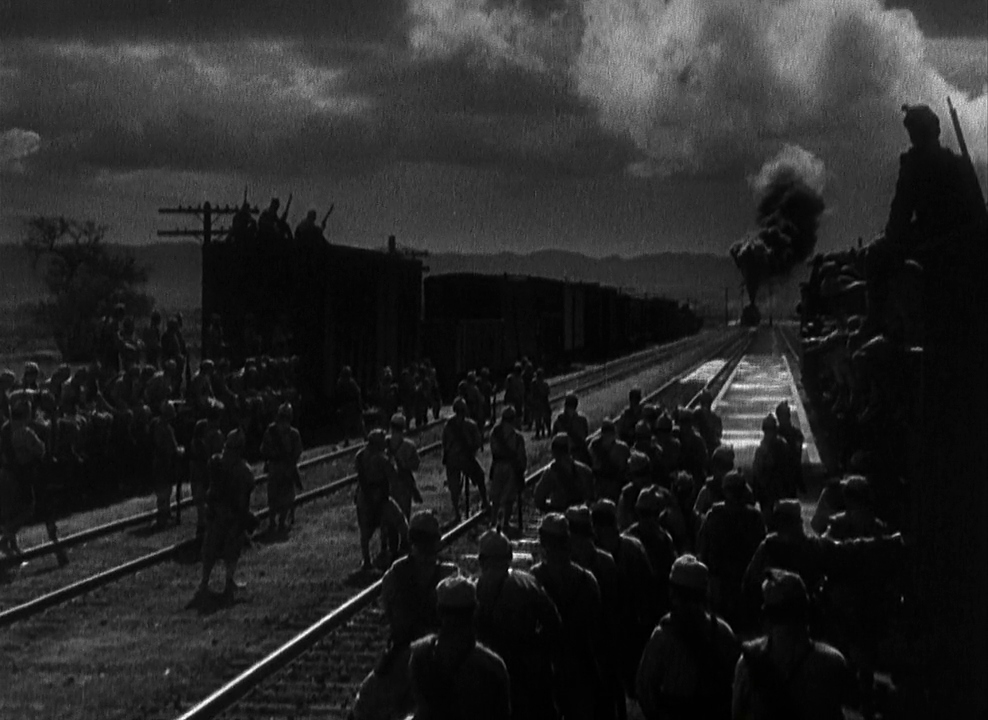
Like The Silence (1963) directed by Ingmar Bergman, Shanghai Express is a dream play. The characters, both here and there, are trapped in a physical space that becomes a kind of psychological limbo. Fittingly, The Silence begins with a train journey through a heightened, almost surrealist landscape of war and devastation; another occupied territory. Is the war real or metaphorical? Is it something that occurs outside the perspective of these characters or within? Is it a projection of their own fear, their trauma or the state of anxiety that holds them captive, or is it simply a dream; a conjuring of the unconscious mind?


The Silence [Ingmar Bergman, 1963]:


Shanghai Express [Josef von Sternberg, 1932]:

Unlike Bergman's film, the backdrop of civil war in Shanghai Express has a historical context. It relates to actual events, but its function within the unfolding melodrama of its characters is no less vague and enigmatic than the fictional wars that Bergman depicts, both in The Silence and in his later film Shame (1968). It is still, to some extent, a vague projection unfolding through the windows of a train. The characters react to it, but mechanically, as if function compels it. They exist always as if sleepwalking through another person's existence.

It's here that I'm reminded of a later film that took great influence from Sternberg's work; Lars von Trier's post-war allegory Europa (1991). Like Shanghai Express, Europa's drama is connected to a train that becomes both an embodiment of the structured narrative and a microcosm of the world in miniature. Its characters are political or philosophical representations that exist to present sides of a specific argument relating to the Second World War, culpability, innocence and the state of post-war Europe. Both films treat historical conflict as psychological conditions; their respective destinations less geographical realities than a state of mind. Both films are coded, stylised and have a dreamlike feeling where characters are robbed of personal agency.


Europa [Lars von Trier, 1991]:

Trier and his co-writer Niels Vørsel make their intentions explicit by creating a framing device around hypnosis. Their film physically takes place while in a state of trance. Sternberg and his screenwriter Jules Furthman are less literal, but the results are nonetheless the same. The atmosphere of the film is stilted, deep and thick; its characters like sleepwalkers moving without recourse; somnambulists lost in some nigh time enchantment that plays out through the window/screen.

In keeping with this, Sternberg's film has the feeling of an endless night. It isn't; bookending sequences are set during the daytime. But it's the impression of the film as something existing within the twilight between sleep and waking, the dreamlike artificiality of the performances, the expressionist gestures of the cinematography and the psychodramatic aspects of the narrative as some internal conflict that the central characters must overcome in order to find a kind of peace, that leave the greatest impression.

Viewed through the prism of Europa, it's much easier to read Shanghai Express on a similar, more expressionist or psychological level. Trier's cynicism means that he ultimately desires to destroy his train, and to destroy the bridge that allows it to travel between two worlds. Sternberg is less cynical. His film reaches a conclusion befitting the films of this period; reaffirming the intentions of characters and moving towards a kind of happiness or hope. Even though the war is still raging, and lives are being lost, it doesn't matter; the war, in this context, always existed as a projection of the inner conflicts within the lives of these characters.

Just as the tunnel in Smith's film provided a necessary function in allowing its two protagonists to share a romantic moment, so too does the civil war of Shanghai Express. Does this make the film weaker, or more exploitative? I couldn't say. However, I found the experience of the film more fascinating, emotionally engaging and beautiful in its design and direction for the way it unfolds in this world of night time shadows; this nocturnal suspension of actual time, wherein characters are trapped, forced to engage with a projected narrative that facilitates a form of emotional transcendence.

Wednesday, 6 June 2012

One-Hundred Favourite Films - Part Eight

Ongoing response to The Dancing Image "100 (of Your) Favourite Movies" meme-that's-not-a-meme, presented here in a loosely alphabetical order. I'm posting the series in reverse formation in an attempt to maintain the original continuity, from A to Z.


Ondine
Directed by Neil Jordan - 2009

A mournful piano chord is struck. The sound of it reverberates, becoming the siren's call to the fisherman, alone and at sea. The landscape, all rolling green hills and black jagged rocks that mark the divide between the land and the water - between his world and hers - suggests something mythical. This is the introduction to a story, told by the man to his daughter. He begins nervously: "once upon a time..." "Does it always have to be once upon a time" she says, cutting through the necessity for these stories to distance themselves from the everyday reality, becoming something fabled, and as a result, less real. The story eventually told by the man is the same story unfolding on screen.

Even before the fisherman has pulled from the water the beautiful young woman - caught in his net as a mess of long pale limbs and damp tangled hair - the film is suggesting this contrast between the reality, a world where a single father must work hard to pay for an operation to save his ailing daughter, and a world of myths and magic, where this woman, whose name is taken literally "from the water", will ensnare him in a story of his own creation. However, what happens when the daughter interjects, telling her own story? No longer informed by the fisherman's romantic yearning or desire to provide an escape for his little girl, but by her own fears and sickness.

The subsequent unravelling of the plot, with its back-and-forth rifts between romantic fable, poignant tragedy and violent noir, suggests the ever shifting perspective of these dual narrators, blurring the boundaries between what is felt by the characters and their own attempts to defuse their concerns by framing them within the reassuring context of a bedtime story. The films of Neil Jordan continually push this relationship between reality and fiction, and Ondine - a film where each new narrator presents a new 'voice', expressed via references to a specific genre - is his most complex work of meta-fiction since The Company of Wolves (1984), and arguably one of his most beautiful films to date.


Only Yesterday
Directed by Isao Takahata - 1991

I recognise a lot of myself in the film's protagonist, the twenty-something office worker Taeko Okajima, and her escape to the countryside as respite from the emptiness of her everyday life. What I recognise most is that sense of anxiety. The feeling of being lost or adrift, of wanting more out of life than the job, the house, the family; those natural expectations of adult life that we're supposed to strive for; that mark us out as successful, well-balanced individuals in the eyes of society, regardless of whether or not such concepts or concerns are emotionally gratifying or personally fulfilling.

Through Taeko and her restless examination of her own childhood memories, which are an attempt to better understand the hopelessness and the disenchantment that make life for her a constant sorrow, the film beautifully captures that feeling of nostalgic yearning that comes to the best of us when we reach a certain age, between the carefree adventures and discoveries of childhood and the commitments and responsibilities of later life. As a character, Taeko is happy to simply exist; to work for the joy of working. Not for financial gain or social status, but to share moments and interactions with likeminded people; to be close to the land and the beauty of nature; to recapture that childhood feeling of endless summer days before the crippling weight of maturity, when everything was simple.

With Only Yesterday, Takahata and his collaborators have produced a film that is every bit as 'human' in spirit as his earlier masterpiece Grave of the Fireflies (1988), and no less moving. An intimate, perfectly observed film, full of atmosphere, emotion and depth, where the adult Taeko's introspective journey into the memories of her childhood is powerful enough to compel the audience to contemplate their own recollections of the past and their dreams for the future.


Ordet
Directed by Carl Theodor Dreyer - 1955

I emerged from the experience of the film, eyes blurred, senses stunned in silent sorrow. I couldn't believe what I'd just witnessed. I can't even explain it now. On paper, the film could be seen as a fairly conventional family drama, full of the usual melodramatic interjections and plays of deep emotion that attempt to inspire a connection in the mind of the audience, eliciting sympathy or understanding, as melodramas often do. But there is an intensity to Dreyer's film that elevates the story far beyond the ordinary; a sense - shared by both the audience and the characters on screen - of seeing something beyond explanation; a genuine miraculous event.

For me, the effect of the film was enormous. The sense of pace, the stillness, the rigorous framing of objects and events, and the austerity of these characters numbed my soul, lulled me into a feeling of total vulnerability. By the time the film had reached its final act I was on the edge of my seat, stomach in knots, too scared to exhale in the event that any subtle change in the air might destroy the feeling of near-religious transcendence taking place right before me. By the end of the film I was emotionally exhausted. The tears broke free and rolled down my face. Finally I felt what Nana must have felt when she sat in the cinema watching The Passion of Joan of Arc (1928) in Godard's Vivre Sa Vie (1962).

In instances where the experience of the film is beyond my grasp, there's always the urge to invoke Godard: 'What we cannot speak about, we must pass over, in silence.' To experience Ordet is to experience the true power of cinema. That is, cinema as an act of faith. The act of faith required by these characters to believe in the unbelievable is mirrored by the act of faith required by the audience to invest in the subject of the film and embrace it, without cynicism. To approach the film with an open mind and an open heart.


Out of the Past
Directed by Jacques Tourneur - 1947

For me, the thing that elevates Out of the Past above any other classic film noir of the studio era, is the mournful direction of Jacques Tourneur. As a director, Tourneur brings to the film the same sense of melancholy and gothic ambience that transformed his earlier supernatural mysteries from potentially lurid little scare-stories into tortured psychological studies of warped minds and characters in torment. In Out of the Past, the feeling of great sorrow, or that faint line between the cruelty of the environment and the unspoken suffering of the protagonist, are brought to the very centre of the thing; not simply there to give added weight or subtext to the development of the plot as they might in a more conventional film noir, but actually defining it.

This is a film about longing, about these characters attempting to find love in a loveless place, or to exist, without becoming numbed to the violence, brutality, cynicism and greed of this literally seething underworld, with its betrayals and deceits. Though it plays with the recognisable iconography of the genre, there is a tension to the film that goes far beyond the requirements of the story. A gravity to the interactions between characters, which carry a feeling of sustained, fatalistic despair; as if the wrath incurred by the central character will not simply result in death, but in something potentially more sinister. Here, the relationship between Douglas and Mitchum becomes more than just that of a crime boss and his stooge, but a genuine deal with the devil.

In this sense, even when working outside of the conventions of the supernatural genre, Tourneur's film still feels like an eerie encounter between ghosts in a world of shadows. His approach, as agonizing and atmospheric as in the films Cat People (1942) and I Walked with a Zombie (1943), seems to transform what could've been a fairly predictable story of deception and double-cross into a psychological drama, where the story emerges - literally 'out of the past' - as these characters remember each moment and encounter, trying to make sense of things as their lives spiral into chaos.


Paris Belongs to Us
Directed by Jacques Rivette - 1961

The first Rivette, and already the great trademarks of his work are presented, fully-formed. The title, which is more a declaration than an adequate description, is the first acknowledgement of the role that Paris will play throughout the director's career, becoming more than just a mere setting, but something greater: a state of mind. In this sense, Paris Belongs to Us is a precursor to the grand adventure of films like Out 1 (1971), Le pont du Nord (1981) and Gang of Four (1989), both in its reliance on arcane conspiracies - which seem to captivate the characters of all Rivette's films - and in that slow thematic descent from playful joie de vivre to suffocating suspicion.

However, the greatest connection between these films is Rivette's use of the city, which here, like in several of the director's later films, becomes a living theatrical space, invaded by a troupe of actors who engage in a series of public rehearsals, providing context for the more mysterious dramas taking place beneath the surface. In the end, the tension, between good-humoured scenes of character interaction and the threat of some possible cataclysmic event, creates a feeling of sustained suspense, suggestive of the final moments of Antonioni's subsequent L'eclisse (1962), which also seemed enthused with a darker undercurrent of cold war paranoia and fear of atomic annihilation.


The Passenger
Directed by Michelangelo Antonioni - 1975

"I know a man who was blind. When he was nearly forty he had an operation and regained his sight. At first he was elated. Really high. Faces, colours, landscapes... But then everything began to change. The world was much poorer than he imagined. No one had ever told him how much dirt there was, how much ugliness... He noticed ugliness everywhere. When he was blind, he used to cross the street alone, with his stick... After he regained his sight, he became afraid. He began to live in darkness. He never left his room. After three years he killed himself."

The identity of 'the passenger' is never made clear. Though one can assume this title refers to the unnamed 'girl' that is first encountered by the protagonist during his stay in Barcelona, and who eventually becomes a travelling companion of sorts on his journey through the second half of the film, it could also just as easily refer to the protagonist himself. The reporter, trading his life for the life of another; choosing to become a 'passenger', emotionally if not physically, through the passage of his own existence; observing it without interaction, and allowing the forces of chance to dictate his inevitable end. In this sense, the story of the blind man is a clue to understanding the progression of this character. A character like many in Antonioni's films who exists as an empty vessel; a shadow, drifting through life, too numbed by the experience of it to engage with a world that crushes him at every turn.

In essence, it is a film about loneliness. The kind of loneliness that isn't simply a symptom of solitude, or of being alone, but a psychological condition that creates a feeling of intense isolation, even in the company of others. The characters in this film are trying to outrun a feeling of disenchantment by embracing the existence of someone else; but these feelings of bitterness and alienations are never really external. No matter how far these characters flee from their own lives, they're unable to escape their own intrinsic feelings of failure, emptiness and disappointment.


The Passion
Directed by Ingmar Bergman - 1969

"I don't imagine I reach into the human soul with this photography. I can only register an interplay of forces, large and small. You look at this picture and imagine things. But it's all nonsense! All play. All poetry. You can't read another person with any claim to certainty. Sometimes not even pain registers as a reaction."

The quoted dialogue seems to offer a vague clue to understanding the film, which is one of Bergman's most difficult and controversial. It is an intense film, full of longing, despair and scenes of quiet anguish, which is deconstructed throughout by the voice of the director, who establishes each scene as if reading from the script, or from occasional on-set interviews with the actors discussing the development of their characters, how they see them, and how the audience should respond to them. These deconstructions, which invite the process of filmmaking into the narrative, exposing the artificiality of these dramas that occur for the benefit of the audience, are disarming - sometimes distracting! - but are necessary to expose the truth behind the usual manipulations that we accept in mainstream cinema, in the same way that the characters attempt to expose the truth behind the deceit of their relationship(s).

As ever with Bergman, private thoughts and fears are made public as the story unfolds. Unravelling, not just in the narrative sense, but emotionally too, as the island where the film takes place becomes an onscreen representation of the characters' fraught psychology, their isolation, and the growing air of violence and persecution that is slowly decimating the landscape, like a plague of madness leading to destruction and annihilation.


Picnic at Hanging Rock
Directed by Peter Weir - 1975

The story is vague and mysterious. If the opening credits didn't suggest some possibility of an actual grounding in recorded history, then we might simply dismiss the scenario as pure fabrication, too extraordinary to believe. However, this question of authenticity is precisely what gives the film its enduring appeal; leaving the audience to speculate about the legitimacy of the disappearances and the surrounding chain of events as a something beyond explanation, uniting the physical and the psychological with the purely supernatural.

The atmosphere of the film certainly suggests the presence of something 'otherworldly', with the mood of the forest - all ethereal, like a fairy story - and the feeling of time standing still, creating an impression of a force of nature greater than anything comprehendible by the human psyche; as if the hanging rock itself has become a sort-of sentinel - a natural 'monolith', in the sense of 2001: A Space Odyssey (1968) - that allows for a communication to take place between worlds. Each moment spent in the shadow of the rock is suspended, compelling these characters into a state of trancelike contemplation, at one with nature, though also at the mercy of it, where "what we see and what we seem are but a dream; a dream within a dream."

The images throughout are haunting; the atmosphere, overwhelming. The sense of this place, the forest, lit by the afternoon rays of the sun, brings to mind a painting like The Luncheon on the Grass by Édouard Manet or Ladies at the Seine by Gustave Courbet. Not just in the continual depiction of idyllic, pastoral scenes of girls in billowing white dresses basking in the soft glow of the sunlight, but in the implied connection between the beauty of nature and this burgeoning (but repressed) sexuality, which might hold the secret to deciphering the whole thing.


Pola X
Directed by Leos Carax - 1999

The subsequent passing of its two lead actors, Guillaume Depardieu and Yekaterina Golubeva, makes the experience of Pola X all the more unsettling. When I first saw the film six years ago it already felt like a work haunted by a great depression; bleak in both subject and approach. But now, more than ever, it has the feel of something truly wounded; a film of immense pain and suffering, where the overwhelming fatalism of its central character is never disguised or subdued by black comedy or ironic detachment, but fully embraced; creating a film not simply about personal misery, but defined by it. This is a film where the only genuine scene of passion takes place between two mangled bodies - reminiscent of figures from the works of Egon Schiele - in a room of total darkness.

Although essentially an adaptation of Melville's controversial Pierre: or, The Ambiguities, Pola X could really be seen as a semi-autobiographical portrait of director Leos Carax; a film in which he reflects on his own position in the world of contemporary French cinema following the critical and commercial disaster of his previous film Les Amants du Pont-Neuf (1991). In Pierre, he finds a means of expression, presenting a character that might seem, from the outside at least, to have everything at his disposal - a man of great wealth and privilege - but who goes out of his way to destroy any chance of contentment in the pursuit of some indefinable truth. The film, in its conception, is a result of that pursuit.


The Purple Rose of Cairo
Directed by Woody Allen - 1985

As a precursor to the recent Midnight in Paris (2011), The Purple Rose of Cairo introduces the idea of the cinema - or art in general - as an escapist pursuit. Although Allen had already explored this theme in earlier films - such as the Herbert Ross directed Play It Again, Sam (1972) and his own masterpiece Stardust Memories (1980); two films in which the author dealt more directly with his own relationship to cinema, as a writer and director - the work in question is really the first to take the subject of cinema - as an escape - and explore it through the perspective of a regular viewer.

As such, the story being told is best seen as a metaphor for the one-way relationship that exists between the audience and the work. A dramatisation of that feeling of seeing a film and falling in love with the spectacle of it, and the resulting sadness of being unable to take an active role in its development. Through its central character, Allen creates a loving ode to the world of movies, where the misery and the bitterness of the character's everyday life only reinforces how much greater a life spent within this world might be, as opposed to a life without it.

Friday, 30 April 2010

Cries and Whispers

Ria Munk On Her Deathbed by Gustav Klimt, 1912:


Death in the Sickroom by Edvard Munch, 1895:

Perhaps the most striking thing about Cries and Whispers, beyond the actual look of the film, is the incredible use of silence to draw out that particular evocation of characters waiting for the inevitable. It is within these prolonged moments of images robbed of sound that the filmmaker is able to establish the sense of confinement; of characters disengaged, not only from the family or from the people closest to them, but somehow disconnect from their own emotional responses to these events as they unfold. It is through this continual near-silence that Bergman creates a suitably clandestine environment for this claustrophobic chamber film to develop; fully aware that any brief release of emotion, any spilled secret or slip of the mask, will resonate throughout the house and through the barriers that have formed between these distant characters haunted by the past.

The silence of Cries and Whispers could be taken as a deliberate obstruction, as disarming - in the sense of engaging the film through the greater lives of these characters - as the Brechtian elements of previous Bergman dramas like Persona (1966) or A Passion (En Passion, 1969); two films in which the director succeeded in placing the audience at an arm's length, aware of the situation and privy to the reactions of the characters and the drama that surrounds them, but also transfixed by the filmmaking technique and how it relates explicitly to the fate of these lives that drift in the balance. It could also be seen as a way of keeping the audience observant; misdirecting us as to what might actually happen, and thus creating a palpable tension; where the build up to a certain scene is prolonged to the point of almost abstract absurdity as we spend the first few minutes of the film hoping and waiting for someone to speak, or some sound beyond that of the distant ticking clock and all its mocking allusions to time and of life slowly slipping away, to break through and offer some sort of respite from the strangulating despair that Bergman carefully creates.

When the silence does break - finally stirring with the early morning light to fracture this impenetrable wall of stillness - it is not a note of hope or of comfort, but instead a scream of pain and anguish: the first suffering cry before the inevitable unravelling of thoughts, feelings and deceits that eventually unfold.


Cries and Whispers directed by Ingmar Bergman, 1972:

The titles of Bergman's films were always incredibly descriptive, giving the potential audience a sense of the central theme of the film or the particular physical or psychological malady that plagued his central characters, but also defining a tone. Blunt and descriptive titles like Shame (Skammen, 1966), The Touch (Beröringen, 1971) and Face to Face (Ansikte mot ansikte, 1976) to name only a select few, get to the very core of the drama in a way that covers both the physical and emotional perspectives of his protagonists. Much like the title of this film, which again creates a suggestion in the mind of the potential audience as to what kind of film they could expect - Cries and Whispers, or from the literal Swedish translation, Whispers and Cries - in which the slow-death of the middle-aged Agnes (Harriet Andersson) is contrasted against the thoughts, fears and regrets of her sisters Karin (Ingrid Thulin) and Maria (Liv Ullmann), and her maid turned personal carer Anna (Kari Sylwan), as the ghosts of the past chatter about this bleak house and we, as an audience, try to make sense of the thing.

It is the combination of sounds and silence - and the spaces between words that say so much more than conventional dialog ever could - that coerce us through this tragedy. Maintaining that incredibly numbing atmosphere, filled with illness and disease, Bergman envisions a painful world where the death-rattle choke of Agnes speaks volumes, not only about her own character, but of the feelings of the other three women who tend to her draconian-like deathbed. As is often the case with Bergman, the drama here is localised mostly to a single location; in this case a large family manor house in the autumnal Swedish countryside, where characters congregate in some kind of seclusion, plagued by the many sinful, unspoken and embarrassing secrets that seem to permeate from the guilt and despair of these three very different women. It is this sense of inner pain that embodies the house with a shocking red hue, offering the fairly obvious though no less powerful associations to the colour or blood, the colour of sickness and the colour of rage.


No. 14, 1960 by Mark Rothko, 1960:


Cries and Whispers directed by Ingmar Bergman, 1972:

The continual image of black and white-clad figures against a backdrop of piercing deep reds is near iconic within the Bergman filmography, combing that visualisation of a particular shared psychological space that is only broken at the end of the film, when a pastoral garden scene offers some kind of relief or reflection of how things were, or how things could have been. There is also the continual device of the fade to red; a fairly novel use of a scene punctuation/transition, which not only announces the movements between memory and reality, but in some way further stresses the idea of characters being swallowed up by the acrid stench of death that clings to them. This approach, combined with Bergman's extraordinary use of the close-up shot, creates an experience that is all the more punishing; as each full-face composition offers the audience the opportunity to study these characters, their faces and the look of fear or duplicity in their worried eyes, and cast judgement or pity upon them as we see it.

It also allows us to study the performances of these four female leads - Harriet Andersson, Ingrid Thulin, Kari Sylwan and Liv Ullman - who each give superlative performances as these women dealing with the passing of time, memory and death, and their reactions to all of the above. In this sense, the use of silence is much more notable, not only for its element of deconstructing the natural rhythm that we might normally expect, but in the way in which it establishes the mood of tragedy, of the pre-mortem and post-mortem limbo that traps these characters in tortured suffocation, infusing the very core of the film's visual identity and the way that we, as an audience, interpret it.


Cries and Whispers directed by Ingmar Bergman, 1972:


Unknown by ?:

Friday, 4 September 2009

Shame

A key example of Bergman's unparalleled ability to create a kind of cinema of alienation through the rigid and meticulous focus on characters interacting; albeit, not simply through the unblinking point-and-shoot interchanges of dialog, but contained within the seemingly inescapable boundaries of a situation that they've been confined to. In this respect, the confines are further illustrated by the practical presentation of the film itself, with those tightly composed images of faces, acting and then reacting to the events as they unfold, and the always brilliant interplay between light and shadow, which, as ever in Bergman's work, manages to maintain some vague semblance to the natural light that one might expect to find illuminating the area of your nearest windowsill, and yet still managing to offer an obvious visual representation of a kind of conflict that is necessary in a film so preoccupied with the clashing of personalities and ideas.

The most obvious and natural conflict at the pure beating heart of the drama is in the particular reliance on a certain kind of character-type: i.e. an individual with a singular point of view that is at odds with the world around them. In much of Bergman's work, this inability to see eye to eye with other human beings - even on such an intimate or entirely personal level - leads his characters to seek solace and escape; burying their heads in the metaphorical and creating a kind of block that allows them to break from the true psychological horrors that plague them. Alongside these particular concerns we find a number of parallel themes that would be further refined and developed in the series of films that Bergman produced during the same period of creative activity as the film in question, with projects like Persona (1966), Hour of the Wolf (Vargtimmen, 1968) and The Rite (Riten, 1969) continuing the idea of characters existing in a world in which the boundaries between the symbolic and the real, performance and actuality, have become blurred by the perspective of the filmmaker.

In keeping with such deconstructive ideas, this film, Shame (Skammen, 1968), offers the central depiction of war as a literal nightmare that explores (or exploits?) the psychological disintegration of its two central characters. It is in this presentation that the progression of the conflict and the breakdown in society becomes the perfect mirror to the breakdown of the couple's relationship; with each escalating scene of violence or atrocity creating the perfect visual, meta-textual reference-point to a jealous glance or a derisive put down, which wounds the fragile ego as fatally as a bullet to the head. It's a novel approach, with these two characters at war with one another and at war with themselves, further represented by a landscape of cold uncertainty, violence and turmoil. With this in mind, Shame is probably not the easiest of Bergman's films to appreciate on an immediate level, though it remains, nonetheless, one of his most fascinating; especially when we compare it to the similar elements presented in the subsequent Bergman-directed psychodrama, A Passion (En Passion, 1969).


A Passion directed by Ingmar Bergman, 1969:


Shame directed by Ingmar Bergman, 1968:

As with that particular film, Shame offers a story about characters in retreat; in retreat from themselves and from the world around them. In Shame, the idea is given a further charge of dramatic weight by an approaching civil war set to eventually destroy the walls of cowardice and self-preservation that these particular characters have put up to protect themselves from the harsh realities of the world beyond. However, as the walls begin to crumble, these characters begin to show certain elements of their true personalities that have remained hidden or disguised during the idyllic years spent safely hidden away amongst the island community; as the escalating horror of the world itself becomes secondary to the crippling emotional suffocation and psychological collapse of these characters as they strive to escape, both literally, as in from the horrors of war, and metaphorically, as in their own emotionally suffocating relationship.

There are, as one might expect, a number of other, more complex themes developed alongside this central concern, with the usual issues of jealousy, adultery, guilt, impotence, a lack of communication and the inability or unwillingness to see the world for what it truly is all featuring as motivating factors at various points throughout; allowing the audience to appreciate, or at least better recognise the sense of dehumanisation - as the machines of war destroy everything, including the human spirit - and the particular way in which these characters cling to a hope for a return to civilisation, when the actual chance of any kind of palpable reconciliation is plainly impossible. Of course, we can criticise this obvious reading as naive or simply skimming the surface of what is quite clearly a complex and exhaustive piece of work, it still, nonetheless, becomes immediately clear even from this initial single splinter of the film's true meaning; which could, in all honesty, be as simple as what is defined by the experience of viewing the film and the odd, accumulative aspect as each scene builds in intensity, until the rage and frenzy exhausts itself, leaving only a tattered, tired scream.


Shame directed by Ingmar Bergman, 1968:

As one might expect from Bergman (and especially the Bergman of this period), Shame is an outstanding piece of work, both as an experience in the cinematic sense - as in to immerse yourself in the spectacle of the thing - and on a purely technical level too. The production design, editing and cinematography are suitably harsh and gritty, creating a very believable situation, though one that is again filled with a very deliberate form of cinematic abstraction that is formed by the use of the high-contrast black and white. Even so, these elements of artistic/cinematic expression never overwhelm the grain of realism that is filtered through our obvious experiences with TV war-reportage or the conflict in Vietnam, which is used as a kind of shorthand to many of the more confrontational or harrowing scenes featured herein. In presenting these sequences, Bergman is able to sidestep any potentially fatal moments of melodrama or shock-tactics, giving us the torture and insanity of war, without turning it into some kind of after-school polemic.

The film is also notable for what seems like an increased budget - or at least, increased by the standards of many of the filmmaker's more iconic pictures, which generally involve small groups of characters drifting in and out of a tightly-structured chamber-piece framework - with Shame instead offering the audience unforgettable images of aeroplanes spitting machine-gun fire and shells across the tiny island community, a procession of military vehicles stretching back through the village as far as the eye can see, thousands of extras, explosions and costumes, and all to establish this cold and nightmarish world that seems to exist beyond the clearly-defined boundaries of context and time. The fact that Bergman chose to leave the setting of this film a mystery is one of its most interesting aspects of the film and the one that makes it more fascinating to re-evaluate from a contemporary perspective; as the wars in Iraq, Afghanistan, etc, or the continual reports of North Korea flexing its Nuclear weight, remind us that potential future conflicts are still lingering on the horizon.


Shame directed by Ingmar Bergman, 1968:

Although the threat of civil war and some of the more heart wrenching depictions of abuse and degradation might suggest the era of the Second World War, the cars and costumes and central political or personal ideologies are all very much a post-war, 1960s affectation. No information about the war is given, other than the fact that it has split the country in half, and that both sides seem to be employing a regime of violence and threat to manipulate the locals into assisting their own particular cause. The fact that the actual war is seemingly secondary to the war that erupts between the two central characters is, again, a sign that Bergman is using this metaphor to externalise a largely internal story; with the inner-battle between two characters being projected out, against the landscape, and resulting in further elements of interpretation that sets the scene for that previously mentioned Bergman film masterpiece, A Passion.

At the end of A Passion we have a vague and enigmatic scene that not only contextualises the whole of that particular film - and the fate of its two central characters - but also the whole of the film in question. Quite what Bergman was suggesting by this break between the two is ultimately unknown, though naturally one always can speculate as to why things happen, and for what reason. Perhaps this final notion is something that is only truly felt when we watch the two films together, and can then begin to see Bergman's perhaps cruel mocking (or understanding, perhaps?) of his principal characters, and the subtle line in which one painful nightmare bleeds into the next.

Schalcken the Painter (1979)

Schalcken the Painter [Schalcken the Painter [Leslie Megahey, 1979]: This is a film I first saw around four years ago. At the time I found...