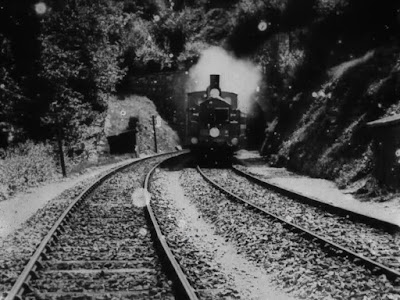
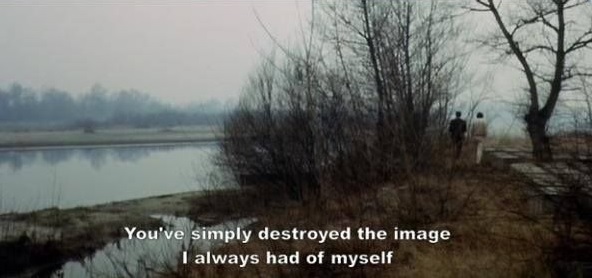
Showing posts with label Stanley Kubrick. Show all posts

Monday, 8 February 2021

Travelling Light


Thoughts on a film by Gina Telaroli

Three quotes preface the presentation of the film on its director's Vimeo profile. One attributed to a fellow filmmaker, one to an author, and one that remains unsigned but is possibly from Telaroli herself.

"Ten properties of a subject, according to Leonardo: light and dark, color and substance, form and position, distance and nearness, movement and stillness." - Robert Bresson

"They began very promptly—these tender, fluttering sensations; they began with the sight of the beautiful English landscape, whose dark richness was quickened and brightened by the season; with the carpeted fields and flowering hedge-rows, as she looked at them from the window of the train; with the spires of the rural churches, peeping above the rook-haunted tree-tops; with the oak-studded parks, the ancient homes, the cloudy light…" - from Henry James' "Daisy Miller: A Study"

An Amtrak train pulls out of Penn Station in New York City on a cold, sunny February morning. The train moves forward as the landscape changes—the East Coast giving way to the Midwest. Passengers fill their roles, the snow begins to fall and the next train station is announced, all while the light continues shifting, bouncing, swelling and slouching into eventual darkness.

The third quote functions as an obvious synopsis/description of the work itself, defining, in clear-terms, the practicalities of the film's recorded journey, from station-to-station, and place to place. But on a certain level, so too do the quotes from James and Bresson. These quotations speak of the subconscious layer of the film; of what it's depicting beneath the surface of the recording. The significance of the train, its passage through the landscape, the changing topography, the contrast between light and dark, and the transient nature of public transportation, with its journey, both physical and emotional, as a mirror to the journey of a life itself, is expressed between the passages of these words.

The film, in a way, adapts these quotations into images that on one level seem staggeringly mundane and even banal in their presentation of the ordinary, or the everyday, or it applies the quotations to give form to what a first appears formless, but either way, it gets at something inherently mysterious, even monumental, that is felt in the journey (or journeys) depicted in Telaroli's film.


Travelling Light [Gina Telaroli, 2011]:

Whether intentionally or not, Telaroli, in filming the passing landscape from the train's window, creates an iris effect, wherein the edges of the window intrude upon the image, creating a frame within a frame. This, on one level, establishes the subjective relationship between the presence of the filmmaker, recording the journey as it unfolds, but also the notion of the camera as the eye of the audience. It doesn't simply record, it observes, active and attentive, the way a human eye might respond when gazing as a passenger from the window of this moving vehicle.

It also has broader connotations, reminding us of the iris effect of old movies, from the silent era to the golden age of Hollywood, and on an even more vague and obscure level, suggesting the perspective of an astronaut gazing through the visor of their space helmet; exaggerating the almost alien sense of the journey as Telaroli records it, and connecting, again, albeit vaguely, the subjective journey of the film through geographical space with the journey of a character like Dr. Dave Bowman as he travels through the stargate in Stanley Kubrick's enduring masterpiece 2001: A Space Odyssey (1968).


Travelling Light [Gina Telaroli, 2011]:


Grandma's Reading Glass [George Albert Smith, 1900]:


2001: A Space Odyssey [Stanley Kubrick, 1968]:

This may seem like an odd connection to make – and in many ways it is – however, in both films we have the presentation of a journey that functions on both a literal and subconscious level. There is the actual, physical journey, with its departures and arrivals, and then there is the metaphysical journey, the one that transforms rather than transports.

From the very first images, Telaroli's film establishes a connection between the idea of travel, the journey, a train on a track, with the notion of the narrative journey, the progression of a story from beginning to end, from its point of departure to its inevitable arrival.

The train is one of the great symbols of the cinema, having played a key role in its formation from the very beginning of its history. It was a train that thrilled audiences in the silent marvel of The Arrival of a Train at La Ciotat Station (1896) by the brothers Auguste and Louis Lumière – investing the cinema was a sense of the sensational – and it was a train that gave way to the notion of narrative cutting, of the edit between interior and exterior spaces, in George Albert Smith's groundbreaking A Kiss in the Tunnel (1899).

Since that time, trains have been a defining narrative and visual presence in cinema, from The Iron Horse (1924) to The General (1926) and beyond, to Shanghai Express (1932), The Lady Vanishes (1938), Strangers on a Train (1951), The Titfield Thunderbolt (1953), Pather Panchali (1955), Night Train (1959), The Train (1964), The Hero (1966), Trans-Europe-Express (1966), La Chionoise (1967), Once Upon a Time in the West (1968), The American Friend (1977), Runaway Train (1985), Europa (1991), Sleepless (2000), Unstoppable (2010), Snowpiercer (2013) and The Image Book (2018), among others.


The Arrival of a Train at La Ciotat Station [Auguste and Louis Lumière, 1896]:


A Kiss in the Tunnel [George Albert Smith, 1899]:


Pather Panchali [Satyajit Ray, 1955]:


Trans-Europe-Express [Alain Robbe-Grillet, 1966]:


The Image Book [Jean-Luc Godard, 2018]:

From the beginning of cinema, the train has moved through its narrative, like a leitmotif; the progression of it, as a collective journey, and the experience of that of the passenger, seated, passive, staring through a rectangular window of light at the changing scenes and dramas that pass before our eyes, is like a mirror reflecting back on itself. In many films, the train is a symbol of discovery, suggesting the encroachment of the "modern" world onto that of the "primitive" or outdated, suggesting an escape, a movement, or the journey between worlds (both real or imagined.)

Telaroli's film fits into this tradition. It represents a recorded journey, both pictorially and, on some level, psychologically, presenting a movement between worlds, but it's also a narrative, where the beginning of the train journey and its conclusion mirrors the beginning and ending of the film.


Travelling Light [Gina Telaroli, 2011]:

Here, the intricacies of the title work on two separate levels. There's "travelling light", in the sense of moving without baggage. As in taking a short journey without the need for heavy luggage, but also baggage in the figurative sense, as in not being burdened by thoughts, fears, and responsibilities. "Travelling light" also refers to the progression of light itself, both in the movement from dawn to dusk, or light into dark, but also the journey of light as it moves through the frames of the film.

Here, sunlight on a passing mountain, or daylight streaking through the windows of the train, or artificial light refracted by rain or frost on the glass, becomes as much of a journey as the one being taken in tandem by the filmmaker and audiences as the train moves along the track. Finally, the connection is made clear, with the closing shot, detailed in the final screenshot above, a train retreating along the platform, slowly disappearing into a bank of fog, with only the light on the front of the locomotive left appearing like a ghostly orb shining in the middle-distance. In this moment, the eye of the camera as surrogate for that of the protagonist/audience, is now liberated from the confines of the train. We're outside, emerged, as if from the womb, and faced with something approaching reality.

As a closing shot, it connects back to the beginning of the film, the movement of the train, departing or progressing through the wintry landscape, but also to the notion of the journey, emotional, psychological, or geographical. The notion that we've arrived, marooned upon the platform, rigid and unmoving, but that another journey is already beginning for someone else. Here, in retrospect, the connection to the three quotes highlighted by Telaroli as a preface to her film, make perfect sense.

Further reading at Lights in the Dusk: Shanghai Express [29 February 2020], The Phantom Ride [09 September 2011]

Wednesday, 27 January 2021

The Box Office Bomb


The Current Cinema

In a recent article for The Guardian, Smash hit or total turkey? In the age of streaming it's impossible to tell, journalist Steve Rose posits: "With the box office closed and only secretive viewing figures to go on, gauging a film’s success is becoming a tricky proposition."

Writing with all the conviction and integrity of a man that's been asked by his editor to turn in 500 words on literally anything to get readers clicking and commenting (thus generating that all important advertising revenue), Rose – using the limited cinema release of the recent superhero spectacle Wonder Woman 1984 (2020) as a point of inception – asks: "Here is the question: was Wonder Woman 1984 a hit movie? How did it compare to the first Wonder Woman? Or how about Soul, or Ma Rainey’s Black Bottom? Were they hits? How can we tell?"


Wonder Woman 1984 [Patty Jenkins, 2020]:

Rose continues, his disinterest in his own question(s) palpable in the snark needlessly injected into every sentence. "In ordinary times we wouldn’t have to ask; we would have box-office figures to go by. Now, the pandemic has hobbled cinema-going, and for most of us the only way to access new movies is via streaming services, which tend to guard their numbers as if they’re nuclear launch codes."

There is an interesting conundrum at the heart of Rose's article that's worth engaging with. The way audiences engage with cinema, and with media in general, has been changing for some time. But discussing the changing trends of popular culture isn't of interest to writers like Rose, who merely churn out clickbait considerations they don't even agree with. No, the real crux of Rose's writing comes, like a lot of recent Guardian articles about the state of cinema, from a place of deep, professional fear.

You see, what Rose and his cronies like Peter Bradshaw and Mark Kermode are really terrified of, is that in an age where audiences get access to a work before journalists and reviewers, where box office figures become meaningless, and where audiences are able to cultivate their own personal and private cinema free of influence or the condemnation of would-be tastemakers, the only way to really write about and promote a particular work is by investing our own subjective thoughts and opinions into the experience of it.

Writing about whether or not a film is a "hit" or a "turkey" will be replaced by deeper considerations of what the film means to the viewer on an individual level; how well it engages the personal and political, how well it employs form and aesthetics. The noise of the industry and the corporate concerns and consensus-shaping that hack journalists have made their bread and butter over the past two decades will be entirely irrelevant.

Rose exposes himself and many of his similarly minded contemporaries completely when he writes: "one of the great things about box-office figures is that they offer nowhere to hide. There is no disputing a franchise-spawning smash such as The Matrix or Avatar, or disguising a bomb such as Cats. We celebrate those successes and revel in those failures together. It’s Darwinian but democratic. It binds us as a society. With streaming, we might get exactly the same good and bad movies, but served as more of an algorithmically curated mulch of “meh”, which nobody consumes in the same way. That doesn’t bode well for the future of movies as popular culture."


Avatar [James Cameron, 2009]:


Cats [Tom Hooper, 2019]:

Of course, Rose doesn't explain why this development doesn't bode well for popular culture. Having fulfilled his word limit, he simply ends his argument on a cliffhanger, his total indifference and disdain for his own readership obvious throughout. But the future he describes is really not that dissimilar to our own recent past.

Just over 20 years ago, before the internet became such a pervasive part of both our lives and the way we share and access information, most audiences didn't follow box-office trends. Unless you were an industry insider, had a subscription to Variety or other high-minded film publications, or approached the cinema as an investment opportunity, most audiences had little to no idea how much a film cost or how much it made. Unless it became an infamous failure, like Heaven's Gate (1980) by Michael Cimino, or a box-office phenomenon, like Steven Spielberg's Jurassic Park (1993), it simply wasn't a part of the conversation.

For context, a film like Misery (1990), which cost $20million to produce and made $61million at the box-office, nonetheless became a genuine event movie. It had a massive impact on popular culture and was widely parodied and referenced in a variety of other media. Similarly, a film like The Shawshank Redemption (1994), which cost $25million and made $58million, was considered a box-office disappointment, despite finding a more appreciative audience on home video and now being seen as one of the best American films of all time. In the days before sites like Box-Office Mojo, The Numbers and even Wikipedia logging a film's budget and box-office from the off, a work was still able to have a life and find an audience and legacy beyond its opening weekend.


Misery [Rob Reiner, 1991]:


French and Saunders: Misery [Bob Spiers, 1993]:


Family Guy: Three Kings [Dominic Bianchi, 2009]:

Similarly, before the introduction of the aptly named Rotten Tomatoes, which Rose himself acknowledges as flawed in his own article, there was no way of knowing for certain whether or not a film had an overwhelming critical consensus. Most people would trust the word of a couple of critics that they read or listened to regularly, or they'd take the word-of-mouth recommendations from video store employees or the endorsements of friends and family.

Before Rotten Tomatoes or Meta Critic, films weren't assigned a number or percentage based on the subjective opinions of a small handful of reviewers. Nothing was set in stone. Which is why films like Blade Runner (1982), The Thing (also 1982), Scarface (1983) and Twin Peaks: Fire Walk with Me (1992) could divide critical opinion, and still go on to become considered genuine modern masterworks by subsequent generations of critics. Stanley Kubrick’s landmark horror film The Shining (1980) received worse reviews than many M. Night Shyamalan films, but as it was never defined for subsequent generations as a 40% or even 20% "rotten" movie, it was able to be discovered by unbiased audiences unfamiliar with its critical legacy. Something that isn't possible for Shyamalan's masterworks, like The Village (2004) and Glass (2019), which have been firmly canonized and recorded as failures.


The Shining [Stanley Kubrick, 1980]:


The Village [M. Night Shyamalan, 2004]:

So, Rose's summation is complete bullshit. The way we approached movies changed massively in the age of the internet, and it indeed continues to change and evolve as both the technology and generational viewing habits change with it.

For my generation and older, there's a clear delineation between cinema and television; between the videos we watch on social media and those produced by professional broadcasters. For younger generations, this isn't the case. The "movies", as a medium, occupy a very narrow window of their interests. They compete with social media, TikTok and YouTube creators, Instagram, video games and facetime with friends. Whether young people see the latest Star Wars or Pixar movie at the cinema, at home on the television, or on laptops and mobile devises, is irrelevant. All that matters is that they're able to see the film as soon as it's available, regardless of the platform or method of delivery.

Personally, I find this new development exciting. Removing unnecessary conversations around box-office and critical consensus removes the barriers that previously denied certain works a space for discussion and analysis. Now we can watch the latest film by Marvel, DC, Pixar, or Disney, alongside films and serials made specifically for Amazon or Netflix, or more interesting and experimental works released on MUBI or via Blu-ray by companies like the BFI, Second Run, and others. We don't have to go into a work with our expectations already tainted by some website calling the film a "hit" or a "Turkey", but can go in fresh, deciding for ourselves what is a hit, and cultivating our own network of trusted movie-watchers to point us towards works of real interest.

There's no longer a need to draw a line between something accessible and mainstream, like Wonder Woman 1984 and Soul (both 2020), and a film like the Spanish-language Netflix production The Invisible Guardian (2017), the British, refugee-themed horror movie, His House (2020), or the difficult to categorize Bertrand Bonello art-house movie, Nocturama (2016), all of which are currently available to stream. Removed from the necessity to discuss budgets and box-office, awards and critical consensus, all these works are simply films, there to be watched and ranked and discussed, and valued entirely on their content, their stories, and their aesthetics. It's like an act of liberation.

Further reading at Lights in the Dusk: Fin de cinema [08 October 2020], The Current Cinema [09 January 2020]

Saturday, 15 August 2020

The Film Director as Superstar


Or: The death of the author auteur

The title here refers to the 1970 book by Joseph Gelmis. I haven't read it, but I saw the cover used on another blog site, where it was being discussed in relation to a quote by Bernardo Bertolucci, and the image captured my attention immediately. The book, as I understand it, is a collection of recorded interviews with a number of high-profile filmmakers that had emerged during the post-war period. Brian de Palma, Robert Downey, Andy Warhol, John Cassavetes, Lindsay Anderson, Arthur Penn, Roger Corman, Richard Lester, Mike Nichols and Stanley Kubrick, among others.

The cover is fascinating because I can't tell if it's a painting or a sculpted model. I want to assume it's the latter, but I'm probably wrong. Chalk it up to my waning eyesight. However, certain elements of the image, the lighting on the hands, the texture of the jeans, the weight of the viewfinder and the perspective of the little director's chair, all have something more tactile and physical about them than a two-dimensional painting.


The Film Director as Superstar [Joseph Gelmis, 1970]:

I think there's something inherently arresting and exciting about the book covers from this particular period. Books published by Penguin and Pelican, specifically during the late 1960s and early 1970s, are always interesting and evocative in their design and illustration. I remember when I went to university, I'd spend hours in the library browsing the shelves of old books that had been collected from the decades before I was born. Books that had lived, that had been enjoyed, that had notes penciled into the margins by previous generations; books that in every sense of the word had a story to tell, their covers barely held together by sellotape yellowed by age.

To this day, if I'm looking for book recommendations, I'll browse old cover art online and become captivated by the presentation of a particular book, then find myself intensely disappointed when I find its more generic looking, modern-day incarnation.


Collage of old Penguin publications [John Greenaway, flickr.com, 2010]:

Many of these covers, and others, speak to me. Every one of these books looks like a must-read.

The cover and, I assume, to a large extent, the subject matter of Gelmis's book, mark it out as a relic to another time. On one level, its cover, no matter how captivating or "cute" it might appear, is a reminder that the history and legacy of the cinema was in many ways colonized by white men. White-male critics elevating the work of white-male filmmakers, often to the detriment of marginalized filmmakers from other backgrounds and persuasions. The director on the cover could have been modeled on Gordon Parks, Satyajit Ray, Agnès Varda, Ousmane Sembène, Marguerite Duras or Akira Kurosawa, all of whom were either superstars or on the road to becoming one.

However, a certain image, epitomizing what a film director looks like, had already been established during the early silent cinema, with figures like Erich von Stroheim, D. W. Griffith, Cecil B. DeMille, Fritz Lang, King Vidor, Charlie Chaplin, Josef von Sternberg, John Ford and Alfred Hitchcock, many of whom continued their respective careers into the post-war cinema, adding to a collective shorthand for what a director was, looked like, or did. For the film culture of the 1970s, still enlivened by the then-recent innovations and provocations of Stanley Kubrick, John Cassavetes, Ingmar Bergman, Federico Fellini, Jean-Luc Godard and others, it must have been a difficult legacy to break away from.

And yet the book is also a relic in the sense that the director, at least as far as the mainstream cinema is concerned, is no longer a superstar. On the contrary, if directors during the post-war years were elevated via an engagement with the auteur theory into cultural "brand names" that could sell a movie to an audience as sufficiently as any Hollywood star, then the modern cinema, existing as it is side-by-side with serialized content, short videos and so-called "prestige" TV, is more preoccupied with companies and studios, be it Disney and Marvel, Netflix and Amazon, Warner Bros. and A24.

The franchise mentality that now infects all discourse surrounding the cinema means that the corporate brand has been elevated above the individual. Nobody cares who directs the latest Marvel superhero movie, or the next Fast & Furious sequel, or the next Star Wars or Jurassic Park spin-offs. This is because the vision of the director is no longer that important. When safeguarding the integrity and fandom of the IP and delivering content that will satisfy the largest number of viewers without causing offence or disappointment, the director becomes little more than a franchise custodian. A brand-guardian that exists to follow the instructions of the studio bosses, the test audiences, and the major theatre owners. They work to translate the studio-approved text into studio-approved images.


Fellini Satyricon (1969) vs. Marvel's Avengers: Infinity War (2018)
[comparative collage created by the blog author]:

The director as superstar, as brand, as "auteur", replaced by the studio as brand, as author. Can you imagine a modern-day filmmaker being afforded such a level of cultural reverence that their name features not just above the title, but a part of it?


Tenet (2020) vs. A Clockwork Orange (1971)
[comparative collage created by the blog author]:

Christopher Nolan is one of the most acclaimed and successful "auteur" filmmakers currently working, but even after generating billions at the box-office, his name barely carries the same promotional weight as Kubrick's.

Perhaps a sequel to Gelmis's book could be called "The Film Director as Dependable Journeyman", or perhaps less sympathetically, "The Film Director as Cog in the Corporate Machine." Something that would express explicitly how undervalued the role of the director, not as superstar, but as artist, has become in the twenty-first century.

It's a shame too, as we're now at a point in the history of the medium where the diversity of voices working in the English-language cinema is becoming richer every year. There are directors as varied as Steve McQueen, Dee Reese, Barry Jenkins, Jordan Peele, M. Night Shyamalan, Cate Shortland, Andrea Arnold, Ava DuVernay, Jon M. Chu, Greta Gerwig, Melina Matsoukas and Ryan Coogler among others, but in most cases these directors aren't dominating the discussion the way Hitchcock, Spielberg and Tarantino did. Instead, they've been forced to either sell out, to assimilate, to become subservient to the brands and the studios, or their work gets released onto Amazon or Netflix and becomes just another bit of product to be discovered.

Thursday, 28 May 2020

Writer's Block


I have to admit, I'm really tired. Not physically tired as such, just mentally. As a result, I haven't felt hugely inspired of late. I was hoping I could maintain the same pace of updates as earlier in the year, but the Covid-19 crisis has disrupted my day-to-day routine to such an extent that it's difficult to maintain a grasp on things. It all seems pointless now.

For the first time in years I feel like I'm back to where I was a decade ago, when depression robbed me of the ability to do creative things. I always wanted this blog to be as popular and prolific as the other blogs I follow, but for the most part I couldn't write or structure my thoughts. It was like trying to maneuver the words through a thick fog and the words were dissolving as I tried to slot them into place. Just attempting to write something would give me aheadache with the clutter and stress of it all. That's where I am right now. Back down the ladder.

I've been trying to remain busy on MUBI, writing small capsule reviews or "micro criticism", so if you're an active user over there, maybe stop by for a look. I'm also on Letterboxd.


I also think I'm becoming disillusioned with blogger, but this may be a discussion to have at a later date when I'm better able to structure my thoughts, and also when I'm not feeling so burnt out. Sometimes I just feel as if my time could perhaps be better spent writing a book or something that could be read and enjoyed by a wide audience, and that could potentially be something that might lead to a career that's sustainable? Again, I don't know.

Tuesday, 13 March 2018

Heart is Where the Home Is


Thoughts on a film: The Killing of a Sacred Deer (2017)

With its extensive use of wide-angle lenses to distort perspective, prolonged tracking shots that unfurl through a maze of labyrinthine corridors and slow, penetrating zooms that seem to expose the hidden emotions of its characters, The Killing of a Sacred Deer (2017) is nothing if not a masterpiece of cinematic form.

In terms of its actual creative lineage, it was difficult not to be reminded of the films of Stanley Kubrick, both in its thematic design and its actual on-screen direction. More specifically, it brought to mind the presentation of Kubrick's similarly languorous and claustrophobic horror film The Shining (1980), where the discordant soundtrack, sense of isolation (both spatial and psychological) and the depiction of a family being pushed to the brink by external, possibly even supernatural forces, calls to mind the same events seen here.

However it also seems reminiscent of the detached and paranoid psychodrama at play within another of Kubrick's films: the often underrated Eyes Wide Shut (1999). Here, a successful doctor/surgeon is thrown into an emotional tailspin when his comfortable image of the world (and his own place within it) is challenged by an accusation that hits a little too close to home.


The Killing of a Sacred Deer [Yorgos Lanthimos, 2017]:

In keeping with the influence of Kubrick, Nicole Kidman once again appears as the wife of a successful doctor/surgeon whose all-knowing perspective on the narrative (and its secrets) creates a question of complicity. The role itself, and much of the resulting scenes, seem to offer a conscious throwback to Kidman's earlier role in Eyes Wide Shut.

Eyes Wide Shut [Stanley Kubrick, 1999]:

In Eyes Wide Shut, Kidman plays Alice; wife of the successful doctor Bill Hartford. It's Alice's initial confession about an erotic fantasy and possible extramarital affair that sends Hartford on his nocturnal odyssey; creating a question as to whether or not Alice is simply a victim of her husband's circumstances or a part of the greater conspiracy acting against him.

The Killing of a Sacred Deer [Yorgos Lanthimos, 2017]:

The frequent tracking shots through the labyrinth-like hospital feel specific to the point of establishing the location as an almost sentient space. Suggesting something of "the corridors of the mind" even; where the presentation seems to recall the vast passageways of the Overlook Hotel, or the hedge-maze and its wider (and applicable) connotations to Greek myth.

The Shining [Stanley Kubrick, 1980]:

Despite the Kubrickian similarities - as well as references and allusions to other works, which will be discussed shortly - The Killing of a Sacred Deer never feels like a copy or a work of imitation, but instead seems to have its own sense of morality and creative identity. It's an assemblage of influences, for certain, as almost all films today seem to be, but one that nonetheless reflects the general attitudes and worldview found in other films by Lanthimos and his co-writer Efthymis Filippou, such as Dogtooth (2009), Alps (2011) and The Lobster (2015).


Dogtooth [Yorgos Lanthimos, 2009]:

Like Dogtooth, The Killing of a Sacred Deer is preoccupied with exploring the roles and routines that come to define the conventional family unit. These routines depict a particular kind of American domesticity that is familiar from Hollywood movies and daytime television, but the scenes that feel most familiar, or recognisable, are robbed of personality, warmth and even basic humanity.

Again, as with Dogtooth - which presented an even more radical deconstruction of the suburban family - Lanthimos and his collaborators exaggerate these domestic routines until they become like little rituals of dehumanisation. Conversations about body hair and mp3 players or scenes of characters flossing their teeth are presented as a reality, but are depicted in such a way that it's as if we're witnessing aliens from a distant planet attempting to grapple with or engage with some rudimentary semblance of human behaviour.

Every scene in the film feels heightened, posed or artificial in construction. There's an almost 'autistic' quality to it, in the sense that so much of The Killing of a Sacred Deer is presented as if reflecting the worldview of characters unsure of how people are expected to respond or react to a situation; or where the intermittent bursts of discordant sound create a feeling of sensory overload; or where the mannered performance style and the bluntness of the dialog don't quite resonate with what feels 'recognisable' to us (whatever that might mean) and yet make sense within the context of everything else.

This aesthetic is symptomatic of the director's need to find new ways of expression; presenting familiar ideas, scenes and characters in a way that is aggressively unfamiliar. It's reflected in the imagery as well, as Lanthimos and cinematographer Thimios Bakatakis shoot from angles that are slightly left of the conventional; or use the wide-angle lens to dwarf the perspective of the characters, making them appear smaller, and the world around them, by contrast, appear greater, more overwhelming.


The Killing of a Sacred Deer [Yorgos Lanthimos, 2017]:

As an aesthetic approach it arrives fully formed with the film's astounding first image; a bird's eye view of a human heart beating inside the exposed chest cavity of one of the surgeon's patients. The shot immediately establishes context - who the character is, what he does for a living, etc - but also reinforces many of the thematic points of reference and interpretations that will develop as the film plays out. The idea of the heart as a symbol - with its conventional connotations of love, family, emotion (the expression, "home is where the heart is", etc) - but also the idea of the heart as a system. A functional organ that beats at the centre of things; like the character Martin; the teenage harbinger who enters into this family and disrupts it from within.

On the surface of it, The Killing of a Sacred Deer seems to blur elements of classical Greek tragedy - specifically the story of Iphigenia, with its themes of revenge, atonement and child sacrifice, as well as the implications of the title itself; which relates to Agamemnon's accidental killing of a deer in the grove of Artemis, who subsequently demands the death of Agamemnon's daughter, Iphigenia, as a penance - alongside further allusions to the film Teorema (1968) by Pier Paolo Pasolini.

In Pasolini's film, a beguiling young stranger enters into the life of a bourgeoisie family and attempts to destroy them from within; an element of the plot that is closely echoed here with Martin's initial acceptance within the family. There's also a suggestion of the children of the protagonist conspiring with the stranger to punish the father for some real or imaginary transgression; which seems to reflect not only the predicament faced by Colin Farrell's character in the film in question but also that of the Daniel Auteuil protagonist in Michael Haneke's similarly cold and clinical psychological study/revenge parable Caché (2005).


Teorema [Pier Paolo Pasolini, 1968]:

The Killing of a Sacred Deer [Yorgos Lanthimos, 2017]:

Caché (aka Hidden) [Michael Haneke, 2005]:

The final act builds to a kind of theatre of cruelty that feels close to another of Haneke's films; the home invasion thriller/didactic cine-essay Funny Games (1997). Here the contrasting elements of Greek myth, psycho-thriller and suburban satire collide in a moment that surely ranks as one of 2017's most jaw-dropping cinematic moments. As a climax to an otherwise slow and hypnotic study in sustained tension and emotional distance, the violent inevitability of this climax, and the way that the characters embrace it so unquestioningly, is absurd and outlandish; illustrating just how far the filmmakers are willing to go in order to honour the bizarre rules and rituals that they've created for themselves through this concoction of influences.

However, the climax is not gratuitous in nature. It doesn't stray into the realms of exploitation or sensationalism, as many of Haneke's (or even Kubrick's) imitators so often do when attempting to provoke or outrage their audience's sensibilities, but instead presents a final reckoning that is unflinching in its commitment and intensity.

While The Killing of a Sacred Deer struck me as an excellent film, much of it only works if we approach it on a level of allegory. Like Darren Aronofsky's recent film, mother! (2017) - which is similarly divisive and similarly brilliant - it's a work that seems to be playing with symbols and representations as opposed to a more tangible kind of reality that an audience can invest in, either emotionally or philosophically.

If we hold the story and its characters up to any kind of close scrutiny then nothing actually works and the whole thing just unravels into a muddle of unanswered questions and loose ends. But it's worth grappling with these issues and inconsistencies in order to experience how the story unfolds, and to appreciate how Lanthimos and his collaborators are able to put together these diverse influences to create something that feels so singular and so different.

Thursday, 8 March 2018

England's Dreaming


Thoughts on a film: Jubilee (1978)

Queen Elizabeth I, transported back in time by the spirit-guide Ariel, conjured from the pages of Shakespeare's The Tempest by the oracle, mathematician, astronomer and occult philosopher John Dee, bears witness to an England in decline. Their year of arrival is 1977; that of the later Queen Elizabeth II's Silver Jubilee celebrations, and - perhaps as-notably - the year punk broke the mainstream; however, it could just as easily have been later than that. Forty years into the future in fact. In the present day...

Had these characters arrived in the year 2017 - a year, which from the timeline of the film itself would've seemed like the stuff of science-fiction; as divorced from the reality of the everyday as Kubrick's 2001: A Space Odyssey must have seemed to audiences in 1968; or the setting of Blade Runner 2049 (2017) still seems to us - they would've found a landscape even more ravaged by economic hardship, mass unemployment, divides of multiculturalism, class exploitation, uneasy political frustrations, violence and criminality; making the film less a product of its time than a prescient future-shock; a vision of the future from the perspective of this imaginary Queen Elizabeth I that is also a vision of our own present, drifting beyond the brink.


Jubilee [Derek Jarman, 1978]:
  
Returning to Derek Jarman's second feature-length work in the context of the world as it exists today is revelatory, but also depressing. It's a film that I first saw as a young teenager; caught as part of a late-night screening on the now-defunct UK subscription channel Film Four Extreme. I hated it! I was new to Jarman's work and was yet to be thrilled by his later achievements with Caravaggio (1986), War Requiem (1989) and Edward II (1991); passionate, painterly, poetic films that benefited from their gorgeous cinematography, imaginative production designs, eclectic soundtracks and diverse performances. These were films that mixed the personal with the prophetic; the political with the profane.

Jubilee seemed like none of these things. From the perspective of someone then unversed in the avant-garde or the legacy of Andy Warhol, this was a coarse, vulgar film, both thematically and aesthetically. I was shocked, not just by its content, but by its method of delivery; the unashamed, low-budget nature of the thing. As a child weaned on Hollywood decadence, Jarman's frugal ingenuity, his gleeful borrowing of high and low-brow institutions, the garish, post John Waters' impropriety of the thing, was lost on me. However, looking at the film anew, with a much broader appreciation of Jarman's other achievements, and in the context of recent events, it's now clear that despite the low-budget nature of the film, this is a work of great insight and lasting ideas.


Jubilee [Derek Jarman, 1978]:

In Jubilee, Jarman depicts an alternate 1977 that seems ravaged by a third world war. Hitler is alive and well, and with him the spirit of fascism still reigns supreme. A multimillionaire media tycoon has bought and privatised the press, the entertainment industries, the government and even the church. The character of Amyl Nitrite - one of the nihilist punk protagonists at the centre of the film - rewrites history and presents her findings to her followers. They become like news reports from some imaginary present; the foundation of what we now call alternative facts; or literally 'fake-news.'

Amyl's reports are delivered straight-faced and direct to camera. They appear like conventional news bulletins from the BBC or similar channels, although the modern-day association to this might be closer to the kind of populist vloggers that thrive on social media platforms, such as YouTube and Twitter; presenting to their audience a veneer of officious professionalism, faux-pathos and concern for the state of the nation, while simply distorting the facts to vent their own highly personalised, heavily biased opinion as truth.


Jubilee [Derek Jarman, 1978]:


Latest Atrocities in Modern Art [Paul Joseph Watson/YouTube, 2017]:

In keeping with the narrative of today, the future of Jubilee is a future where women have seemingly taken control; where the men are either brutal enforcers or neutered servants. Homosexuality is freely embraced; there is a sense of collective engagement between the gang; a sense of trying to move towards something greater, even if it's only destruction. These things are wonderful, but in the modern-day context they become the nightmare of the alt-right/alt-left fear-mongering that now exists in relation to things like the rise of fourth-wave feminism, cultural emasculation (a scene of actual castration occurs), identity politics, the disintegration of traditional gender roles, as well as feeding into the more deeply held conservative attitudes about young people being debauched, depraved, lawless and radicalised. Of course Jarman contradicts these things on many levels, creating a much richer satirical commentary.

As with the society as it exists today, the presentation of these things offers only a single narrative that is always worth scrutiny. While the charismatic but brutal punk matriarch Bod seems to run the gangs - commanding a level of respect from her female associates while the men are reduced to the level of sexualised decoration - Jarman shows us that the real power still rests with those that have always wielded it; specifically rich, privately-educated men. His progressive microcosm of the gang and their liberated way of life is contrasted by the way the media, the government, etc is manipulated by the wealthy mogul Borgia Ginz, or by the police who roam the streets carrying out wanton acts of violence against anyone unwilling to pay-up.

It's as if Jarman was able to look into the future and sees how these fears could at first take root before manifesting into something far more insidious. It's an example of Jarman's tremendous insight into the nature of the human condition; his ability recognise that history repeats itself; that movements occur in waves, cyclical, always recurring.

The England that Jarman depicts may have been an exaggeration at the time of the film's production, but it's taken on greater resonance when we see it in the context of the world as it exists today. How organisations and institutions have hijacked issues to further their own (often financial) agenda. How young people betrayed their principles for fame and fortune. How fascism (which the early punk and new wave music often flirted with, in iconography if not ideology) was able to regain popularity, as people out of work and out of hope were coerced by the media into find a new enemy. How the divide and conquer mentality has worked to pit us against our neighbours, against our own communities, through envy, suspicion and distrust. For the media the goal is to have us point the finger of blame at those that are different, rather than to blame the bankers and the economists and the politicians and the media itself. All of this finds a kind of expression in Jarman's film.

This is a world of police brutality, intimidation, corruption; violence for the sake of it; a world where celebrity is the thing to aspire to; the cult of celebrity that builds on the post-Warholian prediction that in the future everyone would be famous for 15 minutes, and finding something of a precursor to the reality TV/social media fixation of 'status' through popularity. Now imagine someone from the era of Queen Elizabeth I seeing this landscape for the first time, without having watched our society evolve to this particular point. The sense of shock that is felt by the audience is intended.


Jubilee [Derek Jarman, 1978]:


Hate Crime Surged... [Alan Travis/The Guardian, 2017]:


Jordan's Dance [Derek Jarman, 1977]:

If the polemic here feels like it straying into the realms of the Daily Mail and its tabloid-level outrage, then it's important to add that Jarman's projection of a future England in decline is not intended as a piece of fear-mongering, but merely as a hypothetical. He doesn't point the finger of blame at his violent punks, but merely observes their interactions. As in A Clockwork Orange - both the 1962 novella by Anthony Burgess and the 1971 film adaptation by Stanley Kubrick - which seems something of an influence, it is the system that is the real villain, not the violent individuals caught up in it.


A Clockwork Orange [Stanley Kubrick, 1971]:


Jubilee [Derek Jarman, 1978]:

While the film depicts a level of violence and brutality, there's always a sense of contrast found in Jarman's work; a push/pull between oppression and liberation, between ugliness and beauty, between conservatism and decadence. Politically Jarman appropriates punk because it was current; because it was part of the then-tapestry of modern Britain; but he stands apart from it. His depiction of the record industry is brutal and depressing; his view of pop stars is cynical and perhaps even condescending. And while the filmmaker creates a work that is every bit as provocative, violent and aggressive as his punk subjects, there seems to be an underlining yearning for something of the old England. An ongoing nostalgia for Jarman for the England of his childhood; a romanticising of the Queen, as a figurehead, of the Union Jack, or green fields and the post-war years. The iconography that he returns to again and again, in films such as The Queen is Dead (1986), The Last of England (1987) and the aforementioned War Requiem.

In Jubilee's most beautiful sequence, Jarman takes the footage of a short film he produced a year earlier called Jordan's Dance (1977).  Here, the titular actress (who here portrays the character of Amyl Nitrate) performs a ballet recital among the rubble of the ruined dockyards. Masked spectators, one naked, wearing the head of Michelangelo's David, watch as she performs. The shutter and shake of the 8mm footage flattens the perspective of the artist and the flames that surround her, creating the impression of a graceful white swan - perhaps the swan of Avon; the Shakespearian avatar as eulogised in the opening narration of The Last of England, which died a syncopated death - performing within this raging inferno. It's a moment that feels open to interpretation, and like Jubilee as a whole, seems to burn with sadness and the promise of things that could never be.


Jordan's Dance [Derek Jarman, 1977]:


The Last of England [Derek Jarman, 1987]:

A decade after Jubilee, Jarman would return to the same subject matter with his avant-garde masterwork The Last of England. The first film project that Jarman undertook after being diagnosed as HIV positive, The Last of England would strip away the narrative necessities of the film in question to create a work that subjectively expresses his own feeling of rage, concern and disappointment. Tearing away the mask of cinematic convention, Jarman translates the still relevant themes of Jubilee into a kind of audio-visual onslaught. Creating a mixed-media montage of contrasting sounds and images, which allow the audience to feel something akin to the artist's own perception of the world, as opposed to standing away from it and studying it with an ironic eye.

Taken as a kind of cinematic diptych, Jubilee and The Last of England have remained, in both commentary and artistic approach, significant, necessary and singular creative works.

Schalcken the Painter (1979)

Schalcken the Painter [Schalcken the Painter [Leslie Megahey, 1979]: This is a film I first saw around four years ago. At the time I found...