Showing posts with label John Ford. Show all posts

Tuesday, 20 August 2019

Once Upon a Time in Hollywood


Thoughts on the 9th (?) film by Quentin Tarantino

Once Upon a Time in Hollywood (2019), the new film by Quentin Tarantino, is a difficult one to unpack, critically speaking, so this cursory review, if one can even call it such, is more a summing up of initial thoughts, as opposed to any sort of definitive statement. An attempt to process some of the reactions to the film, both from my own initial viewing, as well as the cultural conversations that have surrounded the film since its first release.

To begin, I felt the charges of racism and misogyny seemed a bit off to me, although his female characters have never been more transparent as they are here. It's rare for a Tarantino film to be this lacking in non-white representation, but not unprecedented. Reservoir Dogs (1992) has only one black supporting character, and Inglourious Basterds (2009), despite historical revisionism, is still a largely "white" film. And while the violence at the end of "Once Upon a Time..." is certainly gratuitous, its aimed at both sexes. Tarantino's violence has never had a gender bias.

I had greater problems with the more conventional aspects of the film; chiefly its narrative structure. Tarantino has always been wildly indulgent as a screenwriter, but it's difficult to think of another film of his as undisciplined as this. For a good 90-minutes "Once Upon a Time..." has a relaxed, conversational quality that evokes filmmakers like Eric Rohmer and Richard Linklater; positively luxuriating as it does in a painstakingly recreated late-1960s setting, where scene after scene of characters going about their odd-jobs and daily routines feel designed to barely progress the narrative but suggest something of a life being lived. At one point Tarantino throws in a flashback within a flashback, both of which function mostly as covert exposition (essentially to establish stuntman Cliff's almost superhuman abilities and ease around death - both of which pay off in the final scenes) before jumping eight months ahead for a last act, which for some reason now has a storybook narrator.

I wonder if Tarantino has become so accustomed to dividing his films into chapters that he's now incapable to telling a straight story? Unlike the unconventional narratives of Reservoir Dogs, Pulp Fiction (1994) and Jackie Brown (1997), the storytelling of "Once Upon a Time..." just has the feel of bad plotting.


Once Upon a Time in Hollywood [Quentin Tarantino, 2019]:

After seeing the film, I wrote on Facebook that it was, for the most part: "Tarantino's most restrained and mature film since Jackie Brown; finding an emphasis on leisurely observation, period detail and genuine melancholy. A film that at first seems to be preoccupied with a feeling of finality; its disparate strands of plot and the collisions between real-life and fantasy always arriving at the end of things; the end of the Hollywood studio system, the state of innocence, the American "West", a life, the friendship that exists between men, etc. Then all of a sudden it isn't; erupting into an orgy of cartoon violence in its final scenes.

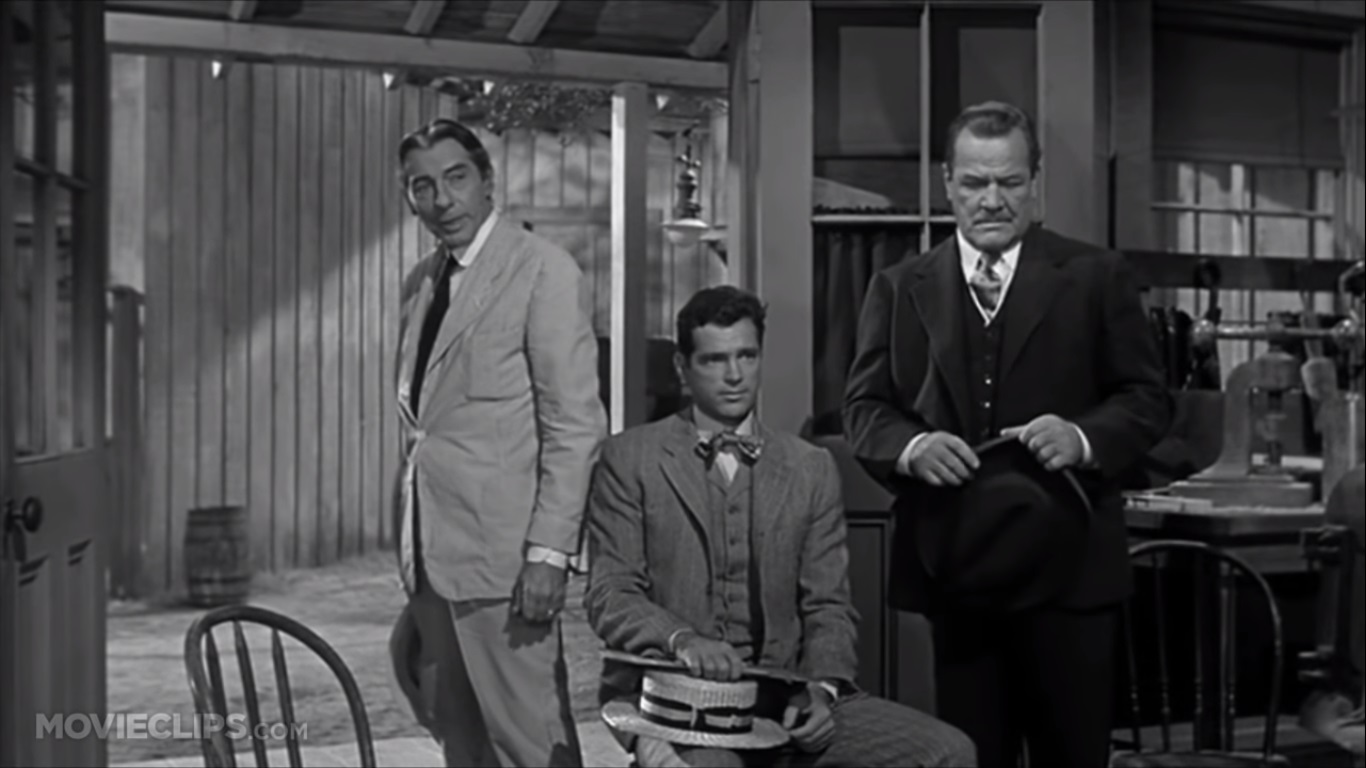
The title however is the clue. "Once Upon a Time...", like in a fairy-story? Here Tarantino wants to show the triumph of Hollywood escapism over brutal reality; re-writing history to provide the closure, catharsis (even vengeance) that real life denies us, but which the cinema is more than capable to indulge. As Carleton Young said in The Man Who Shot Liberty Valance (1962) - "This is the West, sir. When the legend becomes fact, print the legend." But is this enough?


The Man Who Shot Liberty Valance [John Ford, 1962]:


Once Upon a Time in Hollywood [Quentin Tarantino, 2019]:

If I have a complaint about the film it's this: I wish Tarantino had shown enough courage to follow the story through to its historical conclusion. Throughout so much of the film there's a sick-inducing sense of tension and inevitability developing around the expectation of the real-life horrors to come. In this sense, the characterisation of Sharon Tate is the film's representation of American innocence - primed as she is to be lost in a bloodbath of counter-cultural decadence - and the often observational scenes of her character gong about her daily life have a beautiful sadness to them, which is powerful. But by subverting the reality of Tate's eventual fate, Tarantino betrays those scenes and reduces the characterisation to nothing. A shame."

I liked "Once Upon a Time..." a lot better than my least favourite of Tarantino's work to-date, Django Unchained (2013), where the extended third act descent into cartoon violence felt more egregious. But as much as I found a lot to appreciate here, it still ranks as one of the weaker Tarantino efforts for me, far behind my very favourite films of his, Pulp Fiction, Jackie Brown, Death Proof (2007), Inglourious Basterds and The Hateful Eight (2015).

As an aside, I would argue that "Once Upon a Time..." could form an odd little triptych with two other recent "auteurist" films, The House That Jack Built (2018) by Lars von Trier and Glass (2019) by M. Night Shyamalan, in the sense that they function both as a kind of final statement or meta-commentary on their filmmakers' respective careers (loaded as they are with all the quirks, eccentricities and manipulations that their authors are best known for), but also a provocation to the audiences that have both derided and defended them; "doubling down" as it were on the more contentious aspects of their aesthetic and ideological concerns to the extent that the films both define and obfuscate (intentionally?) their actual intentions.

The sense of nostalgia permeates every aspect of Once Upon a Time in Hollywood and its evocation of late-1960s Los Angeles to the point at which the film becomes less concerned with the more conventional development of character and plot, and instead finds drama and interest in the images of actors driving classic cars through painstakingly recreated Hollywood streets; where the camera picks out and lingers on period signage and billboard advertisements while songs and commercials play from stereo to stereo. For Tarantino, such sequences are the backbone of the film, and it's this immersive, atmospheric quality and the sense of period authenticity that really defines the film as a genuine experience.

Tuesday, 29 May 2018

Out of the Past


Thoughts on a film: How Green Was My Valley (1940)

Beginning with the title: How Green Was My Valley. No question mark is necessary; this is a statement as opposed to a enquiry. In any case, we'll never know how green the valley actually was, since the black and white photography denies us such privilege. However, in the heart and mind of this central character, looking back, as the characters in Ford's films often do, the memory of this place and the picture that is captured, photograph-like, in the memory and imagination, is powerful enough to make the significance of the phrasing an important device in communicating what the film is essentially about.  Not just important to the character's own attempts to recall something that no longer exists, in any actual, physical reality, but to the viewing audience and their attempts to find interest and identification in this most personal of personal tales.

This is a title that establishes, up-front and before the film has even begun, a connection between the 'author' - as in, the character bringing these people to life - and the audience. On paper, this is a title that reads like a grandfather handing down old tales to a child; or perhaps even words of wisdom between a father and his son; something similar to the relationship between the young Huw Morgan (Roddy McDowall) and his own father, Mr. Gwillym Morgan (Donald Crisp), as seen in the film itself. A kind of, "How green was my valley? Well son, let me tell you..." sort of thing.


How Green Was My Valley [John Ford, 1941]:

The specific on-screen phrasing of this title seems to emphasise the notion of the personal through the possessive; where the sense of an autobiographical story (or a fictionalised-autobiographical story, as would eventually be revealed) is suggested by the nuances of how the title reads, or indeed, could be spoken. A perfect example of this statement as opposed to enquiry approach can be found in the film's opening monologue, which introduces not only the theme of personal reflection - as the character looks back to a story that is recreated for our benefit - but the usual Fordian interest in the power of memory to transform moments of the mundane, or the everyday, into images of unforgettable spectacle.

****

"I am leaving behind me fifty years of memory. Memory? Who shall say what is real and what is not?  Can I believe my friends all gone when their voices are a glory in my ears? No. And I will stand to say no and no again, for they remain a living truth within my mind. There is no fence nor hedge around time that is gone. You can go back and have what you like of it, if you can remember. So I can close my eyes on my valley as it is today, and it is gone, and I see it as it was when I was a boy. Green it was, and possessed of the plenty of the Earth. In all Wales, there was none so beautiful. Everything I ever learned as a small boy came from my father and I never found anything he ever told me to be wrong or worthless. The simple lessons he taught me are as sharp and clear in my mind as if I had heard them only yesterday. In those days, the black slag, the waste of the coal pits, had only begun to cover the sides of our hill. Not yet enough to mar the countryside, nor blacken the beauty of our village, for the colliery had only begun to poke its skinny black fingers through the green."

****

The images that Ford uses to accompany this narration - which reads like poetry on the page but is near-transcendent when spoken in the film by an unseen Irving Pichel - capture what might have been the reality for these people; but a reality, like everything in the film, defined by the memories of an old man looking back to the days of his youth. The fact that this dialogue, spoken in an attempt to bring dead objects back to life, is narrated by a man perhaps close to death himself, gives these bold, near-defiant images of ordinary people turned into icons of human endurance by the incredible way in which Ford frames them, an even greater emotional weight. Just as the images, in turn, make the dialogue resonate on a far deeper and emotional level by foregrounding it through the associations and juxtapositions of image and text.

The relationship here, between the opening text and the opening images, suggest a greater depth by deliberately playing on the audience's own recollections of what 'home', as something that we return to, subconsciously, throughout our adult lives, actually means. We can grasp, immediately, the significance of this place, exaggerated in the mind as well as on the screen, by the way in which Ford, and his cinematographer Arthur C. Miller, present it to us. These rich, painterly compositions that recall impressionist landscapes of charcoal on paper nonetheless have a touch of the documentary about them. There is a direct, iconographic truth to these images that goes beyond the edges of the frame or the limitations of the Hollywood soundstage; they capture something incredibly real, emotionally at least, that plays into the thoughts and feelings of a viewing audience who can see the enormous power of this place and its people, not as any real location or a work of actuality, but as a universal symbol for something that will one day disappear, or be replaced, but can exist long in the hearts and minds of those who once embraced it.

The notion of a dying world, or a world that no longer exists in any actual, tangible form, is suggested in this opening montage by two shots of elderly ladies. One in full-face close-up, showing the great lines of age and wisdom marked upon her skin; the other, bent-backed and shrivelled, standing frail and small in the shadow of a doorway. These women, like the world of the film, have struggled and endured, but have reached the end of something. Eventually, they too will one day cease to exist, but will live on in the thoughts and feelings of those who once loved and cared for them. As figures in the frame they are as-important as the landscapes that Ford takes great care in presenting as something beyond words. They are assimilated into the frame, as part of this rich, imaginary kingdom, to the point where one could not exist without the other.


How Green Was My Valley [John Ford, 1941]:

Such images suggest the notions of time and the passing-down of traditions, customs, social norms and stories between the generations. These shots of frail old women immediately suggest, on a subconscious level, the potential future manifestations of the once young and beautiful sisters-in-law Angharad (Maureen O'Hara) and Bronwyn (Anna Lee). Two characters inevitably worn down by toil and heartache; still waiting in the front doorway for their men, denied them, either through death or circumstance. This old woman might even be the same woman who once stood, aghast, back-to-the-door, with the same stunned rigidity of Ford's film-camera, when the mine exploded; never moving; still looking out onto the chaos and confusion as if trying to make sense of it all.


How Green Was My Valley [John Ford, 1941]: 

However we choose to see these figures - either as icons or actual fictional characters - it is clear that Ford is introducing these old-faces in an attempt to reinforce the personification of the valley itself. As Pichel, channelling the voice of a now aged Huw Morgan, discusses the desecration of the land's natural beauty by the industrial progression of time, Ford cuts to these two figures in order to contrast the physiognomy of the human face with the physiognomy of the landscape. An audience may not necessarily appreciate the true overwhelming power that the memory of this valley has to the central character, or how significant its destruction is to his own personal identity, but an aged face, marked and transformed by the ravages of time, is immediately relatable. As we watch our own parents, friends, partners and eventually ourselves grow old, we recognise this brutality of age and deterioration, and recognise how each single moment of a life is fleeting.

The presentation of this world is central to what makes the film so remarkable, with Ford going to great lengths to document the social rituals and practices that define this world, its people, and the story taking place.


How Green Was My Valley [John Ford, 1941]:

Without question, How Green Was My Valley remains one of the supreme films, and one that I wish I could dedicate another thousand words to, having barely scratched the surface of what makes the film so remarkable, so moving, so endlessly relevant, in the half-finished thoughts above. It's of course a film about communities; about people, their relationships, their lives and loves. A film full of life, with its various joys and sorrows, and one that manages to celebrate life; or more specifically, the humble, everyday lives that contributed to these communities - to our histories! - though are rarely documented or immortalised in works of stone, paint or ink.

Whether or not Ford was using the Wales of this story as a surrogate for his beloved Ireland is probably debatable, but what the filmmaker achieves here is something more beautiful, more nuanced and more authentic in its emotion than even his own later and more specifically Irish work, The Quiet Man (1952). While that film works to present the minutiae of the Irish experience, or a reflection of it, in such broad detail that it often slips into pure caricature, the presentation of the characters and place of How Green Was My Valley has a more sensitive yearning to it. A solemnity that evokes the feeling of what it is to be connected to a place (even in memory), but unable to go back. It's a humanist film that takes Ford away from the macho westerns and cavalry films, for which many associate him with, and places him within the same tradition and lineage of Jean Renoir, Roberto Rossellini, Terence Davies, Naomi Kawase, Laila Pakalniņa, Pedro Costa and Hong Sang-soo (among others).

While much of its reputation today rests on the trivial fact that How Green Was My Valley beat Citizen Kane (1941) to that year's Academy Award, I have to admit, I find Ford's film every bit the equal to Kane, if not actually greater. It's a film that ranks alongside Ford's other great masterpieces, such as the similarly humanist and strikingly poetic The Informer (1937), Young Mr Lincoln (1939), The Grapes of Wrath (1940), The Long Voyage Home (also 1940), My Darling Clementine (1946), She Wore a Yellow Ribbon (1949), The Searchers (1956), The Horse Soldiers (1959) and Sergeant Rutledge (1960), and remains, for me at least, among the very greatest works of twentieth century cinema.

Thursday, 12 July 2012

One-Hundred Favourite Films - Part Seven

Ongoing response to The Dancing Image "100 (of Your) Favourite Movies" meme-that's-not-a-meme, presented here in a loosely alphabetical order. I'm posting the series in reverse formation in an attempt to maintain the original continuity, from A to Z.


Mauvais sang
Directed by Leos Carax - 1986

With some films, the experience cannot be explained, only felt. As much as I try to put into words some semblance of what these films are about, how they work and why I love them as much as I do, there is always that struggle to do justice to the true experience, which is personal, and difficult to define. With Mauvais sang, I could talk about its ambition and imagination; the gestures towards the poetic realism of filmmakers like Epstein, Vigo and Grémillon; the combination of B-movie noir and impressionist science-fiction (which recalls the Godard of Alphaville (1965) in its presentation of love in a world where the physical act of love has been made unattainable); or the feeling of it: the progression between scenes that are either funny, astounding, romantic or moving.

However, to describe the film in such a way would not do justice to the real feeling that is experienced. The recollections of a relationship, however vague, inform every scene, every word and every movement. The film as a work - as a physical object - reminds me of my own amour fou - mon "Petite Lise" - who loved its bursts of movement, its folly and its declarations, almost as much as I; who saw in it something that brought to mind our own sadness and embraced it, like the characters on-screen. To see the film now is to re-experience that affection in every expression of these characters, their actions and reactions, and in the film's sweeping gestures, which capture a feeling of what it is to love and to be loved.


Metropolis
Directed by Fritz Lang - 1927

In its construction, the city presents the two ideological perspectives established by the film's socialist-leaning epigram, which reads: 'Head' and 'Hands' need a mediator. The mediator between 'Head' and 'Hands' must be 'the Heart.' The city of the film is, in its design, a manmade barrier between these two spheres of society, ensuring that 'Head' and 'Hands' are forever separated, physically, by the structure of the thing; those divides of class, gender and generation made explicit in the very foundation of the world. Through the inadvertent actions of its two protagonists - Freder, son of Fredersen, and the enigmatic Maria - a link between the two words is finally forged, turning the city itself into the beating heart that drives both factions of this so-called Metropolis; this labyrinth of the mind.

However, the vision of the city is not only a mediator for its inhabitants, but inevitably becomes a kind of mediator for its own creators; a link between the politics of Thea von Harbou and the spectacle of Fritz Lang. If writer von Harbou saw the drudgery of the workers as something deplorable, director Lang transforms it into something truly terrifying. A vision of hell, where the workers feed a machine that becomes, in the eyes of the protagonist, like a monster, devastating in its ferocity. While the political aspects of the film are still relevant, it is the pure storytelling of Metropolis that leaves the greatest impression; the manifestation of this world that Lang and his technicians so vividly create is still, after almost a century, a genuine sight to behold.


Mother Küsters' Trip to Heaven
Directed by Rainer Werner Fassbinder - 1975

We contemplate the question: Why does Herr Küsters run amok? As a quotation, it sounds like the start of an appalling joke (and in many respects it is!) though one necessary to draw a line of influence from this film to an earlier one, also associated with Fassbinder, which ended with an explosion of fury and devastation that seemed to anticipate the unseen act of violence that begins the film in question. What is most cruel about the construction of the film is the way Fassbinder has his characters - this small family of aged mother, doting son and imperious daughter-in-law - just going about their usual domestic activities, oblivious to the terrible tragedy taking place on the other side of town.

The film reinforces Fassbinder's reputation as one of the great 'exploitation' directors. Not so much in his technique - which has little in common with filmmakers like Joe D'Amato or Larry Cohen - but in his continual interest in the manipulation of characters too vulnerable or trusting to recognise when the forces of a system far beyond their comprehension is conspiring against them. In Mother Küsters' Trip to Heaven, Fassbinder uses the story of this elderly woman's bleak descent into loneliness, resentment and eventual criminality to condemn the German culture of the 1970s; taking aim at the ineffectual left-wing intelligentsia, armchair terrorists, tabloid press and his own generation's ignorance and greed in contrast with the quiet stoicism and questionable loyalty of the martyred matriarch of the title.

It is easy to see the crime of Herr Küsters and the reactions to it as a comment on how the Germany of Fassbinder's generation had distanced itself from the sins of the father(land); refusing to acknowledge the atrocity of the holocaust on a human level, ignoring it, and therefore allowing the opportunity for history to repeat itself; a fear implicit in the violent conflicts taking place between left and right-wing political groups throughout the 1970s. In the absence of the "father", Mother Küsters becomes the real culprit, the only link to a man that can no longer be held accountable, and as such - a scapegoat? - shunned and ignored, denied any sympathy; guilty by association. Her downfall, chronicled throughout, is shattering to see.


Mulholland Drive
Directed by David Lynch - 2001

For Lynch, there is the surface, the thing that is presented as 'truth', and then there is the world beneath the surface, the dark despair that exists at the wounded heart of everything. In the opening sequence of his earlier film Blue Velvet (1986), Lynch illustrated this idea with a vivid montage of small-town suburban life - a world of fixed-grins, picket fences and saccharine '50s pop - cut-short by the sight of an elderly man falling to the ground in the throes of a violent seizure, and a slow malignant tracking shot through the undergrowth, revealing the writhing worms, festering maggots, and a severed human ear.

In some ways, the narrative of the film in question could be seen as a continuation of this earlier sequence, where Lynch establishes a surface projection of how things appear, or need to appear, and then the reality beneath. The two 'realms' offer two sides of a single story, where failure and disappointment are transformed in the mind of a central character into a waif's dream of Hollywood stardom, full of mystery and adventure. In this sense, the film is an obvious continuation of the same territory explored in Lynch's other great films, Twin Peaks: Fire Walk with Me (1992) and Lost Highway (1997), where a significant event in the lives of his characters causes a literal psychological metamorphosis; turning the story into a series of figurative gestures that hide the clues to an unfortunate chain of events. While the two preceding films are undoubtedly great works, there is a noticeable process of refinement in the development of Mulholland Drive, where the games played with the narrative and the usual interjections of horror, slapstick and soft-core erotica are not used to obfuscate or to confuse the audience, but to reveal hidden depths.

On the surface, the film is of course a captivating mystery; a genuine modern-day noir built around its two unlikely heroines who traverse this frequently sun-dappled Hollywood playground in search of the clues to an arcane conspiracy, and finding instead the hollow bones of a terrifying affair. And yet beneath the surface, the film is a heartbreaking psychological study; one that exposes emotions and ideas that never merely adorn the more characteristic moments of surrealism, but transcend them; turning what could've been a cheaply provocative and transparent experiment in self-reference into a genuine work of art.


Muriel
Directed by Alain Resnais - 1963

Subtitled 'The Time of a Return', Muriel is a film about memory, or more appropriately, about the past as something pervasive, like a shadow walking in-step with each character; something that we're unable to escape. Though other aspects of the work are just as intriguing, it is the film's continual emphasis on time and recollection - and how these concerns can be related through the power of the moving image to capture and record - that Resnais and his scriptwriter Jean Cayrol return to; creating a film where the formalist experiments - the editing and the placement of the camera - attempt to disarm the viewer; showing the capacity for the medium to manipulate and mislead, but also to suggest hidden truths.

The 'Muriel' of the title is not the lead character, as we might expect, but a name that haunts the character's stepson Bernard; a young man still traumatised by his experiences during the conflict in Algeria. In this sense, the scars of war - the lingering traces of it - becomes another great theme of the film; explicit in the battle-marked ruins of Boulogne-sur-Mer where the story takes place and implicit in several interactions between characters, who throughout the film seem to hide behind a facade of middle-class contentment, as if trying to maintain a sense of pre-war normality; almost as if life before the war had continued, uninterrupted.

When Cayrol and Resnais eventually reveal the true story of 'Muriel' - this character that seems to embody, in memory, the very spirit of the film and its restless observations on the themes aforementioned - the effect is truly devastating. The film itself - in its necessary contrast between sound (Bernard's painful confession) and image (a montage of 8mm footage of soldiers languishing between battle) - becomes a eulogy to this young woman, but also a means of expressing the great suffering of those made mute by the ravages inflicted by this stonewalled deceit. This is a film that offers a profound comment on the nature of atrocity, how we live with it, and how the attempt to ignore it, or to put it to one side, is the greatest indignity of all.


My Darling Clementine
Directed by John Ford - 1946

In the broadest terms, the story of Wyatt Earp and the Gunfight at the O.K. Corral doesn't interest me, and yet this is what the film appears to be about. However, beneath the surface of this historical fiction, there is a film about loss; about the loss of a brother. As an only child I've often envied those with close ties to their siblings and that sadness felt by Wyatt Earp after the death of his brother during the first act of the film is something that I can almost relate to. The feeling of wanting something but never having it is sometimes equal to having something and then losing it. The film, in its mood and sense of momentum, is haunted by this loss - the loss of a brother but also the loss of innocence, or an ideal - turning even the burgeoning love story between Earp and the character of Clementine Carter into something charged with the anticipation of a tragedy.

This same feeling of grief is inherent in Ford's direction, with the staging of scenes and the framing of shots, compositionally, emphasising a certain abstract stillness; where interactions between characters are turned into ghostly encounters, intrusions and stolen moments, caught like images from a phantom documentary, "of the period" (though no such documentary could exist). It is the authenticity of these images, the dirt and the grime and the sense of lives being lived, that creates this feeling of something credible, emotionally and cinematically, even if the story is pure fabrication.


Nostalghia
Directed by Andrei Tarkovsky - 1983

Any discussion of the themes behind the film should really begin with the title, which establishes upfront the overwhelming feeling of loss and the personal displacement that hangs above the lives of these characters, suspended, like the sword of Damocles waiting to drop. However, this is not a film about 'nostalgia' in the sense of being a 'nostalgic work' - like for example Amarcord (1973) or Radio Days (1987), where specific memories of places and people are exaggerated on screen as they are in the mind - but rather an attempt to understand the feelings behind this nostalgia. The loneliness, disruption and dissatisfaction that compels these characters to take shelter in a crumbling Italian village, where each relic of a past existence uncovers deep reminders of their own tragic despair.

The character in Tarkovsky's film is, like the filmmaker himself, in exile. Unable to return home, this character finds himself haunted by past recollections; memories of figures framed within a desolate landscape, an old house and a shroud of fog, like the fog of memory, obscuring everything. These images suggest some possible clue to deciphering the true feelings of this character, which, as ever with Tarkovsky, seem impossible to define. For this is a poet's impression of his own great sorrow, suggested throughout by the solitude of the village, the dust and decay, and his own dealings with characters similarly haunted; consigned to their fate, like the defiant 'mad man' Domenico, or like Eugenia, desperate for an escape.

The tone of the film throughout is sombre and pensive. At times, the imagery suggests a continuation of the oppressive, post-apocalyptic misery of the director's previous film Stalker (1979) - or even a precursor to the genuine fear of atomic annihilation featured in his final work, The Sacrifice (1986) - but it's always the feeling of the film, the emotions of it, that draw us in. The emphasis on long takes - where the camera moves about these characters, observing them, presenting each shift between reality and fantasy, past and present, as a genuine movement between worlds - turns the experience of the film into a waking dream. A dream of home shared by each protagonist (and by the audience as well) that is impossible to define and even more difficult to reclaim.


Notre musique
Directed by Jean-Luc Godard - 2004

A film composed of three movements, like a symphony; the association reflecting the greater connotations of the title: the voice, a means of expression and communication: "our music?" Each movement of the film is a representation of a different argument on the nature of war, presented by means of a specific cinematic approach. The three movements - montage, dramatisation and allegory - act as interpretations of the three kingdoms of Dante's the Divine Comedy - Hell, Purgatory and Paradise - creating a single narrative. One that develops like a series of unconscious thoughts, moving, like characters through the rubble of places or the ruin of existence; never acting, but reacting as everyday people might when faced with the reality of war; the injustice of it.

In its rolling montage of violence and devastation - and with the burnt ruins of Sarajevo still standing as a solitary witness to the last great horror of the 20th century - Godard asks the question: "how can we live?" The audience responds: "with our fingers in our ears and our eyes tightly closed." The inquisitive nature of the film is never aggressive or didactic, like the Godard of the 1960s, but gently probing. The aim is to evoke emotions and ideas through sounds and images, creating something that moves between moments of poetic abstraction, wicked satire and affecting psychological study; presenting the atrocity of war and the folly of terrorism without condescension, but also gesturing lightly towards something hopeful; a vision of paradise, tranquil but exclusive, pastoral but closed-in...

The final movement, which acts as a kind of free adaptation the final act of Godard's earlier Week End (1967) - turning that film's depiction of violence and immorality in the Garden of Eden into an Eden of autocratic efficiency - uses this beautiful bucolic setting to create a contrast between something natural and pure and something corrupt; a system built on control and segregation, like the world itself. Although stunning in its presentation, this coda, both satirically and sympathetically, shows us the paradise that awaits these martyrs, and in its own subtle way shows us where the folly of terrorism ultimately leads. A dream of heaven as a place where nothing ever happens.


One from the Heart
Directed by Francis Ford Coppola - 1982

I suppose it makes sense that a film about romantic folly has itself become known as the great romantic folly of its director's career. While Coppola's film may have yet to shed its reputation as the wildly ambitious extravagance that tarnished his reputation and almost destroyed his career, it remains, for me at least, one of the director's greatest films.

On the surface, One from the Heart is as pure a work of cinematic imagination as one could ever hope to see. A vivid extravaganza, full of expressive colours, dazzling sets, theatrical transitions, musical numbers, circus routines and a poet's portrayal of love that finds even the most personal or intimate of feelings transformed into a spectacle of old-Hollywood-style decadence or Cocteau-like verse . However, beneath the surface of this display of magic mirrors, high-wire acts and allusions to MGM musicals there is a story about failure and disappointment, about spent-time and lost chances. A film about the difficulty faced by this couple in their attempts to understand one another; to look into the eyes of the other and see the reason why they first fell in love, and not just a sad reminder of their own disillusionment staring back at them.

Through this contrast between the stylisation of the form and the coarseness of the protagonists, Coppola's film becomes more than just a frivolous fantasy, but a moving and intelligent deconstruction of a relationship; where the carnival spirit and decadent glamour of the world created only reinforces the emptiness shared by these characters, the lack of excitement and adventure. In this respect, Coppola's film is ultimately about the pursuit of love as a physical space. In the arms of another we can accept our situation, or at least find beauty in the world around us, as opposed to dreaming of impossible things.


Onibaba
Directed by Kaneto Shindô - 1964

What I'm always left with is the impression of scenes; the heat, the closeness, the sense of space. Although the story is certainly engaging, it is the feeling of the film - the energy of it - that for me makes the experience so extraordinary and difficult to describe. The atmosphere of the location, barren and claustrophobic, is defined by the imprisoning blur of the marshland, with its tall reeds, which - when presented across the full-width of Kiyomi Kuroda's mesmerising 'scope frame - become like a wall that exists, literally or figuratively, between two realms. A wall that divides these characters, closing in on them, trapping them emotionally, physically and psychologically between the world of the living and the world of the dead.

Everything that happens in the film unfolds as if these characters are in-limbo; each moment held or suspended, like a scream of agony, or one of ecstasy? Although terrifying in its ferocity, the film is also surprisingly sensual. That heat and the closeness of the bodies within the frame, half-naked and wet with sweat, creates the feeling of something primal, even erotic! A heightened emotional state that turns the film into a prolonged nightmare, suggesting an interpretation of lust and jealousy that is almost supernatural.

Monday, 13 December 2010

The Horse Soldiers

The Horse Soldiers directed by John Ford, 1959:

Any analysis of the work should probably begin with an image that succinctly establishes what the film is primarily about. On this occasion, it is an image of eight men in cavalry uniform devising plans around a table. The two leads are set-apart from their associates by subtle differences in costume: John Wayne's Colonel John Marlowe with his red neckerchief; William Holden's Major Henry Kendall in his clean, white coat. Already, Ford and his costume designer Frank Beetson are establishing these characters through their identifiable professions; Marlowe, a man of combat, Kendall, a man of medicine. The two characters are positioned on opposite sides of the table; one seated, one standing; one with hat, one without. Although these men are essentially on the same side, fighting for the same cause, their position from one another within the frame suggests their obvious differences in both ideology and approach.

From this single screen-capture and the information that it conveys we are being informed, subtly, that this is a film about conflict.

Although essentially a War Film in the Hollywood tradition, the conflict in The Horse Soldiers (1959) is not exclusive to the Civil War backdrop that is seen throughout. Rather, it is in the relationship between these two characters - where one personifies the old and the other personifies the new - and in their dalliances with the beautiful landowner Miss Hannah Hunter of Greenbriar (Constance Towers). Like the majority of Ford's films, specifically his westerns, it is in this conflict between the old and the new that the narrative is fully developed; defining not only the dramatic motivations of the script by John Lee Mahin and Martin Rackin - or even the historical re-enactments of Harold Sinclair's original novel - but in a way, every thought and decision that these characters make and the effect that these decisions have on this world, as it is presented.

The Horse Soldiers is, to a large extent, about a changing world as illustrated by its emphasis on the cross-country journey and how the landscape becomes a signifier to the unspoken emotional connotations apparent in the plot. These themes are central to several of Ford's earlier films, such as the towering masterpiece The Grapes of Wrath (1940), in which the family of characters travel from town to town, city to city; effectively looking for work, but only finding the wounded heart and soul of a country beaten by depression. In that film, the projections of ghost-towns or the wounded, sunken faces of what essentially could be described as the living dead, flicker, apparition-like, on the windscreen of the Joad family wagon, convey the literal desperation and depression of these people looking for a world that no longer exists.


The Grapes of Wrath directed by John Ford, 1940:

Likewise, the nostalgic reminisces of How Green Was my Valley (1941) and The Quiet Man (1952) show worlds that exist in the memory of their respective narrators brought into violent conflict with the actual, tangible reality of these places and the inevitability of time. There, as well as here, the intentional, bold-strokes of iconography, from the waving of the Confederate flag to the casting of Wayne himself, seem deliberate attempts to express, in the most direct and appropriate way, the vaguest remnants of historical context and the actual machinations of this world, put on screen, vividly by Ford, in a full-colour, 1.66:1 presentation, to make the best of those seemingly never-ending shots of extras - each dressed in authentic cavalry uniform - cutting a path between the two distinct halves of the horizon, or, more literally in fact, cutting the country in two.


The Horse Soldiers directed by John Ford, 1959:

In The Horse Soldiers, the river, which is shown in the background of several travelling sequences, becomes shorthand for this great divide; from the north and south to divisions of class, race, gender, and (lastly), the two central characters. America, like many places in the world, is a divided country; divided politically as well as culturally, between both the immigrant and indigenous populations. Ford's film communicates this rift visually, through the actual presentation of the landscape, with its dirt-roads and rivers, and through the purely metaphorical; from a pencil-lined direction on a badly folded map, to the long, stretching shadow of a window frame over the hanging, atlas-like wall plan during a discussion between both parties.


The Horse Soldiers directed by John Ford, 1959:

With this in mind, the last act of the film - where the destruction of the bridge illustrates the continual inability for the two sides to meet in the middle - offers one of the most interesting visual metaphors in the entire film. The conflict, both personal and political, traps these characters in their own blinkered perspective, regardless of whether or not their actual opinions on the matter have changed, for better or worse. It is the kind of ending where the closing image, of the woman looking out into the uncertain future, the country disappearing into the horizon, the inevitability of a raging battle that Ford denies us the spectacle of, suggests an almost stoic heroism reminiscent of the iconic final image of Ford's own film The Searchers (1956). However, it also suggests some element of tragedy; the endlessness of war as a machine that moves across the landscape, devouring everything. It is also, in a sense, a deliberate none-ending; these characters may have reached a kind of conclusion, but the journey, and the war itself, still continues.

Through this, we can recognise the thread of identity and the sense of personal responsibility woven througout. The idea of taking characters conditioned into thinking in a specific way - into expecting the world to conform to a certain standard built largely on class, ranking and reputation - and then seeing those beliefs shattered before their very eyes when confronted by the very real consequences of the war itself. That final image, which speaks, on one level, to a certain kind of romantic optimism, as Hannah Hunter is framed - as only John Ford could frame a shot - waving the soldiers off into battle, also carries a certain sense of disillusionment. These young men, heroic into battle, will no doubt return, if lucky, as battered and bruised as the dead-on-their-feet volunteers of the even more restlessly critical Drums Along the Mohawk (1939).

There, in the assumed emotional perspective of characters trapped in the events that exist between the titles of two other Ford movies, The Long Voyage Home (1940) and They Were Expendable (1945), John Martin Feeney makes his second film that dares to ask... What Price Glory?


What Price Glory directed by John Ford, 1952:


The Horse Soldiers directed by John Ford, 1959:

The subtlety of the film's politics or its subtext jarring against the very obvious iconography of its images and sound is characteristic of Ford's work in this particular genre. The look and feel of the film might seem, at times, to be celebratory, with its bold colours and beautiful compositions combined with the rousing performance and the typical, overwhelming presence of Wayne as an avatar for the real, undying spirit of a subsequently lost America. But there's an obvious level of satire in how Ford uses these elements, which one might almost go as far as to call 'ironic'. The contrasts and conflict between the two central characters, on the page, suggests the kind of macho one-upmanship or characteristic male bonding that many expect of a film from this particular era. Yet, in the presentation, and in the incorporation of these characters into a narrative about conflict, the disparities between the two create an additional commentary on the subject itself.

The doctor's profession is one that saves lives; the soldier's is one that ends them. Through this, Ford suggests elements of guilt, honour, responsibility and a questioning of the kind of misguided patriotism that leads a country to tear itself apart. This conflict, on a personal level, could also tie in with the general themes of self-analysis and reflection; those two memorable shots where characters catch their individual reflections in mirrors, says a great deal about how they, as individuals, view themselves within this world of civil war; implicating them to some extent through ignorance or sheer wrongheadedness, or forcing them to look deeper into the mindset of war and how this conflict has changed them, physically as well as psychologically.

In the first of these moments of reflection, Marlowe, distorted by the convexed shape of the glass, studies his features in the hallway mirror of Hannah Hunter's opulent southern mansion. The distortion reduces Marlowe considerably, pushing him back, further into the distance, while exaggerating the size of the door and the picture behind him. The mirror image literally reduces his stature, revealing a small man at odds with the immovable presence that we expect from Wayne and have previously seen in action. The second shot comes much later in the film, following the death of Hunter's chaperone Lukey (Althea Gibson). Here, Hunter is confronted by the face of a girl she no longer recognises. Literally transformed, she is now no longer the spoilt little rich girl waiting out the conflict back home, but someone else; someone debased by war and reminded of the ugliness of the thing by the cracked and filthy mirror she now finds herself in.

Such shots carry the same kind of sadness expressed in the unforgettable moment of self-reflection/recognition in Ford's aforementioned The Grapes of Wrath; in particular, the scene in which Ma Joad (Jane Darwell) studies her face reflected in a dusty windowpane and enjoys a brief moment of warm contentment brought on by a nostalgia almost immediately snuffed out by the crippling destitution and uncertainty of her all-too-painful existence.


The Grapes of Wrath directed by John Ford, 1940:


The Horse Soldiers directed by John Ford, 1959:

Ford's characters in The Horse Soldiers may not be dreaming of better times, or indeed, taking comfort in nostalgic reminisce, but they're being forced to ask important questions. Moral questions that may have previously never been explored, at least, by these particular characters, but now, when challenged by the perspectives of others and forced to see things from a different point of view, the actuality of their situation is changed considerably. This revelation, as the two male protagonists eventually begin to see the situation through the eyes of the other, is best illustrated by the scene in which Wayne's previously gung-ho, no-nonsense Marlowe tends the bedside of a fatally wounded young soldiers and sees, perhaps for the first time, where this level of patriotism has led him. The subsequent scene, in which the character explodes, emotionally, having been goaded somewhat by Hunter, is one of Wayne's greatest screen performances; as the confliction and the confusion of what he's feeling in relation to how he feels he should feel, is brilliantly communicated.


The Horse Soldiers directed by John Ford, 1959:

The tragedy here, hinted at throughout by Ford's clever framing of events, is that the war will continue, long after the closing credits, long after the Civil War and on, into the following centuries. The great divide - be it north or south, east and west - will continue to widen. The visible scars marked in the landscape - from marching soldiers, on horseback or otherwise - connect each generation, from World War II, to Vietnam, to the Falklands, to Iraq and Afghanistan. The propensity for the species to decimate itself is a torch, handed down from generation to generation; from the marching men on horseback that open the film, silhouetted, as if to imply anonymity (the uniform replacing the notion of the individual with the "unit"), to the overpowering sight of the young children, armed and in uniform, marching ever onward, into battle.


The Horse Soldiers directed by John Ford, 1959:

Here, the literal thin blue line that once again divides the landscape, splitting the cinematic image into two recognisable 'sides' (contra and pro) suggests the possibility of all future conflicts. These children become the next link in the chain, and their children, and their children's children, will likewise pick up this torch when called upon by their country to do the right-good thing.

What is perhaps most remarkable about Ford's film is its ability to present the gross futility of war while simultaneously suggesting, on one level at least, the necessity of it. However, by denying the audience the lengthy battle sequence that was initially scripted to end the film and choosing instead to close on a somewhat more enigmatic image that seems to suggest so much more than the potential bloodshed and cannon fire ever could, the notion of a commentary on war, or indeed, on conflict in general, is so much more profound. And this is what separates The Horse Soldiers from films like Platoon (1986) or Saving Private Ryan (1998), where the "horrors of war" can only be communicated by presenting the violence as something visceral or intense. However, in presenting this intensity through the medium of cinema, the conflict itself can only become exhilarating for the viewing audience, thus, destroying its intent.

By emphasising this moment of human endurance - with the conflict stretching out, beyond the horizon - these closing scenes from The Horse Soldiers suggests the effect that war has on the individual, as well as the country itself.


Platoon directed by Oliver Stone, 1986:


The Horse Soldiers, directed by John Ford, 1959:

Saturday, 8 May 2010

The Quiet Man

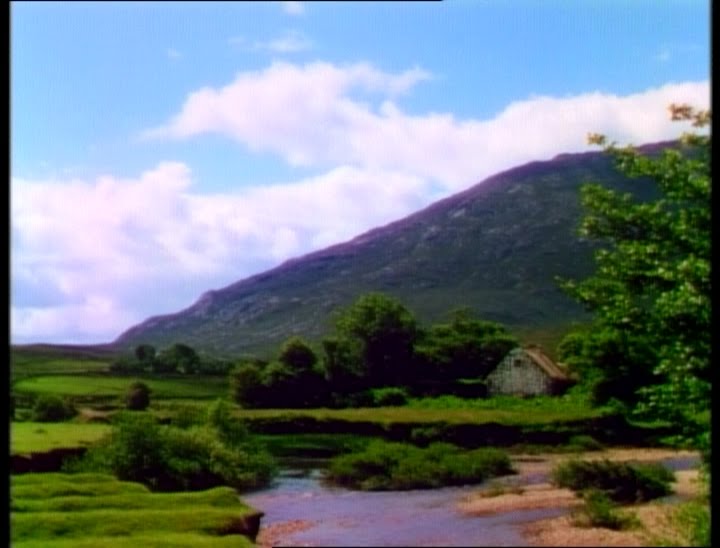
John Ford's Academy Award winning film The Quiet Man (1952) is, in many ways, a story about place and the rediscovery of it. In the film, the expatriate Irish-American Sean Thornton (John Wayne) returns to the village of 'Innisfree' to reclaim his family home. However, his journey has less to do with the actual reclaiming of the property and more to do with the rediscovery of the past through a literal journey in a time. This place, where the character was born and where he eventually hopes to die, is significant, but is somewhere that has only previously existed in the memory and imagination. A second-hand Ireland passed down through the tall tales and fond reminisces of parents and grandparents, where the greens are a little too green, the people a little too broad and the atmosphere closer to caricature. It is Ford's Ireland as much as it is the Ireland of Thornton; this larger than life place presented to us in an idealised fashion that has no bearing on the actual Ireland as it existed in 1952, where the director goes to great lengths to exaggerate every detail, as memories are exaggerated in the mind.

Our first glimpse of this traditional Ireland - a horse and cart, signalling the switch from the modern to the old-fashioned - is shared with the central character, as both he and we catch a glimpse of it through the railway station window. In the literal sense, the framing of this shot as a window into another world becomes an invitation, both to the character and to the audience. This horse and cart are therefore not only a reminder of the archaic, or the out-dated, but a means of transportation, from our world into the next.


The Quiet Man directed by John Ford, 1952:

This contrast, between the old and the new, will be made explicit in the following shot, as the horse and cart, situated in the foreground, make their way beneath the arch of the railway bridge on their way into the village. As the locomotive thunders overhead, marking the horizon where the blue of the sky meets the green of the valley, the film is signalling the shift from the contemporary world of this character (represented by the train) to the otherworld of the film.


The Quiet Man directed by John Ford, 1952:

As the buggy departs, the Greek-chorus of characters, peering out from over the wall and indulging in gossip and idle chit-chat, become an immediate surrogate for the viewing audience. Asking questions about this character, who at this point in the story is still unknown and without conventional introduction, while also establishing the thread of community - as in, a world defined by these characters - that will be further explored throughout.


The Quiet Man directed by John Ford, 1952:

Although in some aspects the film could be seen as playing up to the perceived stereotype of the Irish - in keeping with subsequent Hollywood movies, such as Darby O'Gill and the Little People (1959) and Finian's Rainbow (1968) - the film nonetheless illustrates Ford's great warmth and tremendous affection for these characters; over-embellished, as characters in Ford's films often were, but only as a means of turning even the most humble of supporting players into a bold, heroic figure, commanding the landscape as if it were a part of them.

Adapted from a short story by the Irish writer Maurice Walsh, The Quiet Man is a film often referred to, simplistically speaking, as a romantic melodrama, with the main selling point being the relationship between Thornton and the beautiful spinster Mary Kate Danaher (Maureen O'Hara). However, this surface layer - or selling point - is only one component of a film that has far greater themes beyond whatever was the more popular reading of the time. The romantic element might admittedly be a fairly large component of the story - in the sense that it is motivated by all the other elements at play - it is nonetheless a storyline that sits side-by-side with the other themes, which are perhaps more representative of Ford's own interests as both an artist and a storyteller. Obviously, we recognise immediately the presence of John Wayne, who appeared in countless films by Ford - often as various rough around the edges frontiersmen, soldiers and cavalrymen - but the actual image of the actor in this environment, and in this particular romantic narrative, seems to suggest something slightly off about his character from the very first scene. A hidden depth that will eventually be explained in the second act of the film, but which nonetheless adds subtle shades to our interpretation of him and the general questions that we (and that sort-of Greek chorus) ask ourselves during those opening few minutes.

As a result, the film has an air of mystery to it, as we're left to wonder why Thornton has decided to return to Ireland now, at this point in time, and why he seems so reluctant to engage in the merriment and the frivolity of the local booze hounds as they delight in pulling half-remembered stories of the Thornton ancestry from the murky puddles of the past. Has the character really come back to this place to reclaim the house where he was born, or is there some other motivating factor; some secret shame that has forced him to abscond and find solace in the last place anyone would ever think to look for him?

Ford amplifies this uncertainly through the blocking of scenes, as characters with half-smiles dart their eyes back and forth to one another in a silent judgement, or in the earlier sequences of characters rummaging through Thornton's rucksack as if there's something more to this than simply the shock of the new. However, in a later scene, in which Thornton returns to his newly purchased farm, only to find the fire still burning and the dust and grime swept into a pile in the centre of the room, we think, momentarily, that the past-life of this character has finally caught up with him. The look of this scene, with its vivid studio lighting and special effects to simulate a violent thunder storm, seems closer to the eventual cinema of the Italian director Mario Bava; with the splashes of yellow and purple on the farmhouse wall, and that billowing curtain as it dances in the draught of a broken window, seeming entirely removed from the usual, more characteristic Fordian quirks.


The Quiet Man directed by John Ford, 1952:

Eventually, the threat turns out to be none other than Mary Kate, and the scene climaxes with one of the most famous and iconic screen kisses in cinema history. However, the lead up to this moment, and that tangible sense of a character backed into a corner and ready to lash out for the purposes of self-preservation, confirm our suspicions that there is more to this Sean Thornton than his far too convenient back-story might suggest.

The revelation of this hidden character is eventually covered in the film's second act, in a bravura flashback sequence that remains one of the most incredible pieces of cinema that Ford ever created. Without question, the most jarring moment in the film, this flashback of Thornton's to the tragic boxing match that ended his career and forced him to leave America, is a marvel of purely visual storytelling, character building and pure filmmaking ingenuity. As the character is KO'd by the right-hook of the mean-tempered landowner "Red" Will Danaher (Victor McLaglen) on the day of his wedding, Ford cuts back from Thornton's prone frame to the blinding spotlight as it cools on a shot of Thornton, as pugilist, traumatised and unnerved; looking down at the audience - or through us - at the wounded body of his foe. The actual structure of this scene, with its deliberately odd framing and disorientating use of montage, particularly of expressionless faces, can be seen as an influence on everyone from Jean-Luc Godard to Martin Scorsese, with the editing in films like A Married Woman (Une femme mariée, 1964) and Raging Bull (1980) in particular showing the influence of Ford, and specifically this sequence of shots.


The Quiet Man directed by John Ford, 1952:

The scene seems deliberately structured to disrupt the narrative, throwing both the audience and the character into a kind of chaos. Before this scene, we sort of have a sense of where the film is going, or who this character really is, and yet, through this short series of shots, the film has completely undermined the romantic aspect of the story; pushing the film back towards the figure of Thornton as this "quiet man", and the question of why the image of Ireland - and the need to reclaim or rediscover that second-hand existence - has become so important to him. Therefore, the film, beyond this point, is largely about defining this place; this creation of Ford's, as he delights in documenting the layers of this society, its rules and inner-workings, and how these factors or ideas add to the romantic element, creating comedy or drama from the often farcical interactions of his characters. The film, in this sense, shows Ford at his most self-indulgent (perhaps for the first time in his career), as instead of moving the film on or bringing the audience closer to a natural conclusion, he allows these scenes to play out; letting the audience bask in the atmosphere or the richness of these scenes of the world simply existing.

There's a painterly quality to many of these scenes, as moments of social interaction take on an element of still life. We can look at these frames, robbed of movement, devoid of subtext or narrative chronology, and nonetheless read their specific intentions. An image of a man playing an accordion, while another man looks on approvingly; an elderly man, half-cut, gazing into his pint glass and wondering if it's half full or half empty; the scenes of characters making small talk in drawing rooms, or tending the bedside of a dying man, have an affinity to Velázquez, or the early work of Vincent Van Gogh; where the framing of these moments, and the lighting of cinematographer Winton C. Hoch, help to suggest a story, or the relationship between characters, in the most basic, visual sense.


Old Woman Cooking Eggs by Diego Velázquez, 1618:


The Quiet Man directed by John Ford, 1952:


The Potato Eaters by Vincent Van Gogh, 1885:


The Quiet Man directed by John Ford, 1952:


By the Deathbed by Edvard Munch, 1895:


The Quiet Man directed by John Ford, 1952:

These interior scenes, where their low-lighting and largely subdued colour schemes of browns, blacks, greys and yellows, are wonderfully contrasted by the natural beauty of the exterior locations; where the overwhelming greenery of the hills and the valleys, or the pale blues of an endless sky, remind us of Monet's great landscapes, rich in colour and texture.


The Fisherman's house at Varengeville by Claude Monet, 1882:


The Quiet Man directed by John Ford, 1952:

These scenes of blarney and adventure are intercut with the less characteristic elements of melodrama; where the courtship between the two central characters and the particular sense of longing is illustrated in Ford's typical expressive style: e.g. as thunderstorms, or raindrops on a window. This is, on the one hand, that old Hollywood approach of showing a character's vulnerability without having them cry on camera; where the should-be tears of Thornton or Mary Kate are exaggerated in such a way that this outpouring of emotion becomes an actual physical presence; an expression of such magnitude that it becomes a manifestation of nature itself.


The Quiet Man directed by John Ford, 1952:

Through scenes such as this one, Ford is not only telling the story of these two characters in the conventional sense, but further exploring the workings of this society or the mood of a particular location. We might look at the scene of Thornton and Mary Kate's courtship and see it as two characters simply falling in love but overcome by emotion at the realisation that this world will never let their romance flourish... but then we're also seeing a kind of travelogue of the country's most beautiful haunts. We're also seeing the contrast between these two characters as representations of their individual worlds. As Thornton looks on with a quiet shock and disapproval as Mary Kate removes her stockings - and momentarily reveals her thighs - before running bare-footed through the clear stream, we're seeing the staid, officious Americanism of Thornton against the more free-spirited "Irishness" of Mary Kate; as her unashamed disregard for what Thornton sees as socially acceptable simply illustrates her more primal connection to the country that surrounds her.

This same sense can be seen in the initial meeting between Thornton and Mary Kate, as she wanders into the frame, and into the midst of this pastoral abstraction, beautifully lit and framed in a way that once again demonstrates Ford's total command of his location. Here, the blue of her shawl and the red of her hair stand out against the green field, as she finds herself surrounded by sheep in a circular, almost love-heart formation, once again illustrating the connection that these characters, Irish-born, seem to have with a world that Thornton (and Ford) will never truly comprehend.


The Quiet Man directed by John Ford, 1952:

Once again, this sequence is not simply about the moment of falling in love between two characters, but about the power of the location; or, more importantly, of rediscovering the kind of heroic romance that exists in these stories of Ireland that are passed down from generation to generation.

The film ends with a celebration of these characters and this world, as they wave and curtsy to the camera; again, acknowledging the notion that we are visitors in this imaginary universe, but now, unlike the central character, who has made a home for himself, we must leave, and return to our own less idealised reality. Although The Quiet Man is far from John Ford's greatest achievement as a filmmaker, its place within the broader categorisation of his career as a completely personal project makes it something that is worth experiencing. Simply, the appeal of The Quiet Man goes back to that notion of the still life - of time and its endless stories being recorded for the benefit of future generations - as Ford succeeds in capturing this landscape; not as it existed, but as he must have always imagined it, in his heart and mind.

Schalcken the Painter (1979)

Schalcken the Painter [Schalcken the Painter [Leslie Megahey, 1979]: This is a film I first saw around four years ago. At the time I found...