Showing posts with label Aki Kaurismäki. Show all posts

Tuesday, 12 June 2018

Hovering Over the Earth


Notes on a film: Calamari Union (1985)


Following on from the sombre, contemporary-set Dostoevsky adaptation, Crime and Punishment (1983), this second feature-length effort from Aki Kaurismäki already illustrates the filmmaker's eclectic range and singular ambition, as he graduates from the deadpan, 'Bressonian' hyper-realism of the previous film to embrace a looser, semi-improvised narrative, captured in a stark black and white.

Between the very different approaches of these first two films we begin to see a sort of pattern or template emerging for the films that would eventually follow. An indicator that Kaurismäki's subsequent career would alternate the low-key realism of films like Shadows in Paradise (1986), Ariel (1988) and The Match Factory Girl (1990), with more stylised, absurdist or even eccentric films, such as Hamlet Goes Business (1987), Leningrad Cowboys Go America (1989) and La Vie de Bohème (1992).

Calamari Union definitely falls into the latter category, as its absurd, picaresque narrative follows the misadventures of fifteen men - fourteen of them named Frank, and an idiot man-child named Pekka - who one day decide to leave behind the hopeless working class backdrop of Eira and instead quest to the near-fabled district of Kallio (creating in the process a bizarre passage that turns the suburban boroughs of Helsinki into an almost mythological terrain).


Calamari Union [Aki Kaurismäki, 1985]:

It's not necessarily a film to be taken seriously, as Kaurismäki follows his characters on this meandering journey - finding strange scenes, slapstick humour and at least one rock & roll performance - but it's not to say that the film can't be looked at or appreciated on a deeper, more personal level.

For me, there's a definite air of Buñuel here - both in terms of the plot and in some of the more satirical elements (as the characters become a warped prism through which the filmmaker can exaggerate the various foibles of man) - as well as something reminiscent of Bertrand Blier's fantastic film, Buffet froid (1979). Like Calamari Union, Buffet froid - or Cold Cuts - spins an episodic tale of listless, damaged men caught up in a strange and often benignly surreal adventure, with deeper shades of bleak existentialism punctuating the surface farce.

Both films have the same nocturnal quality, making great use of locations that seem empty, or devoid of life. The sense of the city sleeping becoming like a stage or even a playground in which these characters can enact their various narratives, both comic and tragic.


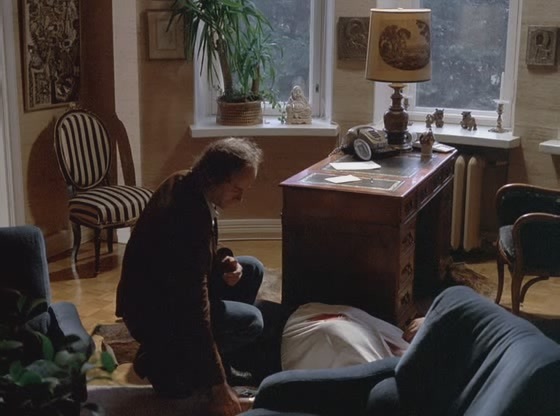
Buffet froid [Bertrand Blier, 1979]: 


Calamari Union [Aki Kaurismäki, 1985]:

Beginning with a quotation, "Dedicated to those ghosts of Baudelaire, Michaux and Prevert, who still hover over this Earth...", Calamari Union immediately finds a tone that's somewhere between parody and sincerity. It's also between the crushing realities of the 1980s - with its bleak prospects and lack of employment - and that typically French romanticism of men in long coats meeting in bars and cafes; attempting, in their own listless and world-weary way, to express the poetry of a different kind of despair.

The black and white cinematography of Timo Salminen plays into this same kind of language and iconography. It feels especially reminiscent of the films of the French New Wave, in its observational visual aesthetic, as well as in the presentation of the characters, their self-awareness and the non-specific subject matter (see also: Kaurismäki's production company at the time was called Villealfa; a nod to Jean-Luc Godard's post-modernist new wave classic, Alphaville, 1965).


Calamari Union [Aki Kaurismäki, 1985]:

More-so than any of his later films, it's difficult to really assume what Kaurismäki's intentions were with this strange Calamari Union. Was he simply trying to produce something that presented a surreal and sardonic experience that could be enjoyed without having to bring to it the same level of consideration needed for a film like Crime and Punishment, or is there a hidden depth to the film just waiting to be rediscovered and interpreted? While some audiences may see the film as a frivolous or even silly work - especially in light of the filmmaker's later, more humanist projects, such as his recent films Le Havre (2011) and The Other Side of Hope (2017) - I still find it somewhat fascinating, compelling and often bleakly funny.

If you wanted to bring a literal interpretation to the film, then Calamari Union could be seen as a representation of the cycle of life. The characters emerge from the womb - or, in this instance, their local pub - and travel by train through an underground tunnel into the wider world. Here they begin this strange journey into life (breaking away from the group - this surrogate family - meeting new people, forming relationships, making decisions, then eventually dropping dead).

You could also see the film as a treatise on the notion of individuality, with the earlier scenes showing the group to be very much a part of this single "union" - both anonymous to themselves and to the viewing audience - and each with the same shared goals and ambitions. Eventually, as they continue their odyssey of self-discovery, they find their own individual interests and directions through life, free of influence, and now able to form their own unique and distinctive personalities.

Wednesday, 6 June 2018

Art Cinema


Thoughts on a film: Shirley: Visions of Reality (2013)


Martin Scorsese once said: "Cinema is a matter of what's in the frame and what's out." It's a statement that I returned to several times within the context of the film in question, and also in relation to another quote, similarly attributed to a legendary filmmaker: "Everything is cinema."

The Scorsese quote is interesting, and speaks to the responsibilities of the filmmaker when approaching the necessities of 'coverage' - i.e. determining where to put the camera, what to emphasise within a given scene, where the point of interest is - as well as considering things such as context, ideology and intention. However, it's a statement that isn't exclusive to the practicalities of filmmaking, and there's the rub. What's in the frame, and what's out, could just as easily be applied to the practice of painting, or photography. It could even be said about the theatre; or at least the conventional theatre, restricted as it often is by the parameters of the stage.

In Shirley: Visions of Reality, the filmmaker Gustav Deutsch applies Scorsese's maxim to the rigorous recreation of several paintings by the artist Edward Hopper; using the notion of "what's in the frame" as a pretext to spin-off a series of interpretations and phantom narratives inspired by what Deutsch sees within the paintings themselves (the representations, the settings, the "protagonists", etc), but also what might be seen outside of them (the historical context, the politics of the age, the fundamentals of Hopper's own life). In doing so, my mind wanders back to that second hypothesis, "everything is cinema" - normally credited to one Jean-Luc Godard - and finds within it a kind of justification for this film and its central experiment.

Throughout the film, Deutsch and his collaborators painstakingly recreate thirteen of Hopper's most iconic paintings as a series of theatrical tableaux. Through further use of voice-over and physical performances, the filmmakers attempt to convey a consistent narrative that runs through each of the paintings in an effort to better explore the nuances and ambiguities of Hoppers own work against the possible historical and social-political contexts that surrounded them.


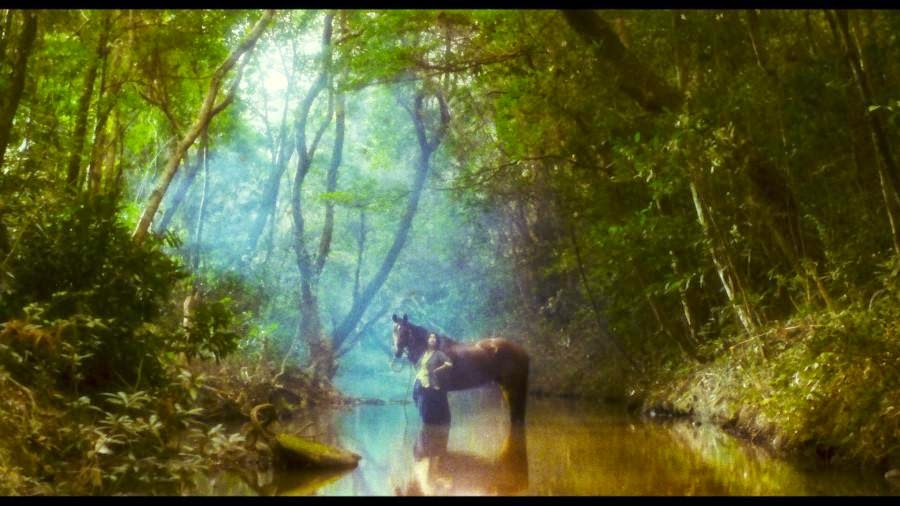
Shirley: Visions of Reality [Gustav Deutsch, 2013]:

I have to admit, as an experiment, and as a work of cinema in its own right, the film left me somewhat conflicted. On the one hand, I don't think the narrative that Deutsch attaches to Hopper's paintings is as interesting as the stories that are already conveyed or suggested by the art itself. Yes, the idea of linking the individual female subjects from several of Hopper's most important works (in order to create a kind of subconscious stand-in for the various themes the filmmaker has extrapolated from his own personal interpretations of the artist's iconography) is a clever one - creating a kind of symbolic representation of either the notion of womanhood in the mid-twentieth century, the 'voice' of the American theatre during its most turbulent and transformative period, or the personification of the country itself from the year 1931 through to 1963 (encapsulating both the pre and post-war periods) - it's never entirely compelling, as a dramatic device, or comprehendible, as a political statement.

Hopper's work already has a long association with the cinema. Several high-profile filmmakers - going back to Alfred Hitchcock's work of the 1940s and 50s; or more specifically, the whole legacy of directors, production designers and cinematographers associated with the development of the 'film noir' (think The Killers (1946) by Robert Siodmak for instance) - have tried to emulate Hopper's distinctive depiction of urban Americana and managed to capture something of that same nocturnal, melancholic air.


Nighthawks [Edward Hopper, 1942]:


The Killers [Robert Siodmak, 1946]:


Deep Red [Dario Argento, 1975]:


The End of Violence [Wim Wenders, 1997]:

When we think of the name Edward Hopper, there's a certain narrative of expectation that presents itself. It's a narrative of loneliness, alienation, longing and disappointment. Hopper's figures are often haunted, alone, disconnected from the society that surrounds them. They exist within settings that are often communal in nature - cafés, bars, cinemas, trains, office-spaces - but his figures are devoid of companionship; frozen almost, in time. They become like ghosts, haunting the landscape of an American Gothic, or like prisoners, trapped by circumstances and routines.

The filmmakers that have best translated Hopper's images to the screen have found a certain affinity for such characteristics and situations, or for that feeling of quiet desperation; the aching loneliness associated with being adrift in the big city. The silence of Hopper's paintings doesn't require a context or elucidation for us to possess a greater understanding or insight into these narratives of still life; it's all there in the expression; the ambience and the sensitivity, which is felt.


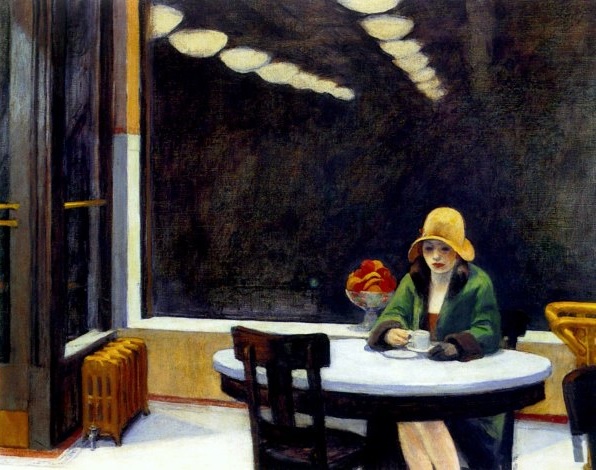
Automat [Edward Hopper, 1927]:


Shadows in Paradise [Aki Kaurismäk, 1986]:

While 'Shirley' does succeed in presenting a sense of the sadness, longing and disconnection associated with Hopper's paintings, there are whole sections of the narrative that are devoted to discussions of the American theatre, Communism, the House Un-American Activities Committee, the betrayals of Elia Kazan, the inferiority of the Hollywood system, the works of Emily Dickinson, the contradiction of the phrase "photography as truth", contemporary journalism, and a vague back-and-forth story about a couple unable to connect.

None of the themes or storylines that are here assigned to Hopper's work feel necessary to our own understanding of the images themselves. Instead, they present a kind of highbrow academic variation on the notion of fan-fiction; connecting the various dots, not because they feel explicit to the conception of Hopper's paintings, but because they're of interest to the filmmaker. This, in and of itself, is not an issue. However, the lines of interpretation that Deutsch attaches to Hopper's works aren't significantly well developed; instead feeling like vague traces or suggestions of something that never quite collates into a consistent narrative.

These fragments of a story play out against the further use of actual news bulletins that cover a whole stratum of American history (taking us from the tail end of the depression, to the outbreak of the Second World War; through the rise of feminism, the civil rights movement and the imminent assassination of president John F. Kennedy). It's difficult to understand what any of these cultural milestones have to do with Hopper's paintings or how we, as an audience, interpret them, but they seem significant to Deutsch's projection of the work and his own perception of this tumultuous period in the country's evolution.

Perhaps this is what the film's subtitle, 'Visions of Reality', is really getting at. The idea that the art, while depicting a simple, still life observation, becomes, in itself, a representation of the period in which it was created. These paintings, as cultural artefacts, do present, in the very literal sense, visions of reality; not just in their emphasis on small, seemingly inconsequential details that define one facet of the human condition, but as a recorded documentation of the attitudes, politics, fashion, styles, expressions and routines depicted in the work; as well as in the social, racial and economic backdrops that existed during their conception.


Shirley: Visions of Reality [Gustav Deutsch, 2013]:


Western Motel [Edward Hopper, 1957]:

While I'm left to question why Deutsch decided to interpret the woman in these paintings as an actress involved in radical left-wing theatre, or what her journeys through Hopper's landscapes are supposed to represent, or how these fragments of a story are supposed to tie the personal to the political, I did find the film strangely beguiling and always beautiful; even if the intellectual context of the work seemed elusive and largely impenetrable.

As a work of cinema, 'Shirley' is undoubtedly a masterpiece of form and stylisation. The use of light and shadow, the colour and texture, the compositions and general mise-en-scene, are all exquisite, both in their mimicry of Hopper's hugely recognisable aesthetic and as an example of pure cinematic craftsmanship. The detail and authenticity with which Deutsch and his cinematographer Jerzy Palacz have brought to life Hopper's work makes the supposedly grand stylisations of Wes Anderson - as typified by films such as The Life Aquatic with Steve Zissou (2004) and The Grand Budapest Hotel (2014) - look like an action-figure's diorama.

The sound-design is also worth highlighting. The ambient sounds of passing trains, street life, seagulls and crashing waves help to give a realistic depth to these abstractions of artificiality; bringing the world of the paintings to life, but still capturing something that is somewhat surreal, even dreamlike. I was less keen on some of the music selections - including, somewhat incongruously, the songs of David Sylvian - which despite capturing the same yearning loneliness inherent in the imagery, felt too modern in this particular context. Nonetheless, the film throughout has an almost hypnotic quality, intensified by the static compositions, slow zooms and languid cutting, as well as through the voice-over evocations of the actress Stephanie Cumming (who brings a captivating and enigmatic presence as the film's central figure).


Shirley: Visions of Reality [Gustav Deutsch, 2013]:

While I'll no doubt wrestle with the intellectual or political merits of this film for some time - with the same unanswered questions and peculiarities going back and forth through my own interpretation of Deutsch's work - there's a part of me that would relish the opportunity to see this again. Whether or not we reject the film as a work of imitation, or as a gimmick, or as something that is more art installation than conventional motion picture, there's no denying that this is a thought-provoking film of precise moments; some perplexing, others astounding.

One scene in particular stood out to me as something so beautiful that it elevated the entire experience of the film as a whole. It's a recreation of Hopper's 1963 painting, Intermission, in which this figure of Shirley finds herself alone in a cinema. As the unseen film begins to play, Shirley realises that the rest of the audience hasn't returned from the intermission. She's sat there - eager to share this experience with her fellow human beings - but she's all alone. In this brief moment, divorced from Deutsch's projected narrative, the combination of the beautiful cinematography, the impeccable production design, the music, the voice and subtleties of Cumming's performance, each work together to create a moment that is fragile, intimate, reflective, heartfelt, biting and perceptive. In a word: unforgettable.

Sunday, 8 April 2018

Crime and Punishment


A note on a film: Crime and Punishment (1983)

In a particularly impressive stroke, Kaurismäki's film - his first as director - begins with a scene taking place in some anonymous Helsinki slaughter house. In close-up, an insect crawls across a blood-splattered plinth. Almost immediately, a cleaver comes down and cuts the bug in two. Ominous music begins to overwhelm the soundtrack as we're subjected to an onslaught of emotionless, repetitive slaughter; a montage of drab, impassive young men in overalls cleaning meat from bone, sawing through sinew and hosing down pools of blood collected under a procession of strung-up animal carcasses.

This first scene introduces us to our central character, Rahikainen; a former lawyer turned butcher, still haunted by the loss of his young fiancé some several years before. However, it also introduces us to the theme of murder, central to both Kaurismäki's film, and the 1866 novel by Dostoevsky on which it is based. More specifically, it introduces us to the idea of murder as somehow existing to sustain balance; the order of murder, as it moves down the chain, from human, to animal, to insect, etc. It also introduces us to Kaurismäki's characteristically ironic and deadpan sense of humour; as he illustrates, in mundane miniature, the very essence of what the film - and, by extension, its esteemed source material - is effectively about.

Like the novel, Kaurismäki's modernised interpretation of Dostoevsky focuses on the attempts made by its central character to kill a principle. Not a specific person or target, but a concept; an ideology. Rahikainen's eventual murder of a seemingly anonymous businessman at first seems divorced from the more conventional justifications we might associate with the crime; such as vengeance and retribution. It doesn't seem motivated by anger or hatred, but instead seems an almost philosophical or moral provocation; an attempt to challenge the societal or evolutionary order of things, as the character sees it.

In this respect, the film predicts certain elements from Krzysztof Kieaelowski's startling Dekalog-spin off, A Short Film About Killing (1988), which probably owes some of its own influence to the work of Dostoevsky. Both films focus on young men cast adrift and unable to connect to a society that seems both cold and colourless, while both films share a thematic preoccupation with the correlation between crime and punishment itself.


Crime and Punishment [Aki Kaurismäki, 1983]:


A Short Film About Killing [Krzysztof Kieaelowski, 1988]:

The similarity feels obvious from the start. While Kaurismäki begins his film in a fully-functioning slaughter house, Kieaelowski famously begins his own film with the image of a dead cat hung from a railing (further accompanied by the sound of children running away in fits of mischievous laughter). Both films evoke the crime of murder, first in miniature, and as a precursor to later events, and both use these crimes against non-human entities to exemplify the loveless nature of the society that these characters are caught up in (Kieaelowski and his screenwriter Krzysztof Piesiewicz go one further by predicting the method of execution that will eventually be favoured by the state; turning their first image into both a personal and political foreshadowing.)

Similarly, the world created by both filmmakers is ugly and dehumanising. Kieaelowski and his cinematographer Sławomir Idziak favour grotesque colour filters that plunge areas of the frame into total darkness, while saturating the remaining image in a wash of green and yellow hues. Conversely, Kaurismäki favours heightened minimalism. His framing is flat and perfunctory, with shots and inserts used sparingly to provide illustration. He focuses on naturalistic location shooting to present an inherent drabness, or dreariness, that seems to suggest something about his protagonist; his lack of prospects and direction; the void of hope.


A Short Film About Killing [Krzysztof Kieaelowski, 1988]:


Crime and Punishment [Aki Kaurismäki, 1983]:

There's also something of Robert Bresson to Kaurismäki's particular aesthetic; not just here, but as it would subsequently develop through his later, better films; such as Ariel (1988), Drifting Clouds (1996) and The Man Without a Past (2002). The presentational nature of the imagery, the use of insert shots, the pace of the editing and the very flat, mannered, almost emotionless delivery of the actors, can't help but evoke Bresson's legacy of works, from Pickpocket (1959) through to L'argent (1983). Pickpocket specifically is said to have been inspired, in-part, by Dostoevsky, and the ending of that particular film is appropriately echoed here.


Pickpocket [Robert Bresson, 1959]:


Crime and Punishment [Aki Kaurismäki, 1983]:

At the end of Pickpocket, the character Michel - the titular thief - finds a kind of spiritual transcendence through incarceration. In this sense, Bresson's film probably has a touch the "existential" about it, as the character intentionally sets in motion a chain of events that will see about his own personal downfall, or a kind of punishment for some perceived weakness or failure. This, as a conception, recalls Dostoevsky, but it also evokes some of the ideas found in Jean-Paul Sartre's Being and Nothingness (published 1943) and the predicament of the character Meursault in Albert Camus's The Stranger (published 1942). Here the notion that "existence precedes essence", and the idea of a character committing a crime as almost primal scream (as well as an attempt to re-establish some kind of emotional balance within his own personal universe) seems to inform the philosophy of Bresson, and by extension, the philosophy of the film in question.   

As a debut, Crime and Punishment lacks much of the nuance and personality that would become characteristic of Kaurismäki's later cinema; which would really come into its own with the release of his third feature, Shadows in Paradise (1986). Subsequent works would take a similar approach to the one seen here, incorporating the same influence of Bresson and the milieu of socio-economic hardship as a backdrop to a more conventional filmic narrative, but would punctuate the deadpan humour and the mannered performance style with a sensitivity seemingly plucked from the quiet melodramas of Yasujirō Ozu (note the appearance of the red kettle in one of the screen captures featured above as an early nod to Ozu's cinema.)

Nonetheless, the film still provides a fascinating insight into Kaurismäki's early approach, his creative vision, and his particularly sardonic sense of ambition (a cavalier approach to adapting literary classics that would eventually carry through to his later, similarly modern and satirical adaptations of Shakespeare - Hamlet Goes Business, 1987 - and Henri Murger - La Vie de Bohème, 1992 - respectively). Crime and Punishment is a film very much worth experiencing, both in its own right, and as a way of introducing the rough essence of what an Aki Kaurismäki film is before approaching his subsequent, more interesting endeavours, such as those aforementioned.

Wednesday, 1 October 2014

Top Ten: 1994


Ranking the Decades
A Year in Film List + Image Gallery


Three Colours: Red [Krzysztof Kieślowski, 1994]:


Ed Wood [Tim Burton, 1994]:


Three Colours: White [Krzysztof Kieślowski, 1994]:


The Hudsucker Proxy [Joel & Ethan Coen, 1994]:


Through the Olive Trees [Abbas Kiarostami, 1994]:


Bullets Over Broadway [Woody Allen, 1994]:


Take Care of Your Scarf, Tatiana [Aki Kaurismäki, 1994]:


Pulp Fiction [Quentin Tarantino, 1994]:


Sátántangó [Béla Tarr, 1994]:


Ashes of Time + "Redux" [Wong Kar Wai, 1994-2008]:

Above, arranged in order of preference, my personal top-ten best films of the year (from what I've seen), accurate at the time of writing.

Saturday, 6 September 2014

Top Ten: 1996


Ranking the Decades
A Year in Film List + Image Gallery


A Moment of Innocence [Mohsen Makhmalbaf, 1996]:


A Summer's Tale [Éric Rohmer, 1996]:


Irma Vep [Olivier Assayas, 1996]:


Brigands-Chapter VII [Otar Iosseliani, 1996]:


Drifting Clouds [Aki Kaurismäki, 1996]:


Mission: Impossible [Brian De Palma, 1996]:


Don't Look Up (aka Ghost Actress) [Hideo Nakata, 1996]:


Karaoke / Cold Lazarus [Renny Rye, 1996]:


For Ever Mozart [Jean-Luc Godard, 1996]:


The Pillow Book [Peter Greenaway, 1996]:

Above, arranged in order of preference, my personal top-ten best films of the year (from what I've seen), accurate at the time of writing.

Thursday, 10 April 2014

Top Ten: 2002


Ranking the Decades
A Year in Film List + Image Gallery


Distant [Nuri Bilge Ceylan, 2002]:


Solaris [Steven Soderbergh, 2002]:


Workers, Peasants [Danièle Huillet & Jean-Marie Straub, 2002]:


Dark Water [Hideo Nakata, 2002]:


The Man Without a Past [Aki Kaurismäki, 2002]:


Waiting for Happiness [Abderrahmane Sissako, 2002]:


Spider [David Cronenberg, 2002]:


The Good Thief [Neil Jordan, 2002]:


Russian Ark [Alexander Sokurov, 2002]:


A Snake of June [Shin'ya Tsukamoto, 2002]:

Above, arranged in order of preference, my personal top-ten best films of the year (from what I've seen), accurate at the time of writing.

Schalcken the Painter (1979)

Schalcken the Painter [Schalcken the Painter [Leslie Megahey, 1979]: This is a film I first saw around four years ago. At the time I found...