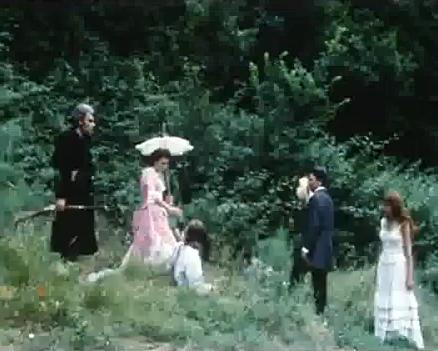
Two voices. One French, one American. A political tract concerning the issues of Communism in the workplace and ideals of freedom and equality, post-May, 1968, is recited back and forth over an obscured image of bodies slumbering in what appears to be a garden. The image is pastoral and idyllic in presentation, suggesting an almost abstract quality devoid of time and place. After a series of static images that simply observe these scenarios - largely with no real movement within the frame - we see a small group of actors preparing themselves for a film. As we continue, these actors, who speak Italian and are dressed in period costume, wander through this idyllic location as the narration goes on to discuss a cinema of revolution and the history of politics in cinema dating as far back as Sergei Eisenstein. Through this, the filmmakers are able to reflect on the notions of politics and history in both a cultural and cinematic sense; creating in the process a film that collapses elements of genuine historical fact, and superimposes them over the struggles and issues of the present day.
Two voices. Both French. The film here is one of a handful of collaborative efforts between the filmmakers Jean-Luc Godard and Jean-Pierre Gorin, who under the creative banner of The Group Dziga Vertov, would produce a number of essay-based films that looked specifically at contemporary political issues from a Marxist/Leninist perspective. Unlike Godard's more socially aware films, pre-1967, The Dziga Vertov Group would reject conventional filmmaking practices altogether; focusing instead on a deconstructive approach that relied heavily upon the use found sounds and images that were cut together with the appropriate use of voice over and ironic screen-titles that not only offer some kind of background to the events unfolding, but also worked against the audience, distracting and disarming the viewer from what was happening on screen. This makes the viewing process even more difficult, with the already weighty bombardment of spoken information and the miscommunication of the two voices already alienating those of us unfamiliar with Communist manifestos or the working conditions in Europe in 1969.
Despite the general ideology of the Dziga Vertov Group, which was to reject the claim of authorship that Godard and his generation of critics had previously helped to define, the images of Le vent d'est (The East Wind/The Wind from the East, 1970) are typical of the man who gave us La chinoise (1967), and later Le gai savoir (The Joy of Learning, 1969), with the pastoral settings suggesting elements of the final act of Week End (1967), while the continual punctuation of high-rise apartment buildings and the wheels of industry that feature in the second half of the film call to mind a similar devise used in the earlier 2 or 3 Things I Know About Her (2 ou 3 choses que je sais d'elle, 1967). However, whereas those films had used clever visual metaphors and deconstructive film techniques to tell stories as a means of conveying socio-political satire, they did so with a vague semblance of narrative.
Here, the film is mostly a continual stream of thought over some beautifully composed images. Naturally, there are numerous other devises used that are typical of Godard's work, both before and after his period with the Group, such as the use of repeated images (or motifs), looped dialog (so that the same words or phrases are repeated a number of times throughout), inter-titles (here, illegibly scrawled in marker pen), the presentation of the camera as part of the proceedings (the "general assembly", as Godard puts it) and the natural facade of cinema as presented by print damage, spliced frames and deliberate mistakes (the deconstructive notion of cinema as truth).
Without question, the images of the film are simply astounding, and are easily amongst the most beautiful and provocative scenarios that Godard has ever created; with the single image of these ancient, anachronistic figures, Bergman-like in their presentation of white gowns against green hills, wandering through these glorious fields being a particularly astounding sight, eventually giving way to the more aggressive, deconstructive images of mass graves, construction and the general process of film production itself, pushing us back towards the direction of Week End. However, despite the brilliance of Godard's filmmaking and the range of his ideas, Le vent d'est - like many of these Dziga Vertov Group films - is incredibly difficult to recommend to a potential audience, despite the obvious quality of its production. The continual bombardment of voice-over narration - delivered in a flat, rapid fire Parisian (American?) accent from an unaccredited voice actress - reminds us that this is a visual essay, presented in the form of a radical, experimental film. As a result, most viewers will find the film a complete chore; more so than any other Godard film, all of which require a certain level of cooperation from the audience, but tend to reward our efforts with an element of human concern.
Even when presented in such a way as to be completely obvious to the point of almost agitprop sloganeering, Le vent d'est nonetheless retains some level of ambiguity; drawing parallels between the two winds - the east and the west - and the voices on the soundtrack, with Godard and Gorin again using the film to investigate the present day struggle by way of the past (a past as represented by the cinema itself). The film isn't to be approached in the conventional sense, but rather digested in two or three single sittings, with any real attempt to interpret the film, or pick up on every single topical reference, really requiring a lot more energy and perception as illustrated in this post. Arguable, the film is dated in the political sense - having now become a period piece that looks at a specific era in twentieth-century existence - however, it is also a truly uncompromising work from a collective of filmmakers attempting to communicate something radical through the medium of film. Even if you disregard the experience, you have to marvel at the presentation of Godard's images, and the conviction of his ideals.
Showing posts with label Dziga Vertov Group. Show all posts
Sunday, 23 August 2009
Saturday, 22 August 2009
Pravda
Essentially a travelogue of images of the Soviet Union, coupled with a voice-over narration explaining the current political climate of Eastern Europe, delivered by an unaccredited North American voice actor who presents his findings in a formal, matter-of-fact approach that suggests the dictation of a letter. Again, this is a filmed essay; an investigatory piece looking into the whys and wherefores of certain socialist issues of class and employment, and how such factors contribute to a recognisable way of life. This involves everything from cars, jobs, homes and industry; all presented as a rolling collage of images that repeat themselves throughout the course of the film, as the discourse on the soundtrack continues.
Although it has some merit as a period piece, this is probably one of the least interesting films from The Dziga Vertov Group; the outlet for filmmakers Jean-Luc Godard and Jean-Pierre Gorin to analyse certain Marxist-Leninist concepts within the cinematic medium, resulting in a collection of films that are either mildly interesting or completely forgettable, depending on the tastes of the particular viewer.
Pravda (1971), the title being the same as the leading Soviet / Russian newspaper, previously referred to in Godard's own pop-art science fiction film Alphaville (1965), in which the translation, "The Truth", is used as an ironic comment on the part of the filmmakers to the images and ideas on screen, works towards an often slyly amusing contrast between the pictures we see and the voice we hear underlining the intentions of the filmmakers in their quest for understanding. It is presented as a collection of seemingly found images, conspicuous in their typically bold, Godardian use of colour and composition, combined with the use of still photography, archive footage, TV clips and jarring bursts of music. The filmmaking devises are all emblematic of Godard's work, both before and after his time with the Dziga Vertov group, and show the definite stamp of authorship that belies the group manifesto and their rejection of the auteur-based cinema that Godard helped to define.
Unlike other films produced by Godard and Gorin during this highly productive period, Pravda simply doesn't hold up to repeated viewings. Projects like Un Film comme les autres (A Film Like Any Other, 1968), Vladimir and Rosa (1970), Tout va bien (Everything is Going Well, 1972) and Ici et ailleurs (Here and Elsewhere, 1976) (the latter produced from the remnants of an aborted Dziga Vertov project that conspires to pick apart the failings of these particular films) managed to overcome the limitations of their political ideologies and the complete disregard for the recognisable conventions of film-making to show the evolution of Godard from a too-clever-for-his-own-good cinephile into some kind of continually probing film poet; mixing words and images to create deeply felt investigations into love, war, death, religion and the complexities of the human condition. Pravda, on the other hand, is simply an information piece. Unless you're incredibly interested in 1960's politics or montage-film-making then there's very little here to keep us interested; with the continual collection of images and constant reliance on voice-over narration to supply information and opinion eventually becoming tiring, even from the perspective of a dedicated admirer of Godard's work, such as myself.
Although films like Vladimir and Rosa, Tout va bien and Ici et ailleurs are incredibly exhausting experiences, filled with dense thought, expressions, and rejections of conventional film-making, they nonetheless reward the viewer with a style and conviction that is unlike anything else presented in contemporary cinema. Later, Godard would reject many of these Dziga Vertov films as a naive attempt to make sense of things, while the filmmaking techniques would be refined through the creation of the films made in collaboration with Anne-Marie Miéville, such as Numéro deux (1975), Comment ça va? (1976) and the twelve part television series France/Tour/Detour/Deux/Enfants (1978) - some of the most probing, challenging and fascinating works of Godard's career.
Pravda is the Dziga Vertov group at their most obvious; there's none of the bold film-making experiments of Vladimir and Rosa or the daring aggression of the flawed Wind from the East (Le vent d'est, 1969), with the whole thing instead becoming a largely quaint collection of sounds and images. As a result, it will probably be of incredibly limited interest to the majority of viewers, Godard appreciators included.
Although it has some merit as a period piece, this is probably one of the least interesting films from The Dziga Vertov Group; the outlet for filmmakers Jean-Luc Godard and Jean-Pierre Gorin to analyse certain Marxist-Leninist concepts within the cinematic medium, resulting in a collection of films that are either mildly interesting or completely forgettable, depending on the tastes of the particular viewer.
Pravda (1971), the title being the same as the leading Soviet / Russian newspaper, previously referred to in Godard's own pop-art science fiction film Alphaville (1965), in which the translation, "The Truth", is used as an ironic comment on the part of the filmmakers to the images and ideas on screen, works towards an often slyly amusing contrast between the pictures we see and the voice we hear underlining the intentions of the filmmakers in their quest for understanding. It is presented as a collection of seemingly found images, conspicuous in their typically bold, Godardian use of colour and composition, combined with the use of still photography, archive footage, TV clips and jarring bursts of music. The filmmaking devises are all emblematic of Godard's work, both before and after his time with the Dziga Vertov group, and show the definite stamp of authorship that belies the group manifesto and their rejection of the auteur-based cinema that Godard helped to define.
Unlike other films produced by Godard and Gorin during this highly productive period, Pravda simply doesn't hold up to repeated viewings. Projects like Un Film comme les autres (A Film Like Any Other, 1968), Vladimir and Rosa (1970), Tout va bien (Everything is Going Well, 1972) and Ici et ailleurs (Here and Elsewhere, 1976) (the latter produced from the remnants of an aborted Dziga Vertov project that conspires to pick apart the failings of these particular films) managed to overcome the limitations of their political ideologies and the complete disregard for the recognisable conventions of film-making to show the evolution of Godard from a too-clever-for-his-own-good cinephile into some kind of continually probing film poet; mixing words and images to create deeply felt investigations into love, war, death, religion and the complexities of the human condition. Pravda, on the other hand, is simply an information piece. Unless you're incredibly interested in 1960's politics or montage-film-making then there's very little here to keep us interested; with the continual collection of images and constant reliance on voice-over narration to supply information and opinion eventually becoming tiring, even from the perspective of a dedicated admirer of Godard's work, such as myself.
Although films like Vladimir and Rosa, Tout va bien and Ici et ailleurs are incredibly exhausting experiences, filled with dense thought, expressions, and rejections of conventional film-making, they nonetheless reward the viewer with a style and conviction that is unlike anything else presented in contemporary cinema. Later, Godard would reject many of these Dziga Vertov films as a naive attempt to make sense of things, while the filmmaking techniques would be refined through the creation of the films made in collaboration with Anne-Marie Miéville, such as Numéro deux (1975), Comment ça va? (1976) and the twelve part television series France/Tour/Detour/Deux/Enfants (1978) - some of the most probing, challenging and fascinating works of Godard's career.
Pravda is the Dziga Vertov group at their most obvious; there's none of the bold film-making experiments of Vladimir and Rosa or the daring aggression of the flawed Wind from the East (Le vent d'est, 1969), with the whole thing instead becoming a largely quaint collection of sounds and images. As a result, it will probably be of incredibly limited interest to the majority of viewers, Godard appreciators included.
Friday, 20 March 2009
British Sounds
"Photography is not the reflection of reality... it is the reality of the reflection."
Quoted above is one of the many confrontational ideologies at the political and philosophical centre of British Sounds (1970) - the Dziga Vertov Group's lengthy polemic on socialism, feminism, equality and the class struggle, post May 1968 - in which the creative emphasis is placed on a continual conflict between the content and the presentation, illustrated in this instance by the further conflict between the film and the viewer. A film where the particular struggle is created by a continually warring juxtaposition between sound and image; with the drab, straightforward formalism of the filmmaker's sub-documentary style arrangement of the images conflicting with the often avant-garde approach to the soundtrack, which here combines lengthy snippets of dialogue and discussions on the various topical subjects listed above, amidst a continual background cacophony of nondescript sounds, musical tones and electronic textures.
The contrast is most apparent in the first half of the film, in which the filmmakers illustrate the central struggle within the narrative by a lengthy tracking-shot through the MG assembly line at the British Motor Car Company in Cowley, Oxford, wherein a barrage of contradictory sounds seem determined in their attempt to make the experience of viewing the film as dissonant and jarring as possible. However, as the film progresses, the idea of contrast - as one idea discussed on the soundtrack is placed against another idea presented on screen - will eventually reveal itself to be one of the central creative concerns of the film. As one would no doubt expect from such a presentation, British Sounds abandons any obvious notion of character and narrative in the conventional sense, with the film instead structured around six major sequences each presented in a similar approach, in which an uncomplicated visual tableau is set against a complicated soundtrack of ideas and expressions to illustrate and eventually educate the audience on the cultural issues of the day.
In a somewhat similar scenario to Godard's earlier film, Le gai savoir (The Joy of Learning, 1969), British Sounds was originally created for television - in this instance the UK's London Weekend Television (or LWT) - though was never officially broadcast as a result of the unconventional approach of its production and the challenging nature of its ideas. This fact is immediately recognisable from the opening sequences, in which Godard and his collaborator Jean Henri Roger confront us with a prolonged ten-minute track through the process of industrial manufacture, over which we hear various recorded arguments on worker's rights and ethics, a back and forth dialog between an adult and a child (further expressing the idea of education) and excerpts from the Communist manifesto being recited on the soundtrack.
Amidst this confusion the screen is occasionally disrupted by examples of agitprop sloganeering to punctuate the monotony of the images, with call and response statements like "what is work?" and "work is struggle" crudely hand-written in black marker pen to draw the obvious parallels with the student protestors and their home-made placards featured later in the film.
This opening sequence is an important one and as a result remains perhaps the most iconic moment in the film. It illustrates the political subtext of the project and the central idea of socialism in action: as the workers toil in the factories, producing cars that they'll never afford, for customers that will never appreciate the work or the craftsmanship that goes into their creation. It also plays on the symbol of the MG itself, of old England, of a certain kind of person and lifestyle that we never see depicted herein, but an idea that is contrasted perfectly by the later sequence in which we witness the workers engaging in a lengthy discussion about their rights in a capitalist society, and how the bourgeoisie, in opposition to a socialist regime, have harvested the power and wealth away from the working class proletarians in order to greater benefit for themselves. The argument presented in this scene, and the conviction and emotion of these people arguing a case for a structure that they believe in, is entirely compelling and no doubt convincing enough to inspire a serious desire on the part of the audience to read more into socialist politics and the subjects at hand.
The opening scene also works on a different level; in illustrating the creative act at its most honest and unpretentious. Like the writing of Sympathy for the Devil in the earlier Godard-directed One Plus One (1968), the tracking shot illustrates the spirit of creation and collaboration as the ultimate metaphor for the politics of the filmmakers and for the dynamics of the film itself; as the images are literally manufactured before our very eyes, documenting the creative process through its various stages until we end on a shot of the final, finished product. It allows us to contemplate the level of work, the creation of this everyday object - the motorcar, something that we so often take for granted - and see the process of work and deliberation that goes into its completion. On a personal level, it also brings to mind the infamous tracking shot in Godard's own masterpiece Week End (1967), establishing the rather perverse idea of where these cars are going, the congestion and confusion, and the image of the MG driven by the lover of Juliet Berto crushed under the weight of an industrial tractor.
Along with the opening scene in the car factory and the discussion between the proletarians that will eventually follow, the other key sequence here is the discussion between the student protestors who, once again, in a show of the creative cycle as presented on film, attempt to rewrite a contemporary pop song in a way that better represents the turbulent social and political climate of the day. As they strum guitars and stencil out placards and banners, we're immediately back in the realms of La Chinoise (1967); with Godard and Roger taking these kids with big ideas and good intentions and exposing the ultimate emptiness of their actions and the smug, pretentious, romanticised view of the working classes by these upper-middle class students, slumming it in an attempt to gain self-gratification from their "comrades" and peers. For all their desire for change and their belief in a socialist system, they are a world away from the hard-working proletarians; separated by class and circumstance, sat writing their trivial songs and making ironic slogans while the real working-classes are toiling in the factories and in the fields. No time for protest; they work because they have to, to make a living for themselves and for their families
In the later sequences, we have an even more obvious attempt to deconstruct the film, with staged news bulletins offering the anti-socialist sentiment of the bourgeois classes, with the bile and vitriol expressed in these sequences tying into the ideologies of someone like Enoch Powell and his infamous "rivers of blood" speech of April 1968; as well as prefiguring the rise of the conservative party, the reign of Margaret Thatcher, the arrival of New Labour and the empty promise that "things can only get better." Such sequences are obvious perhaps, taking the film into the realms of pure agitprop and sitting uncomfortably alongside the other sequences described above, not to mention the lengthy sequence of post-feminist deconstruction presented in the second half of the film. Here, the filmmakers take the image of the naked female form and attempts to desexualise it through a continual soundtrack of sexual politics, equality and discussions about the objectification of women, voiced by a female student in a flat, upper-middle class accent, again showing the slant of the so-called educated thinker as the bourgeoisie.
As it stands, British Sounds, like much of the work of the Dziga Vertov Group, remains a fascinating if inconsistent look into the social climate and political situations of the late 1960s and early 1970s. Its appeal will therefore be limited; with the constant reliance on the voiceover to explain the situations, the presentation will no doubt turn many potential viewers away from the film, with many perhaps becoming bored by the endless representations of socialism, communism and Marxist-Leninist concepts (the alternative title for the film is "See You at Mao!") that are expressed throughout. Nonetheless, it is an oddly absorbing film, filled with ideas and images that have the power to inspire everything from thought to criticism, dismissal and debate, as the overriding notion of a cinema of life as it appears is articulated in Godard's typical style of direct and indirect expression.
Quoted above is one of the many confrontational ideologies at the political and philosophical centre of British Sounds (1970) - the Dziga Vertov Group's lengthy polemic on socialism, feminism, equality and the class struggle, post May 1968 - in which the creative emphasis is placed on a continual conflict between the content and the presentation, illustrated in this instance by the further conflict between the film and the viewer. A film where the particular struggle is created by a continually warring juxtaposition between sound and image; with the drab, straightforward formalism of the filmmaker's sub-documentary style arrangement of the images conflicting with the often avant-garde approach to the soundtrack, which here combines lengthy snippets of dialogue and discussions on the various topical subjects listed above, amidst a continual background cacophony of nondescript sounds, musical tones and electronic textures.
The contrast is most apparent in the first half of the film, in which the filmmakers illustrate the central struggle within the narrative by a lengthy tracking-shot through the MG assembly line at the British Motor Car Company in Cowley, Oxford, wherein a barrage of contradictory sounds seem determined in their attempt to make the experience of viewing the film as dissonant and jarring as possible. However, as the film progresses, the idea of contrast - as one idea discussed on the soundtrack is placed against another idea presented on screen - will eventually reveal itself to be one of the central creative concerns of the film. As one would no doubt expect from such a presentation, British Sounds abandons any obvious notion of character and narrative in the conventional sense, with the film instead structured around six major sequences each presented in a similar approach, in which an uncomplicated visual tableau is set against a complicated soundtrack of ideas and expressions to illustrate and eventually educate the audience on the cultural issues of the day.
In a somewhat similar scenario to Godard's earlier film, Le gai savoir (The Joy of Learning, 1969), British Sounds was originally created for television - in this instance the UK's London Weekend Television (or LWT) - though was never officially broadcast as a result of the unconventional approach of its production and the challenging nature of its ideas. This fact is immediately recognisable from the opening sequences, in which Godard and his collaborator Jean Henri Roger confront us with a prolonged ten-minute track through the process of industrial manufacture, over which we hear various recorded arguments on worker's rights and ethics, a back and forth dialog between an adult and a child (further expressing the idea of education) and excerpts from the Communist manifesto being recited on the soundtrack.
Amidst this confusion the screen is occasionally disrupted by examples of agitprop sloganeering to punctuate the monotony of the images, with call and response statements like "what is work?" and "work is struggle" crudely hand-written in black marker pen to draw the obvious parallels with the student protestors and their home-made placards featured later in the film.
This opening sequence is an important one and as a result remains perhaps the most iconic moment in the film. It illustrates the political subtext of the project and the central idea of socialism in action: as the workers toil in the factories, producing cars that they'll never afford, for customers that will never appreciate the work or the craftsmanship that goes into their creation. It also plays on the symbol of the MG itself, of old England, of a certain kind of person and lifestyle that we never see depicted herein, but an idea that is contrasted perfectly by the later sequence in which we witness the workers engaging in a lengthy discussion about their rights in a capitalist society, and how the bourgeoisie, in opposition to a socialist regime, have harvested the power and wealth away from the working class proletarians in order to greater benefit for themselves. The argument presented in this scene, and the conviction and emotion of these people arguing a case for a structure that they believe in, is entirely compelling and no doubt convincing enough to inspire a serious desire on the part of the audience to read more into socialist politics and the subjects at hand.
The opening scene also works on a different level; in illustrating the creative act at its most honest and unpretentious. Like the writing of Sympathy for the Devil in the earlier Godard-directed One Plus One (1968), the tracking shot illustrates the spirit of creation and collaboration as the ultimate metaphor for the politics of the filmmakers and for the dynamics of the film itself; as the images are literally manufactured before our very eyes, documenting the creative process through its various stages until we end on a shot of the final, finished product. It allows us to contemplate the level of work, the creation of this everyday object - the motorcar, something that we so often take for granted - and see the process of work and deliberation that goes into its completion. On a personal level, it also brings to mind the infamous tracking shot in Godard's own masterpiece Week End (1967), establishing the rather perverse idea of where these cars are going, the congestion and confusion, and the image of the MG driven by the lover of Juliet Berto crushed under the weight of an industrial tractor.
Along with the opening scene in the car factory and the discussion between the proletarians that will eventually follow, the other key sequence here is the discussion between the student protestors who, once again, in a show of the creative cycle as presented on film, attempt to rewrite a contemporary pop song in a way that better represents the turbulent social and political climate of the day. As they strum guitars and stencil out placards and banners, we're immediately back in the realms of La Chinoise (1967); with Godard and Roger taking these kids with big ideas and good intentions and exposing the ultimate emptiness of their actions and the smug, pretentious, romanticised view of the working classes by these upper-middle class students, slumming it in an attempt to gain self-gratification from their "comrades" and peers. For all their desire for change and their belief in a socialist system, they are a world away from the hard-working proletarians; separated by class and circumstance, sat writing their trivial songs and making ironic slogans while the real working-classes are toiling in the factories and in the fields. No time for protest; they work because they have to, to make a living for themselves and for their families
In the later sequences, we have an even more obvious attempt to deconstruct the film, with staged news bulletins offering the anti-socialist sentiment of the bourgeois classes, with the bile and vitriol expressed in these sequences tying into the ideologies of someone like Enoch Powell and his infamous "rivers of blood" speech of April 1968; as well as prefiguring the rise of the conservative party, the reign of Margaret Thatcher, the arrival of New Labour and the empty promise that "things can only get better." Such sequences are obvious perhaps, taking the film into the realms of pure agitprop and sitting uncomfortably alongside the other sequences described above, not to mention the lengthy sequence of post-feminist deconstruction presented in the second half of the film. Here, the filmmakers take the image of the naked female form and attempts to desexualise it through a continual soundtrack of sexual politics, equality and discussions about the objectification of women, voiced by a female student in a flat, upper-middle class accent, again showing the slant of the so-called educated thinker as the bourgeoisie.
As it stands, British Sounds, like much of the work of the Dziga Vertov Group, remains a fascinating if inconsistent look into the social climate and political situations of the late 1960s and early 1970s. Its appeal will therefore be limited; with the constant reliance on the voiceover to explain the situations, the presentation will no doubt turn many potential viewers away from the film, with many perhaps becoming bored by the endless representations of socialism, communism and Marxist-Leninist concepts (the alternative title for the film is "See You at Mao!") that are expressed throughout. Nonetheless, it is an oddly absorbing film, filled with ideas and images that have the power to inspire everything from thought to criticism, dismissal and debate, as the overriding notion of a cinema of life as it appears is articulated in Godard's typical style of direct and indirect expression.
Subscribe to:
Posts (Atom)
Schalcken the Painter (1979)
Schalcken the Painter [Schalcken the Painter [Leslie Megahey, 1979]: This is a film I first saw around four years ago. At the time I found...
-
Beginning with a vague preamble on the use of digital video in achieving that contrast between the abstract and the real... One of the mos...
-
A short note on several films by Eric Rohmer I'm not entirely sure if this blog post constitutes a 'return' in the perman...
-
A Mystery? To talk about the cinema's present, one must first acknowledge its past. Roundhay Garden Scene (1888), one of the oldest...