Showing posts with label M. Night Shyamalan. Show all posts

Wednesday, 27 January 2021

The Box Office Bomb


The Current Cinema

In a recent article for The Guardian, Smash hit or total turkey? In the age of streaming it's impossible to tell, journalist Steve Rose posits: "With the box office closed and only secretive viewing figures to go on, gauging a film’s success is becoming a tricky proposition."

Writing with all the conviction and integrity of a man that's been asked by his editor to turn in 500 words on literally anything to get readers clicking and commenting (thus generating that all important advertising revenue), Rose – using the limited cinema release of the recent superhero spectacle Wonder Woman 1984 (2020) as a point of inception – asks: "Here is the question: was Wonder Woman 1984 a hit movie? How did it compare to the first Wonder Woman? Or how about Soul, or Ma Rainey’s Black Bottom? Were they hits? How can we tell?"


Wonder Woman 1984 [Patty Jenkins, 2020]:

Rose continues, his disinterest in his own question(s) palpable in the snark needlessly injected into every sentence. "In ordinary times we wouldn’t have to ask; we would have box-office figures to go by. Now, the pandemic has hobbled cinema-going, and for most of us the only way to access new movies is via streaming services, which tend to guard their numbers as if they’re nuclear launch codes."

There is an interesting conundrum at the heart of Rose's article that's worth engaging with. The way audiences engage with cinema, and with media in general, has been changing for some time. But discussing the changing trends of popular culture isn't of interest to writers like Rose, who merely churn out clickbait considerations they don't even agree with. No, the real crux of Rose's writing comes, like a lot of recent Guardian articles about the state of cinema, from a place of deep, professional fear.

You see, what Rose and his cronies like Peter Bradshaw and Mark Kermode are really terrified of, is that in an age where audiences get access to a work before journalists and reviewers, where box office figures become meaningless, and where audiences are able to cultivate their own personal and private cinema free of influence or the condemnation of would-be tastemakers, the only way to really write about and promote a particular work is by investing our own subjective thoughts and opinions into the experience of it.

Writing about whether or not a film is a "hit" or a "turkey" will be replaced by deeper considerations of what the film means to the viewer on an individual level; how well it engages the personal and political, how well it employs form and aesthetics. The noise of the industry and the corporate concerns and consensus-shaping that hack journalists have made their bread and butter over the past two decades will be entirely irrelevant.

Rose exposes himself and many of his similarly minded contemporaries completely when he writes: "one of the great things about box-office figures is that they offer nowhere to hide. There is no disputing a franchise-spawning smash such as The Matrix or Avatar, or disguising a bomb such as Cats. We celebrate those successes and revel in those failures together. It’s Darwinian but democratic. It binds us as a society. With streaming, we might get exactly the same good and bad movies, but served as more of an algorithmically curated mulch of “meh”, which nobody consumes in the same way. That doesn’t bode well for the future of movies as popular culture."


Avatar [James Cameron, 2009]:


Cats [Tom Hooper, 2019]:

Of course, Rose doesn't explain why this development doesn't bode well for popular culture. Having fulfilled his word limit, he simply ends his argument on a cliffhanger, his total indifference and disdain for his own readership obvious throughout. But the future he describes is really not that dissimilar to our own recent past.

Just over 20 years ago, before the internet became such a pervasive part of both our lives and the way we share and access information, most audiences didn't follow box-office trends. Unless you were an industry insider, had a subscription to Variety or other high-minded film publications, or approached the cinema as an investment opportunity, most audiences had little to no idea how much a film cost or how much it made. Unless it became an infamous failure, like Heaven's Gate (1980) by Michael Cimino, or a box-office phenomenon, like Steven Spielberg's Jurassic Park (1993), it simply wasn't a part of the conversation.

For context, a film like Misery (1990), which cost $20million to produce and made $61million at the box-office, nonetheless became a genuine event movie. It had a massive impact on popular culture and was widely parodied and referenced in a variety of other media. Similarly, a film like The Shawshank Redemption (1994), which cost $25million and made $58million, was considered a box-office disappointment, despite finding a more appreciative audience on home video and now being seen as one of the best American films of all time. In the days before sites like Box-Office Mojo, The Numbers and even Wikipedia logging a film's budget and box-office from the off, a work was still able to have a life and find an audience and legacy beyond its opening weekend.


Misery [Rob Reiner, 1991]:


French and Saunders: Misery [Bob Spiers, 1993]:


Family Guy: Three Kings [Dominic Bianchi, 2009]:

Similarly, before the introduction of the aptly named Rotten Tomatoes, which Rose himself acknowledges as flawed in his own article, there was no way of knowing for certain whether or not a film had an overwhelming critical consensus. Most people would trust the word of a couple of critics that they read or listened to regularly, or they'd take the word-of-mouth recommendations from video store employees or the endorsements of friends and family.

Before Rotten Tomatoes or Meta Critic, films weren't assigned a number or percentage based on the subjective opinions of a small handful of reviewers. Nothing was set in stone. Which is why films like Blade Runner (1982), The Thing (also 1982), Scarface (1983) and Twin Peaks: Fire Walk with Me (1992) could divide critical opinion, and still go on to become considered genuine modern masterworks by subsequent generations of critics. Stanley Kubrick’s landmark horror film The Shining (1980) received worse reviews than many M. Night Shyamalan films, but as it was never defined for subsequent generations as a 40% or even 20% "rotten" movie, it was able to be discovered by unbiased audiences unfamiliar with its critical legacy. Something that isn't possible for Shyamalan's masterworks, like The Village (2004) and Glass (2019), which have been firmly canonized and recorded as failures.


The Shining [Stanley Kubrick, 1980]:


The Village [M. Night Shyamalan, 2004]:

So, Rose's summation is complete bullshit. The way we approached movies changed massively in the age of the internet, and it indeed continues to change and evolve as both the technology and generational viewing habits change with it.

For my generation and older, there's a clear delineation between cinema and television; between the videos we watch on social media and those produced by professional broadcasters. For younger generations, this isn't the case. The "movies", as a medium, occupy a very narrow window of their interests. They compete with social media, TikTok and YouTube creators, Instagram, video games and facetime with friends. Whether young people see the latest Star Wars or Pixar movie at the cinema, at home on the television, or on laptops and mobile devises, is irrelevant. All that matters is that they're able to see the film as soon as it's available, regardless of the platform or method of delivery.

Personally, I find this new development exciting. Removing unnecessary conversations around box-office and critical consensus removes the barriers that previously denied certain works a space for discussion and analysis. Now we can watch the latest film by Marvel, DC, Pixar, or Disney, alongside films and serials made specifically for Amazon or Netflix, or more interesting and experimental works released on MUBI or via Blu-ray by companies like the BFI, Second Run, and others. We don't have to go into a work with our expectations already tainted by some website calling the film a "hit" or a "Turkey", but can go in fresh, deciding for ourselves what is a hit, and cultivating our own network of trusted movie-watchers to point us towards works of real interest.

There's no longer a need to draw a line between something accessible and mainstream, like Wonder Woman 1984 and Soul (both 2020), and a film like the Spanish-language Netflix production The Invisible Guardian (2017), the British, refugee-themed horror movie, His House (2020), or the difficult to categorize Bertrand Bonello art-house movie, Nocturama (2016), all of which are currently available to stream. Removed from the necessity to discuss budgets and box-office, awards and critical consensus, all these works are simply films, there to be watched and ranked and discussed, and valued entirely on their content, their stories, and their aesthetics. It's like an act of liberation.

Further reading at Lights in the Dusk: Fin de cinema [08 October 2020], The Current Cinema [09 January 2020]

Sunday, 11 October 2020

On contemporary cinema: Superheroes and the denial of humanity


Thoughts on a quote by Alan Moore
 
Every few years, the former comic book writer, Alan Moore, comes out of retirement to give an interview in which he effectively pours fuel on the detritus of the modern comic book industry, superheroes and the general state of popular culture, and takes a flame to it. Recently interviewed for Deadline.com, the writer was there to talk about a new project that he's been working on; a surreal, independently produced fantasy film called The Show (2020). The conversation however soon turned (or more accurately, was pushed) towards the ubiquity of the modern superhero movie, to which Moore made his feelings plainly felt.
 
"Most people equate comics with superhero movies now. That adds another layer of difficulty for me. I haven’t seen a superhero movie since the first Tim Burton Batman film. They have blighted cinema, and also blighted culture to a degree. Several years ago, I said I thought it was a really worrying sign, that hundreds of thousands of adults were queuing up to see characters that were created 50 years ago to entertain 12-year-old boys. That seemed to speak to some kind of longing to escape from the complexities of the modern world, and go back to a nostalgic, remembered childhood. That seemed dangerous, it was infantilizing the population.
 
This may be entirely coincidence but in 2016 when the American people elected a National Socialist satsuma and the UK voted to leave the European Union, six of the top 12 highest grossing films were superhero movies. Not to say that one causes the other, but I think they’re both symptoms of the same thing – a denial of reality and an urge for simplistic and sensational solutions."
 
 
Publicity image of Alan Moore in The Show [Mitch Jenkins/ Protagonist Pictures, 2020]:
 
Unsurprisingly, many commentators and fans of the modern comic book cinema have accused Moore of hypocrisy and called him out for criticizing something that he's admittedly unfamiliar with. While there's an objective truth to this critique against Moore, I don't think the writer necessarily needs to see any of the recent run of highly acclaimed and hugely successful comic book movies for his point to be more or less valid. He isn't arguing against the objective quality of these films, nor the method of delivery, but rather their oversaturation of the marketplace, the politics of the medium, their ideology and corporate intent.
 
Some comic book films, on occasion, might grapple with the moral ambiguities of the superhero as a vigilante, or the lengths that superheroes take in the war on crime, but they don't make them the subject matter or the narrative that defines the whole.
 
As one example, Christopher Nolan's film, The Dark Knight (2008), is a genuinely great work that has aged incredibly well. While occasionally weighed down by unnecessary exposition and narrative contrivances, Nolan's film nonetheless emerges as an engaging and powerful treatise on the morality of vigilantism, the dualism between good and evil, and the reality of how readily the former can be corrupted by tragic circumstances. The subtext is alive with issues of post-millennium terror, giving the action a much deeper emotional resonance. And yet the film isn't really "about" any of these things. They're just subtext. They enrich the action and drama, but they don't define it.
 
 
The Dark Knight [Christopher Nolan, 2008]:
 
                                                                                                                       
Throughout the film, the moral ambiguity of the Batman/Bruce Wayne character is called into question, just enough for Nolan to skirt some of the more right-wing or fascistic elements of the subject matter. However, the issue is never really investigated, dramatically, to the same extent as the corruption of Harvey Keitel's character in director Abel Ferrara's grueling urban drama, Bad Lieutenant (1992). Similarly, the psychological trauma felt by the character in Nolan's film is an important part of the Batman mythology, but it isn't dealt with as sufficiently as the mental illness of the protagonist in the John Cassavetes film A Woman Under the Influence (1974), which is about the impact of mental illness on the individual, and the effect it has on the wider family unit. There, the issue is the text, not the subtext of the work, which is a significant distinction.
 
Further, the development of the Batman character is generated from grief and the processing of bereavement, but the film doesn't explore the intense and transformative aspect of grief as sufficiently, intelligently or destructively as Carine Adler does in her earlier film, Under the Skin (1997). These films are about serious subjects that genuinely affect us, whereas the modern blockbuster cinema, which, for all intents and purposes, is now the only cinema, aren't.
 
 
A Woman Under the Influence [John Cassavetes, 1974]:


Bad Lieutenant [Abel Ferrara, 1992]:
 
 
This for me seems part of the crux of what Moore is saying. Superhero movies, no matter how great or terrible they might be, pander to a very thin veneer of profundity, of "themes" that give context to the scenes of action and adventure, but they don't engage with the reality of these issues with any great intellectual or political complexity. Audiences are denied the realities of police brutality, of innocent bystanders being killed by rampaging villains, of property damage, of lost jobs, of war, of surveillance, of the misuse of technology, of eugenics. All of these are plot points across a litany of popular comic book movies, but they represent an ugly reality that the filmmakers don't want to see intruding upon the fantasy they're trying to sell. Batman might question his moral integrity or the ambiguities of vigilantism, but we're hardly going to see an entire film about the character dealing with the real-world ramifications of guilt and grief after an innocent bystander is killed during a hot pursuit.
 
Of course, another aspect of Moore's argument is that we shouldn't ever see that kind of film to begin with. By looking at real world issues through a prism of comic book fantasy, we're only seeking to further dehumanize the issues that affect us, placing them within an imaginary sandbox that is as divorced from the real world and its politics and corruptions as the space battles of Luke Skywalker. This is the problem with a film like Joker (2019), which attempts to present a serious psychological study of the cartoon character made popular in the Batman comics, but ends up merely exploiting themes of abuse and mental illness by applying them to a character with such a loaded history.
 
Attempts to imbue ostensibly "comic book" characters with serious emotion isn't impossible. It's been done with characters that don't carry as strong of a cultural footprint as the Batman villain; for instance films like RoboCop (1987), Big Hero 6 (2014) and Split (2016) do a much better job of exploring ideas of trauma, bereavement and abuse, because their characters have a veneer of being real and identifiable, at least initially. The attempt to approach an understanding of the Joker through a parody of the Paul Schrader/Martin Scorsese films Taxi Driver (1976) and The King of Comedy (1983) can only feel like a post-modern joke. Whatever a film like Joker thinks it's saying about marginalized characters on the fringes of a society worn down by the abuses of the state and the systems that failed them, it still reduces its symbol of humanity, of identification, to an actual clown. Compare and contrast this to a social realist film like Ladybird, Ladybird (1994) by Ken Loach, and see how much more affecting and galvanizing the drama becomes when we recognize actual humanity on screen.
 
 
Joker [Todd Phillips, 2019]:
 
 
Ladybird, Ladybird [Ken Loach, 1994]:
 
Superhero movies, by and large, don't galvanize their audience. They don't inspire audiences to change their own worlds and make the experience of life better for those who are struggling with the world as it is. They provide only escapism, pushing the narrative that the world can only be saved by magical superbeings that stand above humanity and intercede on our behalf. Change won't come from without. We can't be saved by Superman and Captain America, Wonder Woman or Thor. Change comes from within. It comes from us, and the thousand little acts of charity and kindness that real people enact each day. Acts of kindness and charity that have been banished from the contemporary cinema and the presentation of our own humanity, in favor of superheroes locked in a battle with unreal elemental forces that provide no real-world threat.
 
Fundamentally, I don't think Moore is wrong when he links the popularity of the modern superhero cinema with the rise of Trump in America, or Brexit in the UK. Whether the fans of the sub-genre like to admit it or not (and they don't), the machinations of the comic book movie – the politics of them – are deeply conservative, if not genuinely fascistic. They're aimed at a level of populism; of black and white morality; of simplistic notions of good against evil; and the idea that someone outside of our own system and society can fix systemic problems that make the world worse for all but the 1%.
 
At their core, superhero movies promote the notion of the Übermensch: a corruption of a philosophical theory of Friedrich Nietzsche. The term Übermensch was used frequently by Hitler to describe the Fascist idea of a biologically superior Aryan or Germanic master race. This in turn spawned their idea of "inferior humans" (Untermenschen) who should be dominated and enslaved. Superheroes are, by and large, physically and intellectually superior to the average human. They're often attractive, independently wealthy, charismatic, white, and heterosexual. They stand apart from ordinary humans who are unable to protect themselves from the threat of potential supervillains that are intent on destroying the world.
 
If superheroes are beautiful and physically perfect, then supervillains are often alien invaders (frequently a coded shorthand for outsiders, or "foreigners"), or they're people that have been maimed or disfigured by some terrible incident. Again, there are many exceptions to this – some comic book characters are genuinely progressive – however, the notion of the attractive hero versus the scarred villain is a still popular trope that runs throughout fantasy fiction, from comic book movies and James Bond, even to the family films of Walt Disney. Think Scar from The Lion King (1994) for example.
 
 
The Dark Knight [Christopher Nolan, 2008]:
 
In the aforementioned The Dark Knight, crusading District Attorney Harvey Dent turns to criminality after being disfigured in an accident. The "evil" side of his new persona is physically personified by the scars on his face.
 
 
Captain America: The First Avenger [Joe Johnston, 2011]:
 
Heroes and villains: Clean-cut, all-American Steve Rogers, a genetically modified super soldier dressed literally in the stars and stripes, faces off against Red Skull, not only a Nazi, but a disfigured one.
 
 
Wonder Woman [Patty Jenkins, 2017]:
 
Heroes and villains: Wonder Woman demonstrated that female characters can also save the world, as long as they look like aesthetically perfect supermodels. Conversely, Dr. Isabel Maru has a facial difference, so she's obviously a villain.
 
There are countless other ideological problems that a person could have with the superhero subgenre, especially an avowed anarchist like Moore, who has been stung by the industry. Superhero films are increasingly pro-war. They fetishize the military to the point of mimicking the iconography of recruitment videos. They promote Eugenics. They valorize authority figures, police, military, politicians, while demonizing agitators, rebels, and freethinkers. They dehumanize our own civilization, making us background characters in our own apocalypse, just there to be terrorized, enslaved, blown-up, but rarely killed. Our cities might be crushed, our homes and livelihoods destroyed, our economies trashed, but we never see the real-life consequences of these atrocities.
 
Whereas cinema, books, theatre and art once showed us a reflection of ourselves, our suffering, our collaborations, our spirit of perseverance, the modern superhero movie denies us this identification. They refuse to show the real problems faced by the everyday world, they ignore our real-life heroes, our key workers, and they fail to show us an image of humanity banding together, of ordinary people working to create a better world. This is significant to what Moore is saying. Superhero movies to a large extent condition ordinary people to see themselves as powerless.
 
This is why a film like Glass (2019) by M. Night Shyamalan was so remarkable to me, because it presented its superhero characters – previously steeped in the same ableist tropes as the films discussed above – as victims of a corrupt and heartless system that had denied them their true expression and forced them to play the part of freaks and outcasts. Glass shows that the real supervillains that threaten our civil liberties are shadowy corporations that separate us, that work against our best interests, that convince us that we're powerless to stand against them. The final scene showed ordinary people, people bound together by loss, by grief, by the scars of trauma and abuse, make the first step towards revolution.
 
 
Glass [M. Night Shyamalan, 2019]:
 
 
While the fallout from Moore's interview will follow the same narrative to that of Martin Scorsese, who incurred the wrath of the popular culture when he said Marvel movies weren't cinema. To clarify, the filmmaker went on to explain: "Honestly, the closest I can think of them, as well made as they are, with actors doing the best they can under the circumstances, is theme parks. It isn't the cinema of human beings trying to convey emotional, psychological experiences to another human being." Scorsese was attacked for being old and out of touch with the popular cinema, but what he's saying isn't wrong. No matter how much we might enjoy a film like The Avengers (2012) or Black Panther (2018), they're not films that comment on life and the human condition. There is a world of difference between a film like Late Spring (1949), I Vitelloni (1953), Cleo from 5 to 7 (1962), Wanda (1970) or The Godfather (1972) and a film like Batman Begins (2005) and Watchman (2008).
 
Escapism is fine and should always be encouraged. Life can be difficult, and we all need a release from the pressures and anxieties of modern existence, whether its movies, video games, books, or sport. But escapism without respite or alternative is a distraction. It's a snare and a delusion. We learn so much about ourselves, our humanity, our civilization, by seeing it reflected in media, art, and drama. Superhero movies, by their very nature, deny us this reflection. By allowing comic book movies to dominate the cinema, its discourse, and our conception of the medium, we've effectively created a culture that can no longer recognize real heroes and villains. A culture that has become unable to see itself and its own power and potential reflected on screen. A culture that is poorer, more divided, more deceived, and more consumed by hate and anxiety than it was twenty years ago.
 
Further reading at Lights in the Dusk: Superheroes - Or: why no one is waiting for The Avengers to save the day [18th April, 2020], The Politics of Hope: Glass vs Joker [7th January, 2020], The Popular Cinema: A Question of Aesthetics [22nd June, 2019]

Thursday, 6 February 2020

The Year in Film 2019 - Part One


A Belated List

I'm finally getting around to compiling a list of the best films I saw over the course of 2019. As in previous years, this isn't a list of films released in 2019, but of films I saw during the previous twelve months. As such, it contains some films that are old and some that are new, but really, semantics aside, all these films were new to me. It doesn't matter if a film was released in the 1920s or the 2020s, all films that we see for the first time are "new" films and I think for the cinema, and the history of cinema, to endure over the subsequent decades, we need to stop enshrining works in the reputation and legacy that they attracted when they were originally released and see all films as potentially new discoveries.

On this list you'll find films that many audiences and critics have derided as worthless and that have maintained this reputation for years, if not decades. However, going into these works without prejudice or expectation, I found films that were thrilling, both aesthetically, in the way they were produced, but often emotionally and psychologically as well. They were films that, regardless of when they were produced, still felt relevant. This year, I'm breaking the list down into smaller installments, including only five films per-post, rather than the usual ten. This will hopefully starve off the typical burnout that comes from having to proof-read and edit such a large volume of capsule reviews.


Jamaica Inn [Alfred Hitchcock, 1939]:

Watched: Jan 04, 2019

Overshadowed by Hitchcock's later adaptations of the work of Daphne Du Maurier – Rebecca (1940) and The Birds (1962) respectively – the commanding and atmospheric Jamaica Inn is an arguably minor work for the "master of suspense", and yet remains a film ripe for rediscovery. While not as rich, psychologically, as the subsequent Rebecca, nor as thrilling in its spectacle as The Birds, Jamaica Inn remains an engaging and atmospheric work of pure Gothicism; a rugged "south-western", with smugglers replacing bandits and the titular inn replacing the more conventional homestead or hacienda, where the outlaws hide out. Dominated by a scenery chewing performance from Charles Laughton as a shadowy landowner, Jamaica Inn plays more to Du Maurier's creative interest in lost girls and existential landscapes than to Hitchcock's tales of suspense and obsession. However, the filmmaker commits fully to the spectacle of the film, creating a work where the real star is not so much Laughton and his fellow thespians, but the studio recreated North Cornwall setting, with its desolate moors and rugged coastal scenery. To this day, many critics and audiences have argued that Jamaica Inn is one of the worst Hitchcock films, but I don't agree. In fact, I found it superior to more acclaimed works like Suspicion (1941), Saboteur (1942), Stage Fright (1950), The Wrong Man (1956) and Frenzy (1971). In its spectacle and scenography, the film recalls the greatest works of German Expressionism, with its similar emphasis on theatrical stylisation, atmosphere and suggestion propelling the story forwards, while the narrative itself explores pertinent issues relating to class exploitation, insanity and the loss of innocence.


The Favourite [Yorgos Lanthimos, 2018]:

Watched: Jan 08, 2019

The screenplay by Deborah Davis and Tony McNamara is incredibly witty, the performances are great and the aesthetic of director Yorgos Lanthimos, as it's developed since the masterful Dogtooth (2009), through films like The Lobster (2015) and The Killing of a Sacred Deer (2017), continues to enthral. The chessboard colour scheme, wide-angle lenses and mesmerising tracking shots through darkened corridors evoke The Shining (1980) by way of Peter Greenaway. However, it's the character dynamics that are most engaging, suggesting ideas of systemic abuse, female desire, culpability and how complicit individuals can be in their own exploitation.


Glass [M. Night Shyamalan, 2019]:

Watched: Jan 21, 2019

Much ink has already been spilled here on the subject of Glass; writer and director M. Night Shyamalan's concluding chapter to a loose trilogy of films that began twenty years ago with the ahead of its time Unbreakable (2000) and continued into the previous decade with the superior Split (2016). While less cohesive and less successful than those earlier endeavours, Glass nonetheless struck me as a perfect conclusion to Shyamalan's saga; bringing together as it does the various themes that run throughout the trilogy and through Shyamalan's career as a whole. Like many of the filmmaker's greatest works, Glass is another film about overcoming grief and about forgiveness as an act of faith. Like his masterpiece The Village (2004) it's about secret societies and people bound together by experiences. Like the similarly denigrated but similarly necessary Lady in the Water (2006), it's profoundly uncynical in its intentions and in its celebration of extraordinary people, or ordinary people that rise to extraordinary levels when the situation calls for it. Rather than taking influence from the thundering superhero blockbuster cinema of studios like Marvel and DC, Shyamalan embraces the cult-leaning, low-budget nature of his recent work and creates a film that draws on the influence of writer and director William Peter Blatty, specifically The Ninth Configuration (1980). There as well as here an assortment of characters consigned to an asylum play out their delusions with destructive consequences. For both Shyamalan and Blatty, the psychiatric setting is not just a physical location, but a metaphysical stand-in for the characters' shared psyche. In this sense, the three protagonists become manifestations of the "id", the "ego" and the "super ego", who over the course of the film, battle for supremacy. It's obvious that the three characters reflect the different facets of Shyamalan's creative identity, and his punishment of these characters says a lot about the complex relationship he seems to have with his own work. I found the film fascinating.


Lifeboat [Alfred Hitchcock, 1944]:

Watched: Jan 29, 2019

While one can concede that Jamaica Inn (1939) has its flaws, and that some audiences will be unable to look beyond those flaws to see the elemental and cinematic brilliance that it most definitely contains, Lifeboat is an unarguable Hitchcock masterpiece. Often regarded only in terms of its narrative gimmick, setting a thriller entirely in a small lifeboat as it carries its disparate group of survivors across a desolate ocean, the film is an emotional and political pressure cooker. The perfect meeting place between Hitchcock's formalist game-playing and audience manipulation, and the impassioned, left-leaning, anti-war commentary of author John Steinbeck, who wrote the initial short story on which the film is based. Steinbeck would later disown the film for containing slurs against organised labour and for creating a "stock comedy Negro" when the character he had written was a man of "dignity, purpose and personality." Nonetheless, Steinbeck's fingerprints are all over the film's complex rendering of the way wartime prejudice works to turn people against each other. Hitchcock has a lot of fun with this psychological aspect, subverting not just the conventions of the thriller, but to an extent the machinations of the whodunnit mystery, as the potentially conspiratorial intentions of one or more of these characters becomes a ticking timebomb that threatens to destroy the whole group.


The Killers [Robert Siodmak, 1946]:

Watched: Jan 31, 2019

Siodmak's noir, largely scripted by an uncredited John Huston, builds on the existential conundrum of Ernest Hemmingway's original short story to create a study in narrative as a collated memory. The structure, complex and mysterious as it is, becomes an investigation that reveals a character study in fragments; all avenues of questioning leading back to a series of relationships that swirl around a terrible betrayal. Produced on a minimal budget, Siodmak's filmmaking is incredibly creative, with the black and white cinematography of Elwood Bredell in particular setting a high benchmark for the entire film-noir sub-genre. The writing and performances are impeccable, but it's the emotional and narrative complexity of the film's structure and editing, as well as the inventiveness of Siodmak's direction - with its visual nods to the paintings of Edward Hopper, and a heist sequence covered in a single, carefully choreographed crane-shot - that really mark this out as a genuine masterwork.

Tuesday, 7 January 2020

The Politics of Hope


Glass vs. Joker

Last year, I wrote a bit about the recent M. Night Shyamalan film, Glass (2019). On release, Shyamalan's film was largely pilloried by American critics who claimed at the time to be tired of the superhero sub-genre, only to subsequently praise the mega-budgeted Captain Marvel (2019) and Avengers: Endgame (also 2019) as pinnacles of blockbuster cinema. As the same critics now busy themselves with the pointless task of comprising the best and worst films released during the past year, it makes me sad to think that Shyamalan's personal and eccentric vision will no doubt end up further denigrated by its inclusion on many of these "worst of" listings.

Despite its flaws, Glass remains a bold and original work that stands outside of the conventions of any other superhero movie released in the last two decades. A film that UK critic Mark Kermode compared favourably to the cult works of William Peter Blatty - specifically The Ninth Configuration (1980) - while fellow critic Mark Cousins compared it favourably to The Testament of Orpheus (1960) by Jean Cocteau.


Corridors of the mind: Like The Ninth Configuration, the hospital becomes a physical representation of the unconscious state; the cerebral space where the three characters as manifestations of the "id", the "ego" and the "super ego", battle for supremacy.

However, this end of year concern isn't the only reason why I'm thinking about the film again. Followers of contemporary British politics will know that last month the country voted almost unanimously for the Conservative government to remain in power for the next five years.

Led by bumbling Etonian elite Boris Johnson - a man who compared Muslim women in Niqābs to "ninjas" and "letter boxes”, called black people "piccaninnies with watermelon smiles", referred to homosexual men as "bum-boys" and called working class people "lazy, stupid and feckless" - the Conservative party is now free to continue its campaign of austerity, cruelty and division. A campaign that over the last ten years has seen amenities privatized by massive corporations that refuse to pay tax, services cut or underfunded to the point of failure, benefits for people with disabilities and learning difficulties removed completely, and student loans increased to the point that a good education is now something that only the very privileged can afford.

Most of our town centres are dead and dying. Police funding has been massively cut to the point that violent crime statistics have skyrocketed in the last five years, with hate-crimes increasing exponentially. The future of our National Health Service is at risk and continual focus on Brexit has shown to the world that the British are a nation of bigots and racists that can't get along with any other country unless seeing themselves as superior to them.

That the majority of voters in the UK looked at these last ten years of toxic Conservative leadership and thought: "Yes please, five more years of that!", is truly dispiriting, and while I attempt to remain respectful of others' political choices, I can't help feeling ashamed that this is now the general attitude of the country I grew up in (especially as the result has further widened the political and personal divide between England and our neighbouring countries, Scotland, Ireland and Wales).

But how does this relate to Glass? At the end of Shyamalan's film, three characters marked by grief and trauma, sit together on a bench in the middle of the busy 30th Street train station in Philadelphia (significantly: "the city of brotherly love.") Crossing the divides between age, race and gender, the three characters hold hands and together commit to an act of defiance. Their end-goal? To overthrow the insidious forces that attempt to control and regulate the general populace; to prove to the world that every one of us is remarkable, that every one of us has the power to be extraordinary; to demonstrate that if we work together we can bring about positive change.


Glass: Behind the Scenes Footage [Unknown, 2019]:

I was unable to source an adequate screenshot of the scene in question, so this behind the scenes footage will have to suffice.


Glass [M. Night Shyamalan, 2019]:

Physical gestures and hand-holding are major visual themes in Shyamalan's work. It's often a way for characters to connect or to show their true intentions. Such moments frequently illustrate characters at their most vulnerable; letting down their defences or letting another character in on a secret.


Praying with Anger [M. Night Shyamalan, 1992]:


The Village [M. Night Shyamalan, 2004]:


The Happening [M. Night Shyamalan, 2008]:

Arriving at the end of the film, this connection between characters remains a moment of pure hope and positivity; a complete subversion of the usual expectation of the superhero or comic book movie, where the requirement is for a grand battle in which cities are destroyed, the heroes vanquish the villains, and a beam of light is fired into the sky.

The final battle in Shyamalan's film is less a bang than a whimper, but it's necessary in showing its audience that heroism is not about who can punch the hardest or who can take the most punishment, it's about passive acts of courage. Not beating and abusing mentally ill people whose delusions have made them believe that they have superpowers, but by honouring those same people and standing up against governments and organizations that want to deny each of us our own identities and differences, our strengths and weaknesses, and anything else that mark us out as unique and extraordinary human beings.

The politics of Glass are the politics of hope, which is perhaps why the film was received with such cynicism. Because mainstream critics recognized that they are part of these organizations that tell people they're worthless; that punish those that attempt to be different; that destroy those that seek to push the message that each of us is capable of great change. The critics, who saw Shyamalan's anti-authoritarian, anti-government commentary, were blinded by it; seeing only a critique of themselves and their poor profession.


Glass [M. Night Shyamalan, 2019]:

A moment of reflection: Dr. Ellie Staple, named after the piece of stationary that holds the pages of comic books together, becomes a critical stand-in. The supposed voice of reason or authority that tells these characters they're ordinary; that they're unremarkable.


Lady in the Water [M. Night Shyamalan, 2006]:

A moment of reflection: Dr. Staple connects back to one of the most controversial characters in Shyamalan's oeuvre; the entertainment critic Mr. Farber. Farber stands in judgement over the events of the film, misreading the wonder and magic of the story unfolding through an attitude of cold cynicism.


Unbreakable [M. Night Shyamalan, 2000]:

In the film's reconfiguration of the title character, Mr. Glass, from his appearance in the earlier Unbreakable (2000) to his function in the film in question, Shyamalan has turned the character from a proto-terrorist into an almost Jeremy Corbyn or Bernie Sanders type figure; someone going up against an organization that wants to keep people in their place so as to profit from them; someone pushing a message of hope and collaboration.

As Corbyn, Sanders and others like them have been vanquished and denigrated by cruel populists like Johnson, or the American president Donald J. Trump, so Glass was vanquished by the designer nihilism of another comic book movie, the Todd Philips directed Joker (2019).

Praised by critics for its novelty of presenting the famous comic book villain as if it were a serious psychological study on mental illness, Joker aims for profundity, but merely wallows in its own unpleasantness. Rather than explore mental illness as a serious condition it merely exploits it, as a window dressing. Its existentialism is shallow and third hand; the product of someone that has never read the work of Jean-Paul Sartre, Albert Camus, Martin Heidegger, Søren Kierkegaard or Immanuel Kant, but has seen the films of Martin Scorsese, specifically Taxi Driver (1976) and The King of Comedy (1982), and has borrowed from them, liberally.


Joker [Todd Philips, 2019]:


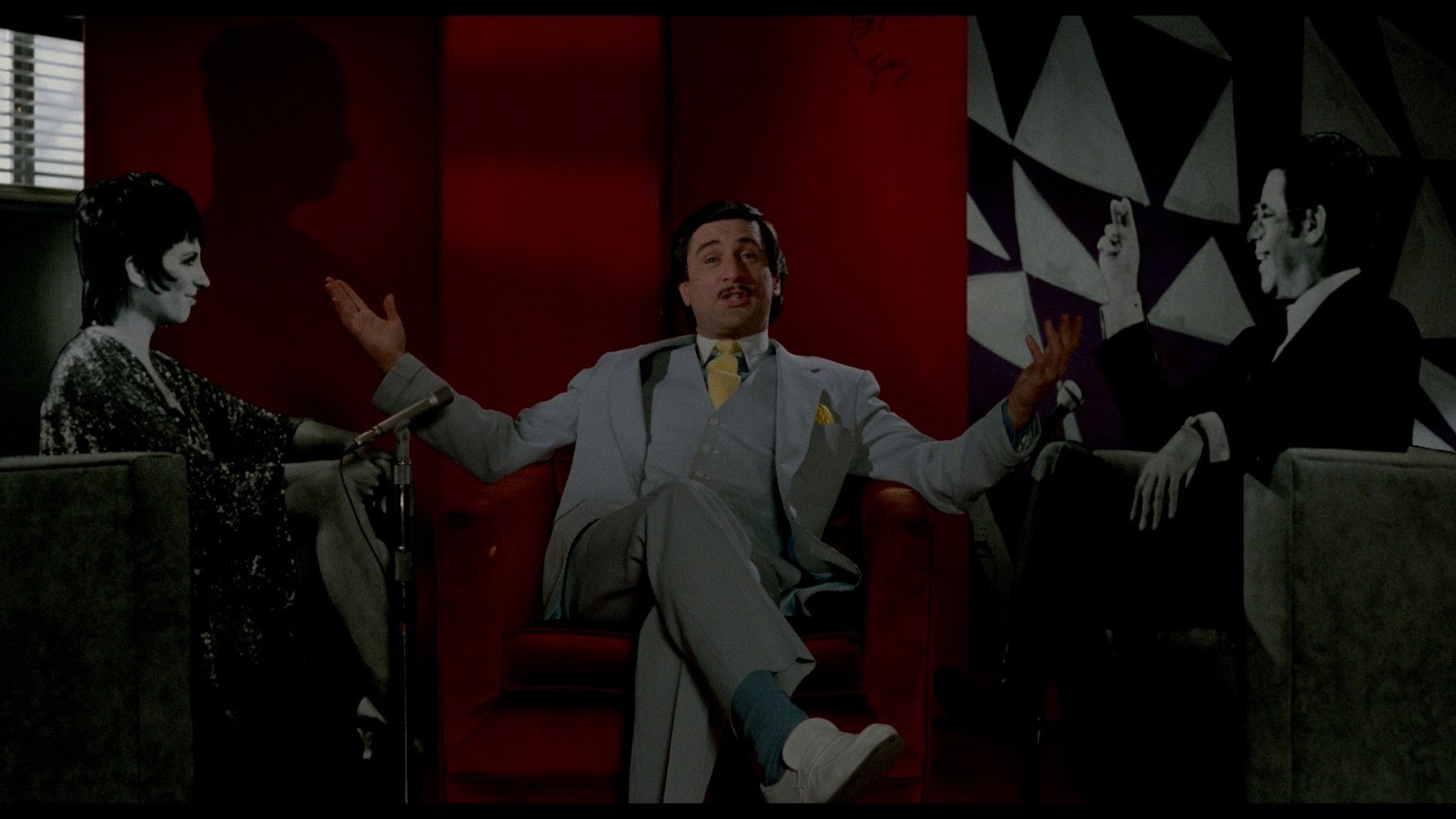
The King of Comedy [Martin Scorsese, 1982]:

Nothing about Joker is original or authentic. Its director, Todd Philips, made his name directing atrocious comedy films like Road Trip (2000), Old School (2003) and The Hangover trilogy (2009-2013); films that revelled in sexism, racism and homophobia, that were crass and morally repugnant, that were defined by a poor, televisual aesthetic. In interviews Philips claims to have turned to drama because comedy has been ruined by millennial "snowflakes"; the culture is apparently so "woke" that audiences don't appreciate the Philips brand of offensive humour. It's no surprise then that Joker has played into the mindset of people like Jordan B. Peterson and Paul Joseph Watson; cultural commentators who see the film's defiantly nihilistic, offensive right-wing aspects as a blow to the supposed suppression of political correctness.


Paul Joseph Watson repeatedly aligning himself with the Joker as a right-wing "anti-SJW" icon.

Throughout his career, Shyamalan's innovations have been denied him. With Unbreakable, he wasn't simply ahead of the curve in creating a modern-day superhero movie, he was creating a serious, psychological superhero movie that approached the sub-genre as if it were a gritty procedural. Shyamalan's film received mixed reviews with many critics calling the film silly, joyless and pretentious. Cut to five years later, when Christopher Nolan directed Batman Begins (2005), and the same stylisation and aesthetic was praised as game changing.

We're seeing the same thing now with Joker being touted as an original work, despite Shyamalan directing arguably the first gritty supervillain origin story with Split (2016) several years earlier. Once again, those that control the narrative have the power to re-write history and Shyamalan's innovations are credited to someone else.

Glass isn't as great as those earlier Shyamalan films, but it's nonetheless a work that connects to the mood of the day and feels - in its final moments at least - like a necessary healing, especially for our countries that have lost sight of what it means to see others as friends and allies. It's a film that shows its surviving characters moving towards something hopeful, something positive, towards genuine change. You can balk at the film's slow pace, its weird tone, its intentionally anti-climactic final face-off (though no critic would balk at these things if the film were a foreign-language art-movie or had been directed by some hitherto unknown A24 sponsored Wizkid), but you can't deny its positive intentions and its message of hope.

Schalcken the Painter (1979)

Schalcken the Painter [Schalcken the Painter [Leslie Megahey, 1979]: This is a film I first saw around four years ago. At the time I found...