Showing posts with label A Ghost Story for Christmas. Show all posts

Saturday, 31 August 2024

Schalcken the Painter (1979)

Schalcken the Painter [Schalcken the Painter [Leslie Megahey, 1979]:


This is a film I first saw around four years ago. At the time I found it slightly disappointing, especially compared to some of the other BFI Flipside titles released for the same genre. I’d expected a more cinematic horror film, like later Flipside titles, Symptoms (1973) and The Appointment (1982), whereas this is very much a TV production in scale and scope.

As such, it’s limited by its exclusive use of studio interiors and lack of establishing shots, which gives the film a very stagey, hermetic quality. It also fumbles its biggest horror set piece by having lead actor Jeremy Clyde show terror in an artificial, slightly pantomimic fashion, which struck me as unintentionally amusing (and as such robbed the sequence in question of its power to shock and unnerve.)

However, a recent rewatch of the film without those earlier expectations made me appreciate it a great deal more. It’s a slow, sombre film with incredible period aesthetics and a restless nocturnal mood. The whole film feels almost suspended, as if the characters are sleepwalkers passing through a nighttime reverie; an eternal ‘dark night of the soul’, where the themes of guilt, betrayal, unrequitable desire, temptation and the certainty of death, haunt the characters like ghosts in the shadows.


Schalcken the Painter [Leslie Megahey, 1979]: 

Made for the TV series ‘Omnibus,’ Megahey’s film is based on an 1839 short story by Sheridan Le Fanu, ‘Strange Event in the Life of Schalken the Painter.’ At first glance, it’s a film that feels very much akin to the kind of stylised arts docudramas pioneered by Ken Russell for the BBC. And yet, it has a tone and a subject matter much closer to the films that Lawrence Gordon Clark produced for the long running ‘A Ghost Story for Christmas’ series.

Having first aired on the BBC on the 23 December 1979, Megahey’s film is an unofficial part of the same tradition of ghost stories for Christmas, though its blending of fact and fiction, as well as its intentionally more restrained and stilted direction, gives it a very different tenor to a film like A Warning to the Curious (1972) or The Signalman (1976).

Esteemed actor Charles Gray voices Le Fanu and his dry, objective delivery helps to establish the historical basis of the film as well as the biographical backgrounds of the various characters. The film is fiction, but it maintains a tone of factual reportage, weaving figures and details from real life into the escalating horror, which gives an illusion of plausibility to the later instances of the supernatural or the unexplained.


Schalcken the Painter [Leslie Megahey, 1979]:


The period detail is exceptional, with many shots functioning as pictorial recreations or references to the Dutch masters in both design and mise-en-scene. The design of the fashionable home of Schalcken’s mentor Gerrit Dou, as well as the flat compositions and the emphasis on framing through open doorways, each recall the paintings of Johannes Vermeer, while the scenes outside the house employ the chiaroscuro lighting of Rembrandt van Rijn.

The Flipside release features in-depth interviews with writer and director Leslie Megahey (who passed away in 2022) and cinematographer John Hooper, which cover the background and production of the film. In the great BFI tradition, the release also contains two short films that explore similar themes of the Gothic and the fantastique: The Pit (1962) and The Pledge (1981)

Wednesday, 2 December 2020

Stigma Revisited


A Ghost Story for Christmas

An updated version of my earlier essay on Stigma (1977) can now be found at Horrified Magazine.

A late entry in the BBC's long-running series of annual horror stories, many of which were directed by the talented Lawrence Gordon Clark, Stigma isn't the best of the collection, paling as it does in comparison to personal favorites like Lost Hearts (1973), The Treasure of Abbot Thomas (1974) and the director's masterpiece, The Signalman (1976). However, the film nonetheless remains an interesting and disturbing work of occultist folk horror, which is well worth a look. You can read my essay here.


Stigma [Lawrence Gordon Clark, 1977]:


Stigma at Horrified Magazine, November 2020:


N.B. I really love the choice of font and background image used to accompany this.
Recently, contributors to Horrified Magazine have produced an entire series of essays, reviews and considerations on content relating to A Ghost Story for Christmas, covering both the films and the history of the series itself. Perfect reading for these dark winter nights.

Further reading at Lights in the Dusk: Garth Marenghi's Darkplace [26 September 2020], A Warning... – Notes on a film and its prologue: A Warning to the Curious (1972) [05 May 2014], Stigma: A Ghost Story? [23 April 2014]

Monday, 5 May 2014

A Warning...


Notes on a film and its prologue:
A Warning to the Curious (1972)


The title and prologue both play, self-reflexively, to the natural inquisitiveness of the viewing audience; that unstated appetite for the forbidden; the impulse to experience the unknown; to look behind the curtain and see how things work; to go where we're not supposed to; to venture out and explore.  In the context of the genre - in this instance, the supernatural - the title becomes more than just a label of identification; it's like a challenge to the individual; acknowledging our curiosity and using it to entice us, to lure us in.  The outcome might be nasty, even unpleasant, but already the title is challenging that spirit of adventure and inquisitiveness; that compulsion to open the previously locked door into the great unknown, as a provocation, or as a test of will.

From the very beginning, director Lawrence Gordon Clark establishes the location as a central character and uses the filmmaking to create an atmosphere of uncertainty and isolation that will intensify as the drama unfolds.

Effectively, the film itself begins with two continuous panning shots.  The first starts on a bleached-out, almost desaturated image of the pallid sand dunes stretching out to meet the shining sea.  Already, the implication of the shot is obvious: we're at the end of the world.  The camera pans to the right, following the coastline until it reaches a far-away copse of trees that wind-back, creating a borderline between earth and sand.  The next shot places us inside the woodland.  We're still outside, in the midst of nature, but the cut feels like a transition between an exterior-space to an interior one.  This time the camera pans to the left, across the wall of trees that appear like a perimeter encircling or imprisoning us; again, creating the impression that there's no place left to run.

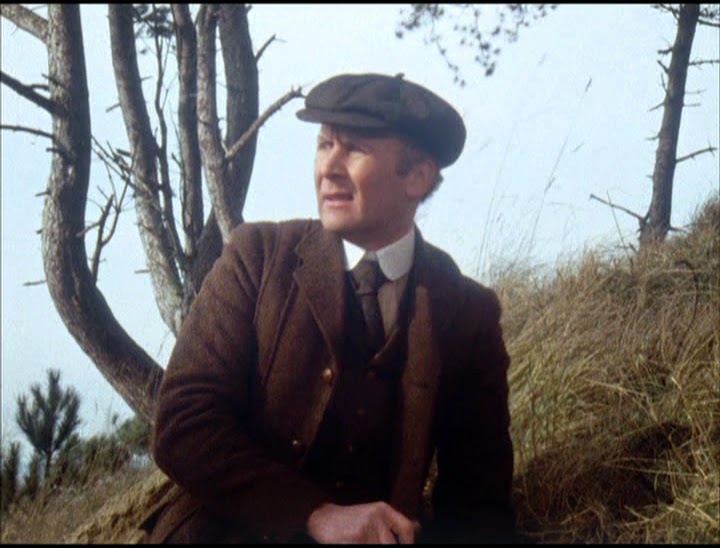
The shot comes to rest on an image of a silhouetted figure in the distance.  Glimpsed between the greying trees that stand guard atop skewed hills that give the image the feeling of something from The Cabinet of Dr. Caligari (1920) - all distorted expressionism; a natural location that seems as stylised and otherworldly as a studio set - we watch the distant figure digging in the dirt.  Subsequent insert shots clarify the action, as the shovel penetrates the mound of earth and the man, now in close-up, exhales exhaustedly, until abruptly... he stops.  We're not sure why (to be exact), but it's almost as if the man has suddenly sensed something unsettling; a hidden presence, perhaps lurking within the periphery...


A Warning to the Curious [Lawrence Gordon Clark, 1972]:

Throughout this sequence, Clark uses images of the surrounding woodland as a form of visual punctuation; accentuating the scene but also adding to the growing tension; that implicit impression that something terrible is about to occur.  Automatically the stylisation creates an eerie feeling; a sense of someone (or something) being present, observing from behind the trees.  There's no one there, physically (for the time being, at least), but even so, the character has the sensation that he's being watched and the audience, knowing instinctively the insinuations of the genre, share these paranoid thoughts.

The isolation of the location and these images of the forest - all ashen trees stripped of greenery; taking on the appearance of horned creatures silhouetted by an almost colourless sky - feed into the underling fear that causes the character to react.  Already I was beginning to question the possibility of an actual danger awaiting this character - trapped within a strange and slightly distorted environment with no easy escape - or if his actions (unstated, but no less suspicious) were in some way fuelling his discomfort (his guilt?), if not genuine fear.

As an approach to technique, the use of these cut-away shots reminded me very much of another film released during the same year; The Wold Shadow (1972) by Stan Brakhage.  Unlikely to have been an influence on Clark, the Brakhage film nonetheless begins with a similar image of trees framed within a woodland environment.  Like the shots here, it's a benign image - just trees, not necessarily something unnerving or unnatural in any immediate way - but one that the audience might interpret as sinister or even threatening if forced to look at for longer than seems necessary...


The Wold Shadow [Stan Brakhage, 1972]:

As the viewer observes The Wold Shadow, the image is transformed.  The transformation is created first through an unconventional manipulation of the aperture and later by shooting the image through an obscured pane of glass (onto which the filmmaker has gradually daubed paint to create an unnatural distortion of the original frame).  While the effect of this transformation on the viewer is intended as purely sensory (a visual metamorphosis), the actual result is far more psychological.

By studying the image, our mind is free to wander.  Even before Brakhage begins his manipulation of the form there is a need to contemplate and make sense of these images.  This "need" forces the viewer to project their own thoughts and fears onto its blank canvas; inventing a narrative where no real narrative exists and, in a sense, bringing the images to life.  In doing so, we start to see things that aren't actually there; we're spooked by what we perceive as shapes between the trees; the illusion of movement created by shadow and light.

It's the impression of nature itself as somehow "possessive", or able to possess, that is the most starting idea communicated by these shared images.  The conception of nature as something, if not genuinely "evil", then as a kind of conduit for something more primitive; an elemental spirit, representing its own energy, or primordial force.  The longer we're forced to stare at these images, the more significant they seem.  To make sense of them, we invent our own nightmares through superstition and attach them to these otherwise normal scenes, so that the images become a kind of black mirror; a deep (Freudian) abyss...


The Wold Shadow [Stan Brakhage, 1972]:

The sequence by Clark works on a similar if more conventional level.  Unlike the Brakhage film, the images remain part of a clear and identifiable narrative.  They work to tell the story, as illustrations, but the presentation of the images and the atmosphere that they evoke are no less charged with that same elemental spirit; where the forest space once again becomes a genuine force, and where the act of seeing (with one's own eyes) transforms a natural and benign image into an unnatural one, loaded as it is with a genuine "supernatural" threat.


A Warning to the Curious [Lawrence Gordon Clark, 1972]:

Convincing himself (like the audience) that it's only his mind playing tricks on him - the superstitions of local lore or the natural isolation of the location getting his imagination spinning off in strange and ridiculous directions - the character gets back to his digging.  Returning to the wide-shot, Clark reminds us that the man is still alone...


A Warning to the Curious [Lawrence Gordon Clark, 1972]:

However, after another one of those "Wold Shadow-like" insert-shots that make us question the safety of this place and its isolation we cut back to the man, now confronted by the sight of a tall, dishevelled figure, dressed almost entirely in black...


A Warning to the Curious [Lawrence Gordon Clark, 1972]:

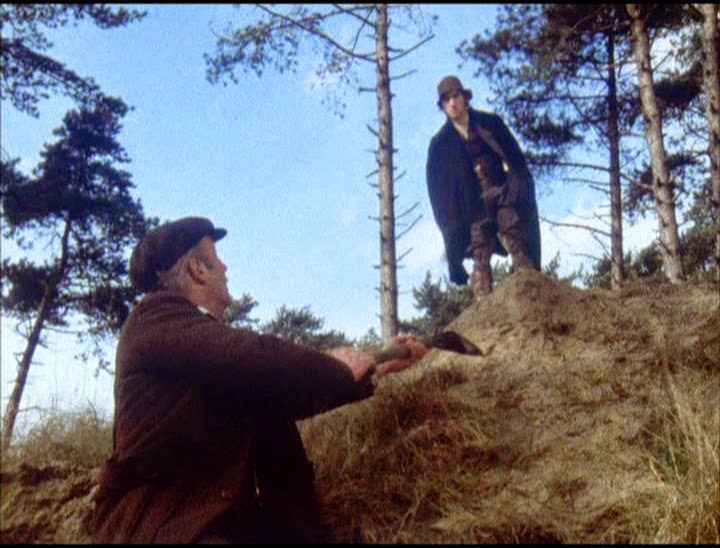
The figure startles both the character and the audience by appearing, as if from nowhere.  Here I asked myself: where did he come from?  Is he a supernatural presence or a local person angry at the man's intrusion?  It's never openly explained but we can draw our own conclusions from the subsequent scenes.  Even so, the unmitigated fear is clearly defined on the countenance of the digging character; a surprised shock or indignation that soon turns to insolence, as the man's upper-class arrogance kicks in.

There is a hint of class-based commentary here consistent with Clark's later film, the previously discussed Stigma (1977), where the digger (a man of some inferred privilege and reputation) believes that he has the right to bend nature to his will and to disturb these sites of sacred interest, while the local man - earnest, possibly simple-minded and with an air of agitated lower-class physicality - is unsurprisingly appalled by the lack of respect for the land and its traditions.

A scuffle breaks out but the man is able to subdue the menacing figure, knocking him to the ground.  At this point, the more rational mind of the audience will be telling the character to flee; to use this advantage to get away.  However, as horror movie law dictates, the man's arrogance and greed has already sealed his fate.  As he returns to his digging, safe in the supercilious belief that he's bested this shabby and cadaverous intruder, the black-clad figure spies a large axe-like implement left idle among the kindling.


A Warning to the Curious [Lawrence Gordon Clark, 1972]:

The blade seems to have appeared as mysteriously as the figure himself, but already Clark is using these metaphysical manifestations to establish, in the collective mind of the viewer, the threat of an actual, physical violence.

While hampered by awkward editorial transitions (no doubt a result of the film's limited budget), the following sequence is no less impressive in its staging; the structure of the shots and the growing momentum of dread and desperation showing an obvious debt of influence to the films of Alfred Hitchcock, and in particular the infamous Bates' Motel shower sequence from the filmmaker's late masterpiece, Psycho (1960).


Psycho [Alfred Hitchcock, 1960]:

Here, as in Hitchcock's film, it is the way the rhythmical cutting between shots suggests the brutality of the violence (as opposed to the violence itself) that makes the greatest impression.  Rather than depicting the attack in explicit detail, the scene instead implies violence through montage and movement and through the facial expressions of the characters on-screen.

As the camera slowly zooms from a mid-shot to a close-up and beyond into an extreme-close-up of the back of the character's neck, we're already certain of what's about to take place.  We're being led to connect the shots in our own imagination; the man, the close-up on the back of his head, the figure with the blade, the blade itself, etc, all combined in the mind's eye of the viewer to suggest something unspeakable, but in a manner that is brilliantly done...


A Warning to the Curious [Lawrence Gordon Clark, 1972]:

As an introductory sequence, the above scene is an attention-grabber.  It establishes, sufficiently and with much atmosphere, the key themes of the film - from greed and curiosity, to the isolation of the countryside and the almost primal preservation of tradition as a genuine supernatural force - as well as introducing the greater practicalities of the subsequent narrative.  Here a man driven by what we assume is greed finds himself isolated in a landscape that takes on a near-paranormal tenor when threatened by external forces.  This, as a distillation of the film in miniature, is like a prelude to everything that we're about to see; a forewarning, of history about to be repeated.

More importantly however, the scene also communicates a level of "meta" commentary that is in keeping with the here-jettisoned narrative structure of the original story by M.R. James.  There, the warning of the title was recounted by the central character, in-hindsight.  He was talking about something that had already occurred, so the character's recollection became a warning to his companions (the listeners to his tale).  As an alternative, Clark structures the film so that this opening sequence, in its entirety, can itself be considered a "warning to the curious."  The curious, in this instance, being the viewing audience (those of us watching the film), but also the soon to be introduced central character, Mr. Paxton, as played by Peter Vaughan.

Wednesday, 23 April 2014

Stigma


A Ghost Story? [Mild SPOILERS]


For the last week or so I've been working my way through the BFI DVD box-set 'Ghost Stories for Christmas Expanded Six-Disk Collection' and trying to surmise my feelings on the individual films contained therein.  Some of the films - such as Lost Hearts (1973), The Treasure of Abbot Thomas (1974) and The Signalman (1976), to say nothing of the markedly more recent 2010 remake of Whistle and I'll Come to You - are genuinely remarkable, while other films are no more than enigmatic sketches that survive on sheer atmosphere alone.  Stigma (1977), the last film to be directed by series regular Lawrence Gordon Clark, falls firmly into the latter category, but is worth discussing for a few rather interesting thematic and directorial ideas.

Right away the first image of the film captured my imagination.  A small red dot, like an orb or a distant planet, is framed against an obscured landscape evocative of some vague science-fiction themed setting, but also suggesting something of a similar atmosphere to director Michelangelo Antonioni's psychological-drama, Red Desert (1964), where the world of the film was frequently reduced to a clouded, indistinguishable smear.


Stigma [Lawrence Gordon Clark, 1977]:

As the credits begin to form - superimposed as they are over this peculiar, abstract vista - I started to question what this image could possibly imply.  At first I thought it was the glow of a synthetic sun, burning a hole through the image and searing the surface of the lens as if an actual shaft of light had somehow pierced the retina of its artificial eye and damaged it beyond repair.  Then I started to think of the more obvious connotation; the drop of blood and with it the memory of an image seen in Nicolas Roeg's horror masterpiece Don't Look Now (1973), where the smearing of a photograph in the opening scene became a premonition to a later moment of blood-curdling threat.


Don't Look Now [Nicolas Roeg, 1973]:

In a quite brilliant directorial stroke, Clark has his cameraman, John Turner, rack the focus of the lens and suddenly the red glowing orb is revealed to have been the out-of-focus glare of a red Citroën Dyane 6; driven here by the film's protagonist, Katherine Delgado, and her teenage daughter, Verity.


Stigma [Lawrence Gordon Clark, 1977]:

The car moves through the quiet countryside, surrounded, on both embankments, by fields and woodland areas, and by the occasional appearance of the mysterious menhirs that (in part) define the pastoral landscapes of Avebury, where the film takes place.

In the setting (and in the contrast between the very practical iconography) Clark is already establishing a disparity between the old and the new; between the "ancient" - as illustrated by the landscape and its mythical stone circles, and the near-unique, almost elemental formation of the hills and fields - and the "modern" - as clearly defined by the car and its cargo.  This juxtaposition is an important theme that gives some credibility to the eventual development of the narrative; where the later sequences (following the couple's return to the family cottage) seem to suggest an element of reincarnation or possibly even demonic possession.


Stigma [Lawrence Gordon Clark, 1977]:
N.B.  Note the reappearance of the colour red as seen on the cottage door.

Making their way up from the driveway and into the back garden, the characters find two local labourers hard at work attempting to remove a large stone from the surface of the lawn.  A short exchange of dialogue sets-up their intentions and why this particular course of action has been decided, despite the difficulty of the task at hand.  Here, Clark deliberately contrasts the harsh, mechanical appearance of the heavy-lifting machinery against the surrounding environment, including those aforementioned stone formations that seem to watch, ominously; like silent sentinels, or the agents of some primitive God.


Stigma [Lawrence Gordon Clark, 1977]:

It is this attempt to move the stone that seems to unleash the unseen evil that will soon throw the lives of these characters (and the narrative itself) into disarray; the generic practicalities of this recalling the recognisable tropes of horror and science-fiction standards like Quatermass and the Pit (1967), The Stone Tape (1972) and later films, like The Keep (1983), Prince of Darkness (1987) and The Hole (2009), where man - in his infinite quest for knowledge or cultural progression - inadvertently awakens something primitive, even primordial, otherwise hidden beneath the earth.

Almost immediately, the mother seems to become transfixed, as if caught in the spell of some insidious "outsider" influence, which leaves her dispossessed (no longer in control of her own emotions).  As she heads back into the house it's almost as if she's drifting through her own life; a sleepwalker, acting but not reacting, or like a puppet compelled into action by the command of a secret master.

As if to create a natural association to where the narrative will eventually lead us, Clark signals the moment before the character's metaphysical metamorphosis with a shot that has some relevance to an earlier film of his own direction.  Here, the claw-like hook of the digger and the very specific way in which it seems to hang in judgement over the face of the character (and the act of desecration that she's brought to bear) looks just like a noose.  A noose, which - in the dark days of people like Mathew Hopkins, the "Witchfinder General" - might have sent a generation of young women like Katherine to their deaths.


Stigma [Lawrence Gordon Clark, 1977]:

This suggestion of judgement or persecution from beyond the grave seems intentionally designed to evoke the same territory as Clark's earlier film from the same series, The Ash Tree (1975).  There, a woman accused and subsequently hanged for the crime of heresy exacts revenge on her prosecutors in a manner best befitting the supernatural predilections of the story's author, M.R. James.


The Ash Tree [Lawrence Gordon Clark, 1975]:

Throughout the film Clark offers these potential clues to understanding or at least interpreting the film's strange and often intangible plot; these bizarre, enigmatic images, or moments that seem to push the audience towards a particular reading (or justification) for the increasingly strange goings-on.  Subtle clues that the audience need to read seem unclear or even arbitrary at the time, but make a small modicum of sense when we see them against the eventual revelation of what this "evil" actually is and of the dark place from which it seems to have emerged.

One such link that Clark and the writer Clive Exton seem to construct is created by intercutting the very frightening and disturbing dilemma of the mother with scenes of her daughter doing ordinary things that become somewhat strange (or extraordinary) when placed within the wider context of later events.

A shot of Verity sat cross-legged on the bedroom floor and illuminated by a small lamp that's been placed like a crystal ball amidst the chaos of teenage debris would not look out of place in a film about troubled youth or family dysfunction, but now seems to evoke the mystical, as the mother suddenly begins to act out of character, as if haunted, or again, genuinely possessed...


Stigma [Lawrence Gordon Clark, 1977]:
Red again, this time as polish on the daughter's finger nails.

Here, the child, removed from events, but almost in contemplation of them, tenses her red-painted fingertips, prayer-like, in a near-magisterial expression; like a witch presiding over a cauldron manifestation taking place in the adjacent room.

Several clues to potentially understanding the film can be found in this scene.  First, there is the song on the soundtrack; Mother's Little Helper by the Rolling Stones.  The song underlines the significance of the mother/daughter relationship, illustrated here by the spatial and/or emotional separation of Katherine and Verity.  The bond between mother and daughter is supposed to be a strong one, but while Katherine goes through her own private anguish in the family bathroom, or wanders disconnected around the kitchen in an empty daze, Verity seems oblivious; instead, heading to the local shop or sitting pensive by the lamplight; spinning her disks with an almost inhuman indifference.  This creates a number of questions that again will make a greater sense towards the end of the film, but for the most part seem to be beyond any standard comprehension.

Even the name of the band on the soundtrack is a kind of clue.  The "Rolling Stones", creating an associative link to the ancient stones that now surround the small house and imprison its inhabitants, while further black magic intrigues are hinted at by the somewhat obvious placement of the band's 1966 album, Their Satanic Majesties Request, amongst the disorganisation of Verity's bedroom.

There is also that interesting use of intercutting, which at first seems frustrating, since it appears to disrupt our connection with Katherine and the terrifying reality of her situation, but which in hindsight gives meaning to the perspective of Verity and the very primal connection that she seems to have to these ancient stone markings that define the surrounding environment and the world outside the home.


Stigma [Lawrence Gordon Clark, 1977]:
Cross-cutting interior and exterior spaces (the physical and
 the psychological/natural and supernatural, etc)

The intercutting of the two locations seems designed to bring these elements together.  On the one hand, we have the scenes of teenage alienation; the daughter, unable to connect with mum, wanders the fields and hills and finds comfort in her room and in the isolation of it.  On the other hand, we have a very violent and unsettling horror story that seems to cut back and forth between the supernatural and the psychological, as the audience, for the most part at least, remains unsure of the real cause of Katherine's unfortunate malady.

It is in the juxtaposition of scenes and the individual arcs of the narrative that Clark offers some reason for events; allowing the viewer to make a connection between the elements so far seen and to use what we know of the horror movie, as a genre, to fill in the blanks.  The implication, that this mythical landscape and the stone formations that so transfix the alienated Verity are somehow conspiring with the ghost of a long-dead victim to take revenge on those unfortunate enough to disturb their unholy slumber, seems to be further reinforced by the development of subsequent scenes.


Stigma [Lawrence Gordon Clark, 1977]:
Henry Fuseli's painting, The Nightmare (1781).  A hint that things are happening outside the realms 
of reality, or simply an acknowledgement of some other form of bodily possession?

By connecting the various occurrences - with one scene leading into another scene, like the links in a chain - Clark and Exton give the audience just enough possibilities to create their own hypothesis regarding the fate of these characters.  In reality, there is no rational explanation for anything taking place, but by seeing an image of Katherine acting dazed and trancelike against an image of the stones as seen through the kitchen window, or the shot of Verity in her bedroom intercut with the mother's violent ordeal, we create a connection between the two.  It's like the Kuleshov Effect in narrative form, wherein the intercutting of potentially unrelated sequences forces the audience to make an associative connection; in a sense, creating the story themselves.

This idea brings us back to that strange and ominous orb seen drifting during the opening credits.  There, the glare of the family car as an out of focus blot against an abstract landscape took on the appearance of an almost extra-terrestrial vision.  However, when we think back to this sequence with the subsequent knowledge of the situation taking place, that connection to the drop of blood (and the idea of the blood as an objective premonition) seems explicitly linked to the horror that befalls the central character.

Having been possessed (seemingly) by a ghost, or by the spirit of the landscape itself, Katherine is struck by an especially terrifying physical affliction.  Blood seeping through the skin, as if secreting from an internal wound that doesn't seem to exist, at least not in the corporal sense.  The way the red dot grows in intensity, spreading out as it soaks through the fabric of Katherine's shirt, once again reminded me of the first image of the film and that red-hued harbinger that appeared to overwhelm the screen.


Stigma [Lawrence Gordon Clark, 1977]:

It is this literal translation of the title - the "stigma" as short for stigmata, in the biblical sense (although the cause of this bloodletting seems to point to something that runs counter to the Christian myth) - which seems the most obvious, but it's only later in the film, when the stone is finally turned, that we're given a (kind of) reason for these bizarre events.


Stigma [Lawrence Gordon Clark, 1977]:

Here, the labourers, having returned the next day with more powerful industrial equipment, remove the stone and discover the makeshift grave of a heavily decomposed body.  The body itself is perplexing enough, but the appearance of several ancient daggers - four at each corner of the grave and one embedded between the ribs of the skeleton, bellow where the victim's heart would have been - gives the mystery an even greater depth.


Stigma [Lawrence Gordon Clark, 1977]:

All of this is intercut with Katherine's final struggle (which I won't spoil), creating the impression of the two occurrences being intrinsically linked.  The subsequent shot is likewise enigmatic and again seems intended to create a potential linkage between the various elements; tying up the narrative but really leaving the audience with as many questions as it does legitimate answers.

In this penultimate moment, a cloaked figure stands guard at the desecrated grave site, somehow detached (emotionally) from previous events.  As the cloaked figure peels away the layers of an onion, I couldn't help subconsciously connecting the red of the nails and the shape of onion itself to that of the mesmerising red orb seen earlier in the film, but also to the iconography of the poisoned apple; the one offered by the Evil Queen (in the guise of an aged witch) to the title character of the Walt Disney production of Snow White and the Seven Dwarfs (1937).


Snow White and the Seven Dwarfs [David Hand & Others, 1937]:


Stigma [Lawrence Gordon Clark, 1977]:

If the plot throughout Stigma is vague and muddled, moving, sometimes awkwardly, between the domestic and the supernatural, it is moments like this that seem to create an emotional coherency beyond any narrative ambiguity (even Clark himself admits during the accompanying DVD introduction that he was never entirely sure where the evil in the film was directed).  In general, these moments succeed in pushing the audience towards a certain (unspoken) interpretation that makes even more sense following the revelation of its parting shot(s).

In this regard, I questioned the possibility that Clark and Exton were offering us, the viewer, the poisoned apple - drawing us into what effectively seems to be a domestic horror movie, with the standard requirements of a woman in peril and lashings of gore, only to reveal a subtext of persecution and atrocity that relates back to the dark days of the witch trials (c.f. The Ash Tree) - or if they were simply peeling away the layers of the story (like the digger, which peeled away the layers of the earth) with the sole intention of providing us one final jolt?  The ending once again shows the connection between the two strands of the narrative; between mother and daughter, or between the supernatural and the psychological interpretations of the scenes.

Although categorised as "a ghost story", Stigma seems to be a departure from the previous films in the series.  Not least because it's the first to feature a contemporary setting (the other films are period pieces adapted from the work of writers like Charles Dickens and M.R. James) but because its supernatural threat seems to take on a physical manifestation, possessing its characters and inflicting a suffering that seems both cruel and unusual when compared to the fate of characters in those earlier instalments.  In previous Clark films, such The Stalls of Barchester (1971) and A Warning to the Curious (1972), the characters are punished as a result of their greed or underhandedness, or because of some perceived failing or flaw (as in the aforementioned Lost Hearts).  In Stigma, Katherine and Verity have done nothing of real malice to incur the wrath of a vengeful spirit; their only crime is that of a selfishness symptomatic of middle-class privilege.

Schalcken the Painter (1979)

Schalcken the Painter [Schalcken the Painter [Leslie Megahey, 1979]: This is a film I first saw around four years ago. At the time I found...