Showing posts with label Dario Argento. Show all posts

Saturday, 15 June 2019

Mia Goth

Thoughts on a film: Suspiria (2018)

Unfortunately I didn't think very much of director Luca Guadagnino's remake of Suspiria (2018), which might be one of the absolute worst recent films I've seen. Since I don't like to get too negative about the things I write about at 'Lights in the Dusk' I'll try to avoid the specifics as to why I found the film such a lamentable experience. However, if anyone is especially interested in gaining an insight into my issues with this new version of the Dario Argento masterpiece, I did leave a short comment about it on my Letterboxd and MUBI profiles.

There were however a couple of things I did like about the film, which are worth clarifying. Firstly, I appreciate that Guadagnino and his collaborators didn't just turn-in a lazy imitation of the Argento film. While it shares a title and some similarities in terms of character and plot, this recent Suspiria has its own aesthetic and philosophical identity that is distinct and original. The changes don't always make for a better experience, but the effort to take the film somewhere different was greatly appreciated. Moreover, Tilda Swinton is excellent in the role of Madame Blanc; the Mary Wigman/Pina Bausch-like leader of an avant-garde dance company, as well as the witch that presides over its hidden coven. [Less successful was Swinton's superfluous casting as an aging holocaust survivor, Dr. Jozef Klemperer; a piece of stunt-casting so unnecessary and distracting that the production company had to create fake social media accounts for a bogus actor, 'Lutz Ebersdorf', before finally admitting what was plainly obvious to anyone with eyes and ears.]

I also liked the appearances from several cult cinema icons, including Angela Winkler, Ingrid Caven, Sylvie Testud, Renée Soutendijk and Jessica Harper (returning here from the original film), as well parts of the soundtrack by Thom Yorke [although I like the soundtrack album more than its appearance in the film itself, as I think Guadagnino misuses it.] However, the main draw of the film for me was the casting of the actor Mia Goth, who plays Sara, one of the dancers studying under Madame Blanc.


Suspiria [Luca Guadagnino, 2018]:

The film's standout sequence has Goth's character playing an Alice in Wonderland figure; lost in a maze of the building's architectural mystery, which is never fully developed. Here we have the mirror as an obvious "looking glass" through which the character must pass. Or is it something that imprisons her, suggesting the idea of reflection - self-analysis and self-actualisation - where the seeds of doubt flower into a doppelganger, or "mirror twin"; presenting a visual representation of a divided mind and divided body in a divided city like 1970s Berlin. Throughout the film hints at these ideas, but does nothing with them.

Goth is an actor I first encountered in Lars von Trier's late masterpiece Nymphomaniac: Vols. I & II (2013). Since that film, she's carved out a career working with interesting filmmakers on projects that are strange, ambitious, challenging and non-commercial. Her appearance in Suspira is bookended by appearances in Gore Verbinski's bizarre and unclassifiable A Cure for Wellness (2017) - a beautifully shot, almost dreamlike work that in its combination of psychological horror and adult fairy-story has a touch of the original Suspira (1977) about it - and Claire Denis's English-language science-fiction drama High Life (2018), where she appears alongside Robert Pattinson and Juliette Binoche.

In Suspira, the film comes to life in the brief scenes that focus on Goth's character and her growing suspicions that something at the dance academy isn't quite as it appears. Here, she's essentially playing this film's version of the Stefania Casini character from Argento's classic, but with a far more compelling narrative arc. However, I would argue that the qualities of Goth as an actor and her approach to the character of Sara actually make her a far more relatable presence to the aforementioned Jessica Harper; the lead in Argento's film. There is an innocence to the way Goth approaches this character that is at once childlike but at the same time fearless and undeterred. She plays the character like Alice in Wonderland, exploring the labyrinthine lower depths of the academy with a strange combination of fascination and fear. These later scenes are mesmerising and should've formed the backbone of the entire film, which is far too often weighed down by the wooden lead performance of Dakota Johnson. In fact, if we were to ever suffer the indignity of a remake of Argento's great follow-up to Suspiria, the similarly bizarre and dreamlike Inferno (1980), it would only be palatable if it featured Goth in the role played by Irene Miracle.

Based on her choice of projects so far, I don't think it's an exaggeration to say that Goth is a cult Euro-cinema superstar in the making; a modern-day Tina Aumont, Sylvia Kristel or Nastassja Kinski, or even someone who might further develop and mature into a future Charlotte Rampling, Catherine Deneuve, or indeed, any of the older cult actors that appeared alongside her in Suspira. Her performance here is subtle, nuanced and fascinating; at odds with much of the film's tasteless, laboured insanity.

Wednesday, 6 June 2018

Art Cinema


Thoughts on a film: Shirley: Visions of Reality (2013)


Martin Scorsese once said: "Cinema is a matter of what's in the frame and what's out." It's a statement that I returned to several times within the context of the film in question, and also in relation to another quote, similarly attributed to a legendary filmmaker: "Everything is cinema."

The Scorsese quote is interesting, and speaks to the responsibilities of the filmmaker when approaching the necessities of 'coverage' - i.e. determining where to put the camera, what to emphasise within a given scene, where the point of interest is - as well as considering things such as context, ideology and intention. However, it's a statement that isn't exclusive to the practicalities of filmmaking, and there's the rub. What's in the frame, and what's out, could just as easily be applied to the practice of painting, or photography. It could even be said about the theatre; or at least the conventional theatre, restricted as it often is by the parameters of the stage.

In Shirley: Visions of Reality, the filmmaker Gustav Deutsch applies Scorsese's maxim to the rigorous recreation of several paintings by the artist Edward Hopper; using the notion of "what's in the frame" as a pretext to spin-off a series of interpretations and phantom narratives inspired by what Deutsch sees within the paintings themselves (the representations, the settings, the "protagonists", etc), but also what might be seen outside of them (the historical context, the politics of the age, the fundamentals of Hopper's own life). In doing so, my mind wanders back to that second hypothesis, "everything is cinema" - normally credited to one Jean-Luc Godard - and finds within it a kind of justification for this film and its central experiment.

Throughout the film, Deutsch and his collaborators painstakingly recreate thirteen of Hopper's most iconic paintings as a series of theatrical tableaux. Through further use of voice-over and physical performances, the filmmakers attempt to convey a consistent narrative that runs through each of the paintings in an effort to better explore the nuances and ambiguities of Hoppers own work against the possible historical and social-political contexts that surrounded them.


Shirley: Visions of Reality [Gustav Deutsch, 2013]:

I have to admit, as an experiment, and as a work of cinema in its own right, the film left me somewhat conflicted. On the one hand, I don't think the narrative that Deutsch attaches to Hopper's paintings is as interesting as the stories that are already conveyed or suggested by the art itself. Yes, the idea of linking the individual female subjects from several of Hopper's most important works (in order to create a kind of subconscious stand-in for the various themes the filmmaker has extrapolated from his own personal interpretations of the artist's iconography) is a clever one - creating a kind of symbolic representation of either the notion of womanhood in the mid-twentieth century, the 'voice' of the American theatre during its most turbulent and transformative period, or the personification of the country itself from the year 1931 through to 1963 (encapsulating both the pre and post-war periods) - it's never entirely compelling, as a dramatic device, or comprehendible, as a political statement.

Hopper's work already has a long association with the cinema. Several high-profile filmmakers - going back to Alfred Hitchcock's work of the 1940s and 50s; or more specifically, the whole legacy of directors, production designers and cinematographers associated with the development of the 'film noir' (think The Killers (1946) by Robert Siodmak for instance) - have tried to emulate Hopper's distinctive depiction of urban Americana and managed to capture something of that same nocturnal, melancholic air.


Nighthawks [Edward Hopper, 1942]:


The Killers [Robert Siodmak, 1946]:


Deep Red [Dario Argento, 1975]:


The End of Violence [Wim Wenders, 1997]:

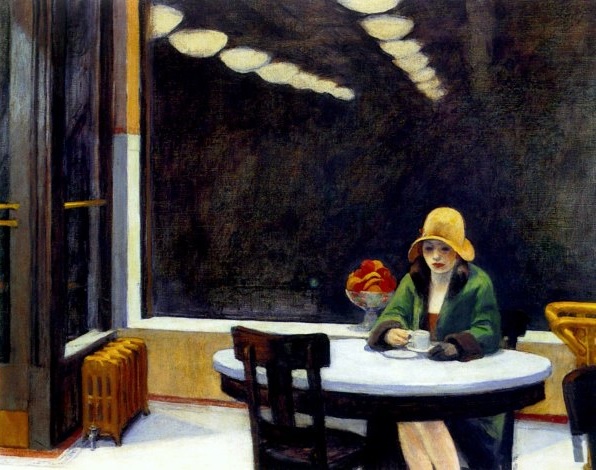
When we think of the name Edward Hopper, there's a certain narrative of expectation that presents itself. It's a narrative of loneliness, alienation, longing and disappointment. Hopper's figures are often haunted, alone, disconnected from the society that surrounds them. They exist within settings that are often communal in nature - cafés, bars, cinemas, trains, office-spaces - but his figures are devoid of companionship; frozen almost, in time. They become like ghosts, haunting the landscape of an American Gothic, or like prisoners, trapped by circumstances and routines.

The filmmakers that have best translated Hopper's images to the screen have found a certain affinity for such characteristics and situations, or for that feeling of quiet desperation; the aching loneliness associated with being adrift in the big city. The silence of Hopper's paintings doesn't require a context or elucidation for us to possess a greater understanding or insight into these narratives of still life; it's all there in the expression; the ambience and the sensitivity, which is felt.


Automat [Edward Hopper, 1927]:


Shadows in Paradise [Aki Kaurismäk, 1986]:

While 'Shirley' does succeed in presenting a sense of the sadness, longing and disconnection associated with Hopper's paintings, there are whole sections of the narrative that are devoted to discussions of the American theatre, Communism, the House Un-American Activities Committee, the betrayals of Elia Kazan, the inferiority of the Hollywood system, the works of Emily Dickinson, the contradiction of the phrase "photography as truth", contemporary journalism, and a vague back-and-forth story about a couple unable to connect.

None of the themes or storylines that are here assigned to Hopper's work feel necessary to our own understanding of the images themselves. Instead, they present a kind of highbrow academic variation on the notion of fan-fiction; connecting the various dots, not because they feel explicit to the conception of Hopper's paintings, but because they're of interest to the filmmaker. This, in and of itself, is not an issue. However, the lines of interpretation that Deutsch attaches to Hopper's works aren't significantly well developed; instead feeling like vague traces or suggestions of something that never quite collates into a consistent narrative.

These fragments of a story play out against the further use of actual news bulletins that cover a whole stratum of American history (taking us from the tail end of the depression, to the outbreak of the Second World War; through the rise of feminism, the civil rights movement and the imminent assassination of president John F. Kennedy). It's difficult to understand what any of these cultural milestones have to do with Hopper's paintings or how we, as an audience, interpret them, but they seem significant to Deutsch's projection of the work and his own perception of this tumultuous period in the country's evolution.

Perhaps this is what the film's subtitle, 'Visions of Reality', is really getting at. The idea that the art, while depicting a simple, still life observation, becomes, in itself, a representation of the period in which it was created. These paintings, as cultural artefacts, do present, in the very literal sense, visions of reality; not just in their emphasis on small, seemingly inconsequential details that define one facet of the human condition, but as a recorded documentation of the attitudes, politics, fashion, styles, expressions and routines depicted in the work; as well as in the social, racial and economic backdrops that existed during their conception.


Shirley: Visions of Reality [Gustav Deutsch, 2013]:


Western Motel [Edward Hopper, 1957]:

While I'm left to question why Deutsch decided to interpret the woman in these paintings as an actress involved in radical left-wing theatre, or what her journeys through Hopper's landscapes are supposed to represent, or how these fragments of a story are supposed to tie the personal to the political, I did find the film strangely beguiling and always beautiful; even if the intellectual context of the work seemed elusive and largely impenetrable.

As a work of cinema, 'Shirley' is undoubtedly a masterpiece of form and stylisation. The use of light and shadow, the colour and texture, the compositions and general mise-en-scene, are all exquisite, both in their mimicry of Hopper's hugely recognisable aesthetic and as an example of pure cinematic craftsmanship. The detail and authenticity with which Deutsch and his cinematographer Jerzy Palacz have brought to life Hopper's work makes the supposedly grand stylisations of Wes Anderson - as typified by films such as The Life Aquatic with Steve Zissou (2004) and The Grand Budapest Hotel (2014) - look like an action-figure's diorama.

The sound-design is also worth highlighting. The ambient sounds of passing trains, street life, seagulls and crashing waves help to give a realistic depth to these abstractions of artificiality; bringing the world of the paintings to life, but still capturing something that is somewhat surreal, even dreamlike. I was less keen on some of the music selections - including, somewhat incongruously, the songs of David Sylvian - which despite capturing the same yearning loneliness inherent in the imagery, felt too modern in this particular context. Nonetheless, the film throughout has an almost hypnotic quality, intensified by the static compositions, slow zooms and languid cutting, as well as through the voice-over evocations of the actress Stephanie Cumming (who brings a captivating and enigmatic presence as the film's central figure).


Shirley: Visions of Reality [Gustav Deutsch, 2013]:

While I'll no doubt wrestle with the intellectual or political merits of this film for some time - with the same unanswered questions and peculiarities going back and forth through my own interpretation of Deutsch's work - there's a part of me that would relish the opportunity to see this again. Whether or not we reject the film as a work of imitation, or as a gimmick, or as something that is more art installation than conventional motion picture, there's no denying that this is a thought-provoking film of precise moments; some perplexing, others astounding.

One scene in particular stood out to me as something so beautiful that it elevated the entire experience of the film as a whole. It's a recreation of Hopper's 1963 painting, Intermission, in which this figure of Shirley finds herself alone in a cinema. As the unseen film begins to play, Shirley realises that the rest of the audience hasn't returned from the intermission. She's sat there - eager to share this experience with her fellow human beings - but she's all alone. In this brief moment, divorced from Deutsch's projected narrative, the combination of the beautiful cinematography, the impeccable production design, the music, the voice and subtleties of Cumming's performance, each work together to create a moment that is fragile, intimate, reflective, heartfelt, biting and perceptive. In a word: unforgettable.

Wednesday, 11 September 2013

Cross/Cutting

First scene: A group of models on a catwalk, resplendent in their gold and silver outfits, the cameras recording, following their every move.  They hold at the end of the runway, a flash goes off, cold, like an accusation, threatening to reveal the truth behind this hideous facade; the ugliness beneath the glamour and the decadence.


Giallo [Dario Argento, 2009]:

Second scene: The killer - at this point, still largely unseen - excites himself by taking photographs of a bound and tortured victim.  Another flash of the camera, this time bright enough to transform the image into an abstract impression; a body without shape or definition, just form.  Like Dollarhyde in Manhunter (1986), the act of photographing the victim reveals a hidden truth; part of the great transformation that his image of death will bring.
 
 
Giallo [Dario Argento, 2009]:

Third scene: A return to the location of the first.  Celine (Elsa Pataky) on the catwalk, shimmering in a black transparent dress, caught in the crossfire of the flashbulbs.  Already the next victim, posed and manipulated, transformed by the glare of the lights and the framing of Argento's camera into a symbol of beauty; there to counter the ugliness (both physical and psychological) of this deranged killer.

 
Giallo [Dario Argento, 2009]:

The connection between these sequences is immediately clear.  A group of women - with particular emphasis placed on the two victims; current and potential - violated by the camera.  The image itself, as a weapon, powerful enough to penetrate deeper than the knives that Argento's own camera lingers over in excruciating detail, disarms the viewer through its provocation.  It finds an ugliness in this scene of fashionable grandeur (exposing the artificiality of the world; the medium itself) and beauty in an act of violence.  The power of the image, or the cross-cutting between it, is evident in the presentation of this scene, which could almost be called a master-class in how to use film editing to create a story.  The seeds of a story (and its development) suggest by the associations created between shots.

We know, from the way this sequence is structured - the intercutting between the locations, the three sets of women - that Celine is our next victim.  It is this notion of the camera as the murderous eye - leering and intrusive; already watching, observing, penetrating, like the gaze of the killer, the filmmaker, or the eyes of an audience - that imposes this narrative, this suspenseful chain of events, against the presentation of the actress, the "model", already a performer, already posed and placed for the benefit of the "voyeur."  Through this, Argento is once again questioning the nature of these violent movies and his own role as the instigator - the hands and eyes of each respective killer - where the viewer becomes victim.

Thursday, 24 January 2013

Viewing Log / 2013 / Week Three


14/01/2013 - 20/01/2013


Phenomena [Dario Argento, 1985]:  The opening sequence is still one of the strongest and most unnerving moments from any of Argento's films.  The sense of terror and isolation, as this young girl finds herself stranded in the heart of the Swiss countryside, is heightened by the ominous tone of the music, the constant winds that throughout the film suggest the air of hysteria (or emotional unbalance) that propels these characters towards madness (or worse), and the natural contrast between the setting, this stunning and serene backdrop of verdant hills and silhouetted peaks, and the anticipation of the violence still to come.  The presentation of the scene is like something out of a fairy tale, where the emphasis on these young characters - trapped in a state of trance between childhood and adolescence - find themselves lost within a world that at first seems strange and beautiful, but through the actual process of its character's investigation, soon reveals a darker, more dangerous edge.  The otherworldly feel continues throughout the film, becoming increasingly more abstract, as the plot - which owes as much to Sleeping Beauty (1959) as it does to Suspiria (1977) - warps and mutates to the point of straining credibility, as the young protagonist Jennifer Corvino uses her ability to commune with insects in an attempt to find the vicious killer terrorising her school.  Many will no doubt find this aspect of Argento's film ridiculous, but for me I've always seen it as something very haunting and evocative.  A pure exercise in atmosphere and mood, where the author, rejecting logic and convention, creates something that is more like an extended nightmare or a never-ending dream. 

The Early Bird [Robert Asher, 1965]:  I'm not an expert here (obviously!), but The Early Bird seems to have had a much larger budget than any of the other Norman Wisdom films I've seen, with a lot of optical effects, miniatures, matte-paintings and elaborate sets used to give the illusion of a fully functioning world.  Unfortunately, the emphasis on grand spectacle comes at the expense of the characters and their story, with this charming and still very relevant tale of two rival dairies (one, a large conglomerate, the other a family run business) being pushed to the background while we're instead treated to endless scenes of the bumbling Norman demolishing an entire manor house with a runaway lawnmower, wrecking a golf match while masquerading as an elderly vicar, and eventually flooding a poor woman's sitting-room with a gallon of spilled milk (before having to watch as his runaway cart is crushed under the weight of a speeding train).  The quality of these set-pieces is actually rather good considering the age of the film, but there is no heart to this story, which for me, lacks both the quiet whimsy and the subtle sadness of something like Trouble in Store (1953) or the brilliant One Good Turn (1954), or even the madcap satire of the slyly subversive The Square Peg (1958).  It's certainly not a terrible film since many of the jokes are actually quite funny, but compared to these other, earlier Wisdom classics, The Early Bird just never achieves its full potential.


Revolver [Guy Ritchie, 2005]:  I would find it virtually impossible to say with any great conviction what this film is "about."  I've seen it twice now and I have my theories, but the film is beyond interpretation, playing a kind of arcane game of deception with its audience that mirrors the relationship between the characters on-screen.  Just when we think we've figured out a possible explanation as to what is taking place, or why these particular characters are being played-off against one another - like living chess pieces - a character will suddenly appear to acknowledge and dismiss this interpretation, leading to more questions without answers and a feeling of external manipulation, as if all these events and characters are somehow guided by an invincible, omnipotent force.  From this, we could maybe see the film as a sort of meta-commentary, in which the author explores the war between the 'id', the 'ego' and the 'super-ego' by way of a generic crime story that eventually distorts into a complicated psychological study about failure and insecurity.  In this sense, the plot could be an acknowledgement of the director's painful disappointment following the failure of his previous film, Swept Away (2002), or maybe even a gesture to his own fear of being typecast as a director only suited to gangster movies of the Lock, Stock... (1998) and Snatch (2000) variety.  Personally, I find the film quite fascinating, as much for its creative visual approach as for the labyrinthine plot.  The dazzling grab-bag of slow-motion sequences, fluorescent light, saturated colour, jump cuts, subtitles, animation and over-lapping voiceover might be perceived by many as post-Tarantino affectations (or just flashy showboating), but to me this approach feels intensely cinematic.  At a time when I'm bombarded with the promos for dreary Oscar-bait movies, à la Affleck, Hooper, Bigelow, etc, it's encouraging to see a director using the 'form' to create content, as opposed to just serving it. 

Batman & Robin [Joel Schumacher, 1997]:  Don't get me wrong, I didn't necessarily like it, but I do think a lot of the negativity surrounding this film is a kneejerk reaction to the context of the thing.  For one, Batman & Robin is not an adaptation of the Batman character, his mythos or his ideology - in the sense of being truthful (if not "reverent") to the source - but more a pastiche of it.  To borrow a British phrase, you could almost call it a "piss-take"; a film that underlines the inherent absurdity of the Batman character and exaggerates it to a near-outlandish degree.  While the recent Batman films have attempted to approach the concept from a more realistic or at least semi-plausible perspective, they still can't change the fact that it's a franchise built around the idea of a billionaire playboy fighting crime in a rubber costume.  Schumacher's film not only understands that Batman, as an idea, is total nonsense, it celebrates the theatricality of it; turning the adventure into farce and the action into camp.  Many have taken this aspect of the film's approach to be an example of the director's blatant homosexuality getting in the way of the Batman character, but I'm not so sure.  Yes, there are nipples on the costumes and occasional close-ups of his hero's rubber-clad crotch, but even with screenwriter Akiva Goldsman's often quite smutty double entendres and the kaleidoscope of vivid, flowery colours, the tone of the film is more or less in keeping with the harmless kitsch of the 1960s T.V. show.  Like Mario Bava's delirious spy parody, Danger: Diabolik (1968), this seems to be the spirit the filmmakers were going for; creating something that could be, to Batman, what Austin Powers was to James Bond.  Yes, it's incredibly stupid, but I suspect that's kind of the point...


Nomads [John McTiernan, 1986]:  On paper, the film sounds exceedingly silly.  Something about the displaced spirits of an Inuit tribe that congregate on the sites of past tragedies.  Into this we have a story about the transferral of memories, from one character to the next.  Nothing is very clear and I could imagine a lot of potential viewers, when faced with the sheer insanity of the thing, either laughing at it, or rolling their eyes in disbelief at the inevitable direction McTiernan takes.  With its reckless ambition, "rock video" aesthetics and eclectic cast (a pre-Bond Pierce Brosnan as a heavily-accented French anthropologist), the film almost invites ridicule.  That said, there's a germ of a great movie here, and McTiernan - debuting as both writer and director - instils it with such a complete and utter seriousness that the audience has no other option but to go along with it; embracing its bizarre twists and turns and effectively 'buying into' the delusions of its central protagonist (much like the supporting characters on screen).  Although the film is far from perfect, I still found it interesting, for its ideas.  A film about madness, or more specifically, the idea of madness as a kind of contagion.  The madness of the modern world, suggested by the almost documentary-like presentation of 1980s Los Angeles - with of its exiled subcultures, late night loneliness, darkened alleyways and neon-lit streets - which provides a stark and alarming contrast to the more bizarre excursions into genuine horror.  Here, McTiernan creates a style that falls somewhere between the gritty L.A. noir of James Cameron's The Terminator (1984) and the otherworldly suburban-surrealism of Wes Craven's A Nightmare on Elm Street (1984); an approach that finds its most startling expression in the scene in which Brosnan, having been pursued by these 'nomads' through the actuality of downtown L.A., takes shelter in an abandoned mission station, where his personal nightmare of death and transfiguration is fully exposed.

Predator [John McTiernan, 1987]:  Now that its blockbuster credentials have dated slightly, I suppose one could argue that the film has become the '80s equivalent of a great '50s B-movie; not quite Invasion of the Body Snatchers (1956) perhaps, but maybe The Thing from Another World (1951).  The comparison would be apt given the occasional references to director John McTiernan's approach as being somewhat 'Hawksian' in nature.  True enough, there's a great economy to the director's use of space that recalls a film like Red River (1948) or Rio Bravo (1959), with the same use of the frame to suggest the various on-going power struggles within the group.  However, what's more interesting (to me) is the way the filmmakers exploit the over-the-top machismo so prevalent in American action cinema of the 1980s by making it a film primarily about the physicality of its characters.  A film where these two-dimensional musclemen are pitted against the ultimate adversary - a creature, able to use their own surroundings against them - which forces them to throw away their weapons and artillery and revert to more old-fashioned methods of survival and self-preservation.  This is something of a running theme for McTiernan, beginning with his debut film - the aforementioned Nomads (1986) - and continuing through to the hugely successful Die Hard (1988) and the flawed but fascinating The 13th Warrior (1999).  In these films, the "modern man" (or "modern" to the world of the film) has to regress to a more primal or primitive state when faced with a particular threat.  For me, Predator - still one of the director's most popular and enduring films - might be the most clear and concise distillation of this theme, for obvious reasons.

Thursday, 2 April 2009

[REC]

In George A. Romero's Diary of the Dead (2007), the recent trend for confessional, self-shot horror cinema, post The Blair Witch Project (1999), was satirised as yet another extension of the current generation's supposed obsession with exhibitionism and self-analysis. A kind of egotistical self-infatuation facilitated, to some extent, by websites such as YouTube, Facebook and Twitter, where even the most personal or upsetting events of a person's life can be exploited in an attempt to create insight or entertainment for an unseen, possibly voyeuristic audience, no longer able to feel anything unless distanced by a television monitor or computer screen.

The concept - and Romero's presentation of it - puts me in mind of a quote by Guy Debord, which helps to contextualise the particular commentary being woven, consciously or unconsciously, throughout. "In societies where modern conditions of production prevail, all of life presents itself as an immense accumulation of spectacles. Everything that was directly lived has moved away into a representation"


Diary of the Dead directed by George A. Romero, 2007:

Although [REC] (2007) has no such higher ambitions, the ideology at work is nonetheless similar to the Romero film. In both instances, it is the characters' perseverance and obsession with documenting the proceedings at all costs that pushes the narrative forwards. The motivation of these characters to capture, for whatever reason, the carnage and the bloodshed, inspires the real dramatic incentive to pursue this story, even if it means putting themselves (and others) in danger. It is this personal motivation that effectively transforms a routine trash-TV exposé into the lives of Barcelona fire-fighters into a self-reflexive examination into the power of the image (not only as a spectacle, but as a means of documentation: the RECording of the title), and the more important relationship between the camera, the viewer and the subject in-between.


[REC] directed by Jaume Balagueró & Paco Plaza, 2007:

If [REC], as a companion piece to the Romero film, is ultimately derivative in concept - with the snappy banner on the back of the DVD-sleeve ably (or idly?) surmising the film's creative intentions as "The Blair Witch meets 28 Days Later..." - it nonetheless succeeds over many of these similarly constructed "found-footage" experiments as a result of its authenticity. Whereas Romero's film suffered greatly from implausibility - not simply in terms of the general motivation of its characters or the development of its plot, but in the kind of situations actually being recorded (especially if we're to believe that these so-called film students are operating on a limited power-supply and budget) - [REC], by comparison, really does feel like an authentic, low-budget piece of late-night television info-fodder.

It also helps that the film is genuinely appealing, both in its themes and in its creative development; with the more outlandish twists of the plot finding an anchor through the believable performances of a cast that play on subtlety, and a general feeling of dread and uncertainty that is elevated by the skilful editing; managing to retain the obvious genre expectations of the jumps and jolts, but still remaining true to the overall creative intentions of the directors and their crew.

The appeal of [REC], beyond the more obvious genre paraphernalia, is therefore this sense of placing the spectator directly within the action via the first-person associations of the camera's eye.


Man with a Movie Camera directed by Dziga Vertov, 1929:


[REC] directed by Jaume Balagueró & Paco Plaza, 2007:

Whereas conventionally the director creates a shot, and within the frame of this shot places various objects and characters of significance to what the film or the scene is about, the self-shot/found-footage format obscures the hand of directorial control, making the audience feel as if we're discovering something that is real; something that hasn't been manufactured. We're still seeing exactly what the filmmaker wants us to see, but in a way that is much less obvious. Instead of the carefully composed images of films like The Exorcist (1973), Halloween (1978), The Shining (1980) or The Sixth Sense (1999), where there is a very clear sense of how to frame these moments of shock and suspense in order to satisfy audience anticipation, the chaos of these images, and the sometimes difficulty of having to squint out the significance, adds to the general confusion of the situation.


Halloween directed by John Carpenter, 1978:


The Shining directed by Stanley Kubrick, 1980:


The Sixth Sense directed by M. Night Shyamalan, 1999:


[REC] directed by Jaume Balagueró & Paco Plaza, 2007:

It makes the viewer more active, placing us, as spectator, into the situation; not only forcing us to experience this horror as the characters themselves might experience it, but exaggerating the anticipation by deliberately obscuring some of the more important information on screen.

Many of these stylisations could be considered emblematic of a continual interest on the part of a contemporary audience for what is perceived to be a greater sense of realism. From the introduction of reality television in the early part of the decade - which itself was a lead-off from the previously popular docusoap format - a kind of real-life soap opera form of cinema vérité - audiences have demanded images that resonate on a recognisable level.

The reality-TV culture thrives on the authenticity of real laughter, real tears and real emotions; where the process of manipulation is understated, and where the usually recognisable limitations of the fourth-wall are almost entirely removed. If the filmmakers can convince us during these opening scenes that these characters are real people doing real things, then the eventual shift into the more outlandish genre territory of zombies and potential government conspiracies will be given a greater hit of plausibility. We accept the scenario as being far more convincing if placed within this style of heightened faux-documentary realism than if it were shown with all the gothic, romanticised style of the Hammer Horror-movies, or the incredibly beautiful or conventionally more cinematic terror of Bava, Kubrick or Argento.


Suspiria directed by Dario Argento, 1977:


[REC] directed by Jaume Balagueró & Paco Plaza, 2007:

It could be argued that this particular style of film, in which the audience is thrown headlong into the action, and into the horror, helps to overcome some of the less original aspects of the plot. Had the film been presented in the more conventional approach - of wide-shot, to mid-shot to close-up, etc - the continual reliance on the work of Romero - specifically Dawn of the Dead (1978) and The Crazies (1973) - as well as the early films of David Cronenberg - such as Shivers (1975) and Rabid (1977) - might have plunged the film into the same kind of hollow, artless predictability of the average Hollywood remake.

Instead, the wide contrast between the content, which is generic, and the approach, which isn't, help us to identify and experience these clichés and predictable accoutrements from an entirely fresh perspective. It gives a kind of greater plausibility to the general "what if..." scenario that the horror movie, as a phenomenon, has exploited since day one. So "what if..." a local access-all-areas television crew were there to document the unfolding of a film like Rabid, or The Crazies; "what if..." something like that really did happen; how would we react, etc.

At a time when most of the human race is documenting their own lives on camera phones or video recording equipment, putting these feelings on the web in order to form a connection with the world as a twenty-first equivalent of a message in a bottle (and yes, this blog functions on a similar level), the idea of someone just being there to capture this chaos is not only close to actuality, it's an acceptable truth. You only have to look at the news coverage of any recent disaster, terrorist attack or major event, from the horrors of 9/11 to the natural wonder of the recent eruption of Eyjafjallajökull, the documentation of these spectacles is captured, in the absence of a professional crew, by the every-day man on the street.

This is what gives the film its recognisable weight; "real people" in "real peril". It works, but only because the thing is so well-made. It elevates itself from the usual low-budget horror cinema, not by looking down on the genre, of thinking that it's somehow better or more relevant than any other film using the same techniques, but by actually engaging the audience in its scenes of terror, in its plot, and the lives of its characters.


[REC] directed by Jaume Balagueró & Paco Plaza, 2007:

The film draws the audience in slowly, establishing a believable context in which local television news reporter Ángela Vidal (Manuela Velasco) and her never-seen cameraman Pablo (Pablo Rosso) interview the staff of a small Barcelona fire department. In the opening scenes, we see Ángela, sometimes unsuccessfully attempt to engage the fire fighters in a conversation in the hope of getting to the heart of what it is they actually do. As Pablo pans back and forth with his shoulder-mounted video camera, recording these men and women filling out paperwork, or eating, sleeping and playing sports, Ángela and the viewer are secretly hoping for something (more exciting) to happen. Eventually, a call comes in; a disturbance at a small apartment building on the outskirts of city.

From this point on, anyone familiar with how horror movies work will have a good idea of what to expect from the narrative development of the film. The pressure-cooker atmosphere of the residents gathered together in the foyer, confused and agitated - concerned for the wellbeing of the old lady locked in her apartment but also frightened - is conspicuous from their initial introduction. It is obvious that as the horror builds and becomes more focused and frenzied that this tension between the ranks will feed into the general chaos and confusion, causing mistakes to be made, loved ones to be lost and our "heroes" (for lack of a better word) to be put at risk.

As the storyline develops, and the horror-movie aspect becomes much more pronounced, the style of the film and the way it is used to reveal or obscure the elements of the plot, is perfectly utilised, as the audience are placed into these situations, witnessing them from the first-person POV vantage point of the camera, thus putting us right on the frontline. It helps that the co-directors Jaume Balagueró and Paco Plaza chose to have the film's actual cinematographer stand in as the character of Pablo, meaning that we really do get the sense of an actual camera man at work, framing the shots as best he can, as a professional, but also trying to keep himself and others safe in this incredibly hostile environment.


[REC] directed by Jaume Balagueró & Paco Plaza, 2007:

As with the Romero film, one can choose to see [REC] as a commentary on the power of the screen-image and how it has been used in the first part of the twenty-first century, not just as a kind of confessional, but as a way of desensitising characters to their own suffering or peril. Ángela doesn't have to keep filming. She could put the camera down. She could free up her arms making it easier for her to run up and down the winding staircases, or down those long shadowy corridors. But she doesn't. Why? Does the camera remain turned on for our benefit or for hers? Again, it's that misguided sense of duty that these characters feel they need a recording of this event for whatever reason. It's also, on some level, the act of looking at the world through the viewfinder of a camera to create a filter to reality. It also shows the voyeuristic nature of the characters, and by extension the audience itself; more concerned with documenting the violence and the suffering as it happens, instead of attempting to get away from it.

If [REC] lacks Romero's pointed social commentary, it is no less representative of this curious new subgenre. As Ángela's direction to "just keep filming" is offered as a hollow echo as the final scene fades to black, we find ourselves in the world where characters feel they must record everything. It shows the genre moving further and further away from the usual self sacrifice/self preservation preoccupations that have so often triumphed in the structure and conventions of the horror movie narrative, as we expect our protagonists to escape from this evil, to flee from it, as we cheer their escape or eventual re-capture. It replaces this with a fascinating if largely observational sense of self-absorption; as the walls of civilisation come tumbling down we begin to turn the cameras, not on the event, but on ourselves, to fulfil some kind of vague misguided sense of purpose, before our own moment of expiration.

Schalcken the Painter (1979)

Schalcken the Painter [Schalcken the Painter [Leslie Megahey, 1979]: This is a film I first saw around four years ago. At the time I found...