Showing posts with label Alfred Hitchcock. Show all posts

Thursday, 6 February 2020

The Year in Film 2019 - Part One


A Belated List

I'm finally getting around to compiling a list of the best films I saw over the course of 2019. As in previous years, this isn't a list of films released in 2019, but of films I saw during the previous twelve months. As such, it contains some films that are old and some that are new, but really, semantics aside, all these films were new to me. It doesn't matter if a film was released in the 1920s or the 2020s, all films that we see for the first time are "new" films and I think for the cinema, and the history of cinema, to endure over the subsequent decades, we need to stop enshrining works in the reputation and legacy that they attracted when they were originally released and see all films as potentially new discoveries.

On this list you'll find films that many audiences and critics have derided as worthless and that have maintained this reputation for years, if not decades. However, going into these works without prejudice or expectation, I found films that were thrilling, both aesthetically, in the way they were produced, but often emotionally and psychologically as well. They were films that, regardless of when they were produced, still felt relevant. This year, I'm breaking the list down into smaller installments, including only five films per-post, rather than the usual ten. This will hopefully starve off the typical burnout that comes from having to proof-read and edit such a large volume of capsule reviews.


Jamaica Inn [Alfred Hitchcock, 1939]:

Watched: Jan 04, 2019

Overshadowed by Hitchcock's later adaptations of the work of Daphne Du Maurier – Rebecca (1940) and The Birds (1962) respectively – the commanding and atmospheric Jamaica Inn is an arguably minor work for the "master of suspense", and yet remains a film ripe for rediscovery. While not as rich, psychologically, as the subsequent Rebecca, nor as thrilling in its spectacle as The Birds, Jamaica Inn remains an engaging and atmospheric work of pure Gothicism; a rugged "south-western", with smugglers replacing bandits and the titular inn replacing the more conventional homestead or hacienda, where the outlaws hide out. Dominated by a scenery chewing performance from Charles Laughton as a shadowy landowner, Jamaica Inn plays more to Du Maurier's creative interest in lost girls and existential landscapes than to Hitchcock's tales of suspense and obsession. However, the filmmaker commits fully to the spectacle of the film, creating a work where the real star is not so much Laughton and his fellow thespians, but the studio recreated North Cornwall setting, with its desolate moors and rugged coastal scenery. To this day, many critics and audiences have argued that Jamaica Inn is one of the worst Hitchcock films, but I don't agree. In fact, I found it superior to more acclaimed works like Suspicion (1941), Saboteur (1942), Stage Fright (1950), The Wrong Man (1956) and Frenzy (1971). In its spectacle and scenography, the film recalls the greatest works of German Expressionism, with its similar emphasis on theatrical stylisation, atmosphere and suggestion propelling the story forwards, while the narrative itself explores pertinent issues relating to class exploitation, insanity and the loss of innocence.


The Favourite [Yorgos Lanthimos, 2018]:

Watched: Jan 08, 2019

The screenplay by Deborah Davis and Tony McNamara is incredibly witty, the performances are great and the aesthetic of director Yorgos Lanthimos, as it's developed since the masterful Dogtooth (2009), through films like The Lobster (2015) and The Killing of a Sacred Deer (2017), continues to enthral. The chessboard colour scheme, wide-angle lenses and mesmerising tracking shots through darkened corridors evoke The Shining (1980) by way of Peter Greenaway. However, it's the character dynamics that are most engaging, suggesting ideas of systemic abuse, female desire, culpability and how complicit individuals can be in their own exploitation.


Glass [M. Night Shyamalan, 2019]:

Watched: Jan 21, 2019

Much ink has already been spilled here on the subject of Glass; writer and director M. Night Shyamalan's concluding chapter to a loose trilogy of films that began twenty years ago with the ahead of its time Unbreakable (2000) and continued into the previous decade with the superior Split (2016). While less cohesive and less successful than those earlier endeavours, Glass nonetheless struck me as a perfect conclusion to Shyamalan's saga; bringing together as it does the various themes that run throughout the trilogy and through Shyamalan's career as a whole. Like many of the filmmaker's greatest works, Glass is another film about overcoming grief and about forgiveness as an act of faith. Like his masterpiece The Village (2004) it's about secret societies and people bound together by experiences. Like the similarly denigrated but similarly necessary Lady in the Water (2006), it's profoundly uncynical in its intentions and in its celebration of extraordinary people, or ordinary people that rise to extraordinary levels when the situation calls for it. Rather than taking influence from the thundering superhero blockbuster cinema of studios like Marvel and DC, Shyamalan embraces the cult-leaning, low-budget nature of his recent work and creates a film that draws on the influence of writer and director William Peter Blatty, specifically The Ninth Configuration (1980). There as well as here an assortment of characters consigned to an asylum play out their delusions with destructive consequences. For both Shyamalan and Blatty, the psychiatric setting is not just a physical location, but a metaphysical stand-in for the characters' shared psyche. In this sense, the three protagonists become manifestations of the "id", the "ego" and the "super ego", who over the course of the film, battle for supremacy. It's obvious that the three characters reflect the different facets of Shyamalan's creative identity, and his punishment of these characters says a lot about the complex relationship he seems to have with his own work. I found the film fascinating.


Lifeboat [Alfred Hitchcock, 1944]:

Watched: Jan 29, 2019

While one can concede that Jamaica Inn (1939) has its flaws, and that some audiences will be unable to look beyond those flaws to see the elemental and cinematic brilliance that it most definitely contains, Lifeboat is an unarguable Hitchcock masterpiece. Often regarded only in terms of its narrative gimmick, setting a thriller entirely in a small lifeboat as it carries its disparate group of survivors across a desolate ocean, the film is an emotional and political pressure cooker. The perfect meeting place between Hitchcock's formalist game-playing and audience manipulation, and the impassioned, left-leaning, anti-war commentary of author John Steinbeck, who wrote the initial short story on which the film is based. Steinbeck would later disown the film for containing slurs against organised labour and for creating a "stock comedy Negro" when the character he had written was a man of "dignity, purpose and personality." Nonetheless, Steinbeck's fingerprints are all over the film's complex rendering of the way wartime prejudice works to turn people against each other. Hitchcock has a lot of fun with this psychological aspect, subverting not just the conventions of the thriller, but to an extent the machinations of the whodunnit mystery, as the potentially conspiratorial intentions of one or more of these characters becomes a ticking timebomb that threatens to destroy the whole group.


The Killers [Robert Siodmak, 1946]:

Watched: Jan 31, 2019

Siodmak's noir, largely scripted by an uncredited John Huston, builds on the existential conundrum of Ernest Hemmingway's original short story to create a study in narrative as a collated memory. The structure, complex and mysterious as it is, becomes an investigation that reveals a character study in fragments; all avenues of questioning leading back to a series of relationships that swirl around a terrible betrayal. Produced on a minimal budget, Siodmak's filmmaking is incredibly creative, with the black and white cinematography of Elwood Bredell in particular setting a high benchmark for the entire film-noir sub-genre. The writing and performances are impeccable, but it's the emotional and narrative complexity of the film's structure and editing, as well as the inventiveness of Siodmak's direction - with its visual nods to the paintings of Edward Hopper, and a heist sequence covered in a single, carefully choreographed crane-shot - that really mark this out as a genuine masterwork.

Friday, 24 January 2020

The Thin Grey Line


Speculative thoughts on a film: 1917 (2019)

Granted, I haven't seen 1917 (2019), the Sam Mendes directed WWI epic currently generating much discussion following the film's innumerable Academy Award nominations, so this post is pure conjecture; a kind of hypothetical dialog that functions on a level similar to that of thinking out loud.

At the time of writing, critics have praised Mendes's film for its technical proficiency and "event movie" status, as well as its worthy and historically significant depiction of the First World War. However, there's one specific aspect of the film's construction that has really dominated the discourse surrounding the work and its supposed claim to greatness. In short, 1917 is made up of several increasingly long takes, which, when creatively edited to disguise the moment of 'the cut', give the impression of the entire film taking place in "real-time", over the duration of a single, continuous shot.

As an experiment, this is reminiscent of two earlier films released almost twenty years ago: Timecode (2000), conceived and directed by Mike Figgis - which upped the ante by filming not one but four continuous sequences in single shots that played out simultaneously on-screen - and Russian Ark (2002), co-written and directed by Alexander Sokurov.


Timecode [Mike Figgis, 2000]:


Russian Ark [Alexander Sokurov, 2002]:

Timecode and Russian Ark were two films that took full advantage of the digital revolution that occurred at the beginning of the current century. The move towards high-profile directors like Lars von Trier, Hal Hartley, Bernard Rose, Spike Lee, Danny Boyle and others shooting acclaimed films on consumer-quality digital video was an act of liberation; not only freeing up the filmmaking process from the more cumbersome necessities of shooting on 35mm film, but resulting in pacing and imagery that would've been impossible to achieve with more conventional filmmaking methods.

This period was one of the most bold and experimental periods since the beginning of cinema itself, with directors, cinematographers and camera operators taking up the challenge to rediscover the language of film using these new tools. Tools that were considered primitive - in the sense of being accessible (and as such apparently lesser in quality) - but also ultra-modern. The disparity between the two forms completely apparent in that first wave of digital cinema, from Festen (1998) to Dancer in the Dark (2000), from Bamboozled (2000) to Hotel (2001), from 28 Days Later (2002) to Topspot (2004), where the divides between professional and unprofessional, mainstream and experimental, old and new, blurred into insignificance.

It would be tempting to say that 1917 has taken up the baton passed from Timecode to Russian Ark, to films such as Victoria (2015) and Lost in London (2017), but this would be untrue. While critics have zeroed in on the apparently single-take, fully immersive aesthetic that Mendes has adopted, it would be more accurate to say that his film has instead taken up the baton passed from Rope (1948) to Birdman (2014). In other words, it's a film that gives the impression of having been filmed in a single continuous shot, but was in fact pieced together from several different ones. The distinction is important.


1917 review [Peter Bradshaw/The Guardian, 2019]:

"And it's filmed in one extraordinary single take by cinematographer Roger Deakins, a continuous fluid travelling shot (with digital edits sneaked in...)" Arguably Britain's worst high-profile film critic Peter Bradshaw contradicting himself as he pushes the false narrative of the film having been done in a single-shot. Also, wouldn't it have been more appropriate to turn a single-shot masterpiece into a western front horror, and not the other way around? Bradshaw's take elevates formalism above historical atrocity.


Rope [Alfred Hitchcock, 1948]:

The construction of Rope, like the titular cord of death, is a continues strand, tight and unbroken. The beginning and end – isolated elements there to be "tied up" in the sense of narrative exposition – eventually becomes entwined at the precise moment of James Stewart's third act reveal, creating a twist, or should that be a noose?


Behind the scenes on Rope [photo credit: https://cinephiliabeyond.org/alfred-hitchcocks-rope/]

Rope was one of the earliest films to attempt to create the impression of a single continuous take. On one level it could be read as an experiment in recorded theatre, but that's not the case. Hitchcock was a filmmaker who revelled in the artificiality of the film medium and in the introduction of intentional creative restrictions. For Hitchcock, creating the impression of a single take was more important than shooting a film in an actual single take, and being able to achieve such a feat with the cumbersome camera equipment available in 1948 was part of the challenge.

So, what do we make of Mendes's decision to adopt this approach and to marry it to a film about survival and The First World War? It would be impossible to say without seeing the film for myself, but being an inherent cynic, I have my reservations, specifically in regards to the way the "form" is being pushed as a unique selling point to the extent of trivialising (or further trivialising) the notion of the war film, as a genre. Characters and even plot are not part of the cultural discussion here; the film has instead been reduced to its subject and method of delivery.

For those that have already seen 1917, I'd be tempted to ask: does making the film look as if it were shot in a single take add anything to the commentary on war, or is it simply a formalist gimmick? I can see the appeal of trying to make the experience more immersive; however, making combat immersive is kind of counterproductive if you want to express war as the horror it truly is.


1917 [Sam Mendes, 2019]:

Watching footage put out by the studio to further promote the massive technical achievement of Mendes and his crew set alarm bells ringing for me. The side-by-side comparison between how the film was made and the resulting image of a shell-shocked soldier fleeing across a battlefield as militias storm the trenches and bombs erupt like anxious tremors of the unconscious, signalling fears of destruction and death. The footage is visceral, epic in scope and succeeds in propelling the audience along on the soldier's journey, where the bombs and the bloodshed are designed to elicit an emotional response from the audience equivalent to that of a big-budget Hollywood action movie.

This is problematic for me for several reasons. In presenting war as a series of action set-pieces, the film, intentionally or accidentally, succeeds in making war, for lack of a better word, "thrilling." No matter how persuasively the film works to push an anti-war commentary, there will always be large factions of the audience who find the combat - and the filmmaking as illustrated in the above shots - exciting; the explosions and the gun fire, and the intensity of the performances, turning the battle scenes into something exhilarating. Without wishing to invoke Martin Scorsese and his infamous 2019 commentary on the modern superhero movie, the approach turns the spectacle of war into something closer to a theme-park ride, or even a video game.

This seems dishonest to me as it shows only the valour of war and combat and not the reality of what war is. A film like Come and See (1985) for example is immersive, but it immerses the audience in the muck and bloodshed of war and the prolonged state of horror that comes with it. Not soldiers storming trenches or trying to outrun bullets, but families rounded up and burned alive in barns, or corpses piled high alongside villages.


Come and See [Elem Klimov, 1985]:

The horror of Come and See, and why it works as an anti-war statement, comes from the film's evocation of the occupation and the unending nightmare of what it must have been like for normal people just trying to live from day to day. Not soldiers or lieutenants, but farmers, labourers, teenagers, all caught up in an unwanted intrusion that robs people of their dignity, their morality, and even their lives.

From the trailers and promotional materials, 1917 seems to fall into the same trap as Steven Spielberg's similarly acclaimed war movie Saving Private Ryan (1998). There, Spielberg worked to throw the audience headlong into the chaos and the horror of the Normandy invasion by using the cinematic form to immerse us in the experience.

Spielberg uses handheld cameras that seem to shake uncontrollably as they react to every explosion or bullet hit, disjointed cutting that turns the melee into a free-for-all, shots that are intentionally out of focus or obscured by seawater or bursts of arterial spray. He also experimented with the sound in much the same way that Klimov and his sound-designers did in Come and See, letting the explosions boom in deafening crescendos of noise and then whistling through the perforated eardrums of his characters rendered subjectively for the audience as the sound becomes muted and disorienting. Violence occurs as something surreal, something that we can barely believe, capturing the senselessness of it all.


Saving Private Ryan [Steven Spielberg, 1998]:

The sequence is astounding. If you need clarification that Spielberg is one of the great technical filmmakers, then look no further. However, despite the aesthetic brilliance of its presentation, the sequence sits uneasily within the context of the film itself. Presenting a highly manipulative and melodramatic narrative that refuses to engage with the realities of war in favour of a generic men on a mission adventure story, Saving Private Ryan is ultimately one-sided, jingoistic and effectively works to show the nobility of war-time sacrifice, and the invented valour of men killing and dying for "the greater good."

By aiming for the subjective and immersive, and by refusing to contextualise the scenes of action and violence with a stronger political and intellectual commentary on war and the impact that war has on societies, culture and humanity, Saving Private Ryan turns its combat into cinematic spectacle. So persuasive and immersive were these sequences in their stylisation they worked against the supposed anti-war commentary of the filmmakers and instead led to the further fetishizing of war and military manoeuvres in popular culture through things like the TV series Band of Brothers (2001) and video games, like the "Call of Duty" and "Medal of Honour" franchises.


Medal of Honour: Allied Assault [2015, inc., 2002]:

Know your enemy. Medal of Honour: Allied Assault carries a writing credit for Steven Spielberg. The general gameplay and historical detail are heavily modelled on Saving Private Ryan, but it's the unbroken, fully immersive, single-shot aesthetic that predicts the subsequent approach of 1917. In forcing the player to identify with these soldiers in a first-person format, the games compel the player to not only adopt a pro-war mindset, but to trivialise war atrocity by carrying out unthinking murder in the name of valour and heroism.

It's this aspect that has me concerned about Mendes's film; the presentation of war, not as a period of occupation that destroys communities, cultures and perspectives, but as something thrilling or "epic" in nature. At a time when the world and its politics is already divided and hostile to outsiders, we need war films that are defiantly "anti-war"; something that isn't reducing a historical atrocity to a formalist gimmick; something that refuses to show scenes of combat or heroism; something like Jean-Luc Godard's Notre Musique (2004), which picks the scab of the atrocities of Bosnia and Herzegovina as the wars in Iraq and Afghanistan were still raging, and shows the struggle of people to continue on when the scars of war remain from generation to generation.

Again, I haven't seen Mendes's film, so this is all just an obscure line of thought on my part and I'm happy to be proven wrong. I just wonder what this particular visual aesthetic is meant to communicate about war, as both a reality and an ideology. Doesn't this approach turn war into an aesthetic fetish that dehumanises and depoliticises the true historical significance of the event and the profound impact it had on people? Time will tell.

Sunday, 17 March 2019

Through the Looking Glass


Thoughts on a film: Petria's Wreath (1980)

PART II: WINDOWS

To see the memory of a life through a window-frame is a presentation inherently cinematic. It plays into the natural association of the window as something to be looked through; a window not just looking out into the wider world from the perspective of the inhabitant within, but a window looking in on a new world from the contrasting perspective of the attentive voyeur. A private world full of characters and stories that are different but also recognisably the same.

The most obvious example of this - one that I've returned to several times in the context of the blog - is the Alfred Hitchcock directed masterpiece Rear Window (1954). Here, the central character, bound as he is by injury, finds himself cast as the aforementioned voyeur; his window-space becoming a surrogate for the cinema screen; each adjacent room and apartment presenting a new scene, story or, apropos to television, a "channel." Actuality is transformed here by the subjective gaze into a murder-mystery of the character's own conception.


Rear Window [Alfred Hitchcock, 1954]:

However, a window, if lit correctly, can also become a mirror. It reflects the thing in front of it; giving us the image not just of the small (or great) drama occurring on the other side of the screen, but the reflected image of the observer projected upon its gleaming surface. An example of this can be found in the Fassbinder film, The Bitter Tears of Petra von Kant (1972), where the long-suffering character Marlene watches with a resigned desperation as the object of her affection is seduced by a love that isn't her.


The Bitter Tears of Petra von Kant [Rainer Werner Fassbinder, 1972]:

Here the window - which both reveals and obscures the act itself (as well as further representing the idea of objectification as a symptom of romantic desire, even obsession) - is also a reflection of everything Marlene wants but is unable to achieve. Her emptiness - or position as someone outside of the conventional parameters of an equal partnership - is represented by the imprisoning blinds and the dead space that seems to overwhelm the right-hand side of the composition, creating an even greater reflection (or projection) of the character's distance and isolation.

The fact that she, in her separation, is the one literally behind the glass, shows how Marlene herself is objectified by her own submissiveness. The window, in this presentation, is less a portal to another world than an emotional or psychological barrier; something that keeps the character from connecting to the pleasures and sensations of life itself.

The same aesthetic ideology once again refers back to Hitchcock. The scene in Vertigo (1958), in which the well meaning but painfully naive character Midge - the would-be romantic foil to the film's obsessive anti-hero Scottie Ferguson - sees herself alone and dejected following an attempt to impress her disinterested protagonist, and becomes - for only a brief moment - a sad reflection in the window pane of a studio apartment.


Vertigo [Alfred Hitchcock, 1958]:

In this small moment, the character is finally confronted with the reality of how the protagonist sees her; effectively invisible, transparent and incomplete. Like an insect trapped behind a pane of glass in a museum - to be viewed by the curious as an example of something no longer living - this Midge (the name alone analogous to that of an actual bug; a "pest") is barely visible, opaque, indecipherable; a phantom lady hovering lonesome-like over the city. This backdrop itself mocks the character with a vision of life, vibrancy and adventure, which, given the particular context, seems forever out of reach.

These windows become mirrors to their respective characters conception of "the self"; reflecting a self-image that is all too painful to embrace. However, they also provide a mirror for the viewing audience, who project on to them, Rear Window-like, their own impressions of a story; one based on their own subjective point of view.  Do I, as the viewer, see the pain and frustration of these characters because that's what the filmmakers intended, or do I project such feelings onto the images because of my own experiences and beliefs. As ever, it's a bit of both.

The use of the window in Petria's Wreath represents a combination of the three points of view expressed herein. At the most immediate level, the window is a portal; a means of looking back on something that occurred many decades ago from the perspective of the present day. It's also a part of the self-reflexive aspect of the film; specifically in how the scene is framed by the appearance of a photographer, who captures the old woman's image and then, through old-fashioned editing techniques, transformers her into a younger self. In this sense the photographer could be seen as an on-screen avatar for Karanović himself, creating, through the portrait of Petria, the story we're about to see.

The composition of the earlier image - Petria posed for the photographer - is interesting in this respect. If we think of the presentation of the window as a frame within a frame, then it creates the impression of a kind of diptych. On one side a portrait of the photographer, camera on tripod, lining up a shot; on the other side, the photographer's subject; the young woman, solemn and composed. Playing around with the dimensions of the frame, this right-hand side - the portrait of Petria - suddenly becomes a prelude to the film in miniature.


Petria's Wreath [Srđan Karanović, 1980]:


Detail - "Petria's Portrait" [edited by the author]:

While the rest of the film will soon settle into a more conventional narrative, as we follow the journey of this young woman through a series of emotional hardships - such as marriage, children, war and revolution; all seen against a backdrop of significant moments in the history of Yugoslavia during the pre and post-war periods - it is this one image that seems to evoke the very essence of what the film is about. The reflection of the past as a still vivid memory; a life recalled by a character who becomes, through the presentation of this memory, like a living embodiment or personification of the country, its struggles, histories and ideals.

In presentation, it's an act of turning the character into an icon. Something that becomes much clearer during the subsequent credit sequence, in which the image of the elderly Petria, as captured by the photographer in this first scene, is made youthful; another example of Karanović using the appearance of images to suggest a passage through time. It will also act as a self-aware acknowledgement of the filmmaker's own role in the creation of this story, as the depiction of cameras and photography become an important part of documenting the story we're about to see.

Like the emphasis on the objects and mementos that defined the elderly Petria's house in the first part of this sequences, the significance of the portrait is about memory; about how certain objects, passed down through the generations, hold stories and emotions that speak to the ghosts of the past. I'd like to talk more about the portrait and its self-reflexive role in the film at a later date, but for now let's consider this moment, viewed through the kitchen window, and how it pre-establishes a lot of these ideas relating to the window as shorthand for cinema, about the objectification of a character as personification of a particular time, place or state-of-being, and what it suggests about the relationship between the viewer and the viewed.

Sunday, 10 August 2014

Key Films #32


Stage Fright [Alfred Hitchcock, 1950]:

The curtain goes up.  Not on a stage or theatrical setting, but on a London vista; a genuine street scene documentation (no studio interiors, for now, at least) that is alive with action and adventure. As a visual sleight of hand, it establishes, upfront, the intentions of the film and the way Hitchcock works to subvert the implications of the title, which, without the benefit of a plot-synopsis, might suggest something more predictable; the story of a young ingénue, perhaps terrorised by a masked avenger; one who stalks the theatre - Phantom of the Opera-like - killing anyone who stands in their way. Of course, this isn't what the film is about - although it does come somewhat close to such expectations in the final third (by which point the audience is well up on the joke) - but another example of Hitchcock taking something that could have been very generic and mundane and elevating it through his usual games of theatricality, deconstruction and narrative misdirection.

With this opening shot, Hitchcock is effectively taking his movie out of the theatre and into the streets; into the soon to be studio-recreated reality of life and the everyday. What this does is the opposite of what we might expect.  Rather than give the film a gritty authenticity – the pretence becoming a reality as the fourth wall is broken; allowing "the play" to spill out into the aisles and seats – the machinations of Hitchcock are instead intended to give the film a self-aware, self-reflexive quality; where "real life" becomes as shadowy, exciting and intriguing as a work of living theatre. Like the viewing audience sitting down to watch the film, these characters, at first spectators, are eventually co-opted by the filmmaker (and his various creative deceptions) and coerced into becoming amateur sleuths; investigating the details of a story and in the process solving the crime.  Once these characters have become caught-up in the intrigues of the situation - the murder and the innocent accused - they find themselves having to take on and embody the additional roles that they've been chosen to play (from detective, to seductress, to blackmailer, respectively). This again seems intended to further evoke the very "Hitchcockian" idea of life as an intricate and self-aware system of performances, facades and representations (c.f. Alicia in Notorious, 1946, or Norman in Psycho, 1960).


Although a lighter film in comparison to many of Hitchcock's more acclaimed works, such as Rebecca (1940), Shadow of a Doubt (1943) or Vertigo (1958), the ensuing narrative (with its emphasis on role-playing and the presentation of the world itself as a vast and limitless stage) is tailored to the filmmaker's fondness for self-reflection; where the story, or the journey of its central character - an actress, studying at RADA - becomes almost something of a conceptual prelude to the director's later film; the more intelligent and fully formed "meta"-themed deliberation, Rear Window (1954). Stage Fright doesn't quite succeed on the same level as that particular film - too often sidetracked by comical interludes, bizarre contrivances and bare-faced manipulations - but what it does achieve (and achieve well) is an illustration of what Hitchcock's conception of cinema might have been; his interest in the artificialities of the motion picture, and how this process of manipulation (or illusion) can be reflected, self-consciously or not, in the dramatic elements of the film.

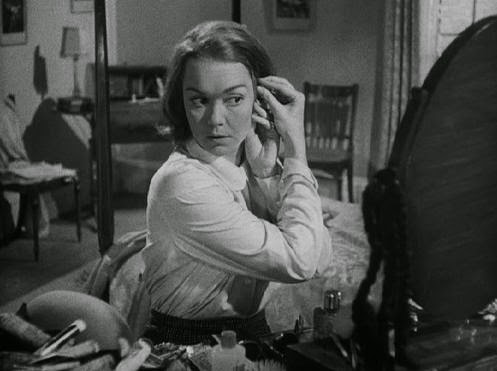
When the protagonist (played here by a young Jane Wyman) attempts to infiltrate the household of a wealthy widow, her methodology is not that of a concerned citizen but of an actress preparing for a role. She adopts a character, a voice, a look, and tries to fool those closest to her as a form of elaborate rehearsal. That her own mother sees through the ruse almost immediately says a lot about Hitchcock's need to revel in the obvious way filmmakers engage in these games of deception. The audience, like the mother, can see through the facade of these shenanigans, but we accept them, nonetheless, because they facilitate drama, mystery, action, humour and suspense. This, as an ideology, is something that continues right the way through the film; from the flashback that follows the raising of the curtain, to the stage-bound finale, which concludes, fittingly enough, with the same curtain falling, like a guillotine (the idea of death as the ultimate climax). Hitchcock knows that his audience will accept these absurdities because we're looking for that rush of excitement, the thrill of the chase and the anticipation of great spectacle; as such, the presentation, as ever with the filmmaker, becomes a playful punishment for the intrinsic voyeurism of both the audience and the characters on screen.

____________________________________________________


The Second Circle [Aleksandr Sokurov, 1990]:

There was a struggle with this one. In fact it would be a cheat to even consider this a key film were it not for at least two significant elements that elevate it above the immediate level of refined tedium.  Firstly, the stylisation of the film is clever and compelling. The juxtaposition, between supposed "art house" tropes - as defined by a filmmaker like Tarkovsky; for instance, mechanical tracking shots, long takes, an emphasis on the elements (harsh landscapes, dripping water, howling winds, etc) - and the less conventional influence of the silent cinema - trick shots, miniatures; an inter-cutting between black & white and saturated colour - created, in my mind, a rather strange and at times almost abstract reading of what initially seems to be a fairly straightforward series of events.  This approach forces the audience to think more intensely about the drama being depicted and the possible reason as to why Sokurov might have approached this story in such a way as to deliberately call attention to the artificiality of the filmmaking form.

This divide, between the content (which is social-realist in nature) and the form (which is more affected and theatrical), seems intended to act as a barrier between the audience and the work itself. While the majority of directors will actively invite the audience into the experience of the film by having the viewer identify with the central character(s) and the minutiae of the plot - creating a sense of connection, through close-ups, the use of music, or the emotions suggested by the actors on-screen - Sokurov instead seems almost intent to push his audience away. His compositions are not conventionally beautiful, but are often cluttered, incoherent and defiantly careless. Wide angle lenses distort the natural perspective of rooms, making those in the foreground look like giants, while those in the background shrink into the vanishing point. Muddied filters obscure parts of the frame, giving us only the impression of characters and their actions.  Bodies and furniture are placed haphazardly; a hanging light bulb, the corner of a table or a character's bare foot each seem to cut aggressively into the edges of the frame.


The second point of interest is the film's central metaphor (at least as far as I understood it); the relationship between the son and his deceased father, and how this - in its self - refers back to film's political subtext; specifically, a kind of commentary on the once contemporary position of the Soviet Union. Made directly before the state's dissolution in 1991, Sokurov's film uses the father as a surrogate for everything the Soviet Union represents; his death - in both the literal and symbolic sense - signals the end of a particular tradition.  It brings forth a sign of great change and possibility; a chance to adapt and progress.  Through this, the son becomes an obvious stand-in for the next generation. He is left to clean up, to pick up the pieces, but also to fend for himself. How is this possible when one's life and identity have been so rigorously defined and fashioned by all that came before? This is the question that Sokurov poses and one that seems manifest in many of the film's longest and most laborious scenes.

By adopting a visual style that creates distance and artificiality, Sokurov seems to be making a concentrated effort to take the film out of the recognisable reality; to say "this is not the truth", but something else. As with the director's later film, Whispering Pages (1994), it is this emphasis on stylisation - the obvious artifice of the film-world - that intercedes on behalf of these characters, unable to express. The film's distorted framing, the slow drifting between colour and black & white (where the colour will literally bleed into an image, mid-scene, as if to suggest life slowly returning to the flesh of a pallid corpse) and the aerial views of the village, which present it as a miniature facade, all seem - on one level - to be entirely "Brechtian"; alienation techniques intended to take the audience out of the reality of the film, reminding us throughout that what we are seeing is a motion picture. However, such stylisations are also necessary to depict, visually, the subconscious perspective of the central character. His loneliness, the disorder of his own mind, both reflected in the murky chaos of Sokurov's frame.

Sunday, 18 May 2014

The Spider's Web


Prelude to a note on Alfred Hitchcock's film Suspicion (1941)

Mild SPOILERS


With the relatively recent releases of both The Girl (2012) and Hitchcock (2012) - two films that deal with the more sensationalist aspects of the director's art - it seems necessary to draw the emphasis back to Hitchcock's craft - his filmmaking - and to ponder the questions: what makes Hitchcock so great, so essential to the development of the motion picture as a legitimate art-form, and so enduring, as a cultural concern?  For many, it's his obvious ability to tell a story; to involve an audience in the intrigues of a protagonist, and in the emotional and psychological progression of his characters through the course of a film.  For others, it's his talent for creating moments of pure action, drama, mystery and suspense; the way the filmmaker so skilfully manufactures or engineers those iconic moments that seem to capture so well the emotional perspectives of his central characters (and even, in some cases, the antagonists) and to make them relatable to the viewing audience, still passive before the screen.

All of these factors are no less true, but the thing that makes Hitchcock's films stand out against the work of those that have followed in his footsteps - at least, from my own perspective - is the director's commitment to maintaining the sense of artistry and poetic grandeur explicit in the cinema of the silent age.  The stylisation of these films, where the unreality of the work - the sense of the film being liberated from the more cumbersome expectations of reality, or actuality, to instead soar with the grace of a bird from the screen - stands in stark contrast to the heavier, noisier, more overbearing bombast of contemporary directors like Michael Bay, Paul Greengrass and Christopher Nolan, who assault the senses of the audience in an effort to enforce a heightened air of overdramatic reality.  Their work might focus on the implausibility of fighting robots, super spies or men in rubber costumes, but the unimaginative, often "televisual" approach to the staging and general design of these films (handheld cameras, frequent close-ups, disorganised cutting, etc) seems intent to remind the viewer that this is "real"; that the action and adventure is genuinely taking place.

For Hitchcock, the ideology is reversed.  His stories could be real - they build on the recognisable (small towns, city streets, apartment buildings, hotels, everyman characterisations, etc) - but they're presented in a way that exaggerates the theatricality; the "abstractness" of the situation.  If modern filmmakers seek to show - to put into images a story that can be followed and felt - then Hitchcock sought to adapt the psychology of his characters; to put into images a particular mindset; a sensation of fear, panic, hostility, danger and even death.  Rather than attempting to place the audience outside of the action, as objective observers, he invites us in; exploiting the tools and techniques available to him as a filmmaker versed in the developments of pioneers like F. W. Murnau, Sergei Eisenstein, Fritz Lang, Lev Kuleshov and Robert Wiene, so that the audience is, in a way, more cognisant of what the characters are thinking.  We see what they see, feel what they feel, and so on.

Hitchcock manipulates the viewer, but does so with the intention of making the audience identify with his protagonists. In Rear Window (1954) for instance, he traps the viewer in a single midtown apartment, with only the 1.66:1-like window-space to occupy our curiosity, as we're inevitably forced to accept our own role as the submissive voyeur as surrogate for the character on-screen. In Vertigo (1958), he has the viewer dangling from the edge of a high-rise rooftop while the trickery of the camera imposes a feeling of dizziness that will in turn overwhelm both audience and protagonist alike...


Rear Window [Alfred Hitchcock, 1954]:
Ways of seeing: characters as viewers, the "viewer" as victim, etc.


Vertigo [Alfred Hitchcock, 1958]:
Identification marks: audience and character (on-screen) scarred by the same experiences.

With Suspicion, every scene - every shot! - is designed to show us the "reality" as the heroine sees it.  If a character looks at a note or letter, or sees something occur and registers it as either strange or suspicious, then Hitchcock designs the scene so that the audience is naturally compelled to think the same...


Suspicion [Alfred Hitchcock, 1941]:
Hitchcock uses an artificial highlight to draw the audience's attention to a particularly 
chilling quotation as read by the film's protagonist.

It's all foreplay, here. Hitchcock as seducer, misleading, manipulating; using the film-making to skew our perception of the story, but also to add clues and commentary to the sub-text of the narrative taking place beneath the frame.

While Suspicion isn't my favourite film by Hitchcock (for reasons that I'll return to soon) it is one of the strongest examples of the director's aesthetic approach.  This is a film like many by Hitchcock where the subjectivity of his character's psyche - her way of perceiving events - overwhelms the experience; creating the impression that all aspects of the film (the music, cinematography, editing and design) are somehow interceding on behalf of this character; expressing (visually) the fraught emotions that she herself is unable to put into words.

Take this scene, for instance.  Here, the protagonist - the vulnerable Lina (as accompanied by her husband, the rakish but somewhat still threatening Johnnie Aysgarth) - is moving into an expensive and opulent new house on the edge of the village.  The characters pause in the foyer while the anxious estate agent closes the deal.  It's a perfunctory scene - intended to establish the setting and a general feeling of happiness and excitement shared by these characters before the story changes gear - but it's also a scene that creates an added depth and texture by the general approach to composition (the mise en scène) and the effect that Hitchcock and his cinematographer Harry Stradling Sr. achieve with the clever lighting of the set....


Suspicion [Alfred Hitchcock, 1941]:

The art-direction by Van Nest Polglase incorporates a large skylight, which, when lit from a certain angle, creates a magnificent silhouette.  The design of the silhouette has the clear appearance of a spider's web.  As an effect, it's ornate, eye-catching and highly decorative, but it also suggests something more significant about the film's subtext.  In relation to what we've seen and to what Hitchcock wants us to think, the appearance of this web informs both the relationship between these two characters and the situation, as it unfolds.

The initial courtship between Lina and Johnnie is like a whirlwind.  We find out very little about these characters prior to their initial meeting, and before we've even had sufficient time to suss out their motivations, or the giddy feelings shared by these characters, or to see them develop and progress, the couple are already married and settling down into a life of polite domesticity.  It is at this precise moment that Hitchcock (and his writers) begin alluding to the true nature of Johnnie - his gambling addiction, foul temper and general lack of funds - and how this seems related to his relationship with Lina; this shy, largely naive young woman, with a background of wealth and privilege.

As an audience, we suspect what Hitchcock wants us to suspect; that Johnnie is using Lina for her inheritance.  Suddenly, the subconscious idea expressed by the production design and cinematography becomes clear.  Lina is now trapped.  Marriage has bound her to this potentially dangerous character, while the house itself, as a materialist object, is the thing that holds them together.

In using the cinematography and production design to suggest this particular reading - cluing the audience into the potential motivation of his character (as well as the rules of the game) - Hitchcock is showing the influence of German Expressionism; specifically a film like Wiene's The Cabinet of Dr. Caligari (1920), where the stylisation of the frame frequently hints at the tortured psyche of its central character.  Hitchcock's adaptation of Wiene's technique is more subtle but no less artificial in the way that it draws our attention to the unreality of the world; the perspective of a place as distorted by the fragility of human emotions.


The Cabinet of Dr. Caligari [Robert Wiene, 1920]:
Caligari's iconic production design is intended to express the world of the protagonist 
as a reflection of his own subconscious mind.

Throughout the film, Hitchcock will have his players return to the above-mentioned skylight/veranda setting in an effort to emphasise the predicament of his central character and how the behaviour of her husband has left no other alternative than to speculate on the possibility of a dastardly deed.  The setting becomes an almost emotional leitmotif; one that again reinforces the idea of Lina as both trapped by this relationship and by the circumstances created by her less than honest husband, but also by the web of suspicion itself, and how this deadly trapping lures these characters, unsuspectingly, into a psychology quagmire of self-deception and acute/ironic misunderstanding.

This, as an idea, is suggested in a later scene, in which Lina confronts the housekeeper Ethel, and enquires about the location of her husband (already suspecting the worst).  As the two characters converse, the shadow of the spider's web once again hangs heavily behind them, reminding both the characters and the audience of Johnnie's presence (even when absent from the frame) but also as an unspoken acknowledgement of the secret thoughts and feelings (known but unstated) that seem to circulate around the house, or around the position of these various characters too afraid to confront the issue (the "real" issue) head-on...


Suspicion [Alfred Hitchcock, 1941]:

As the ensuing dialogue is struck, the camera tracks in.  The movement of the apparatus is designed to bring the audience closer to these two characters, as if we're drawn deeper into the intrigues of their conversation as well as into the web of narrative conspiracies, both as mutual witness and as a kind of co-conspirator.  However, the effect created by this dolly is also expressive of the filmmaker's as yet unacknowledged psychological reading of his central character; an understanding that only becomes blatant in the film's final scene.  As the movement of the camera further flattens the depth of field, it creates an even greater impression of the character (or characters) as being caught in this web of their conflicting suspicions, mistrust, passion and peril...


Suspicion [Alfred Hitchcock, 1941]:

This web, which we assume relates to the presence of Johnnie as expressive of his control and underhanded manipulation of events, is in fact conjured by our protagonist.  It is the web of her own suspicion; her distrust of others and her implicit snobbery that creates this feeling that changes the perception of the world.  Because we see the entire second-act of the film subjectively, through Lina's eyes, her own emotional or psychological perspective on events colours the way the audience itself reads the film, or the intentions of its narrative.  It forces us to see these scenes and interactions as part of a larger conspiracy of events that can only lead towards a murderous end, when the reality is something much more tangible, even benign.

This, as a misdirection (which will only become explicit during a last minute twist), is best expressed in that remarkable, almost dreamlike sequence, in which Lina envisions her husband as a faceless figure.   Shrouded in the silhouetted cloak of a velvety blackness, he approaches with a sinister looking glass of warm milk.  The glass itself becomes a signifier; the expressionist unreality of it (where the liquid literally glows on-screen) is like an indicator that all is not as it should be.  In this scene, Hitchcock is once again pushing the audience towards a certain realisation where Lina is continually being reinforced as a potential victim - the helpless fly caught in the sinister web of her husband's misdeeds - but also revealing something more interesting about the psychology of the heroine...


Suspicion [Alfred Hitchcock, 1941]:
Who's who?  Is Lina trapped in a web of Johnnie's malevolence 
or of her own inability to observe the truth?

All of this is part of the film's clever (but frustrating) game of misdirection, where the filmmakers strive to establish the perspective of Lina as that of the obvious victim - the frightened woman - even if the eventual outcome shows this to be a cheat.  Conversely, Johnnie is presented as mysterious, deceptive and often aggressive.  The audience, like Lina, is incapable of seeing him as anything less than a threat.  However, the stylisations - which at first play into this deception, making the audience suspect Johnnie's intentions (just as Lina does) - will in hindsight become expressive of Lina's own perception of the word, which is fuelled throughout by the sheltered life that she had led prior to her first encounter with Johnnie, to say nothing of the death of her father, or the importance of social standing and reputation as something threatened by her husband's more casual and potentially more illicit way of life.

Nonetheless, it is this approach to staging and stylisation that defines our experience of the film (or mine at least) and what for me elevated a minor Hitchcock to a greater level of technical sophistication and significance.  If nothing else, the film remains an outstanding example of the director's remarkable approach to craft.

Perhaps more than anyone, Hitchcock recognised that the language of cinema is not "text"; it's not written.  It's imagery; shots and cuts, observations and movement.  We can take any frame of this film and "read" the images.  We can perceive the fear, the concern of characters, the relationship between people, the tone of a particular scene.  The body language, the composition of the shot, the use of light (and in later films, the use of colour) are each significant; all suggestive of the emotional and psychological subtext of the film, as well as existing as a more conventional means of furthering narrative progression.

This, as a mentality, is true for the majority of the other great Hollywood filmmakers - Ford, Ray, Hawks, Tourneur - just as it's true of the director's most indebted to Hitchcock's influence; Chabrol, Rivette, Spielberg, Fincher; the more contentious but no less brilliant likes of De Palma, Argento and Shyamalan.  This sense of the image - of the filmmaking apparatus - being used as a pen to tell a story; of "motion pictures" being used to suggest or evoke specific thoughts, feelings and desires that enrich the story, or the way that we interact with the characters on-screen.  It's also the self-reflexivity of this - the "web" itself, as a recurrent visual motif - which ensnares the doubtful Lina, and likewise ensnares the viewing audience, just as easily misled by Hitchcock's clever manipulation of the form.

Schalcken the Painter (1979)

Schalcken the Painter [Schalcken the Painter [Leslie Megahey, 1979]: This is a film I first saw around four years ago. At the time I found...