Showing posts with label Robert Siodmak. Show all posts

Friday, 21 February 2020

The Year in Film 2019 - Part Three


El patrullero (Highway Patrolman) [Alex Cox, 1991]:

Watched: Mar 17, 2019

If one filmmaker dominated 2019 for me, it was Alex Cox. Earlier in the year I read his 2008 memoir, "X-Films: True Confessions of a Radical Filmmaker", and greatly enjoyed its informative and always self-deprecating approach. I purchased two more of Cox's excursions into the literary world, his 2017 book "I am (Not) a Number: Decoding the Prisoner" and 2009's "10,000 Ways to Die: A Director's Take on the Spaghetti Western", and found both to be of a similar value. Inspired by the books I was also watching and re-watching Cox's films. Of those that were new to me, his films The Winner (1996), Revengers Tragedy (2002), Searchers 2.0 (2007) and Bill the Galactic Hero (2014) are either excellent or better than their reputations suggest, however one film stood out as a definite highlight. Filmed in Mexico following Cox's departure from Hollywood, El patrullero – or Highway Patrolman as it's commonly known – ties with Walker (1987) as the absolute pinnacle of the filmmaker's career. Scripted by Lorenzo O'Brien, El patrullero takes the mythos of the American western – where the lone lawman attempts to remain moral and just as he fights corruption and criminality in a lawless border town – and contrasts it against the conventions of the road movie. The tone is anarchic, carefully mixing between scenes of broad comedy, character development and gritty violence, while the filmmaking is ambitious and creative. This was the period when Cox was shooting his films "plano secuencia", meaning every scene is filmed in a single, carefully choreographed take. The result is a complete masterpiece of narrative, theme and aesthetics, and one of the absolute great films of the 1990s.


Phantom Lady [Robert Siodmak, 1944]:

Watched: Mar 24, 2019

The title hints at something supernatural, putting us in mind of certain analogous Val Lewton produced horror films, such as The Leopard Man, or The Seventh Victim (both 1943), but this isn't the case. Instead, Phantom Lady could be described as a "proto-giallo"; a film noir that predicts many of the conventions and practicalities that would go on to define that particular sub-genre of Italian murder mysteries so popular during the 1960s and 1970s. While it doesn't have the black-gloved serial killer or the stylised death scenes, there is nonetheless something about this story of a bystander taking on the role of amateur-sleuth to investigate a grisly murder, as well as the subsequent confession of the killer, whose grip on sanity has unraveled into tortured exposition, that recalls the practicalities of later films by directors like Mario Bava, Dario Argento and others. Films like The Girl Who Knew Too Much (1963) and Deep Red (1975) specifically, which capture something of a similar atmosphere, as well as 'cat and mouse' scenes of the "hunter" becoming the hunted. While not as powerful in its emotional drama or as inventive in its storytelling as his later film, The Killers (1946), the imagery of director Robert Siodmak is at its peak here, as the film blends the mystery and procedural elements with a thrilling descent into a third-act psychodrama.


Pirates of the Caribbean: Dead Man's Chest [Gore Verbinski, 2006]:

Watched: Mar 26, 2019

Dispensing with plot to an even greater degree than the original film, the likable but otherwise thinly-sketched Pirates of the Caribbean: Curse of the Black Pearl (2003), director Gore Verbinski's first sequel to the long-running franchise builds on its greatest strength (i.e. Johnny Depp as the irrepressible Captain Jack Sparrow) and runs with it, creating a narrative that exists for no other reason than to place its central characters into situations that allow for much comic misunderstanding, stunts and orchestrated suspense. The result, a non-stop cavalcade of action and comedy, feels less like a Hollywood blockbuster than something possessed by the cinematic spirits of Jackie Chan, Harold Lloyd and Buster Keaton. It's a film that places the emphasis on spectacle; upping the ante on what the first film was able to achieve and creating a series of visuals and set-pieces that are thrilling, original and brimming with imagination. For me, "Dead Man's Chest" is the absolute pinnacle of the first three "Pirates" films, and is a work that marks the beginning of Verbinski's run as a genuine "termite artist"; a filmmaker working within the mainstream that is nonetheless able to invest his films with ideas, images and scenarios that are subversive, eccentric, or defiantly anti-mainstream. In its scope, ambition and pure force of vision, it's a definite precursor to Verbinski's subsequent fantastic oddities, The Lone Ranger (2013) and A Cure for Wellness (2016).


Dumbo [Tim Burton, 2019]:

Watched: Apr 08, 2019

The experience of the film for me was like the world in miniature; the big-top reverie of the American experience distilled to its key essentials. The real pleasure of the film was not limited to the story and its presentation, but more redolent in what the film was able to suggest between the lines of blockbuster expectation. In its tone and intentions, Dumbo is capitalism and candy floss. It's the triumph of the broken, the different, the "other", struggling against uncertain odds. It's maudlin sentimentality. It's love, both between the child and its mother, but also at first sight. It's the struggle of the independent cinema against the unstoppable Disney machine. It's escapism. It's a circus train moving across the landscape in-time to the clamour of musical instruments. It's prejudice and persecution, pre-packaged in such a way that its message will be understood by young children, but not lost on the parents and adults also in attendance. It's a film about understanding. So many of the current crop of "live-action" Disney remakes are films made without style or personal aesthetic. They exist first and foremost as product; the imagery is there to illustrate the story and little else. Dumbo is not only defiantly beautiful as a piece of cinema, its alive with themes and ideas. While the anti-corporate, anti-big business subtext might seem disingenuous given that the film is a product of the Disney™ brand, it's another example of Burton as the "termite artist", biting the hand that feeds him. The small circus becomes a metaphor not just for the family (extended, as in the 'community') but the independent cinema. "Dreamland" as an obvious Disneyland surrogate, represents the mainstream, with its profit driven incentives, callous treatment of artists and emphasis on merchandising. The film even ends with an image of the cinema as a symbol of the great spectacles to come.


Cloud Atlas [Lilly Wachowski, Lana Wachowski & Tom Tykwer, 2012]:

Watched: Apr 14, 2019

The earnest nature of its message and the eccentricity of its delivery invite ridicule. After all, this is a film that casts recognisable superstars and has them speak in a variety of contrived, even fictional dialects, buries them under heavy prosthetic effects, and even at times indulges in the more controversial practices of gender and race-bending. To see Halle Berry portraying a white character, Hugo Weaving imitating a woman and Jim Sturgess playing Chinese isn't perfect, but it's practical, and plays into one of the more important components of the film; specifically the idea of a small group of "souls" inhabiting different variations of the same characters throughout history. Covering six different timelines and a variety of locations, from the Chatham Islands in 1849 to a post-apocalyptic future world in the year 2321, Cloud Atlas is by far the most ambitious Hollywood film of the past decade. Here, its three directors' cross countries and continents, cross boundaries of style and genre, and even cross the lines of convention and common-sense, delivering a film that for all its fantasy and imagination is focused on a human story of love and perseverance. Like Sense8 (2015-2018), the mostly brilliant TV series that Tkwer and Wachowskis would go on to helm a few years later, Cloud Atlas is a story about connections. Individual narratives find parallel lines that tangle and enfold, while music, words, images and characters echo across time and space. At close to three hours in duration there are many that would argue the film is too slight and simplistic in its message to justify the level of indulgence, but I found it genuinely moving. That the message can be regarded as "prejudice is bad and we should live as better people" was not a flaw for me. I found it beautiful, moving and admirably humanist in intentions.

Thursday, 6 February 2020

The Year in Film 2019 - Part One


A Belated List

I'm finally getting around to compiling a list of the best films I saw over the course of 2019. As in previous years, this isn't a list of films released in 2019, but of films I saw during the previous twelve months. As such, it contains some films that are old and some that are new, but really, semantics aside, all these films were new to me. It doesn't matter if a film was released in the 1920s or the 2020s, all films that we see for the first time are "new" films and I think for the cinema, and the history of cinema, to endure over the subsequent decades, we need to stop enshrining works in the reputation and legacy that they attracted when they were originally released and see all films as potentially new discoveries.

On this list you'll find films that many audiences and critics have derided as worthless and that have maintained this reputation for years, if not decades. However, going into these works without prejudice or expectation, I found films that were thrilling, both aesthetically, in the way they were produced, but often emotionally and psychologically as well. They were films that, regardless of when they were produced, still felt relevant. This year, I'm breaking the list down into smaller installments, including only five films per-post, rather than the usual ten. This will hopefully starve off the typical burnout that comes from having to proof-read and edit such a large volume of capsule reviews.


Jamaica Inn [Alfred Hitchcock, 1939]:

Watched: Jan 04, 2019

Overshadowed by Hitchcock's later adaptations of the work of Daphne Du Maurier – Rebecca (1940) and The Birds (1962) respectively – the commanding and atmospheric Jamaica Inn is an arguably minor work for the "master of suspense", and yet remains a film ripe for rediscovery. While not as rich, psychologically, as the subsequent Rebecca, nor as thrilling in its spectacle as The Birds, Jamaica Inn remains an engaging and atmospheric work of pure Gothicism; a rugged "south-western", with smugglers replacing bandits and the titular inn replacing the more conventional homestead or hacienda, where the outlaws hide out. Dominated by a scenery chewing performance from Charles Laughton as a shadowy landowner, Jamaica Inn plays more to Du Maurier's creative interest in lost girls and existential landscapes than to Hitchcock's tales of suspense and obsession. However, the filmmaker commits fully to the spectacle of the film, creating a work where the real star is not so much Laughton and his fellow thespians, but the studio recreated North Cornwall setting, with its desolate moors and rugged coastal scenery. To this day, many critics and audiences have argued that Jamaica Inn is one of the worst Hitchcock films, but I don't agree. In fact, I found it superior to more acclaimed works like Suspicion (1941), Saboteur (1942), Stage Fright (1950), The Wrong Man (1956) and Frenzy (1971). In its spectacle and scenography, the film recalls the greatest works of German Expressionism, with its similar emphasis on theatrical stylisation, atmosphere and suggestion propelling the story forwards, while the narrative itself explores pertinent issues relating to class exploitation, insanity and the loss of innocence.


The Favourite [Yorgos Lanthimos, 2018]:

Watched: Jan 08, 2019

The screenplay by Deborah Davis and Tony McNamara is incredibly witty, the performances are great and the aesthetic of director Yorgos Lanthimos, as it's developed since the masterful Dogtooth (2009), through films like The Lobster (2015) and The Killing of a Sacred Deer (2017), continues to enthral. The chessboard colour scheme, wide-angle lenses and mesmerising tracking shots through darkened corridors evoke The Shining (1980) by way of Peter Greenaway. However, it's the character dynamics that are most engaging, suggesting ideas of systemic abuse, female desire, culpability and how complicit individuals can be in their own exploitation.


Glass [M. Night Shyamalan, 2019]:

Watched: Jan 21, 2019

Much ink has already been spilled here on the subject of Glass; writer and director M. Night Shyamalan's concluding chapter to a loose trilogy of films that began twenty years ago with the ahead of its time Unbreakable (2000) and continued into the previous decade with the superior Split (2016). While less cohesive and less successful than those earlier endeavours, Glass nonetheless struck me as a perfect conclusion to Shyamalan's saga; bringing together as it does the various themes that run throughout the trilogy and through Shyamalan's career as a whole. Like many of the filmmaker's greatest works, Glass is another film about overcoming grief and about forgiveness as an act of faith. Like his masterpiece The Village (2004) it's about secret societies and people bound together by experiences. Like the similarly denigrated but similarly necessary Lady in the Water (2006), it's profoundly uncynical in its intentions and in its celebration of extraordinary people, or ordinary people that rise to extraordinary levels when the situation calls for it. Rather than taking influence from the thundering superhero blockbuster cinema of studios like Marvel and DC, Shyamalan embraces the cult-leaning, low-budget nature of his recent work and creates a film that draws on the influence of writer and director William Peter Blatty, specifically The Ninth Configuration (1980). There as well as here an assortment of characters consigned to an asylum play out their delusions with destructive consequences. For both Shyamalan and Blatty, the psychiatric setting is not just a physical location, but a metaphysical stand-in for the characters' shared psyche. In this sense, the three protagonists become manifestations of the "id", the "ego" and the "super ego", who over the course of the film, battle for supremacy. It's obvious that the three characters reflect the different facets of Shyamalan's creative identity, and his punishment of these characters says a lot about the complex relationship he seems to have with his own work. I found the film fascinating.


Lifeboat [Alfred Hitchcock, 1944]:

Watched: Jan 29, 2019

While one can concede that Jamaica Inn (1939) has its flaws, and that some audiences will be unable to look beyond those flaws to see the elemental and cinematic brilliance that it most definitely contains, Lifeboat is an unarguable Hitchcock masterpiece. Often regarded only in terms of its narrative gimmick, setting a thriller entirely in a small lifeboat as it carries its disparate group of survivors across a desolate ocean, the film is an emotional and political pressure cooker. The perfect meeting place between Hitchcock's formalist game-playing and audience manipulation, and the impassioned, left-leaning, anti-war commentary of author John Steinbeck, who wrote the initial short story on which the film is based. Steinbeck would later disown the film for containing slurs against organised labour and for creating a "stock comedy Negro" when the character he had written was a man of "dignity, purpose and personality." Nonetheless, Steinbeck's fingerprints are all over the film's complex rendering of the way wartime prejudice works to turn people against each other. Hitchcock has a lot of fun with this psychological aspect, subverting not just the conventions of the thriller, but to an extent the machinations of the whodunnit mystery, as the potentially conspiratorial intentions of one or more of these characters becomes a ticking timebomb that threatens to destroy the whole group.


The Killers [Robert Siodmak, 1946]:

Watched: Jan 31, 2019

Siodmak's noir, largely scripted by an uncredited John Huston, builds on the existential conundrum of Ernest Hemmingway's original short story to create a study in narrative as a collated memory. The structure, complex and mysterious as it is, becomes an investigation that reveals a character study in fragments; all avenues of questioning leading back to a series of relationships that swirl around a terrible betrayal. Produced on a minimal budget, Siodmak's filmmaking is incredibly creative, with the black and white cinematography of Elwood Bredell in particular setting a high benchmark for the entire film-noir sub-genre. The writing and performances are impeccable, but it's the emotional and narrative complexity of the film's structure and editing, as well as the inventiveness of Siodmak's direction - with its visual nods to the paintings of Edward Hopper, and a heist sequence covered in a single, carefully choreographed crane-shot - that really mark this out as a genuine masterwork.

Wednesday, 6 June 2018

Art Cinema


Thoughts on a film: Shirley: Visions of Reality (2013)


Martin Scorsese once said: "Cinema is a matter of what's in the frame and what's out." It's a statement that I returned to several times within the context of the film in question, and also in relation to another quote, similarly attributed to a legendary filmmaker: "Everything is cinema."

The Scorsese quote is interesting, and speaks to the responsibilities of the filmmaker when approaching the necessities of 'coverage' - i.e. determining where to put the camera, what to emphasise within a given scene, where the point of interest is - as well as considering things such as context, ideology and intention. However, it's a statement that isn't exclusive to the practicalities of filmmaking, and there's the rub. What's in the frame, and what's out, could just as easily be applied to the practice of painting, or photography. It could even be said about the theatre; or at least the conventional theatre, restricted as it often is by the parameters of the stage.

In Shirley: Visions of Reality, the filmmaker Gustav Deutsch applies Scorsese's maxim to the rigorous recreation of several paintings by the artist Edward Hopper; using the notion of "what's in the frame" as a pretext to spin-off a series of interpretations and phantom narratives inspired by what Deutsch sees within the paintings themselves (the representations, the settings, the "protagonists", etc), but also what might be seen outside of them (the historical context, the politics of the age, the fundamentals of Hopper's own life). In doing so, my mind wanders back to that second hypothesis, "everything is cinema" - normally credited to one Jean-Luc Godard - and finds within it a kind of justification for this film and its central experiment.

Throughout the film, Deutsch and his collaborators painstakingly recreate thirteen of Hopper's most iconic paintings as a series of theatrical tableaux. Through further use of voice-over and physical performances, the filmmakers attempt to convey a consistent narrative that runs through each of the paintings in an effort to better explore the nuances and ambiguities of Hoppers own work against the possible historical and social-political contexts that surrounded them.


Shirley: Visions of Reality [Gustav Deutsch, 2013]:

I have to admit, as an experiment, and as a work of cinema in its own right, the film left me somewhat conflicted. On the one hand, I don't think the narrative that Deutsch attaches to Hopper's paintings is as interesting as the stories that are already conveyed or suggested by the art itself. Yes, the idea of linking the individual female subjects from several of Hopper's most important works (in order to create a kind of subconscious stand-in for the various themes the filmmaker has extrapolated from his own personal interpretations of the artist's iconography) is a clever one - creating a kind of symbolic representation of either the notion of womanhood in the mid-twentieth century, the 'voice' of the American theatre during its most turbulent and transformative period, or the personification of the country itself from the year 1931 through to 1963 (encapsulating both the pre and post-war periods) - it's never entirely compelling, as a dramatic device, or comprehendible, as a political statement.

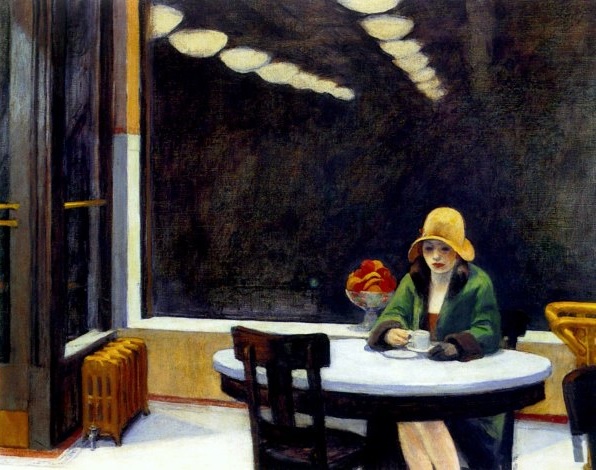
Hopper's work already has a long association with the cinema. Several high-profile filmmakers - going back to Alfred Hitchcock's work of the 1940s and 50s; or more specifically, the whole legacy of directors, production designers and cinematographers associated with the development of the 'film noir' (think The Killers (1946) by Robert Siodmak for instance) - have tried to emulate Hopper's distinctive depiction of urban Americana and managed to capture something of that same nocturnal, melancholic air.


Nighthawks [Edward Hopper, 1942]:


The Killers [Robert Siodmak, 1946]:


Deep Red [Dario Argento, 1975]:


The End of Violence [Wim Wenders, 1997]:

When we think of the name Edward Hopper, there's a certain narrative of expectation that presents itself. It's a narrative of loneliness, alienation, longing and disappointment. Hopper's figures are often haunted, alone, disconnected from the society that surrounds them. They exist within settings that are often communal in nature - cafés, bars, cinemas, trains, office-spaces - but his figures are devoid of companionship; frozen almost, in time. They become like ghosts, haunting the landscape of an American Gothic, or like prisoners, trapped by circumstances and routines.

The filmmakers that have best translated Hopper's images to the screen have found a certain affinity for such characteristics and situations, or for that feeling of quiet desperation; the aching loneliness associated with being adrift in the big city. The silence of Hopper's paintings doesn't require a context or elucidation for us to possess a greater understanding or insight into these narratives of still life; it's all there in the expression; the ambience and the sensitivity, which is felt.


Automat [Edward Hopper, 1927]:


Shadows in Paradise [Aki Kaurismäk, 1986]:

While 'Shirley' does succeed in presenting a sense of the sadness, longing and disconnection associated with Hopper's paintings, there are whole sections of the narrative that are devoted to discussions of the American theatre, Communism, the House Un-American Activities Committee, the betrayals of Elia Kazan, the inferiority of the Hollywood system, the works of Emily Dickinson, the contradiction of the phrase "photography as truth", contemporary journalism, and a vague back-and-forth story about a couple unable to connect.

None of the themes or storylines that are here assigned to Hopper's work feel necessary to our own understanding of the images themselves. Instead, they present a kind of highbrow academic variation on the notion of fan-fiction; connecting the various dots, not because they feel explicit to the conception of Hopper's paintings, but because they're of interest to the filmmaker. This, in and of itself, is not an issue. However, the lines of interpretation that Deutsch attaches to Hopper's works aren't significantly well developed; instead feeling like vague traces or suggestions of something that never quite collates into a consistent narrative.

These fragments of a story play out against the further use of actual news bulletins that cover a whole stratum of American history (taking us from the tail end of the depression, to the outbreak of the Second World War; through the rise of feminism, the civil rights movement and the imminent assassination of president John F. Kennedy). It's difficult to understand what any of these cultural milestones have to do with Hopper's paintings or how we, as an audience, interpret them, but they seem significant to Deutsch's projection of the work and his own perception of this tumultuous period in the country's evolution.

Perhaps this is what the film's subtitle, 'Visions of Reality', is really getting at. The idea that the art, while depicting a simple, still life observation, becomes, in itself, a representation of the period in which it was created. These paintings, as cultural artefacts, do present, in the very literal sense, visions of reality; not just in their emphasis on small, seemingly inconsequential details that define one facet of the human condition, but as a recorded documentation of the attitudes, politics, fashion, styles, expressions and routines depicted in the work; as well as in the social, racial and economic backdrops that existed during their conception.


Shirley: Visions of Reality [Gustav Deutsch, 2013]:


Western Motel [Edward Hopper, 1957]:

While I'm left to question why Deutsch decided to interpret the woman in these paintings as an actress involved in radical left-wing theatre, or what her journeys through Hopper's landscapes are supposed to represent, or how these fragments of a story are supposed to tie the personal to the political, I did find the film strangely beguiling and always beautiful; even if the intellectual context of the work seemed elusive and largely impenetrable.

As a work of cinema, 'Shirley' is undoubtedly a masterpiece of form and stylisation. The use of light and shadow, the colour and texture, the compositions and general mise-en-scene, are all exquisite, both in their mimicry of Hopper's hugely recognisable aesthetic and as an example of pure cinematic craftsmanship. The detail and authenticity with which Deutsch and his cinematographer Jerzy Palacz have brought to life Hopper's work makes the supposedly grand stylisations of Wes Anderson - as typified by films such as The Life Aquatic with Steve Zissou (2004) and The Grand Budapest Hotel (2014) - look like an action-figure's diorama.

The sound-design is also worth highlighting. The ambient sounds of passing trains, street life, seagulls and crashing waves help to give a realistic depth to these abstractions of artificiality; bringing the world of the paintings to life, but still capturing something that is somewhat surreal, even dreamlike. I was less keen on some of the music selections - including, somewhat incongruously, the songs of David Sylvian - which despite capturing the same yearning loneliness inherent in the imagery, felt too modern in this particular context. Nonetheless, the film throughout has an almost hypnotic quality, intensified by the static compositions, slow zooms and languid cutting, as well as through the voice-over evocations of the actress Stephanie Cumming (who brings a captivating and enigmatic presence as the film's central figure).


Shirley: Visions of Reality [Gustav Deutsch, 2013]:

While I'll no doubt wrestle with the intellectual or political merits of this film for some time - with the same unanswered questions and peculiarities going back and forth through my own interpretation of Deutsch's work - there's a part of me that would relish the opportunity to see this again. Whether or not we reject the film as a work of imitation, or as a gimmick, or as something that is more art installation than conventional motion picture, there's no denying that this is a thought-provoking film of precise moments; some perplexing, others astounding.

One scene in particular stood out to me as something so beautiful that it elevated the entire experience of the film as a whole. It's a recreation of Hopper's 1963 painting, Intermission, in which this figure of Shirley finds herself alone in a cinema. As the unseen film begins to play, Shirley realises that the rest of the audience hasn't returned from the intermission. She's sat there - eager to share this experience with her fellow human beings - but she's all alone. In this brief moment, divorced from Deutsch's projected narrative, the combination of the beautiful cinematography, the impeccable production design, the music, the voice and subtleties of Cumming's performance, each work together to create a moment that is fragile, intimate, reflective, heartfelt, biting and perceptive. In a word: unforgettable.

Schalcken the Painter (1979)

Schalcken the Painter [Schalcken the Painter [Leslie Megahey, 1979]: This is a film I first saw around four years ago. At the time I found...