Notes on a film and its prologue:
A Warning to the Curious (1972)
The title
and prologue both play, self-reflexively, to the natural inquisitiveness of the
viewing audience; that unstated appetite for the forbidden; the impulse to
experience the unknown; to look behind the curtain and see how things work; to
go where we're not supposed to; to venture out and explore. In the context of the genre - in this
instance, the supernatural - the title becomes more than just a label of
identification; it's like a challenge to the individual; acknowledging our
curiosity and using it to entice us, to lure us in. The outcome might be nasty, even unpleasant,
but already the title is challenging that spirit of adventure and
inquisitiveness; that compulsion to open the previously locked door into the
great unknown, as a provocation, or as a test of will.
From the
very beginning, director Lawrence Gordon Clark establishes the location as a
central character and uses the filmmaking to create an atmosphere of uncertainty
and isolation that will intensify as the drama unfolds.
Effectively, the film itself begins with two continuous panning shots. The first starts on a bleached-out, almost
desaturated image of the pallid sand dunes stretching out to meet the shining
sea. Already, the implication of the
shot is obvious: we're at the end of the world.
The camera pans to the right, following the coastline until it reaches a
far-away copse of trees that wind-back, creating a borderline between earth and
sand. The next shot places us inside the
woodland. We're still outside, in the
midst of nature, but the cut feels like a transition between an exterior-space
to an interior one. This time the camera
pans to the left, across the wall of trees that appear like a perimeter encircling
or imprisoning us; again, creating the impression that there's no place left to
run.
The shot
comes to rest on an image of a silhouetted figure in the distance. Glimpsed between the greying trees that stand
guard atop skewed hills that give the image the feeling of something from The
Cabinet of Dr. Caligari (1920) - all distorted expressionism; a natural
location that seems as stylised and otherworldly as a studio set - we watch the
distant figure digging in the dirt.
Subsequent insert shots clarify the action, as the shovel penetrates the
mound of earth and the man, now in close-up, exhales exhaustedly, until abruptly...
he stops. We're not sure why (to be
exact), but it's almost as if the man has suddenly sensed something unsettling;
a hidden presence, perhaps lurking within the periphery...
A Warning to
the Curious [Lawrence Gordon Clark, 1972]:


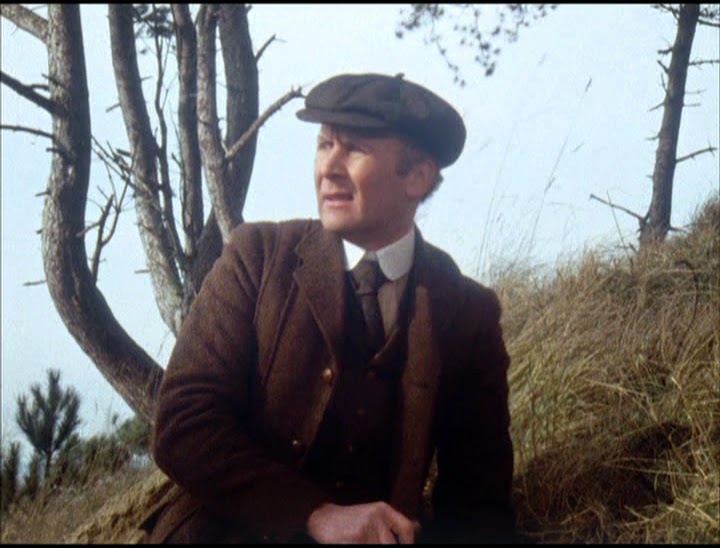

Throughout this sequence, Clark uses images of the surrounding woodland
as a form of visual punctuation; accentuating the scene but also adding to the growing
tension; that implicit impression that something terrible is about to occur. Automatically the stylisation creates an
eerie feeling; a sense of someone (or something) being present, observing from behind
the trees. There's no one there, physically (for the time being, at least), but even
so, the character has the sensation that he's being watched and the audience, knowing
instinctively the insinuations of the genre, share these paranoid thoughts.
The isolation of the location and these images of the forest - all ashen
trees stripped of greenery; taking on the appearance of horned creatures silhouetted
by an almost colourless sky - feed into the underling fear that causes the
character to react. Already I was
beginning to question the possibility of an actual danger awaiting this
character - trapped within a strange and slightly distorted environment with no
easy escape - or if his actions (unstated, but no less suspicious) were in some
way fuelling his discomfort (his guilt?), if not genuine fear.
As an approach to technique, the use of these cut-away shots reminded me
very much of another film released during the same year; The Wold Shadow (1972)
by Stan Brakhage. Unlikely to have been
an influence on Clark, the Brakhage film nonetheless begins with a similar image
of trees framed within a woodland environment.
Like the shots here, it's a benign image - just trees, not necessarily something
unnerving or unnatural in any immediate way - but one that the audience might interpret
as sinister or even threatening if forced to look at for longer than seems necessary...
The Wold Shadow [Stan Brakhage, 1972]:

As the viewer observes The Wold Shadow, the image is transformed. The transformation is created first through
an unconventional manipulation of the aperture and later by shooting the image
through an obscured pane of glass (onto which the filmmaker has gradually daubed
paint to create an unnatural distortion of the original frame). While the effect of this transformation on the
viewer is intended as purely sensory (a visual metamorphosis), the actual
result is far more psychological.
By studying the image, our mind is free to wander. Even before Brakhage begins his manipulation
of the form there is a need to contemplate and make sense of these images. This "need" forces the viewer to
project their own thoughts and fears onto its blank canvas; inventing a
narrative where no real narrative exists and, in a sense, bringing the images
to life. In doing so, we start to see
things that aren't actually there; we're spooked by what we perceive as shapes
between the trees; the illusion of movement created by shadow and light.
It's the impression of nature itself as somehow "possessive",
or able to possess, that is the most starting idea communicated by these shared
images. The conception of nature as
something, if not genuinely "evil", then as a kind of conduit for something
more primitive; an elemental spirit, representing its own energy, or primordial
force. The longer we're forced to stare
at these images, the more significant they seem. To make sense of them, we invent our own
nightmares through superstition and attach them to these otherwise normal
scenes, so that the images become a kind of black mirror; a deep (Freudian) abyss...
The Wold Shadow [Stan Brakhage, 1972]:

The sequence by Clark works on a similar if more conventional
level. Unlike the Brakhage film, the
images remain part of a clear and identifiable narrative. They work to tell the story, as illustrations,
but the presentation of the images and the atmosphere that they evoke are no
less charged with that same elemental spirit; where the forest space once again
becomes a genuine force, and where the act of seeing (with one's own eyes)
transforms a natural and benign image into an unnatural one, loaded as it is
with a genuine "supernatural" threat.
A Warning to
the Curious [Lawrence Gordon Clark, 1972]:

Convincing
himself (like the audience) that it's only his mind playing tricks on him - the
superstitions of local lore or the natural isolation of the location getting
his imagination spinning off in strange and ridiculous directions - the
character gets back to his digging.
Returning to the wide-shot, Clark reminds us that the man is still alone...
A Warning to
the Curious [Lawrence Gordon Clark, 1972]:

However,
after another one of those "Wold Shadow-like" insert-shots that make
us question the safety of this place and its isolation we cut back to the man,
now confronted by the sight of a tall, dishevelled figure, dressed almost
entirely in black...
A Warning to
the Curious [Lawrence Gordon Clark, 1972]:

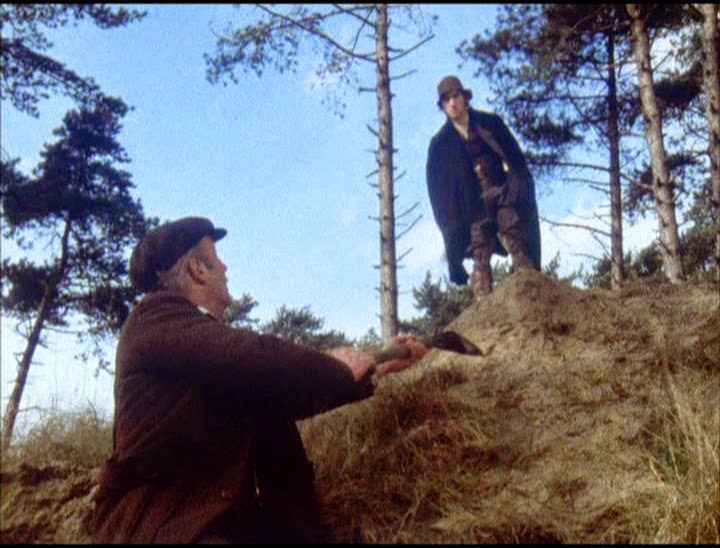
The figure
startles both the character and the audience by appearing, as if from
nowhere. Here I asked myself: where did
he come from? Is he a supernatural
presence or a local person angry at the man's intrusion? It's never openly explained but we can draw
our own conclusions from the subsequent scenes.
Even so, the unmitigated fear is clearly defined on the countenance of
the digging character; a surprised shock or indignation that soon turns to
insolence, as the man's upper-class arrogance kicks in.
There is a
hint of class-based commentary here consistent with Clark's later film, the
previously discussed Stigma (1977), where the digger (a man of some inferred privilege
and reputation) believes that he has the right to bend nature to his will and to
disturb these sites of sacred interest, while the local man - earnest, possibly
simple-minded and with an air of agitated lower-class physicality - is unsurprisingly
appalled by the lack of respect for the land and its traditions.
A scuffle
breaks out but the man is able to subdue the menacing figure, knocking him to
the ground. At this point, the more rational
mind of the audience will be telling the character to flee; to use this
advantage to get away. However, as
horror movie law dictates, the man's arrogance and greed has already sealed his
fate. As he returns to his digging, safe
in the supercilious belief that he's bested this shabby and cadaverous intruder,
the black-clad figure spies a large axe-like implement left idle among the
kindling.
A Warning to
the Curious [Lawrence Gordon Clark, 1972]:


The blade
seems to have appeared as mysteriously as the figure himself, but already Clark
is using these metaphysical manifestations to establish, in the collective mind
of the viewer, the threat of an actual, physical violence.
While
hampered by awkward editorial transitions (no doubt a result of the film's
limited budget), the following sequence is no less impressive in its staging;
the structure of the shots and the growing momentum of dread and desperation
showing an obvious debt of influence to the films of Alfred Hitchcock, and in
particular the infamous Bates' Motel shower sequence from the filmmaker's late
masterpiece, Psycho (1960).
Psycho
[Alfred Hitchcock, 1960]:

Here, as in
Hitchcock's film, it is the way the rhythmical cutting between shots suggests the
brutality of the violence (as opposed to the violence itself) that makes the
greatest impression. Rather than
depicting the attack in explicit detail, the scene instead implies violence through montage and movement and through the
facial expressions of the characters on-screen.
As the
camera slowly zooms from a mid-shot to a close-up and beyond into an
extreme-close-up of the back of the character's neck, we're already certain of
what's about to take place. We're being led
to connect the shots in our own imagination; the man, the close-up on the back
of his head, the figure with the blade, the blade itself, etc, all combined in
the mind's eye of the viewer to suggest something unspeakable, but in a manner that
is brilliantly done...
A Warning to
the Curious [Lawrence Gordon Clark, 1972]:


As an
introductory sequence, the above scene is an attention-grabber. It establishes, sufficiently and with much
atmosphere, the key themes of the film - from greed and curiosity, to the
isolation of the countryside and the almost primal preservation of tradition as
a genuine supernatural force - as well as introducing the greater
practicalities of the subsequent narrative.
Here a man driven by what we assume is greed finds himself isolated in a
landscape that takes on a near-paranormal tenor when threatened by external
forces. This, as a distillation of the
film in miniature, is like a prelude to everything that we're about to see; a forewarning,
of history about to be repeated.
More
importantly however, the scene also communicates a level of "meta"
commentary that is in keeping with the here-jettisoned narrative structure of
the original story by M.R. James. There,
the warning of the title was recounted by the central character,
in-hindsight. He was talking about
something that had already occurred, so the character's recollection became a
warning to his companions (the listeners to his tale). As an alternative, Clark structures the film
so that this opening sequence, in its entirety, can itself be considered a
"warning to the curious." The
curious, in this instance, being the viewing audience (those of us watching the
film), but also the soon to be introduced central character, Mr. Paxton, as
played by Peter Vaughan.


