Thoughts on a film by Gina Telaroli
Three quotes preface the presentation of the film on its director's Vimeo profile. One attributed to a fellow filmmaker, one to an author, and one that remains unsigned but is possibly from Telaroli herself.
"Ten properties of a subject, according to Leonardo: light and dark, color and substance, form and position, distance and nearness, movement and stillness." - Robert Bresson
"They began very promptly—these tender, fluttering sensations; they began with the sight of the beautiful English landscape, whose dark richness was quickened and brightened by the season; with the carpeted fields and flowering hedge-rows, as she looked at them from the window of the train; with the spires of the rural churches, peeping above the rook-haunted tree-tops; with the oak-studded parks, the ancient homes, the cloudy light…" - from Henry James' "Daisy Miller: A Study"
An Amtrak train pulls out of Penn Station in New York City on a cold, sunny February morning. The train moves forward as the landscape changes—the East Coast giving way to the Midwest. Passengers fill their roles, the snow begins to fall and the next train station is announced, all while the light continues shifting, bouncing, swelling and slouching into eventual darkness.
The third quote functions as an obvious synopsis/description of the work itself, defining, in clear-terms, the practicalities of the film's recorded journey, from station-to-station, and place to place. But on a certain level, so too do the quotes from James and Bresson. These quotations speak of the subconscious layer of the film; of what it's depicting beneath the surface of the recording. The significance of the train, its passage through the landscape, the changing topography, the contrast between light and dark, and the transient nature of public transportation, with its journey, both physical and emotional, as a mirror to the journey of a life itself, is expressed between the passages of these words.
The film, in a way, adapts these quotations into images that on one level seem staggeringly mundane and even banal in their presentation of the ordinary, or the everyday, or it applies the quotations to give form to what a first appears formless, but either way, it gets at something inherently mysterious, even monumental, that is felt in the journey (or journeys) depicted in Telaroli's film.
Travelling Light [Gina Telaroli, 2011]:


Whether intentionally or not, Telaroli, in filming the passing landscape from the train's window, creates an iris effect, wherein the edges of the window intrude upon the image, creating a frame within a frame. This, on one level, establishes the subjective relationship between the presence of the filmmaker, recording the journey as it unfolds, but also the notion of the camera as the eye of the audience. It doesn't simply record, it observes, active and attentive, the way a human eye might respond when gazing as a passenger from the window of this moving vehicle.
It also has broader connotations, reminding us of the iris effect of old movies, from the silent era to the golden age of Hollywood, and on an even more vague and obscure level, suggesting the perspective of an astronaut gazing through the visor of their space helmet; exaggerating the almost alien sense of the journey as Telaroli records it, and connecting, again, albeit vaguely, the subjective journey of the film through geographical space with the journey of a character like Dr. Dave Bowman as he travels through the stargate in Stanley Kubrick's enduring masterpiece 2001: A Space Odyssey (1968).


It also has broader connotations, reminding us of the iris effect of old movies, from the silent era to the golden age of Hollywood, and on an even more vague and obscure level, suggesting the perspective of an astronaut gazing through the visor of their space helmet; exaggerating the almost alien sense of the journey as Telaroli records it, and connecting, again, albeit vaguely, the subjective journey of the film through geographical space with the journey of a character like Dr. Dave Bowman as he travels through the stargate in Stanley Kubrick's enduring masterpiece 2001: A Space Odyssey (1968).
Travelling Light [Gina Telaroli, 2011]:

Grandma's Reading Glass [George Albert Smith, 1900]:

2001: A Space Odyssey [Stanley Kubrick, 1968]:


This may seem like an odd connection to make – and in many ways it is – however, in both films we have the presentation of a journey that functions on both a literal and subconscious level. There is the actual, physical journey, with its departures and arrivals, and then there is the metaphysical journey, the one that transforms rather than transports.
From the very first images, Telaroli's film establishes a connection between the idea of travel, the journey, a train on a track, with the notion of the narrative journey, the progression of a story from beginning to end, from its point of departure to its inevitable arrival.
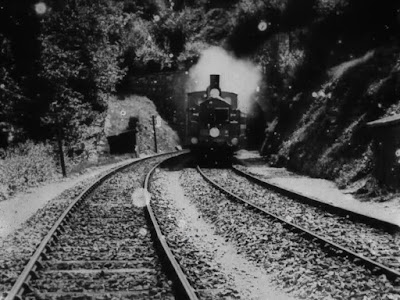
The train is one of the great symbols of the cinema, having played a key role in its formation from the very beginning of its history. It was a train that thrilled audiences in the silent marvel of The Arrival of a Train at La Ciotat Station (1896) by the brothers Auguste and Louis Lumière – investing the cinema was a sense of the sensational – and it was a train that gave way to the notion of narrative cutting, of the edit between interior and exterior spaces, in George Albert Smith's groundbreaking A Kiss in the Tunnel (1899).
Since that time, trains have been a defining narrative and visual presence in cinema, from The Iron Horse (1924) to The General (1926) and beyond, to Shanghai Express (1932), The Lady Vanishes (1938), Strangers on a Train (1951), The Titfield Thunderbolt (1953), Pather Panchali (1955), Night Train (1959), The Train (1964), The Hero (1966), Trans-Europe-Express (1966), La Chionoise (1967), Once Upon a Time in the West (1968), The American Friend (1977), Runaway Train (1985), Europa (1991), Sleepless (2000), Unstoppable (2010), Snowpiercer (2013) and The Image Book (2018), among others.




From the very first images, Telaroli's film establishes a connection between the idea of travel, the journey, a train on a track, with the notion of the narrative journey, the progression of a story from beginning to end, from its point of departure to its inevitable arrival.
The train is one of the great symbols of the cinema, having played a key role in its formation from the very beginning of its history. It was a train that thrilled audiences in the silent marvel of The Arrival of a Train at La Ciotat Station (1896) by the brothers Auguste and Louis Lumière – investing the cinema was a sense of the sensational – and it was a train that gave way to the notion of narrative cutting, of the edit between interior and exterior spaces, in George Albert Smith's groundbreaking A Kiss in the Tunnel (1899).
Since that time, trains have been a defining narrative and visual presence in cinema, from The Iron Horse (1924) to The General (1926) and beyond, to Shanghai Express (1932), The Lady Vanishes (1938), Strangers on a Train (1951), The Titfield Thunderbolt (1953), Pather Panchali (1955), Night Train (1959), The Train (1964), The Hero (1966), Trans-Europe-Express (1966), La Chionoise (1967), Once Upon a Time in the West (1968), The American Friend (1977), Runaway Train (1985), Europa (1991), Sleepless (2000), Unstoppable (2010), Snowpiercer (2013) and The Image Book (2018), among others.
The Arrival of a Train at La Ciotat Station [Auguste and Louis Lumière, 1896]:


A Kiss in the Tunnel [George Albert Smith, 1899]:


Pather Panchali [Satyajit Ray, 1955]:

Trans-Europe-Express [Alain Robbe-Grillet, 1966]:

The Image Book [Jean-Luc Godard, 2018]:


From the beginning of cinema, the train has moved through its narrative, like a leitmotif; the progression of it, as a collective journey, and the experience of that of the passenger, seated, passive, staring through a rectangular window of light at the changing scenes and dramas that pass before our eyes, is like a mirror reflecting back on itself. In many films, the train is a symbol of discovery, suggesting the encroachment of the "modern" world onto that of the "primitive" or outdated, suggesting an escape, a movement, or the journey between worlds (both real or imagined.)
Telaroli's film fits into this tradition. It represents a recorded journey, both pictorially and, on some level, psychologically, presenting a movement between worlds, but it's also a narrative, where the beginning of the train journey and its conclusion mirrors the beginning and ending of the film.


Telaroli's film fits into this tradition. It represents a recorded journey, both pictorially and, on some level, psychologically, presenting a movement between worlds, but it's also a narrative, where the beginning of the train journey and its conclusion mirrors the beginning and ending of the film.
Travelling Light [Gina Telaroli, 2011]:


Here, the intricacies of the title work on two separate levels. There's "travelling light", in the sense of moving without baggage. As in taking a short journey without the need for heavy luggage, but also baggage in the figurative sense, as in not being burdened by thoughts, fears, and responsibilities. "Travelling light" also refers to the progression of light itself, both in the movement from dawn to dusk, or light into dark, but also the journey of light as it moves through the frames of the film.
Here, sunlight on a passing mountain, or daylight streaking through the windows of the train, or artificial light refracted by rain or frost on the glass, becomes as much of a journey as the one being taken in tandem by the filmmaker and audiences as the train moves along the track. Finally, the connection is made clear, with the closing shot, detailed in the final screenshot above, a train retreating along the platform, slowly disappearing into a bank of fog, with only the light on the front of the locomotive left appearing like a ghostly orb shining in the middle-distance. In this moment, the eye of the camera as surrogate for that of the protagonist/audience, is now liberated from the confines of the train. We're outside, emerged, as if from the womb, and faced with something approaching reality.
As a closing shot, it connects back to the beginning of the film, the movement of the train, departing or progressing through the wintry landscape, but also to the notion of the journey, emotional, psychological, or geographical. The notion that we've arrived, marooned upon the platform, rigid and unmoving, but that another journey is already beginning for someone else. Here, in retrospect, the connection to the three quotes highlighted by Telaroli as a preface to her film, make perfect sense.
Further reading at Lights in the Dusk: Shanghai Express [29 February 2020], The Phantom Ride [09 September 2011]
Here, sunlight on a passing mountain, or daylight streaking through the windows of the train, or artificial light refracted by rain or frost on the glass, becomes as much of a journey as the one being taken in tandem by the filmmaker and audiences as the train moves along the track. Finally, the connection is made clear, with the closing shot, detailed in the final screenshot above, a train retreating along the platform, slowly disappearing into a bank of fog, with only the light on the front of the locomotive left appearing like a ghostly orb shining in the middle-distance. In this moment, the eye of the camera as surrogate for that of the protagonist/audience, is now liberated from the confines of the train. We're outside, emerged, as if from the womb, and faced with something approaching reality.
As a closing shot, it connects back to the beginning of the film, the movement of the train, departing or progressing through the wintry landscape, but also to the notion of the journey, emotional, psychological, or geographical. The notion that we've arrived, marooned upon the platform, rigid and unmoving, but that another journey is already beginning for someone else. Here, in retrospect, the connection to the three quotes highlighted by Telaroli as a preface to her film, make perfect sense.
Further reading at Lights in the Dusk: Shanghai Express [29 February 2020], The Phantom Ride [09 September 2011]


