Ongoing response to The Dancing Image "100 (of Your) Favourite Movies" meme-that's-not-a-meme, presented here in a loosely alphabetical order. I'm posting the series in reverse formation in an attempt to maintain the original continuity, from A to Z.

Ondine
Directed by Neil Jordan - 2009
A mournful piano chord is struck. The sound of it reverberates, becoming the siren's call to the fisherman, alone and at sea. The landscape, all rolling green hills and black jagged rocks that mark the divide between the land and the water - between his world and hers - suggests something mythical. This is the introduction to a story, told by the man to his daughter. He begins nervously: "once upon a time..." "Does it always have to be once upon a time" she says, cutting through the necessity for these stories to distance themselves from the everyday reality, becoming something fabled, and as a result, less real. The story eventually told by the man is the same story unfolding on screen.
Even before the fisherman has pulled from the water the beautiful young woman - caught in his net as a mess of long pale limbs and damp tangled hair - the film is suggesting this contrast between the reality, a world where a single father must work hard to pay for an operation to save his ailing daughter, and a world of myths and magic, where this woman, whose name is taken literally "from the water", will ensnare him in a story of his own creation. However, what happens when the daughter interjects, telling her own story? No longer informed by the fisherman's romantic yearning or desire to provide an escape for his little girl, but by her own fears and sickness.
The subsequent unravelling of the plot, with its back-and-forth rifts between romantic fable, poignant tragedy and violent noir, suggests the ever shifting perspective of these dual narrators, blurring the boundaries between what is felt by the characters and their own attempts to defuse their concerns by framing them within the reassuring context of a bedtime story. The films of Neil Jordan continually push this relationship between reality and fiction, and Ondine - a film where each new narrator presents a new 'voice', expressed via references to a specific genre - is his most complex work of meta-fiction since The Company of Wolves (1984), and arguably one of his most beautiful films to date.

Only Yesterday
Directed by Isao Takahata - 1991
I recognise a lot of myself in the film's protagonist, the twenty-something office worker Taeko Okajima, and her escape to the countryside as respite from the emptiness of her everyday life. What I recognise most is that sense of anxiety. The feeling of being lost or adrift, of wanting more out of life than the job, the house, the family; those natural expectations of adult life that we're supposed to strive for; that mark us out as successful, well-balanced individuals in the eyes of society, regardless of whether or not such concepts or concerns are emotionally gratifying or personally fulfilling.
Through Taeko and her restless examination of her own childhood memories, which are an attempt to better understand the hopelessness and the disenchantment that make life for her a constant sorrow, the film beautifully captures that feeling of nostalgic yearning that comes to the best of us when we reach a certain age, between the carefree adventures and discoveries of childhood and the commitments and responsibilities of later life. As a character, Taeko is happy to simply exist; to work for the joy of working. Not for financial gain or social status, but to share moments and interactions with likeminded people; to be close to the land and the beauty of nature; to recapture that childhood feeling of endless summer days before the crippling weight of maturity, when everything was simple.
With Only Yesterday, Takahata and his collaborators have produced a film that is every bit as 'human' in spirit as his earlier masterpiece Grave of the Fireflies (1988), and no less moving. An intimate, perfectly observed film, full of atmosphere, emotion and depth, where the adult Taeko's introspective journey into the memories of her childhood is powerful enough to compel the audience to contemplate their own recollections of the past and their dreams for the future.

Ordet
Directed by Carl Theodor Dreyer - 1955
I emerged from the experience of the film, eyes blurred, senses stunned in silent sorrow. I couldn't believe what I'd just witnessed. I can't even explain it now. On paper, the film could be seen as a fairly conventional family drama, full of the usual melodramatic interjections and plays of deep emotion that attempt to inspire a connection in the mind of the audience, eliciting sympathy or understanding, as melodramas often do. But there is an intensity to Dreyer's film that elevates the story far beyond the ordinary; a sense - shared by both the audience and the characters on screen - of seeing something beyond explanation; a genuine miraculous event.
For me, the effect of the film was enormous. The sense of pace, the stillness, the rigorous framing of objects and events, and the austerity of these characters numbed my soul, lulled me into a feeling of total vulnerability. By the time the film had reached its final act I was on the edge of my seat, stomach in knots, too scared to exhale in the event that any subtle change in the air might destroy the feeling of near-religious transcendence taking place right before me. By the end of the film I was emotionally exhausted. The tears broke free and rolled down my face. Finally I felt what Nana must have felt when she sat in the cinema watching The Passion of Joan of Arc (1928) in Godard's Vivre Sa Vie (1962).
In instances where the experience of the film is beyond my grasp, there's always the urge to invoke Godard:
'What we cannot speak about, we must pass over, in silence.' To experience Ordet is to experience the true power of cinema. That is, cinema as an act of faith. The act of faith required by these characters to believe in the unbelievable is mirrored by the act of faith required by the audience to invest in the subject of the film and embrace it, without cynicism. To approach the film with an open mind and an open heart.

Out of the Past
Directed by Jacques Tourneur - 1947
For me, the thing that elevates Out of the Past above any other classic film noir of the studio era, is the mournful direction of Jacques Tourneur. As a director, Tourneur brings to the film the same sense of melancholy and gothic ambience that transformed his earlier supernatural mysteries from potentially lurid little scare-stories into tortured psychological studies of warped minds and characters in torment. In Out of the Past, the feeling of great sorrow, or that faint line between the cruelty of the environment and the unspoken suffering of the protagonist, are brought to the very centre of the thing; not simply there to give added weight or subtext to the development of the plot as they might in a more conventional film noir, but actually
defining it.
This is a film
about longing, about these characters attempting to find love in a loveless place, or to exist, without becoming numbed to the violence, brutality, cynicism and greed of this literally seething underworld, with its betrayals and deceits. Though it plays with the recognisable iconography of the genre, there is a tension to the film that goes far beyond the requirements of the story. A gravity to the interactions between characters, which carry a feeling of sustained, fatalistic despair; as if the wrath incurred by the central character will not simply result in death, but in something potentially more sinister. Here, the relationship between Douglas and Mitchum becomes more than just that of a crime boss and his stooge, but a genuine deal with the devil.
In this sense, even when working outside of the conventions of the supernatural genre, Tourneur's film still feels like an eerie encounter between ghosts in a world of shadows. His approach, as agonizing and atmospheric as in the films Cat People (1942) and I Walked with a Zombie (1943), seems to transform what could've been a fairly predictable story of deception and double-cross into a psychological drama, where the story emerges - literally 'out of the past' - as these characters remember each moment and encounter, trying to make sense of things as their lives spiral into chaos.

Paris Belongs to Us
Directed by Jacques Rivette - 1961
The first Rivette, and already the great trademarks of his work are presented, fully-formed. The title, which is more a declaration than an adequate description, is the first acknowledgement of the role that Paris will play throughout the director's career, becoming more than just a mere setting, but something
greater: a state of mind. In this sense, Paris Belongs to Us is a precursor to the grand adventure of films like Out 1 (1971), Le pont du Nord (1981) and Gang of Four (1989), both in its reliance on arcane conspiracies - which seem to captivate the characters of all Rivette's films - and in that slow thematic descent from playful
joie de vivre to suffocating suspicion.
However, the greatest connection between these films is Rivette's use of the city, which here, like in several of the director's later films, becomes a living theatrical space, invaded by a troupe of actors who engage in a series of public rehearsals, providing context for the more mysterious dramas taking place beneath the surface. In the end, the tension, between good-humoured scenes of character interaction and the threat of some possible cataclysmic event, creates a feeling of sustained suspense, suggestive of the final moments of Antonioni's subsequent L'eclisse (1962), which also seemed enthused with a darker undercurrent of cold war paranoia and fear of atomic annihilation.

The Passenger
Directed by Michelangelo Antonioni - 1975
"I know a man who was blind. When he was nearly forty he had an operation and regained his sight. At first he was elated. Really high. Faces, colours, landscapes... But then everything began to change. The world was much poorer than he imagined. No one had ever told him how much dirt there was, how much ugliness... He noticed ugliness everywhere. When he was blind, he used to cross the street alone, with his stick... After he regained his sight, he became afraid. He began to live in darkness. He never left his room. After three years he killed himself."
The identity of 'the passenger' is never made clear. Though one can assume this title refers to the unnamed 'girl' that is first encountered by the protagonist during his stay in Barcelona, and who eventually becomes a travelling companion of sorts on his journey through the second half of the film, it could also just as easily refer to the protagonist himself. The reporter, trading his life for the life of another; choosing to become a 'passenger', emotionally if not physically, through the passage of his own existence; observing it without interaction, and allowing the forces of chance to dictate his inevitable end. In this sense, the story of the blind man is a clue to understanding the progression of this character. A character like many in Antonioni's films who exists as an empty vessel; a shadow, drifting through life, too numbed by the experience of it to engage with a world that crushes him at every turn.
In essence, it is a film about loneliness. The kind of loneliness that isn't simply a symptom of solitude, or of being alone, but a psychological condition that creates a feeling of intense isolation, even in the company of others. The characters in this film are trying to outrun a feeling of disenchantment by embracing the existence of someone else; but these feelings of bitterness and alienations are never really external. No matter how far these characters flee from their own lives, they're unable to escape their own intrinsic feelings of failure, emptiness and disappointment.

The Passion
Directed by Ingmar Bergman - 1969
"I don't imagine I reach into the human soul with this photography. I can only register an interplay of forces, large and small. You look at this picture and imagine things. But it's all nonsense! All play. All poetry. You can't read another person with any claim to certainty. Sometimes not even pain registers as a reaction."
The quoted dialogue seems to offer a vague clue to understanding the film, which is one of Bergman's most difficult and controversial. It is an
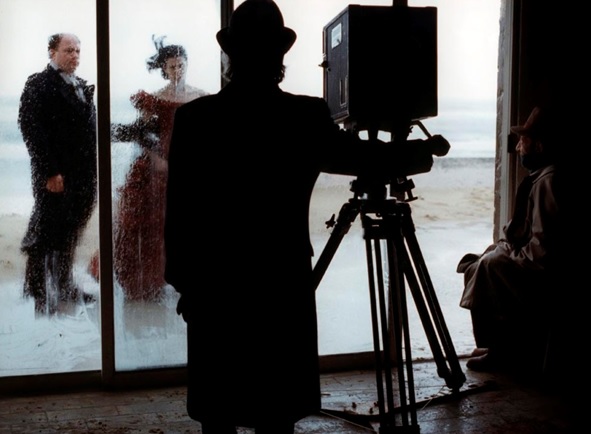
intense film, full of longing, despair and scenes of quiet anguish, which is deconstructed throughout by the voice of the director, who establishes each scene as if reading from the script, or from occasional on-set interviews with the actors discussing the development of their characters, how they see them, and how the audience should respond to them. These deconstructions, which invite the process of filmmaking into the narrative, exposing the artificiality of these dramas that occur for the benefit of the audience, are disarming - sometimes distracting! - but are necessary to expose the truth behind the usual manipulations that we accept in mainstream cinema, in the same way that the characters attempt to expose the truth behind the deceit of their relationship(s).
As ever with Bergman, private thoughts and fears are made public as the story unfolds. Unravelling, not just in the narrative sense, but emotionally too, as the island where the film takes place becomes an onscreen representation of the characters' fraught psychology, their isolation, and the growing air of violence and persecution that is slowly decimating the landscape, like a plague of madness leading to destruction and annihilation.

Picnic at Hanging Rock
Directed by Peter Weir - 1975
The story is vague and mysterious. If the opening credits didn't suggest some possibility of an actual grounding in recorded history, then we might simply dismiss the scenario as pure fabrication, too extraordinary to believe. However, this question of authenticity is precisely what gives the film its enduring appeal; leaving the audience to speculate about the legitimacy of the disappearances and the surrounding chain of events as a something beyond explanation, uniting the physical and the psychological with the purely supernatural.
The atmosphere of the film certainly suggests the presence of something 'otherworldly', with the mood of the forest - all ethereal, like a fairy story - and the feeling of time standing still, creating an impression of a force of nature greater than anything comprehendible by the human psyche; as if the hanging rock itself has become a sort-of sentinel - a natural 'monolith', in the sense of 2001: A Space Odyssey (1968) - that allows for a communication to take place between worlds. Each moment spent in the shadow of the rock is suspended, compelling these characters into a state of trancelike contemplation, at one with nature, though also at the mercy of it, where "what we see and what we seem are but a dream; a dream within a dream."
The images throughout are haunting; the atmosphere, overwhelming. The sense of this place, the forest, lit by the afternoon rays of the sun, brings to mind a painting like The Luncheon on the Grass by Édouard Manet or Ladies at the Seine by Gustave Courbet. Not just in the continual depiction of idyllic, pastoral scenes of girls in billowing white dresses basking in the soft glow of the sunlight, but in the implied connection between the beauty of nature and this burgeoning (but repressed) sexuality, which might hold the secret to deciphering the whole thing.

Pola X
Directed by Leos Carax - 1999
The subsequent passing of its two lead actors, Guillaume Depardieu and Yekaterina Golubeva, makes the experience of Pola X all the more unsettling. When I first saw the film six years ago it already felt like a work haunted by a great depression; bleak in both subject and approach. But now, more than ever, it has the feel of something truly wounded; a film of immense pain and suffering, where the overwhelming fatalism of its central character is never disguised or subdued by black comedy or ironic detachment, but fully embraced; creating a film not simply about personal misery, but defined by it. This is a film where the only genuine scene of passion takes place between two mangled bodies - reminiscent of figures from the works of Egon Schiele - in a room of total darkness.
Although essentially an adaptation of Melville's controversial Pierre: or, The Ambiguities, Pola X could really be seen as a semi-autobiographical portrait of director Leos Carax; a film in which he reflects on his own position in the world of contemporary French cinema following the critical and commercial disaster of his previous film Les Amants du Pont-Neuf (1991). In Pierre, he finds a means of expression, presenting a character that might seem, from the outside at least, to have everything at his disposal - a man of great wealth and privilege - but who goes out of his way to destroy any chance of contentment in the pursuit of some indefinable truth. The film, in its conception, is a result of that pursuit.

The Purple Rose of Cairo
Directed by Woody Allen - 1985
As a precursor to the recent Midnight in Paris (2011), The Purple Rose of Cairo introduces the idea of the cinema - or art in general - as an escapist pursuit. Although Allen had already explored this theme in earlier films - such as the Herbert Ross directed Play It Again, Sam (1972) and his own masterpiece Stardust Memories (1980); two films in which the author dealt more directly with his own relationship to cinema, as a writer and director - the work in question is really the first to take the subject of cinema - as an escape - and explore it through the perspective of a regular viewer.
As such, the story being told is best seen as a metaphor for the one-way relationship that exists between the audience and the work. A dramatisation of that feeling of seeing a film and falling in love with the spectacle of it, and the resulting sadness of being unable to take an active role in its development. Through its central character, Allen creates a loving ode to the world of movies, where the misery and the bitterness of the character's everyday life only reinforces how much greater a life spent within this world might be, as opposed to a life without it.