In The Brave One (2007), Neil Jordan uses reflections to suggest a character trapped by circumstances.
From the very first image of Erica Bain (Jodie Foster) as a translucent spectral projection against the glass walls of the recording booth where she delivers her morning show, to the later instances of painful self-reflection - as the same character is forced to question whether the severity of her actions is justified by the sense of overwhelming loss felt in the wake of her fiancé's murder - the visual design of the film repeatedly reinforces the idea of a person struggling to break free.
The sense of isolation and claustrophobia that develops during the weeks and months that follow the initial attack is intensified through the framing of shots; the camera exaggerating Erica's emotional detachment by presenting her as a ghost, literally just drifting, unloved and unseen, through the relics of a previous existence. These images, like the character, obscured and fragmented, flatten the sense of perspective. There is no clear sense of morality for Erica, as Jordan's overpowering depth of field reduces the character to an out of focus blemish against the harsh hyper-reality of the city that overwhelms her; just a growing sense of impotence yielding to desperation.
The presentation of Erica as a woman numbed by the world that she inhabits brings to mind the character of Simone (Cathy Tyson) from Jordan's earlier film Mona Lisa (1986). Both women are placed like insects beneath the glass, studied by sympathetic male characters that, in general, are oblivious to their true nature as hostages to emotional bitterness.
Jordan makes the connection explicit as Erica, like Simone in the earlier film, is caught in the reflection of a car's rear-view mirror. Unlike other shots in which Erica is acknowledging her own psychological metamorphosis from liberal-minded media personality to skulking night-time avenger, this moment - as with the moment in Mona Lisa - provides the audience with enough room to consider the effect that this world with its cruelty, apathy and sense of moral decay has had on these characters; allowing us to question, personally and individually, whether the end really justifies the means.
The way the image is presented, with the character literally and physically confined to a frame within a frame - with the world, this backdrop of squalor and human suffering surrounding her, out of focus, but still dominating the screen - deliberately establishes this character as a prisoner; not just to the world and this situation that she's created, but to a particular state of mind.
Throughout the film, every action poses a question for the character, which Jordan emphasises with these moments of literal reflection. Trapped, psychologically as well as physically in a cycle of violence - slowly fading into the background of the city she once celebrated in mawkish prose that now seems even more deceitful when repeated against this milieu of violence and retribution - Erica is forced to look long and hard to find the person she was when faced with the person she is.
During the course of the film's journey, every violent act removes this character even further from the world of the living; killing the spirit of life and leaving only the faint outline a body without a soul. As she studies her own face reflected against the artefacts of this world to make sense of who she is there is only the traces of violence, the loveless eyes and the ghost of who she was, caught, forever, in this labyrinth of despair, desperate to find a way out.
Tuesday, 12 July 2011
Saturday, 9 July 2011
Planets
Three spheres, planet, star and satellite, drift in orbit. Each sphere is an avatar for these characters that collide during the course of the film; pre-establishing the eventual relationships between men, linked, physically as well as spatially, by the consequences of a single event.
Respectively, the three men are the chief protagonist, antagonist and force of moral conscience in the plot of a standard film-noir. Though the machinations of noir are continually dismantled or disrupted by Tarr's languid, observational techniques - which, during the course of the film, reduce moments of potential Hitchcockian suspense and the possibility for Hollywood intrigue to a series of looks, rituals and objects of personal significance - the film nonetheless engages, actively and enthusiastically, with the recognisable tropes of the genre.
Specifically, the motivating factor of greed, and the general fatalistic belief that every action, no matter how seemingly insignificant, carries a greater responsibility.
The scene in which these characters eventually share the screen is significant for the particular way Tarr and Hranitzky emphasise these spherical objects (three in each instance, corresponding with the number of characters on screen) and how this can be seen as relative to the opening sequence of the director's previous film, Werckmeister Harmonies (2000). There, the young misfit János Valuska (Lars Rudolph) enacts a piece of live theatre, in which village drunkards are used as representations of the sun, the moon and the earth in a dramatisation of a solar eclipse.
In the earlier film, the demonstration establishes the idea of unexplained natural phenomena. The image of choreographed bodies within a space (defining space) is a prelude to the general descent into chaos and mass-hysteria that follows the arrival of the circus trailer, and the mysterious character called 'The Prince.' Here, the sense of disorder is less cosmic. Instead, the narrative emphasis on the personal downfall of characters stumbling into a situation not entirely beyond their control is more indebted to the necessary conventions of film noir.
It also carries greater philosophical notions pertaining to actions and their consequences. This can be seen in relation to Newton's basic Laws of Motion; "An object that is in motion will not change its velocity unless an unbalanced force acts upon it." Or, more appropriately, "To every action, there is always an equal and opposite reaction."
The event - the murder of the mysterious man and the retrieval of the money - represents the unbalanced force, the thing that sends these characters into their gravitational spiral; a fatal collision course that is continually alluded to by the film's production design and the precise way the camera encircles, blocks, traps and reveals these characters, like objects, drifting without recourse, into the chasm of a black hole.
Three spheres, three men...
The hanging lights, like the objects careening into one another on the snooker table at the beginning of the scene, correspond with the three characters and their place, both within the frame and within the general orbit of existence. Maloin (Miroslav Krobot), the hapless railway pointsman who witnesses the murder and absconds with the cash; Brown (János Derzsi), the possible murderer now left with the impossible task of retrieving the money at all costs; and Morrison (István Lénárt), who claims to be a police inspector from London, pulling the strings for a shadowy conspiracy of forces that exist beyond the periphery of the narrative.
The camera reveals these characters one by one during the course of a conversation; a single fluid movement that establishes Morrison as the centre of this circulatory system of images, pulling the characters of Maloin and Brown ever deeper into the depths of his investigation.
Tarr's blocking of this almost nine-minute sequence is as remarkable as one might expect given the presentation of his previous work. Throughout the conversation, Maloin remains in the background of things. As the camera traverses the trajectory around Brown and Morrison engaging in this moment of narrative exposition, Maloin is clearly visible; an observer on the edges of the frame, sentinel in the sense of being the one person who actually knows where the money is, as well as becoming a substitute for the viewing audience. After all, it is Maloin who witnesses the original murder, thus establishing himself (along with the audience) as the only person really capable of carrying the full weight of responsibility when this sad burlesque reaches its inevitable close.
Tarr and Hranitzky acknowledge this burden in the final shot of Maloin, in close-up, his face pregnant with the anticipation of things to come, a single sphere of light above his head.
The presentation of this sequence is reminiscent of a similar planetary revelation that occurs towards the end of Fassbinder's fittingly titled In a Year of 13 Moons (1978). In that particular film, Sister Gudrun (Lilo Pempeit) observes the aftermath of a character's death; drifting, unseen, like the camera in Tarr's film, through the wreckage of their extinction. There as well as here the characters drift in orbit; solitary planets incapable of reaching out to anyone for anything; just lost souls that yield to desperation.
Respectively, the three men are the chief protagonist, antagonist and force of moral conscience in the plot of a standard film-noir. Though the machinations of noir are continually dismantled or disrupted by Tarr's languid, observational techniques - which, during the course of the film, reduce moments of potential Hitchcockian suspense and the possibility for Hollywood intrigue to a series of looks, rituals and objects of personal significance - the film nonetheless engages, actively and enthusiastically, with the recognisable tropes of the genre.
Specifically, the motivating factor of greed, and the general fatalistic belief that every action, no matter how seemingly insignificant, carries a greater responsibility.
The scene in which these characters eventually share the screen is significant for the particular way Tarr and Hranitzky emphasise these spherical objects (three in each instance, corresponding with the number of characters on screen) and how this can be seen as relative to the opening sequence of the director's previous film, Werckmeister Harmonies (2000). There, the young misfit János Valuska (Lars Rudolph) enacts a piece of live theatre, in which village drunkards are used as representations of the sun, the moon and the earth in a dramatisation of a solar eclipse.
In the earlier film, the demonstration establishes the idea of unexplained natural phenomena. The image of choreographed bodies within a space (defining space) is a prelude to the general descent into chaos and mass-hysteria that follows the arrival of the circus trailer, and the mysterious character called 'The Prince.' Here, the sense of disorder is less cosmic. Instead, the narrative emphasis on the personal downfall of characters stumbling into a situation not entirely beyond their control is more indebted to the necessary conventions of film noir.
It also carries greater philosophical notions pertaining to actions and their consequences. This can be seen in relation to Newton's basic Laws of Motion; "An object that is in motion will not change its velocity unless an unbalanced force acts upon it." Or, more appropriately, "To every action, there is always an equal and opposite reaction."
The event - the murder of the mysterious man and the retrieval of the money - represents the unbalanced force, the thing that sends these characters into their gravitational spiral; a fatal collision course that is continually alluded to by the film's production design and the precise way the camera encircles, blocks, traps and reveals these characters, like objects, drifting without recourse, into the chasm of a black hole.
Three spheres, three men...
The hanging lights, like the objects careening into one another on the snooker table at the beginning of the scene, correspond with the three characters and their place, both within the frame and within the general orbit of existence. Maloin (Miroslav Krobot), the hapless railway pointsman who witnesses the murder and absconds with the cash; Brown (János Derzsi), the possible murderer now left with the impossible task of retrieving the money at all costs; and Morrison (István Lénárt), who claims to be a police inspector from London, pulling the strings for a shadowy conspiracy of forces that exist beyond the periphery of the narrative.
The camera reveals these characters one by one during the course of a conversation; a single fluid movement that establishes Morrison as the centre of this circulatory system of images, pulling the characters of Maloin and Brown ever deeper into the depths of his investigation.
Tarr's blocking of this almost nine-minute sequence is as remarkable as one might expect given the presentation of his previous work. Throughout the conversation, Maloin remains in the background of things. As the camera traverses the trajectory around Brown and Morrison engaging in this moment of narrative exposition, Maloin is clearly visible; an observer on the edges of the frame, sentinel in the sense of being the one person who actually knows where the money is, as well as becoming a substitute for the viewing audience. After all, it is Maloin who witnesses the original murder, thus establishing himself (along with the audience) as the only person really capable of carrying the full weight of responsibility when this sad burlesque reaches its inevitable close.
Tarr and Hranitzky acknowledge this burden in the final shot of Maloin, in close-up, his face pregnant with the anticipation of things to come, a single sphere of light above his head.
The presentation of this sequence is reminiscent of a similar planetary revelation that occurs towards the end of Fassbinder's fittingly titled In a Year of 13 Moons (1978). In that particular film, Sister Gudrun (Lilo Pempeit) observes the aftermath of a character's death; drifting, unseen, like the camera in Tarr's film, through the wreckage of their extinction. There as well as here the characters drift in orbit; solitary planets incapable of reaching out to anyone for anything; just lost souls that yield to desperation.
Wednesday, 6 July 2011
Ocean Song
I am sat by the water; scribbling these words in a notebook to be transcribed at a later date. The light is growing dim; a soft blue light, like the kind found in old European-horror movies - something like The Devil's Nightmare (1971) or Requiem for a Vampire (1973) - where the filmmakers would try to give the impression of night in a scene originally (and quite obviously) shot during the day. This technique is called Day-for-night, and as a look, it's often incredibly beautiful...
There is music playing. Not just one song, but several, all overlapping in an aural collage of voices and notes. The sound, attractive as it is discordant, pours from the open doors of various bars and restaurants; catching the breeze and travelling down, along the bay to where I sit, slumped and content in a kind of coastal loneliness; a seaside melancholy usually reserved for the greatest films of Neil Jordan.
Outstanding films like Mona Lisa (1986), The Miracle (1991), The Butcher Boy (1997) and The End of the Affair (1999); each one contains a key scene in which a central character attempts to escape from some great abuse by retreating to the coast. Perhaps it's the sense of being on the edge of the world that appeals to these characters; the past is behind them, only the water and the endless possibilities that exist beyond the horizon lay in front.
Perhaps it's a purifying thing too; the water not only offers the possibility for reflection, it washes everything clean.
The Jordan film that stands out the most in my mind is the beautiful Ondine (2009). Every scent, sight and sensation felt on the edge of this water brings the memory of the film closer to my heart. Specific images repeat and spill over my own thoughts and personal recollections until the film becomes more than just a passive experience, but something that needs to be lived. It's a remarkable film; one that I've seen four times this year, and I keep promising myself that I'll write about it, and maybe one day I will... but for now the impression of it, here, with the sea before me, and that same blue light, is entirely overwhelming.
Transparent almost, this blue, like the most beautiful eyes you've ever seen; a soft watercolour light, like a wash of seawater has splashed back, across the promenade, with its seafront bars, hotels and nightclubs, and stained the whole thing in a beautiful shade of sadness.
The thing that keeps Ondine in my heart more than any other Neil Jordan film (and really, I love them all, to varying degrees; he's an outstanding filmmaker) is the use of the song All Alright by Sigur Rós. Finding an almost perfect unity between sound and image, All Alright is a strange, ethereal ballad; a love song from an alien planet, where the emotion expressed is universal, because the presentation is so vague. Occasionally we might catch something that seems to make sense; a particular word or phrase that creates an immediate image in the mind of the listener... but then it's lost again.
Each new change or movement within the structure suggests a new emotional landscape. It's impressionism of sound to compliment Jordan's impressionism of storytelling; where each development of the plot - each new twist and turn, sometimes light, sometimes dark - suggests the impression of a story being invented for the benefit of a sick child.
Really, it's the song that keeps reminding me of this place. Perhaps the real reason why I love Ondine more than say The Butcher Boy or Breakfast on Pluto (2005) or The Good Thief (2002) (all incredible films) is because of this song. And maybe I only love this song because it reminds me of her...
When I peer into the dark mirror of the sea, it's not my own face staring back, but hers. Somewhere, the same bright stars, reflected here, on the still of the water, watch over her as they watch over me. I'm reminded of Woolf's epitaph; or more appropriately, the quotation of it by Godard in his short film, Dans le noir du temps (2002): And in me too the wave rises. It swells, it arches its back. I am aware once more of a new desire; something rising beneath me; like the proud horse who's rider first whispers and then pulls him back. Against you I will fling myself, unvanquished, and unyielding...
If the sea is a mirror, then perhaps Jordan's characters are so attracted to it because it offers them a chance to really look at themselves, away from the suffocation of home, or the depravity of a criminal underworld, or the responsibilities of having to hide painful emotions in order to protect the husband of the woman you love, so as to finally see, beneath the bravado and the veneer, the yearning of the heart within. Against this infinite void, where the blue of the sky meets the blue of the ocean, these characters can see, for possibly the very first time, who they really are.
There is music playing. Not just one song, but several, all overlapping in an aural collage of voices and notes. The sound, attractive as it is discordant, pours from the open doors of various bars and restaurants; catching the breeze and travelling down, along the bay to where I sit, slumped and content in a kind of coastal loneliness; a seaside melancholy usually reserved for the greatest films of Neil Jordan.
Outstanding films like Mona Lisa (1986), The Miracle (1991), The Butcher Boy (1997) and The End of the Affair (1999); each one contains a key scene in which a central character attempts to escape from some great abuse by retreating to the coast. Perhaps it's the sense of being on the edge of the world that appeals to these characters; the past is behind them, only the water and the endless possibilities that exist beyond the horizon lay in front.
Perhaps it's a purifying thing too; the water not only offers the possibility for reflection, it washes everything clean.
The Jordan film that stands out the most in my mind is the beautiful Ondine (2009). Every scent, sight and sensation felt on the edge of this water brings the memory of the film closer to my heart. Specific images repeat and spill over my own thoughts and personal recollections until the film becomes more than just a passive experience, but something that needs to be lived. It's a remarkable film; one that I've seen four times this year, and I keep promising myself that I'll write about it, and maybe one day I will... but for now the impression of it, here, with the sea before me, and that same blue light, is entirely overwhelming.
Transparent almost, this blue, like the most beautiful eyes you've ever seen; a soft watercolour light, like a wash of seawater has splashed back, across the promenade, with its seafront bars, hotels and nightclubs, and stained the whole thing in a beautiful shade of sadness.
The thing that keeps Ondine in my heart more than any other Neil Jordan film (and really, I love them all, to varying degrees; he's an outstanding filmmaker) is the use of the song All Alright by Sigur Rós. Finding an almost perfect unity between sound and image, All Alright is a strange, ethereal ballad; a love song from an alien planet, where the emotion expressed is universal, because the presentation is so vague. Occasionally we might catch something that seems to make sense; a particular word or phrase that creates an immediate image in the mind of the listener... but then it's lost again.
Each new change or movement within the structure suggests a new emotional landscape. It's impressionism of sound to compliment Jordan's impressionism of storytelling; where each development of the plot - each new twist and turn, sometimes light, sometimes dark - suggests the impression of a story being invented for the benefit of a sick child.
Really, it's the song that keeps reminding me of this place. Perhaps the real reason why I love Ondine more than say The Butcher Boy or Breakfast on Pluto (2005) or The Good Thief (2002) (all incredible films) is because of this song. And maybe I only love this song because it reminds me of her...
When I peer into the dark mirror of the sea, it's not my own face staring back, but hers. Somewhere, the same bright stars, reflected here, on the still of the water, watch over her as they watch over me. I'm reminded of Woolf's epitaph; or more appropriately, the quotation of it by Godard in his short film, Dans le noir du temps (2002): And in me too the wave rises. It swells, it arches its back. I am aware once more of a new desire; something rising beneath me; like the proud horse who's rider first whispers and then pulls him back. Against you I will fling myself, unvanquished, and unyielding...
If the sea is a mirror, then perhaps Jordan's characters are so attracted to it because it offers them a chance to really look at themselves, away from the suffocation of home, or the depravity of a criminal underworld, or the responsibilities of having to hide painful emotions in order to protect the husband of the woman you love, so as to finally see, beneath the bravado and the veneer, the yearning of the heart within. Against this infinite void, where the blue of the sky meets the blue of the ocean, these characters can see, for possibly the very first time, who they really are.
Sunday, 20 March 2011
Artefacts
I wanted to share a few thoughts and images from a film I'd been working on, tentatively titled 'A World Between Worlds', but also at various points called 'Artefacts' or 'Transmissions from The End of the World' It's a project I initially began when I was at college, though very quickly had to abandon, as it proved too ambitious and possibly even too dangerous to complete in the appropriate time given. Eventually I made a different film instead...
Nonetheless, I continued working on 'A World Between Worlds' after completing my university degree; shooting hours of landscape footage around England, Ireland and the Isle of Man, all the while attempting to make sense of the story I was developing across several different notebooks. In one, "a story of existence…" was written in black biro. In another, "O, revoir..." (a terrible pun) was written in felt-tip pen.
I started thinking about Nicolas Roeg's The Man Who Fell to Earth (1976) and the image of Thomas Jerome Newton; wandering the earth like a ghost of a stick-figure still haunted by a childhood trauma. I started thinking about specific images; an image of the earth that looked like a distant planet; faces, almost human, reflected in pools of murky water; an image of some archaic artefact to the days of global communication, pre-Internet.
The radio tower suggested, by association of name only, the idea of radioactivity, and the sense that the film should take place at least 78 years after the end of civilisation.
As the film begins, an alien anthropologist named Rector wanders the charred remains of an unidentified European country. The images are black and white; like charcoal drawings, or promises written in water. The anthropologist thumbs through scattered remnants of lives, finding old toys, food cartons and fragments of old newspapers. Creating a home for himself in an abandoned communications centre, Rector begins to piece together these fragments, creating a timeline that points, ever forward, to the moment of our demise.
In the first glimpse of this event, a four-minute panning shot shows the morning fog roll back, off the waves, like the fog of memory retreating. Transmissions from the final days of earth, glimpsed, like dreams, Prince of Darkness (1987) style, as Rector wanders derelict buildings and decayed promenades. As the mist recedes further, revealing more and more of the surrounding mountains, a flash of light flares on the horizon.
This is the beginning of the event; the first stage. It's not the job of the anthropologist to find out what happened to civilisation, but simply to find out enough information regarding the species; how we lived, our strengths and weaknesses. But in poring over the relics of our existence, Rector becomes mournful. He wonders how a species capable of creating such extraordinary works of art, music, design and engineering (images of which flicker to life on the banks of television monitors configured to record and playback these transmissions from the earth's final days) could also be capable of such violence and brutality.
This part of the film is essentially very close to The Man Who Fell to Earth; Rector trying to make sense of the 21st century culture while growing ever more disconnected from his own. I tried to convey loneliness through images of old buildings - thinking about that song by Tom Waits, House Where Nobody Lives, as a metaphor - while also wanting to capturing the same feeling of melancholy present in my favourite films; Michelangelo Antonioni's The Passenger (1975) and Wim Wenders' Kings of the Road (1976). Films where a general disparity between characters is conveyed through a restless observation of the landscape (which, in both films, is as alien as anything in Stanley Kubrick's 2001: A Space Odyssey, 1968).
For the scenes of the unexplained event and the moments leading up to it, I knew I wanted a specific look. Colour images as an obvious contrast, but not like reality. I started thinking about my own impressions of the past. As Francis Coppola noted during the making of his recent masterwork Tetro (2009), our ideas of the past are often coloured by the nostalgia of home movies. That sickly, over-saturated, not-quite accurate to life look of Polaroid cameras or Super 8 film.
This is the look I eventually settled on; however, a few years later and with the benefit of hindsight, it now seems almost entirely too aggressive. It should have been more natural; raw DV stock with no manipulation. The home movies of the future will not be shot on Super 8, but captured on Hi-Def video phones. This is the stuff of the 1970s...
It's only during the last six or seven months that I decided to finally terminate this project for good... already my second great failure as a filmmaker! Ultimately, the film was too derivative of greater films, like La jetée (1962) by Chris Marker, Anti-Clock (1979) by Jane Arden & Jack Bond, The Falls (1980) by Peter Greenaway, Germany Year 90 Nine Zero (1991) by Jean-Luc Godard and The Happening (2008) by M. Night Shyamalan. It didn't have a voice of its own, and as a result, the creative ambitions felt pretentious.
Added to this realisation, there's the unavoidable downside of spending too much time on a project. During the last five years, my sensibilities have changed drastically, and unfortunately this is no longer the kind of film I want to make.
I still have the original ending; never filmed, but there amongst a box of old notebooks on a recent visit to my grandmother's house in Port St. Mary. I still have the storyboards too. The ending of the film was always intended to be something grand; something beyond words. While the first part of the film was about loneliness, and the second part was about destruction, the final part would've been about love as a physical act of forgiveness.
In discovering this old footage (and accompanying notes, storyboards and, most surprisingly, even some original soundtrack recordings), I found a more interesting idea for my next project; something that will no doubt be indebted to the great lineage of films that play with self-conscious references to Antonioni's masterpiece Blowup (1966), but with a greater emphasis on the nature of photography in the 21st century.
Nonetheless, I continued working on 'A World Between Worlds' after completing my university degree; shooting hours of landscape footage around England, Ireland and the Isle of Man, all the while attempting to make sense of the story I was developing across several different notebooks. In one, "a story of existence…" was written in black biro. In another, "O, revoir..." (a terrible pun) was written in felt-tip pen.
I started thinking about Nicolas Roeg's The Man Who Fell to Earth (1976) and the image of Thomas Jerome Newton; wandering the earth like a ghost of a stick-figure still haunted by a childhood trauma. I started thinking about specific images; an image of the earth that looked like a distant planet; faces, almost human, reflected in pools of murky water; an image of some archaic artefact to the days of global communication, pre-Internet.
The radio tower suggested, by association of name only, the idea of radioactivity, and the sense that the film should take place at least 78 years after the end of civilisation.
As the film begins, an alien anthropologist named Rector wanders the charred remains of an unidentified European country. The images are black and white; like charcoal drawings, or promises written in water. The anthropologist thumbs through scattered remnants of lives, finding old toys, food cartons and fragments of old newspapers. Creating a home for himself in an abandoned communications centre, Rector begins to piece together these fragments, creating a timeline that points, ever forward, to the moment of our demise.
In the first glimpse of this event, a four-minute panning shot shows the morning fog roll back, off the waves, like the fog of memory retreating. Transmissions from the final days of earth, glimpsed, like dreams, Prince of Darkness (1987) style, as Rector wanders derelict buildings and decayed promenades. As the mist recedes further, revealing more and more of the surrounding mountains, a flash of light flares on the horizon.
This is the beginning of the event; the first stage. It's not the job of the anthropologist to find out what happened to civilisation, but simply to find out enough information regarding the species; how we lived, our strengths and weaknesses. But in poring over the relics of our existence, Rector becomes mournful. He wonders how a species capable of creating such extraordinary works of art, music, design and engineering (images of which flicker to life on the banks of television monitors configured to record and playback these transmissions from the earth's final days) could also be capable of such violence and brutality.
This part of the film is essentially very close to The Man Who Fell to Earth; Rector trying to make sense of the 21st century culture while growing ever more disconnected from his own. I tried to convey loneliness through images of old buildings - thinking about that song by Tom Waits, House Where Nobody Lives, as a metaphor - while also wanting to capturing the same feeling of melancholy present in my favourite films; Michelangelo Antonioni's The Passenger (1975) and Wim Wenders' Kings of the Road (1976). Films where a general disparity between characters is conveyed through a restless observation of the landscape (which, in both films, is as alien as anything in Stanley Kubrick's 2001: A Space Odyssey, 1968).
For the scenes of the unexplained event and the moments leading up to it, I knew I wanted a specific look. Colour images as an obvious contrast, but not like reality. I started thinking about my own impressions of the past. As Francis Coppola noted during the making of his recent masterwork Tetro (2009), our ideas of the past are often coloured by the nostalgia of home movies. That sickly, over-saturated, not-quite accurate to life look of Polaroid cameras or Super 8 film.
This is the look I eventually settled on; however, a few years later and with the benefit of hindsight, it now seems almost entirely too aggressive. It should have been more natural; raw DV stock with no manipulation. The home movies of the future will not be shot on Super 8, but captured on Hi-Def video phones. This is the stuff of the 1970s...
It's only during the last six or seven months that I decided to finally terminate this project for good... already my second great failure as a filmmaker! Ultimately, the film was too derivative of greater films, like La jetée (1962) by Chris Marker, Anti-Clock (1979) by Jane Arden & Jack Bond, The Falls (1980) by Peter Greenaway, Germany Year 90 Nine Zero (1991) by Jean-Luc Godard and The Happening (2008) by M. Night Shyamalan. It didn't have a voice of its own, and as a result, the creative ambitions felt pretentious.
Added to this realisation, there's the unavoidable downside of spending too much time on a project. During the last five years, my sensibilities have changed drastically, and unfortunately this is no longer the kind of film I want to make.
I still have the original ending; never filmed, but there amongst a box of old notebooks on a recent visit to my grandmother's house in Port St. Mary. I still have the storyboards too. The ending of the film was always intended to be something grand; something beyond words. While the first part of the film was about loneliness, and the second part was about destruction, the final part would've been about love as a physical act of forgiveness.
In discovering this old footage (and accompanying notes, storyboards and, most surprisingly, even some original soundtrack recordings), I found a more interesting idea for my next project; something that will no doubt be indebted to the great lineage of films that play with self-conscious references to Antonioni's masterpiece Blowup (1966), but with a greater emphasis on the nature of photography in the 21st century.
Thursday, 10 March 2011
Lotus Flower
The new Radiohead video, Lotus Flower - the first single from their already available to download album The King of Limbs - continues the band's interest in promoting themselves via simple, low-fi, low-budget promos that seem positively homemade in comparison to the celebrated, high-concept videos for songs like Street Spirit, Karma Police, Pyramid Song, etc. Having first discovered the notion of music as something more than just a soundtrack to childhood family outings during that particular period of the band's creative evolution there's still a lingering sense of warm nostalgia for the days, pre-access to the Internet, when coming home from school and flicking through the music channels to see the new Radiohead video (or Björk, or Blur, or Eels) brought on a rush of excitement unlike anything else.
It was the whole cultural communicative thing too, which probably still exists, but like everything else these days is accelerated; no longer something to actually wait for, discover or stumble across when you least expect it, but there, at your fingertips, and on-demand. The playground buzz of the next few days when you'd ask your friends "did you see that?" no doubt has less of the same sting of anticipation that it used to have in the early-millennium days when the thought of using a computer to simultaneously link your friends with the relevant clips and information was the stuff of older kids, or science fiction.
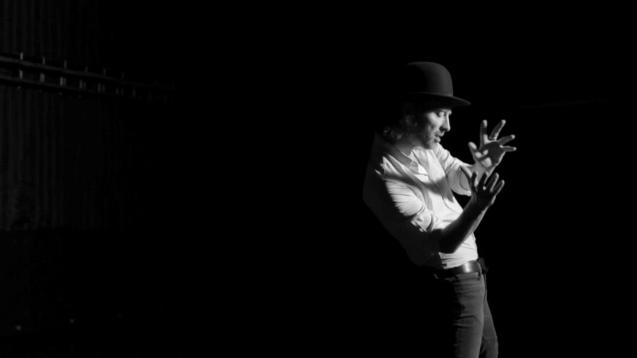
Lotus Flower begins, in back-lit black and white, in a severe looking service tunnel reminiscent of the one featured in Philippe Garrel's silent post-May '68 psychodrama, Le révélateur (1968). It could be described, with total straight-faced honesty, as a "performance video", though not in the industry jargon sense of a band or musician sitting in a room hitting their instruments in-sync with a studio backing track. This is the performance video as a work of legitimate performance art; where the movement of the body, in time and in step with the beats, melodies, counter melodies and chord changes of the song itself creates an expression that articulates, not necessarily what the song is about, but the mood, the atmosphere and the way the song makes us feel.
The feel of any Radiohead song is unmistakable: nocturnal, restless, desolate and claustrophobic; with the sense of technology as both a liberator and facilitator in our own glorious downfall. A cultural year-zero in the beautifully Ballardian notion of consumer meltdown; kingdom come and the myths of the near future. Though the dance is typically a kind of celebration, it is here a solitary expression, performed for the benefit of an audience no doubt alone or connected to the world only by that thin invisible thread that links us, from one machine to the next. As the video develops, moving with each new change in rhythm and tone, the hypnotic convulsions on screen become as mournful and sombre as Yorke's wailing falsetto. At the same time they possess a freedom and a lack of self-consciousness usually reserved for the inner-city drunk or the roadside lunatic. Someone like Denis Lavant's character in the Yorke affiliated Rabbit in Your Headlights video, who finds strength in absolute abandon.
Lotus Flower may not have the immediate awe-factor or something like Just or Street Spirit or Knives Out, with their unanswerable questions, technical virtuosity and endless imagination, but there's something quietly overwhelming about this video that at first seems to be almost thrown-together as an afterthought, but reveals, with subsequent viewings, to be something quite remarkable, fascinating and total alien to anything else currently being produced.
It was the whole cultural communicative thing too, which probably still exists, but like everything else these days is accelerated; no longer something to actually wait for, discover or stumble across when you least expect it, but there, at your fingertips, and on-demand. The playground buzz of the next few days when you'd ask your friends "did you see that?" no doubt has less of the same sting of anticipation that it used to have in the early-millennium days when the thought of using a computer to simultaneously link your friends with the relevant clips and information was the stuff of older kids, or science fiction.
Lotus Flower begins, in back-lit black and white, in a severe looking service tunnel reminiscent of the one featured in Philippe Garrel's silent post-May '68 psychodrama, Le révélateur (1968). It could be described, with total straight-faced honesty, as a "performance video", though not in the industry jargon sense of a band or musician sitting in a room hitting their instruments in-sync with a studio backing track. This is the performance video as a work of legitimate performance art; where the movement of the body, in time and in step with the beats, melodies, counter melodies and chord changes of the song itself creates an expression that articulates, not necessarily what the song is about, but the mood, the atmosphere and the way the song makes us feel.
The feel of any Radiohead song is unmistakable: nocturnal, restless, desolate and claustrophobic; with the sense of technology as both a liberator and facilitator in our own glorious downfall. A cultural year-zero in the beautifully Ballardian notion of consumer meltdown; kingdom come and the myths of the near future. Though the dance is typically a kind of celebration, it is here a solitary expression, performed for the benefit of an audience no doubt alone or connected to the world only by that thin invisible thread that links us, from one machine to the next. As the video develops, moving with each new change in rhythm and tone, the hypnotic convulsions on screen become as mournful and sombre as Yorke's wailing falsetto. At the same time they possess a freedom and a lack of self-consciousness usually reserved for the inner-city drunk or the roadside lunatic. Someone like Denis Lavant's character in the Yorke affiliated Rabbit in Your Headlights video, who finds strength in absolute abandon.
Lotus Flower may not have the immediate awe-factor or something like Just or Street Spirit or Knives Out, with their unanswerable questions, technical virtuosity and endless imagination, but there's something quietly overwhelming about this video that at first seems to be almost thrown-together as an afterthought, but reveals, with subsequent viewings, to be something quite remarkable, fascinating and total alien to anything else currently being produced.
Monday, 7 February 2011
Renault Clio Commercial
Can television commercials be elevated to the creative level of modern art? The new promo for the Renault Clio, currently screening on British television, attempts to establish itself as something a little different from the average car commercial through an adventurous appropriation of both conventional and unconventional references. The result: a 40 second clip that impresses as a work of pure audio-visual experimentation but, like the majority of the kind of modern-art being referenced herein, leaves the audience wondering... what does it all mean?
Mixing contrasting elements of pop-culture and high-art, the ad' plays like a bizarre combination of installation-piece and the trailer to Jean-Luc Godard's recent Film Socialisme (2010). Cross-cutting between stock-footage of movie stars like Audrey Hepburn and Marlon Brando with sequences of the burlesque "performer" Dita Von Teese and the French football player Thierry Henry - while the soundtrack blurs samples of Clare Maguire, David Bowie and Rihanna to create something that adds an enigmatic commentary to the images - the intention of the clip seems to be the presentation of the spectacle of glamour; where art, celebrity and the car itself become objects to be fetishized and admired.
On top of this, oblique inter-titles that work against the images are superimposed on-screen to create an association of ideas. The intent? To hypothesize about the possible meanings behind Renault's famous advertising slogan: "what is va va voom?" At this point, I'm not sure if this commercial really warrants any kind of greater, in-depth analysis (sometimes a commercial is just a commercial), but I did enjoy it; not just as a work of actual video production, but as a rather interesting and impressive piece of contemporary objet d'art.
Mixing contrasting elements of pop-culture and high-art, the ad' plays like a bizarre combination of installation-piece and the trailer to Jean-Luc Godard's recent Film Socialisme (2010). Cross-cutting between stock-footage of movie stars like Audrey Hepburn and Marlon Brando with sequences of the burlesque "performer" Dita Von Teese and the French football player Thierry Henry - while the soundtrack blurs samples of Clare Maguire, David Bowie and Rihanna to create something that adds an enigmatic commentary to the images - the intention of the clip seems to be the presentation of the spectacle of glamour; where art, celebrity and the car itself become objects to be fetishized and admired.
On top of this, oblique inter-titles that work against the images are superimposed on-screen to create an association of ideas. The intent? To hypothesize about the possible meanings behind Renault's famous advertising slogan: "what is va va voom?" At this point, I'm not sure if this commercial really warrants any kind of greater, in-depth analysis (sometimes a commercial is just a commercial), but I did enjoy it; not just as a work of actual video production, but as a rather interesting and impressive piece of contemporary objet d'art.
Monday, 31 January 2011
Triangle
Some notes [spoilers included]:
I. Introduction:
The opening titles introduce the theme of recurrence, and in doing so, create a visual representation of the premonition. Already the film is establishing an emphasis on repeated themes, shifting realities, and the echoes of past and future events. As the words form and fade from screen, each reiteration of the title brings with it a greater clarity. The words, as they drift further away from us, becoming smaller in scale, like the Aeolus as viewed from the capsized yacht, come sharply into focus.
This presentation of text, illustrating the idea of perception through the various layers - as the repetition of the same word brings us closer to the true meaning - is probably one of the most intelligent uses of creative screen-titling seen in recent cinema. It isn't just another instance of style over substance, or an attempt to give an independent UK/Australian co-production a mainstream Hollywood veneer; instead, these titles inform the audience, right from the very beginning, of a particular structure and approach; creating in the mind of the viewer a certain expectation, of narrative, perspective, or the manipulation of events.
The three repetitions of the title, like the three sides of an Isosceles triangle (which itself looks almost like the sail of a ship), are different elements of a single theme. As our mysterious heroine enters this world, which throughout seems to be suspended in time (as if trapped between a moment of life and death), she tries desperately to change the outcome of events, either through the manipulation of other characters, or by leaving clues for any potential future manifestations. However, as with the presentation of the title, each recurrence is not something new, but simply the same thing repeated; an echo of an event, replicated, unceasingly, like the notes of a record caught on an endless loop.
Each return, each re-emergence, is only a new form of repetition. Like the film's central character, the more of these repetitions we grapple with, the closer we get to an actual revelation.
II. Premonitions:
The first image: a toy boat, capsized in a child's paddling pool; already writer/director Christopher Smith is offering the audience a deliberate premonition of events. This toy boat, drifting on the still waters, may seem fairly innocuous, especially as Smith attempts to present the calm, everyday exterior of his suburban location; however, as the film develops, and the narrative twists and turns through fractures and skips that change our interpretation of events with every new progression, this seemingly common, everyday image, will be repeated on a far grander scale. First, as a literal presentation: as the yacht this character sets out on is hit by a particularly violent thunder storm and is capsized. This event is further referenced later in the film, after the mood switches from staggered confusion to an expression of very real life and death violence, where an on-stage mural depicts the sinking of a huge ship, once again caught within the storm.
Of these two echoes, it is the first event - the capsizing of the yacht - that seems to throw the film's narrative into chaos. It is here, in this sequence, where the film plays into probably the greatest association of the title, the infamous Bermuda Triangle.
However, the reference to that particular 'triangle' is deliberately misleading, since the film eventually draws us away from this initial suggestion, establishing a secondary line of thought that is much more interesting and creative. When the character spots a drifting ocean liner, sailing unmanned and unattended through the mists, they (and we) assume that this vessel is an actual ghost ship. Questions are raised; where did the ship come from; where is the crew; where are the passengers? But these questions become less important as the film develops and the characters begin to cogitate about what the ship actually is and more importantly what its name represents.
Victor: The Aeolus?
Downey: Aeolus was the Greek God of the winds and the father of Sisyphus; a man condemned by the Gods to the task of pushing a rock up a mountain, only to see it roll back down again.
Victor: That's a pretty shitty punishment. What did he do?
Sally: He cheated death, or... no. He made a promise to death that he didn't keep.
The discussion here offers a new perspective on the events previously witnessed; the storm, the destruction of the boat, the ocean-liner that appears, miraculously, as if from nowhere; more of an imposing prison ship with its rusted barred exterior than a luxury hotel of the sea. However, it also offers a new significance to the seagull; the bird, first seen drifting across the suburbs of this supposed-to-be west-coast America (but actually Queensland, Australia), and later seen following the boat as it departs from the harbour.
Throughout the film, the significance of the seagull will be one of the main questions that we return to. What does it mean? Initially we might suspect this bird to be a representation of death; the great shadow that hangs over Jess and her friends, seen, backlit against the sun, shortly before the storm and the impending destruction of the boat. However, as the story builds and progresses, we discover a new significance. The bird is not simply a premonition of death; it is a harbinger to the accident - not seen until later in the film - which kills Jess' son and sets the wheels of the plot in motion. Like Jess, this seagull has cheated death and like her is now attempting to find a way out of this maze of false endings and counterfeit realities.
If we attempt to straighten the film's chronology, finding the most convenient in-point as a foundation to this story, then the seagull is with Jess from the very beginning. A different kind of visual premonition in this instance, as later in the film - when the events roll back to what was effectively the first scene - we see on the wall of Jess' house a painting. A painting of two seagulls, backlit by a circular, stylised orb (within an orb) that represents the sun. Is this a retroactive precursor, of one seagull becoming two seagulls: already creating a kind of recurrence; a duplication or repetition, like the various, otherworldly manifestations of Jess?
III. Reflections and Repetitions:
As the events are repeated, each repetition brings with it a new manifestation of the survivors. This element of the plot gives Smith the opportunity to play with the compositional aspects of his film; filling the Aeolus with great floor to ceiling mirrors that literally multiply and fragment characters within the frame. This is given an even greater element of depth by the use of the 2.35:1 aspect ratio, where the general look might recall, on a superficial level, an almost retro 1960s style split-screen effect, or even an actual strip of film. However, the framing, and in particular the use of the full 'scope image, seems intended to overwhelm the audience with the literal, on-screen sense of various recreations of time.
Here, the mirrors aren't simply a visual representation of the repetition or recurrence of events; they illustrate the possibility of parallel realities existing side by side. It is that same sense of worlds within worlds, best illustrated by the dramatic set-up of Lewis Carroll's Alice-adventure Through the Looking-Glass (1871), which hint towards ruptures in the character's psychology. The symbol of the mirror itself, as a portal or a gateway into another realm, is a familiar plot point from earlier horror films, such as Poltergeist III (1988) or John Carpenter's Prince of Darkness (1987), as well as the more familiar personification of Narcissus, and the idea that the mirror exists to entice and eventually trap those who spend too much time studying their own reflected gaze.
Here, the mirror traps these various manifestations of the character and her doomed companions, but the reflection, as in the reflection of events, isn't always a direct recreation. Like all mirror images, there is a sense of physical abstraction; everything transformed left-to-right and right-to-left, creating a copy but also something of a potential doppelganger. This particular idea brings to mind the presentation of the famous painting by the surrealist artist René Magritte, titled in English Not to be Reproduced (La reproduction interdite, 1937), where the idea of the reflected self as a new manifestation (existing in a world within worlds) is made all the more clear.
It isn't simply the repetition of events that creates in the mind of the viewer the connection to the myth of Sisyphus or the role that the Aeolus plays in forcing this character to accept the futility of her own mortality, but the repetition of certain significant objects. If the mirror symbolises the repetition of the self, then these objects present the slowly developing clues that lead, inevitably, to that final revelation. Smith frames these objects with the same repetitiveness; establishing for the benefit of the viewer the noteworthy similarities between, for example, the heart-shaped pendants against the pile of dead seagulls towards the end of the film.
However, these shots, which communicate the central theme of the narrative, also establish a sense of uncertainty pertaining to the main character's emotional state of mind. The psychological aspect, which could be seen as a possible interpretation of events, at least before the film's final twist, is an element that Smith uses to keep the audience on their toes; deliberately misleading us, in the Hitchcockian sense, with these clues and associations that show Jess as a character physically removed and to some extent emotionally withdrawn. Maybe it's in the film's broader references to Stanley Kubrick's adaptation of The Shining (1980) or the deceptive homage to Friday the 13th (1981) that convince the viewer that there is something much more conventional or straightforward to these scenes of horror and suspense; a haunted house/ghost ship story combined with a generic stalk n' slash picture with obvious nods to Knife in the Water (Nóż w wodzie, 1962) or Dead Calm (1989)?
For most of the film, the audience is left wondering whether it is the actual sense of confinement that comes from the ship (here a surrogate for the haunted Overlook is Kubrick's film) or the seemingly dissociative behaviour of Jess that is causing the almost irrational fracturing of events. However, the eventual revelation of the car crash, or the true nature of Jess (as both a mother and a character) in the moments leading up to her death (or what we assume to be a death), reduce these elements to nothing more than knowing nods to the genre; stylistic MacGuffin's that tap into the greater game being played between Smith and his potential audience.
IV. Fractures:
As with the on-screen reflections and repetitions, Smith uses the mise-en-scene to introduce the idea of fractures, or spaces between characters and events. The windows and mirrors that previously showed the recurrence of characters also illustrate the breaks in personality; creating further representations of replication, albeit, as a single, splintered form. The presentation reminds me of a line of dialogue from Dario Argento's horror masterpiece Suspira (1977), which again, hints at the relationship between the self (in the psychological sense) and the power of the mirror as a prison that traps us, exposing our flaws and weaknesses: "bad luck isn't brought by broken mirrors, but broken minds"
Part of Jess' journey in the film is discovering her own strengths and weaknesses through a particular form of self-analysis that comes from the unique ability to observe her own actions from a distance. In witnessing the events play out, again and again, and each time attempting to fix the things that hinder her in the attempts to retroactively save her own son, Jess is able to realise her greatest failing as a human being. We can only assume from this that the death of her son is the fracture that causes the narrative to break off in a different direction; the peak, the point of this triangular bend in time that causes the story to re-start, repeating events, while never quite reaching a conclusion.
It is in this particular idea of the fracture that I feel the significance of the title is most evident. A triangle, which, geometrically, has three sides meeting in the middle, creating a point, is very much like a broken version of a conventional narrative storyline. If we think of a predictable narrative as a straight-line, moving in one direction from beginning to end, then the narrative of Triangle is transformed by events that break the narrative flow at a specific point, causing the story to then repeat itself. Not necessarily from the beginning (as a circular narrative might) but from a significant point in time. This notion of the narrative as something that develops, drops, rolls back and develops again plays into the earlier reference to Sisyphus, pushing his boulder to the top of the mountain (itself an almost triangular shape) only to watch it roll back back, down to the beginning, repeating the same action endlessly.
If the narrative was circular, then all things would converge at the beginning before repeating from start to finish. Instead, the potential bend in the storyline suggests at least three possible beginnings, or at least three possible ends. The story stops and starts repeatedly from several different points in the timeline; sometimes beginning on the boat, other times beginning on the ship, and eventually taking us right the way back to the very first scene of the film, where those once arbitrary artefacts (the toy boat, the spilled ink, the seagull painting) now have a far greater significance on events. However, even here, we're still not sure if this is really the beginning or if there are indeed further ruptures and breaks in this narrative that go deeper, backwards or forwards, through time.
Maybe this all points back to an alternate story; the story of Jess' son: an autistic child with obsessive compulsive disorder, who spends all day, day after day, painting a picture of a ship's rescue; painting and re-painting images on images, each overlapping, until multiple variations exist, layer upon layer of the same thing. It is only then that a new story is revealed.
I. Introduction:
The opening titles introduce the theme of recurrence, and in doing so, create a visual representation of the premonition. Already the film is establishing an emphasis on repeated themes, shifting realities, and the echoes of past and future events. As the words form and fade from screen, each reiteration of the title brings with it a greater clarity. The words, as they drift further away from us, becoming smaller in scale, like the Aeolus as viewed from the capsized yacht, come sharply into focus.
This presentation of text, illustrating the idea of perception through the various layers - as the repetition of the same word brings us closer to the true meaning - is probably one of the most intelligent uses of creative screen-titling seen in recent cinema. It isn't just another instance of style over substance, or an attempt to give an independent UK/Australian co-production a mainstream Hollywood veneer; instead, these titles inform the audience, right from the very beginning, of a particular structure and approach; creating in the mind of the viewer a certain expectation, of narrative, perspective, or the manipulation of events.
The three repetitions of the title, like the three sides of an Isosceles triangle (which itself looks almost like the sail of a ship), are different elements of a single theme. As our mysterious heroine enters this world, which throughout seems to be suspended in time (as if trapped between a moment of life and death), she tries desperately to change the outcome of events, either through the manipulation of other characters, or by leaving clues for any potential future manifestations. However, as with the presentation of the title, each recurrence is not something new, but simply the same thing repeated; an echo of an event, replicated, unceasingly, like the notes of a record caught on an endless loop.
Each return, each re-emergence, is only a new form of repetition. Like the film's central character, the more of these repetitions we grapple with, the closer we get to an actual revelation.
II. Premonitions:
The first image: a toy boat, capsized in a child's paddling pool; already writer/director Christopher Smith is offering the audience a deliberate premonition of events. This toy boat, drifting on the still waters, may seem fairly innocuous, especially as Smith attempts to present the calm, everyday exterior of his suburban location; however, as the film develops, and the narrative twists and turns through fractures and skips that change our interpretation of events with every new progression, this seemingly common, everyday image, will be repeated on a far grander scale. First, as a literal presentation: as the yacht this character sets out on is hit by a particularly violent thunder storm and is capsized. This event is further referenced later in the film, after the mood switches from staggered confusion to an expression of very real life and death violence, where an on-stage mural depicts the sinking of a huge ship, once again caught within the storm.
Of these two echoes, it is the first event - the capsizing of the yacht - that seems to throw the film's narrative into chaos. It is here, in this sequence, where the film plays into probably the greatest association of the title, the infamous Bermuda Triangle.
However, the reference to that particular 'triangle' is deliberately misleading, since the film eventually draws us away from this initial suggestion, establishing a secondary line of thought that is much more interesting and creative. When the character spots a drifting ocean liner, sailing unmanned and unattended through the mists, they (and we) assume that this vessel is an actual ghost ship. Questions are raised; where did the ship come from; where is the crew; where are the passengers? But these questions become less important as the film develops and the characters begin to cogitate about what the ship actually is and more importantly what its name represents.
Victor: The Aeolus?
Downey: Aeolus was the Greek God of the winds and the father of Sisyphus; a man condemned by the Gods to the task of pushing a rock up a mountain, only to see it roll back down again.
Victor: That's a pretty shitty punishment. What did he do?
Sally: He cheated death, or... no. He made a promise to death that he didn't keep.
The discussion here offers a new perspective on the events previously witnessed; the storm, the destruction of the boat, the ocean-liner that appears, miraculously, as if from nowhere; more of an imposing prison ship with its rusted barred exterior than a luxury hotel of the sea. However, it also offers a new significance to the seagull; the bird, first seen drifting across the suburbs of this supposed-to-be west-coast America (but actually Queensland, Australia), and later seen following the boat as it departs from the harbour.
Throughout the film, the significance of the seagull will be one of the main questions that we return to. What does it mean? Initially we might suspect this bird to be a representation of death; the great shadow that hangs over Jess and her friends, seen, backlit against the sun, shortly before the storm and the impending destruction of the boat. However, as the story builds and progresses, we discover a new significance. The bird is not simply a premonition of death; it is a harbinger to the accident - not seen until later in the film - which kills Jess' son and sets the wheels of the plot in motion. Like Jess, this seagull has cheated death and like her is now attempting to find a way out of this maze of false endings and counterfeit realities.
If we attempt to straighten the film's chronology, finding the most convenient in-point as a foundation to this story, then the seagull is with Jess from the very beginning. A different kind of visual premonition in this instance, as later in the film - when the events roll back to what was effectively the first scene - we see on the wall of Jess' house a painting. A painting of two seagulls, backlit by a circular, stylised orb (within an orb) that represents the sun. Is this a retroactive precursor, of one seagull becoming two seagulls: already creating a kind of recurrence; a duplication or repetition, like the various, otherworldly manifestations of Jess?
III. Reflections and Repetitions:
As the events are repeated, each repetition brings with it a new manifestation of the survivors. This element of the plot gives Smith the opportunity to play with the compositional aspects of his film; filling the Aeolus with great floor to ceiling mirrors that literally multiply and fragment characters within the frame. This is given an even greater element of depth by the use of the 2.35:1 aspect ratio, where the general look might recall, on a superficial level, an almost retro 1960s style split-screen effect, or even an actual strip of film. However, the framing, and in particular the use of the full 'scope image, seems intended to overwhelm the audience with the literal, on-screen sense of various recreations of time.
Here, the mirrors aren't simply a visual representation of the repetition or recurrence of events; they illustrate the possibility of parallel realities existing side by side. It is that same sense of worlds within worlds, best illustrated by the dramatic set-up of Lewis Carroll's Alice-adventure Through the Looking-Glass (1871), which hint towards ruptures in the character's psychology. The symbol of the mirror itself, as a portal or a gateway into another realm, is a familiar plot point from earlier horror films, such as Poltergeist III (1988) or John Carpenter's Prince of Darkness (1987), as well as the more familiar personification of Narcissus, and the idea that the mirror exists to entice and eventually trap those who spend too much time studying their own reflected gaze.
Here, the mirror traps these various manifestations of the character and her doomed companions, but the reflection, as in the reflection of events, isn't always a direct recreation. Like all mirror images, there is a sense of physical abstraction; everything transformed left-to-right and right-to-left, creating a copy but also something of a potential doppelganger. This particular idea brings to mind the presentation of the famous painting by the surrealist artist René Magritte, titled in English Not to be Reproduced (La reproduction interdite, 1937), where the idea of the reflected self as a new manifestation (existing in a world within worlds) is made all the more clear.
It isn't simply the repetition of events that creates in the mind of the viewer the connection to the myth of Sisyphus or the role that the Aeolus plays in forcing this character to accept the futility of her own mortality, but the repetition of certain significant objects. If the mirror symbolises the repetition of the self, then these objects present the slowly developing clues that lead, inevitably, to that final revelation. Smith frames these objects with the same repetitiveness; establishing for the benefit of the viewer the noteworthy similarities between, for example, the heart-shaped pendants against the pile of dead seagulls towards the end of the film.
However, these shots, which communicate the central theme of the narrative, also establish a sense of uncertainty pertaining to the main character's emotional state of mind. The psychological aspect, which could be seen as a possible interpretation of events, at least before the film's final twist, is an element that Smith uses to keep the audience on their toes; deliberately misleading us, in the Hitchcockian sense, with these clues and associations that show Jess as a character physically removed and to some extent emotionally withdrawn. Maybe it's in the film's broader references to Stanley Kubrick's adaptation of The Shining (1980) or the deceptive homage to Friday the 13th (1981) that convince the viewer that there is something much more conventional or straightforward to these scenes of horror and suspense; a haunted house/ghost ship story combined with a generic stalk n' slash picture with obvious nods to Knife in the Water (Nóż w wodzie, 1962) or Dead Calm (1989)?
For most of the film, the audience is left wondering whether it is the actual sense of confinement that comes from the ship (here a surrogate for the haunted Overlook is Kubrick's film) or the seemingly dissociative behaviour of Jess that is causing the almost irrational fracturing of events. However, the eventual revelation of the car crash, or the true nature of Jess (as both a mother and a character) in the moments leading up to her death (or what we assume to be a death), reduce these elements to nothing more than knowing nods to the genre; stylistic MacGuffin's that tap into the greater game being played between Smith and his potential audience.
IV. Fractures:
As with the on-screen reflections and repetitions, Smith uses the mise-en-scene to introduce the idea of fractures, or spaces between characters and events. The windows and mirrors that previously showed the recurrence of characters also illustrate the breaks in personality; creating further representations of replication, albeit, as a single, splintered form. The presentation reminds me of a line of dialogue from Dario Argento's horror masterpiece Suspira (1977), which again, hints at the relationship between the self (in the psychological sense) and the power of the mirror as a prison that traps us, exposing our flaws and weaknesses: "bad luck isn't brought by broken mirrors, but broken minds"
Part of Jess' journey in the film is discovering her own strengths and weaknesses through a particular form of self-analysis that comes from the unique ability to observe her own actions from a distance. In witnessing the events play out, again and again, and each time attempting to fix the things that hinder her in the attempts to retroactively save her own son, Jess is able to realise her greatest failing as a human being. We can only assume from this that the death of her son is the fracture that causes the narrative to break off in a different direction; the peak, the point of this triangular bend in time that causes the story to re-start, repeating events, while never quite reaching a conclusion.
It is in this particular idea of the fracture that I feel the significance of the title is most evident. A triangle, which, geometrically, has three sides meeting in the middle, creating a point, is very much like a broken version of a conventional narrative storyline. If we think of a predictable narrative as a straight-line, moving in one direction from beginning to end, then the narrative of Triangle is transformed by events that break the narrative flow at a specific point, causing the story to then repeat itself. Not necessarily from the beginning (as a circular narrative might) but from a significant point in time. This notion of the narrative as something that develops, drops, rolls back and develops again plays into the earlier reference to Sisyphus, pushing his boulder to the top of the mountain (itself an almost triangular shape) only to watch it roll back back, down to the beginning, repeating the same action endlessly.
An illustration of the 'conventional narrative storyline' against the narrative of Triangle, created by the blog author:


If the narrative was circular, then all things would converge at the beginning before repeating from start to finish. Instead, the potential bend in the storyline suggests at least three possible beginnings, or at least three possible ends. The story stops and starts repeatedly from several different points in the timeline; sometimes beginning on the boat, other times beginning on the ship, and eventually taking us right the way back to the very first scene of the film, where those once arbitrary artefacts (the toy boat, the spilled ink, the seagull painting) now have a far greater significance on events. However, even here, we're still not sure if this is really the beginning or if there are indeed further ruptures and breaks in this narrative that go deeper, backwards or forwards, through time.
Maybe this all points back to an alternate story; the story of Jess' son: an autistic child with obsessive compulsive disorder, who spends all day, day after day, painting a picture of a ship's rescue; painting and re-painting images on images, each overlapping, until multiple variations exist, layer upon layer of the same thing. It is only then that a new story is revealed.
Subscribe to:
Posts (Atom)
Schalcken the Painter (1979)
Schalcken the Painter [Schalcken the Painter [Leslie Megahey, 1979]: This is a film I first saw around four years ago. At the time I found...
-
Beginning with a vague preamble on the use of digital video in achieving that contrast between the abstract and the real... One of the mos...
-
A short note on several films by Eric Rohmer I'm not entirely sure if this blog post constitutes a 'return' in the perman...
-
A Mystery? To talk about the cinema's present, one must first acknowledge its past. Roundhay Garden Scene (1888), one of the oldest...