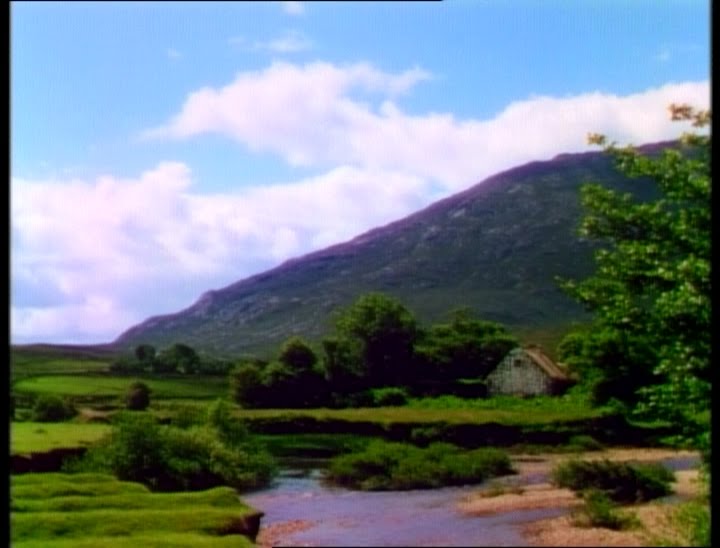
A song about embracing the new - about the restless pursuit of the next great adventure - presented with a visual accompaniment that achieves the expression of the unbelievable, the astounding, or the thrill of the unknown. Wanderlust, in its purest form, is an adventure in eight-minutes; a breathless, exhausting trek down river, where the forward motion of this character is matched by the driving rhythms of the music itself. Kraftwerk-like rhythms that recall something like Trans-Europe-Express (1977); where the sense of movement, atmosphere and place is the thing that draws us in, maintains our interest throughout the duration of this narrative (aural, visual or imaginary), and leaves us hopelessly searching for that next rush of discovery when the song comes to an inevitable close.
The particular yearning for a new place or the need to travel, explore and do other things is largely a metaphor for Björk's career as a whole. In this sense, the video could be seen as a dramatised fantasy version of her own life and vocation; beginning with this small, exotic figure discovering something extraordinary that comes from her own connection with nature; a connection that will grow and transform into an uncontrollable entity, forcing her to leave the security of home and taking her on this remarkable journey - where she is carried along through uncertain waters by the support of others, where she fights a battle with herself, where she is plagued by various obstacles that attempt to harm and hinder - before eventually making the ultimate plunge into the unfamiliar; into the great unknown.
This beautifully made clip is everything a film like Avatar (2009) promised to deliver, but couldn't; a fully immersive 3D experience, which - through the sheer power of its imagery and imagination - transports us to another world.
Wednesday, 26 May 2010
Wednesday, 19 May 2010
Waltz with Bashir
Obviously, one could dismiss the general appearance of the film as a clear gimmick; something to attract an audience. The film would have been no less powerful or engrossing had it been presented as a series of traditional 'talking-head' sequences recorded onto film or DV. However, in presenting the film as a work of animation, the director, Ari Folman, is able to better express the purely sensory notion of memory abstracted by time. These moments of recollection, or reflection, which occur around the narrative, like the ripples in the ocean during the character's initial dream, are embellished by the general sense of horror that alters the perspective of those experiencing periods of great conflict, and distorted by the back-and-forth unravelling of the 'Chinese whispers' style narrative; where the search for the truth of "what really happened?", becomes an investigation into the past.
It is, first and foremost, a personal film about this character, this 'avatar' for the director, and the various stories within stories that grow and transform the understanding of events as he interviews those that knew him twenty years ago; who experienced the conflict, and can therefore better explain the holes in his memory, or why he's blocked out those intangible recollections to begin with. Therefore, the film, at its most immediate level, is a detective story by way of the documentary. However, through the power and pull of these image that are both primitive and beyond anything else we've ever witnessed (at least in terms of conventional cinema), the experience is transformed into something beyond mystery; beyond documentary. The film becomes an experience, like the dream itself, where the actual process of viewing the film - these images - is as life changing for the audience as it is for the central character.
It is a film that goes beyond the trite categorisations of the "war film", and yet, at the same time, it is one of the great "war films" ever produced. Great in the same way that Jean-Luc Godard's Notre musique (Our Music, 2004) is great; in the sense that it dispenses with the usual nonsense of a film like Saving Private Ryan (1998) or Rambo (2008), etc, where the filmmakers portray the horror of war by presenting the battle as something visceral, explosive or exhilarating. These are films where the audience already knows who the villain is, and where the good die heroes. Instead, Waltz with Bashir creates its narrative from the recollections of real people with real experiences. Drama and anti-war commentary created, not through spectacle, but through the memory of events.
These experiences define the film and make our own experiences with it entirely unforgettable. I'm thinking specifically of three scenes.
1) The young solder having to swim to safety after his tank is ambushed and his friends are killed. He sees the lights in the distance and swims towards them, not sure what to expect, too tired to care. When he reaches the beach, he finds the same squad that abandoned him during the initial attack. Whereas before he felt animosity towards these comrades for leaving him out in the open, he now feels an incredible sense of regret for leaving his own fallen brothers and attempting to find safety. Propelled by that memory of his mother (a memory within a memory) that will break the heart of any viewer who is a first-born son, or, as in my case, an only child.
2) The ambush in the plantation, where the soldier with the RPG that is cut down in an explosion of sniper fire, turns out to be a young boy, not even a teenager.
3) The experience of the war correspondent who initially saw the war as filtered through his camera's lens; transforming the horror and the bloodshed into moments of great poetry and heroism. However, when he arrives at a scene where a group of horses have been maimed and murdered, the filter can no longer work, and he's suddenly overwhelmed by the unbelievable monstrosity of this conflict; the destruction of such incredible beauty.
It is obvious throughout that this is a film of staggering contradictions; where moments of poetry are transformed or distorted by images of unforgiving brutality; or where images of unforgiving brutality are transformed or distorted by moments of incredible poetry. The dream itself is unforgettable; Folman and two other soldiers float in the ocean, watching the city of Beirut, lit by an ethereal yellow glow. There's a touch of Lars von Trier's The Element of Crime (1984) about these images; not simply in the emphasis on the water or the superficial murkiness of the colour scheme (that shared vision of the post-world-war devastation), but in the abstraction of reality; a slowing down of time, distorting it, so that we're seeing these events as if looking down at our own lifeless body. Sparks of light reflect in the ripples as the three men emerge from the water, naked, entranced by the strange show of light. It is only at the end of the film that we discover the true horror behind this beauty; the light of a thousand flares shot into the night sky to better aid the soldiers in their massacre of these civilians.
I'm not going to pretend that I understood the entire political background of this film. Many of these events took place before I was born, in a country I've never visited. However, the real genius of Folman's film is in its perfect evocation of a time and place - specifically Israel, in the early 1980s - presented, not as it actual was, but as the director remembers it, or experienced it. The music and fashions are recognisable of the period, but juxtaposed against the tangible sense of how the experience of war has transformed the world around it, meaning that even the most ordinary or commonplace of activities have associations to the bloodshed and confusion.
There are images of war found in everything; in video arcades, in pop songs: Enola Gay, by OMD; This is Not a Love Song, by PiL. The hazy movements of an attractive girl at the discothèque have the same surreal expression of force and exuberance as the bodies of the soldiers as they're riddled with bullets. These associations, of memory/experience, like something approaching post-traumatic stress disorder for this character attempting to readjust or come to terms with what he witnessed two decades before, are unknowable to those of us that have never experienced a war first-hand, but they hit us on an emotional level that is absolutely immediate.
Some may attempt to define the film beyond such vague appraisals, demanding a definitive explanation as to what it says, whose side is it on, how much of this commentary we can accept as fact... but all of this is beside the point. Waltz With Bashir is a film that exists on several levels: as a film about memory; as an investigation into the past; as a political satire; as a character study; as a work of historical fiction; as a sensory experience; as a nightmare on film; as a affirmation of peace; as a reminder of the unsung loss. Above all else, however, Waltz With Bashir is challenging, personal, thought-provoking cinema that transcends boundaries, defies classification. It is both an experience, and a necessary, purging rite.
It is, first and foremost, a personal film about this character, this 'avatar' for the director, and the various stories within stories that grow and transform the understanding of events as he interviews those that knew him twenty years ago; who experienced the conflict, and can therefore better explain the holes in his memory, or why he's blocked out those intangible recollections to begin with. Therefore, the film, at its most immediate level, is a detective story by way of the documentary. However, through the power and pull of these image that are both primitive and beyond anything else we've ever witnessed (at least in terms of conventional cinema), the experience is transformed into something beyond mystery; beyond documentary. The film becomes an experience, like the dream itself, where the actual process of viewing the film - these images - is as life changing for the audience as it is for the central character.
It is a film that goes beyond the trite categorisations of the "war film", and yet, at the same time, it is one of the great "war films" ever produced. Great in the same way that Jean-Luc Godard's Notre musique (Our Music, 2004) is great; in the sense that it dispenses with the usual nonsense of a film like Saving Private Ryan (1998) or Rambo (2008), etc, where the filmmakers portray the horror of war by presenting the battle as something visceral, explosive or exhilarating. These are films where the audience already knows who the villain is, and where the good die heroes. Instead, Waltz with Bashir creates its narrative from the recollections of real people with real experiences. Drama and anti-war commentary created, not through spectacle, but through the memory of events.
These experiences define the film and make our own experiences with it entirely unforgettable. I'm thinking specifically of three scenes.
1) The young solder having to swim to safety after his tank is ambushed and his friends are killed. He sees the lights in the distance and swims towards them, not sure what to expect, too tired to care. When he reaches the beach, he finds the same squad that abandoned him during the initial attack. Whereas before he felt animosity towards these comrades for leaving him out in the open, he now feels an incredible sense of regret for leaving his own fallen brothers and attempting to find safety. Propelled by that memory of his mother (a memory within a memory) that will break the heart of any viewer who is a first-born son, or, as in my case, an only child.
2) The ambush in the plantation, where the soldier with the RPG that is cut down in an explosion of sniper fire, turns out to be a young boy, not even a teenager.
3) The experience of the war correspondent who initially saw the war as filtered through his camera's lens; transforming the horror and the bloodshed into moments of great poetry and heroism. However, when he arrives at a scene where a group of horses have been maimed and murdered, the filter can no longer work, and he's suddenly overwhelmed by the unbelievable monstrosity of this conflict; the destruction of such incredible beauty.
It is obvious throughout that this is a film of staggering contradictions; where moments of poetry are transformed or distorted by images of unforgiving brutality; or where images of unforgiving brutality are transformed or distorted by moments of incredible poetry. The dream itself is unforgettable; Folman and two other soldiers float in the ocean, watching the city of Beirut, lit by an ethereal yellow glow. There's a touch of Lars von Trier's The Element of Crime (1984) about these images; not simply in the emphasis on the water or the superficial murkiness of the colour scheme (that shared vision of the post-world-war devastation), but in the abstraction of reality; a slowing down of time, distorting it, so that we're seeing these events as if looking down at our own lifeless body. Sparks of light reflect in the ripples as the three men emerge from the water, naked, entranced by the strange show of light. It is only at the end of the film that we discover the true horror behind this beauty; the light of a thousand flares shot into the night sky to better aid the soldiers in their massacre of these civilians.
I'm not going to pretend that I understood the entire political background of this film. Many of these events took place before I was born, in a country I've never visited. However, the real genius of Folman's film is in its perfect evocation of a time and place - specifically Israel, in the early 1980s - presented, not as it actual was, but as the director remembers it, or experienced it. The music and fashions are recognisable of the period, but juxtaposed against the tangible sense of how the experience of war has transformed the world around it, meaning that even the most ordinary or commonplace of activities have associations to the bloodshed and confusion.
There are images of war found in everything; in video arcades, in pop songs: Enola Gay, by OMD; This is Not a Love Song, by PiL. The hazy movements of an attractive girl at the discothèque have the same surreal expression of force and exuberance as the bodies of the soldiers as they're riddled with bullets. These associations, of memory/experience, like something approaching post-traumatic stress disorder for this character attempting to readjust or come to terms with what he witnessed two decades before, are unknowable to those of us that have never experienced a war first-hand, but they hit us on an emotional level that is absolutely immediate.
Some may attempt to define the film beyond such vague appraisals, demanding a definitive explanation as to what it says, whose side is it on, how much of this commentary we can accept as fact... but all of this is beside the point. Waltz With Bashir is a film that exists on several levels: as a film about memory; as an investigation into the past; as a political satire; as a character study; as a work of historical fiction; as a sensory experience; as a nightmare on film; as a affirmation of peace; as a reminder of the unsung loss. Above all else, however, Waltz With Bashir is challenging, personal, thought-provoking cinema that transcends boundaries, defies classification. It is both an experience, and a necessary, purging rite.
Saturday, 8 May 2010
The Quiet Man
John Ford's Academy Award winning film The Quiet Man (1952) is, in many ways, a story about place and the rediscovery of it. In the film, the expatriate Irish-American Sean Thornton (John Wayne) returns to the village of 'Innisfree' to reclaim his family home. However, his journey has less to do with the actual reclaiming of the property and more to do with the rediscovery of the past through a literal journey in a time. This place, where the character was born and where he eventually hopes to die, is significant, but is somewhere that has only previously existed in the memory and imagination. A second-hand Ireland passed down through the tall tales and fond reminisces of parents and grandparents, where the greens are a little too green, the people a little too broad and the atmosphere closer to caricature. It is Ford's Ireland as much as it is the Ireland of Thornton; this larger than life place presented to us in an idealised fashion that has no bearing on the actual Ireland as it existed in 1952, where the director goes to great lengths to exaggerate every detail, as memories are exaggerated in the mind.
Our first glimpse of this traditional Ireland - a horse and cart, signalling the switch from the modern to the old-fashioned - is shared with the central character, as both he and we catch a glimpse of it through the railway station window. In the literal sense, the framing of this shot as a window into another world becomes an invitation, both to the character and to the audience. This horse and cart are therefore not only a reminder of the archaic, or the out-dated, but a means of transportation, from our world into the next.
This contrast, between the old and the new, will be made explicit in the following shot, as the horse and cart, situated in the foreground, make their way beneath the arch of the railway bridge on their way into the village. As the locomotive thunders overhead, marking the horizon where the blue of the sky meets the green of the valley, the film is signalling the shift from the contemporary world of this character (represented by the train) to the otherworld of the film.
As the buggy departs, the Greek-chorus of characters, peering out from over the wall and indulging in gossip and idle chit-chat, become an immediate surrogate for the viewing audience. Asking questions about this character, who at this point in the story is still unknown and without conventional introduction, while also establishing the thread of community - as in, a world defined by these characters - that will be further explored throughout.
Although in some aspects the film could be seen as playing up to the perceived stereotype of the Irish - in keeping with subsequent Hollywood movies, such as Darby O'Gill and the Little People (1959) and Finian's Rainbow (1968) - the film nonetheless illustrates Ford's great warmth and tremendous affection for these characters; over-embellished, as characters in Ford's films often were, but only as a means of turning even the most humble of supporting players into a bold, heroic figure, commanding the landscape as if it were a part of them.
Adapted from a short story by the Irish writer Maurice Walsh, The Quiet Man is a film often referred to, simplistically speaking, as a romantic melodrama, with the main selling point being the relationship between Thornton and the beautiful spinster Mary Kate Danaher (Maureen O'Hara). However, this surface layer - or selling point - is only one component of a film that has far greater themes beyond whatever was the more popular reading of the time. The romantic element might admittedly be a fairly large component of the story - in the sense that it is motivated by all the other elements at play - it is nonetheless a storyline that sits side-by-side with the other themes, which are perhaps more representative of Ford's own interests as both an artist and a storyteller. Obviously, we recognise immediately the presence of John Wayne, who appeared in countless films by Ford - often as various rough around the edges frontiersmen, soldiers and cavalrymen - but the actual image of the actor in this environment, and in this particular romantic narrative, seems to suggest something slightly off about his character from the very first scene. A hidden depth that will eventually be explained in the second act of the film, but which nonetheless adds subtle shades to our interpretation of him and the general questions that we (and that sort-of Greek chorus) ask ourselves during those opening few minutes.
As a result, the film has an air of mystery to it, as we're left to wonder why Thornton has decided to return to Ireland now, at this point in time, and why he seems so reluctant to engage in the merriment and the frivolity of the local booze hounds as they delight in pulling half-remembered stories of the Thornton ancestry from the murky puddles of the past. Has the character really come back to this place to reclaim the house where he was born, or is there some other motivating factor; some secret shame that has forced him to abscond and find solace in the last place anyone would ever think to look for him?
Ford amplifies this uncertainly through the blocking of scenes, as characters with half-smiles dart their eyes back and forth to one another in a silent judgement, or in the earlier sequences of characters rummaging through Thornton's rucksack as if there's something more to this than simply the shock of the new. However, in a later scene, in which Thornton returns to his newly purchased farm, only to find the fire still burning and the dust and grime swept into a pile in the centre of the room, we think, momentarily, that the past-life of this character has finally caught up with him. The look of this scene, with its vivid studio lighting and special effects to simulate a violent thunder storm, seems closer to the eventual cinema of the Italian director Mario Bava; with the splashes of yellow and purple on the farmhouse wall, and that billowing curtain as it dances in the draught of a broken window, seeming entirely removed from the usual, more characteristic Fordian quirks.
Eventually, the threat turns out to be none other than Mary Kate, and the scene climaxes with one of the most famous and iconic screen kisses in cinema history. However, the lead up to this moment, and that tangible sense of a character backed into a corner and ready to lash out for the purposes of self-preservation, confirm our suspicions that there is more to this Sean Thornton than his far too convenient back-story might suggest.
The revelation of this hidden character is eventually covered in the film's second act, in a bravura flashback sequence that remains one of the most incredible pieces of cinema that Ford ever created. Without question, the most jarring moment in the film, this flashback of Thornton's to the tragic boxing match that ended his career and forced him to leave America, is a marvel of purely visual storytelling, character building and pure filmmaking ingenuity. As the character is KO'd by the right-hook of the mean-tempered landowner "Red" Will Danaher (Victor McLaglen) on the day of his wedding, Ford cuts back from Thornton's prone frame to the blinding spotlight as it cools on a shot of Thornton, as pugilist, traumatised and unnerved; looking down at the audience - or through us - at the wounded body of his foe. The actual structure of this scene, with its deliberately odd framing and disorientating use of montage, particularly of expressionless faces, can be seen as an influence on everyone from Jean-Luc Godard to Martin Scorsese, with the editing in films like A Married Woman (Une femme mariée, 1964) and Raging Bull (1980) in particular showing the influence of Ford, and specifically this sequence of shots.
The scene seems deliberately structured to disrupt the narrative, throwing both the audience and the character into a kind of chaos. Before this scene, we sort of have a sense of where the film is going, or who this character really is, and yet, through this short series of shots, the film has completely undermined the romantic aspect of the story; pushing the film back towards the figure of Thornton as this "quiet man", and the question of why the image of Ireland - and the need to reclaim or rediscover that second-hand existence - has become so important to him. Therefore, the film, beyond this point, is largely about defining this place; this creation of Ford's, as he delights in documenting the layers of this society, its rules and inner-workings, and how these factors or ideas add to the romantic element, creating comedy or drama from the often farcical interactions of his characters. The film, in this sense, shows Ford at his most self-indulgent (perhaps for the first time in his career), as instead of moving the film on or bringing the audience closer to a natural conclusion, he allows these scenes to play out; letting the audience bask in the atmosphere or the richness of these scenes of the world simply existing.
There's a painterly quality to many of these scenes, as moments of social interaction take on an element of still life. We can look at these frames, robbed of movement, devoid of subtext or narrative chronology, and nonetheless read their specific intentions. An image of a man playing an accordion, while another man looks on approvingly; an elderly man, half-cut, gazing into his pint glass and wondering if it's half full or half empty; the scenes of characters making small talk in drawing rooms, or tending the bedside of a dying man, have an affinity to Velázquez, or the early work of Vincent Van Gogh; where the framing of these moments, and the lighting of cinematographer Winton C. Hoch, help to suggest a story, or the relationship between characters, in the most basic, visual sense.
These interior scenes, where their low-lighting and largely subdued colour schemes of browns, blacks, greys and yellows, are wonderfully contrasted by the natural beauty of the exterior locations; where the overwhelming greenery of the hills and the valleys, or the pale blues of an endless sky, remind us of Monet's great landscapes, rich in colour and texture.
These scenes of blarney and adventure are intercut with the less characteristic elements of melodrama; where the courtship between the two central characters and the particular sense of longing is illustrated in Ford's typical expressive style: e.g. as thunderstorms, or raindrops on a window. This is, on the one hand, that old Hollywood approach of showing a character's vulnerability without having them cry on camera; where the should-be tears of Thornton or Mary Kate are exaggerated in such a way that this outpouring of emotion becomes an actual physical presence; an expression of such magnitude that it becomes a manifestation of nature itself.
Through scenes such as this one, Ford is not only telling the story of these two characters in the conventional sense, but further exploring the workings of this society or the mood of a particular location. We might look at the scene of Thornton and Mary Kate's courtship and see it as two characters simply falling in love but overcome by emotion at the realisation that this world will never let their romance flourish... but then we're also seeing a kind of travelogue of the country's most beautiful haunts. We're also seeing the contrast between these two characters as representations of their individual worlds. As Thornton looks on with a quiet shock and disapproval as Mary Kate removes her stockings - and momentarily reveals her thighs - before running bare-footed through the clear stream, we're seeing the staid, officious Americanism of Thornton against the more free-spirited "Irishness" of Mary Kate; as her unashamed disregard for what Thornton sees as socially acceptable simply illustrates her more primal connection to the country that surrounds her.
This same sense can be seen in the initial meeting between Thornton and Mary Kate, as she wanders into the frame, and into the midst of this pastoral abstraction, beautifully lit and framed in a way that once again demonstrates Ford's total command of his location. Here, the blue of her shawl and the red of her hair stand out against the green field, as she finds herself surrounded by sheep in a circular, almost love-heart formation, once again illustrating the connection that these characters, Irish-born, seem to have with a world that Thornton (and Ford) will never truly comprehend.
Once again, this sequence is not simply about the moment of falling in love between two characters, but about the power of the location; or, more importantly, of rediscovering the kind of heroic romance that exists in these stories of Ireland that are passed down from generation to generation.
The film ends with a celebration of these characters and this world, as they wave and curtsy to the camera; again, acknowledging the notion that we are visitors in this imaginary universe, but now, unlike the central character, who has made a home for himself, we must leave, and return to our own less idealised reality. Although The Quiet Man is far from John Ford's greatest achievement as a filmmaker, its place within the broader categorisation of his career as a completely personal project makes it something that is worth experiencing. Simply, the appeal of The Quiet Man goes back to that notion of the still life - of time and its endless stories being recorded for the benefit of future generations - as Ford succeeds in capturing this landscape; not as it existed, but as he must have always imagined it, in his heart and mind.
Our first glimpse of this traditional Ireland - a horse and cart, signalling the switch from the modern to the old-fashioned - is shared with the central character, as both he and we catch a glimpse of it through the railway station window. In the literal sense, the framing of this shot as a window into another world becomes an invitation, both to the character and to the audience. This horse and cart are therefore not only a reminder of the archaic, or the out-dated, but a means of transportation, from our world into the next.
This contrast, between the old and the new, will be made explicit in the following shot, as the horse and cart, situated in the foreground, make their way beneath the arch of the railway bridge on their way into the village. As the locomotive thunders overhead, marking the horizon where the blue of the sky meets the green of the valley, the film is signalling the shift from the contemporary world of this character (represented by the train) to the otherworld of the film.
As the buggy departs, the Greek-chorus of characters, peering out from over the wall and indulging in gossip and idle chit-chat, become an immediate surrogate for the viewing audience. Asking questions about this character, who at this point in the story is still unknown and without conventional introduction, while also establishing the thread of community - as in, a world defined by these characters - that will be further explored throughout.
Although in some aspects the film could be seen as playing up to the perceived stereotype of the Irish - in keeping with subsequent Hollywood movies, such as Darby O'Gill and the Little People (1959) and Finian's Rainbow (1968) - the film nonetheless illustrates Ford's great warmth and tremendous affection for these characters; over-embellished, as characters in Ford's films often were, but only as a means of turning even the most humble of supporting players into a bold, heroic figure, commanding the landscape as if it were a part of them.
Adapted from a short story by the Irish writer Maurice Walsh, The Quiet Man is a film often referred to, simplistically speaking, as a romantic melodrama, with the main selling point being the relationship between Thornton and the beautiful spinster Mary Kate Danaher (Maureen O'Hara). However, this surface layer - or selling point - is only one component of a film that has far greater themes beyond whatever was the more popular reading of the time. The romantic element might admittedly be a fairly large component of the story - in the sense that it is motivated by all the other elements at play - it is nonetheless a storyline that sits side-by-side with the other themes, which are perhaps more representative of Ford's own interests as both an artist and a storyteller. Obviously, we recognise immediately the presence of John Wayne, who appeared in countless films by Ford - often as various rough around the edges frontiersmen, soldiers and cavalrymen - but the actual image of the actor in this environment, and in this particular romantic narrative, seems to suggest something slightly off about his character from the very first scene. A hidden depth that will eventually be explained in the second act of the film, but which nonetheless adds subtle shades to our interpretation of him and the general questions that we (and that sort-of Greek chorus) ask ourselves during those opening few minutes.
As a result, the film has an air of mystery to it, as we're left to wonder why Thornton has decided to return to Ireland now, at this point in time, and why he seems so reluctant to engage in the merriment and the frivolity of the local booze hounds as they delight in pulling half-remembered stories of the Thornton ancestry from the murky puddles of the past. Has the character really come back to this place to reclaim the house where he was born, or is there some other motivating factor; some secret shame that has forced him to abscond and find solace in the last place anyone would ever think to look for him?
Ford amplifies this uncertainly through the blocking of scenes, as characters with half-smiles dart their eyes back and forth to one another in a silent judgement, or in the earlier sequences of characters rummaging through Thornton's rucksack as if there's something more to this than simply the shock of the new. However, in a later scene, in which Thornton returns to his newly purchased farm, only to find the fire still burning and the dust and grime swept into a pile in the centre of the room, we think, momentarily, that the past-life of this character has finally caught up with him. The look of this scene, with its vivid studio lighting and special effects to simulate a violent thunder storm, seems closer to the eventual cinema of the Italian director Mario Bava; with the splashes of yellow and purple on the farmhouse wall, and that billowing curtain as it dances in the draught of a broken window, seeming entirely removed from the usual, more characteristic Fordian quirks.
Eventually, the threat turns out to be none other than Mary Kate, and the scene climaxes with one of the most famous and iconic screen kisses in cinema history. However, the lead up to this moment, and that tangible sense of a character backed into a corner and ready to lash out for the purposes of self-preservation, confirm our suspicions that there is more to this Sean Thornton than his far too convenient back-story might suggest.
The revelation of this hidden character is eventually covered in the film's second act, in a bravura flashback sequence that remains one of the most incredible pieces of cinema that Ford ever created. Without question, the most jarring moment in the film, this flashback of Thornton's to the tragic boxing match that ended his career and forced him to leave America, is a marvel of purely visual storytelling, character building and pure filmmaking ingenuity. As the character is KO'd by the right-hook of the mean-tempered landowner "Red" Will Danaher (Victor McLaglen) on the day of his wedding, Ford cuts back from Thornton's prone frame to the blinding spotlight as it cools on a shot of Thornton, as pugilist, traumatised and unnerved; looking down at the audience - or through us - at the wounded body of his foe. The actual structure of this scene, with its deliberately odd framing and disorientating use of montage, particularly of expressionless faces, can be seen as an influence on everyone from Jean-Luc Godard to Martin Scorsese, with the editing in films like A Married Woman (Une femme mariée, 1964) and Raging Bull (1980) in particular showing the influence of Ford, and specifically this sequence of shots.
The scene seems deliberately structured to disrupt the narrative, throwing both the audience and the character into a kind of chaos. Before this scene, we sort of have a sense of where the film is going, or who this character really is, and yet, through this short series of shots, the film has completely undermined the romantic aspect of the story; pushing the film back towards the figure of Thornton as this "quiet man", and the question of why the image of Ireland - and the need to reclaim or rediscover that second-hand existence - has become so important to him. Therefore, the film, beyond this point, is largely about defining this place; this creation of Ford's, as he delights in documenting the layers of this society, its rules and inner-workings, and how these factors or ideas add to the romantic element, creating comedy or drama from the often farcical interactions of his characters. The film, in this sense, shows Ford at his most self-indulgent (perhaps for the first time in his career), as instead of moving the film on or bringing the audience closer to a natural conclusion, he allows these scenes to play out; letting the audience bask in the atmosphere or the richness of these scenes of the world simply existing.
There's a painterly quality to many of these scenes, as moments of social interaction take on an element of still life. We can look at these frames, robbed of movement, devoid of subtext or narrative chronology, and nonetheless read their specific intentions. An image of a man playing an accordion, while another man looks on approvingly; an elderly man, half-cut, gazing into his pint glass and wondering if it's half full or half empty; the scenes of characters making small talk in drawing rooms, or tending the bedside of a dying man, have an affinity to Velázquez, or the early work of Vincent Van Gogh; where the framing of these moments, and the lighting of cinematographer Winton C. Hoch, help to suggest a story, or the relationship between characters, in the most basic, visual sense.
These interior scenes, where their low-lighting and largely subdued colour schemes of browns, blacks, greys and yellows, are wonderfully contrasted by the natural beauty of the exterior locations; where the overwhelming greenery of the hills and the valleys, or the pale blues of an endless sky, remind us of Monet's great landscapes, rich in colour and texture.
These scenes of blarney and adventure are intercut with the less characteristic elements of melodrama; where the courtship between the two central characters and the particular sense of longing is illustrated in Ford's typical expressive style: e.g. as thunderstorms, or raindrops on a window. This is, on the one hand, that old Hollywood approach of showing a character's vulnerability without having them cry on camera; where the should-be tears of Thornton or Mary Kate are exaggerated in such a way that this outpouring of emotion becomes an actual physical presence; an expression of such magnitude that it becomes a manifestation of nature itself.
Through scenes such as this one, Ford is not only telling the story of these two characters in the conventional sense, but further exploring the workings of this society or the mood of a particular location. We might look at the scene of Thornton and Mary Kate's courtship and see it as two characters simply falling in love but overcome by emotion at the realisation that this world will never let their romance flourish... but then we're also seeing a kind of travelogue of the country's most beautiful haunts. We're also seeing the contrast between these two characters as representations of their individual worlds. As Thornton looks on with a quiet shock and disapproval as Mary Kate removes her stockings - and momentarily reveals her thighs - before running bare-footed through the clear stream, we're seeing the staid, officious Americanism of Thornton against the more free-spirited "Irishness" of Mary Kate; as her unashamed disregard for what Thornton sees as socially acceptable simply illustrates her more primal connection to the country that surrounds her.
This same sense can be seen in the initial meeting between Thornton and Mary Kate, as she wanders into the frame, and into the midst of this pastoral abstraction, beautifully lit and framed in a way that once again demonstrates Ford's total command of his location. Here, the blue of her shawl and the red of her hair stand out against the green field, as she finds herself surrounded by sheep in a circular, almost love-heart formation, once again illustrating the connection that these characters, Irish-born, seem to have with a world that Thornton (and Ford) will never truly comprehend.
Once again, this sequence is not simply about the moment of falling in love between two characters, but about the power of the location; or, more importantly, of rediscovering the kind of heroic romance that exists in these stories of Ireland that are passed down from generation to generation.
The film ends with a celebration of these characters and this world, as they wave and curtsy to the camera; again, acknowledging the notion that we are visitors in this imaginary universe, but now, unlike the central character, who has made a home for himself, we must leave, and return to our own less idealised reality. Although The Quiet Man is far from John Ford's greatest achievement as a filmmaker, its place within the broader categorisation of his career as a completely personal project makes it something that is worth experiencing. Simply, the appeal of The Quiet Man goes back to that notion of the still life - of time and its endless stories being recorded for the benefit of future generations - as Ford succeeds in capturing this landscape; not as it existed, but as he must have always imagined it, in his heart and mind.
Friday, 30 April 2010
Cries and Whispers
Perhaps the most striking thing about Cries and Whispers, beyond the actual look of the film, is the incredible use of silence to draw out that particular evocation of characters waiting for the inevitable. It is within these prolonged moments of images robbed of sound that the filmmaker is able to establish the sense of confinement; of characters disengaged, not only from the family or from the people closest to them, but somehow disconnect from their own emotional responses to these events as they unfold. It is through this continual near-silence that Bergman creates a suitably clandestine environment for this claustrophobic chamber film to develop; fully aware that any brief release of emotion, any spilled secret or slip of the mask, will resonate throughout the house and through the barriers that have formed between these distant characters haunted by the past.
The silence of Cries and Whispers could be taken as a deliberate obstruction, as disarming - in the sense of engaging the film through the greater lives of these characters - as the Brechtian elements of previous Bergman dramas like Persona (1966) or A Passion (En Passion, 1969); two films in which the director succeeded in placing the audience at an arm's length, aware of the situation and privy to the reactions of the characters and the drama that surrounds them, but also transfixed by the filmmaking technique and how it relates explicitly to the fate of these lives that drift in the balance. It could also be seen as a way of keeping the audience observant; misdirecting us as to what might actually happen, and thus creating a palpable tension; where the build up to a certain scene is prolonged to the point of almost abstract absurdity as we spend the first few minutes of the film hoping and waiting for someone to speak, or some sound beyond that of the distant ticking clock and all its mocking allusions to time and of life slowly slipping away, to break through and offer some sort of respite from the strangulating despair that Bergman carefully creates.
When the silence does break - finally stirring with the early morning light to fracture this impenetrable wall of stillness - it is not a note of hope or of comfort, but instead a scream of pain and anguish: the first suffering cry before the inevitable unravelling of thoughts, feelings and deceits that eventually unfold.
The titles of Bergman's films were always incredibly descriptive, giving the potential audience a sense of the central theme of the film or the particular physical or psychological malady that plagued his central characters, but also defining a tone. Blunt and descriptive titles like Shame (Skammen, 1966), The Touch (Beröringen, 1971) and Face to Face (Ansikte mot ansikte, 1976) to name only a select few, get to the very core of the drama in a way that covers both the physical and emotional perspectives of his protagonists. Much like the title of this film, which again creates a suggestion in the mind of the potential audience as to what kind of film they could expect - Cries and Whispers, or from the literal Swedish translation, Whispers and Cries - in which the slow-death of the middle-aged Agnes (Harriet Andersson) is contrasted against the thoughts, fears and regrets of her sisters Karin (Ingrid Thulin) and Maria (Liv Ullmann), and her maid turned personal carer Anna (Kari Sylwan), as the ghosts of the past chatter about this bleak house and we, as an audience, try to make sense of the thing.
It is the combination of sounds and silence - and the spaces between words that say so much more than conventional dialog ever could - that coerce us through this tragedy. Maintaining that incredibly numbing atmosphere, filled with illness and disease, Bergman envisions a painful world where the death-rattle choke of Agnes speaks volumes, not only about her own character, but of the feelings of the other three women who tend to her draconian-like deathbed. As is often the case with Bergman, the drama here is localised mostly to a single location; in this case a large family manor house in the autumnal Swedish countryside, where characters congregate in some kind of seclusion, plagued by the many sinful, unspoken and embarrassing secrets that seem to permeate from the guilt and despair of these three very different women. It is this sense of inner pain that embodies the house with a shocking red hue, offering the fairly obvious though no less powerful associations to the colour or blood, the colour of sickness and the colour of rage.
The continual image of black and white-clad figures against a backdrop of piercing deep reds is near iconic within the Bergman filmography, combing that visualisation of a particular shared psychological space that is only broken at the end of the film, when a pastoral garden scene offers some kind of relief or reflection of how things were, or how things could have been. There is also the continual device of the fade to red; a fairly novel use of a scene punctuation/transition, which not only announces the movements between memory and reality, but in some way further stresses the idea of characters being swallowed up by the acrid stench of death that clings to them. This approach, combined with Bergman's extraordinary use of the close-up shot, creates an experience that is all the more punishing; as each full-face composition offers the audience the opportunity to study these characters, their faces and the look of fear or duplicity in their worried eyes, and cast judgement or pity upon them as we see it.
It also allows us to study the performances of these four female leads - Harriet Andersson, Ingrid Thulin, Kari Sylwan and Liv Ullman - who each give superlative performances as these women dealing with the passing of time, memory and death, and their reactions to all of the above. In this sense, the use of silence is much more notable, not only for its element of deconstructing the natural rhythm that we might normally expect, but in the way in which it establishes the mood of tragedy, of the pre-mortem and post-mortem limbo that traps these characters in tortured suffocation, infusing the very core of the film's visual identity and the way that we, as an audience, interpret it.
Subscribe to:
Posts (Atom)
Schalcken the Painter (1979)
Schalcken the Painter [Schalcken the Painter [Leslie Megahey, 1979]: This is a film I first saw around four years ago. At the time I found...
-
Beginning with a vague preamble on the use of digital video in achieving that contrast between the abstract and the real... One of the mos...
-
A short note on several films by Eric Rohmer I'm not entirely sure if this blog post constitutes a 'return' in the perman...
-
A Mystery? To talk about the cinema's present, one must first acknowledge its past. Roundhay Garden Scene (1888), one of the oldest...