I wanted to share a few thoughts and images from a film I'd been working on, tentatively titled 'A World Between Worlds', but also at various points called 'Artefacts' or 'Transmissions from The End of the World' It's a project I initially began when I was at college, though very quickly had to abandon, as it proved too ambitious and possibly even too dangerous to complete in the appropriate time given. Eventually I made a different film instead...
Nonetheless, I continued working on 'A World Between Worlds' after completing my university degree; shooting hours of landscape footage around England, Ireland and the Isle of Man, all the while attempting to make sense of the story I was developing across several different notebooks. In one, "a story of existence…" was written in black biro. In another, "O, revoir..." (a terrible pun) was written in felt-tip pen.
I started thinking about Nicolas Roeg's The Man Who Fell to Earth (1976) and the image of Thomas Jerome Newton; wandering the earth like a ghost of a stick-figure still haunted by a childhood trauma. I started thinking about specific images; an image of the earth that looked like a distant planet; faces, almost human, reflected in pools of murky water; an image of some archaic artefact to the days of global communication, pre-Internet.
The radio tower suggested, by association of name only, the idea of radioactivity, and the sense that the film should take place at least 78 years after the end of civilisation.
As the film begins, an alien anthropologist named Rector wanders the charred remains of an unidentified European country. The images are black and white; like charcoal drawings, or promises written in water. The anthropologist thumbs through scattered remnants of lives, finding old toys, food cartons and fragments of old newspapers. Creating a home for himself in an abandoned communications centre, Rector begins to piece together these fragments, creating a timeline that points, ever forward, to the moment of our demise.
In the first glimpse of this event, a four-minute panning shot shows the morning fog roll back, off the waves, like the fog of memory retreating. Transmissions from the final days of earth, glimpsed, like dreams, Prince of Darkness (1987) style, as Rector wanders derelict buildings and decayed promenades. As the mist recedes further, revealing more and more of the surrounding mountains, a flash of light flares on the horizon.
This is the beginning of the event; the first stage. It's not the job of the anthropologist to find out what happened to civilisation, but simply to find out enough information regarding the species; how we lived, our strengths and weaknesses. But in poring over the relics of our existence, Rector becomes mournful. He wonders how a species capable of creating such extraordinary works of art, music, design and engineering (images of which flicker to life on the banks of television monitors configured to record and playback these transmissions from the earth's final days) could also be capable of such violence and brutality.
This part of the film is essentially very close to The Man Who Fell to Earth; Rector trying to make sense of the 21st century culture while growing ever more disconnected from his own. I tried to convey loneliness through images of old buildings - thinking about that song by Tom Waits, House Where Nobody Lives, as a metaphor - while also wanting to capturing the same feeling of melancholy present in my favourite films; Michelangelo Antonioni's The Passenger (1975) and Wim Wenders' Kings of the Road (1976). Films where a general disparity between characters is conveyed through a restless observation of the landscape (which, in both films, is as alien as anything in Stanley Kubrick's 2001: A Space Odyssey, 1968).
For the scenes of the unexplained event and the moments leading up to it, I knew I wanted a specific look. Colour images as an obvious contrast, but not like reality. I started thinking about my own impressions of the past. As Francis Coppola noted during the making of his recent masterwork Tetro (2009), our ideas of the past are often coloured by the nostalgia of home movies. That sickly, over-saturated, not-quite accurate to life look of Polaroid cameras or Super 8 film.
This is the look I eventually settled on; however, a few years later and with the benefit of hindsight, it now seems almost entirely too aggressive. It should have been more natural; raw DV stock with no manipulation. The home movies of the future will not be shot on Super 8, but captured on Hi-Def video phones. This is the stuff of the 1970s...
It's only during the last six or seven months that I decided to finally terminate this project for good... already my second great failure as a filmmaker! Ultimately, the film was too derivative of greater films, like La jetée (1962) by Chris Marker, Anti-Clock (1979) by Jane Arden & Jack Bond, The Falls (1980) by Peter Greenaway, Germany Year 90 Nine Zero (1991) by Jean-Luc Godard and The Happening (2008) by M. Night Shyamalan. It didn't have a voice of its own, and as a result, the creative ambitions felt pretentious.
Added to this realisation, there's the unavoidable downside of spending too much time on a project. During the last five years, my sensibilities have changed drastically, and unfortunately this is no longer the kind of film I want to make.
I still have the original ending; never filmed, but there amongst a box of old notebooks on a recent visit to my grandmother's house in Port St. Mary. I still have the storyboards too. The ending of the film was always intended to be something grand; something beyond words. While the first part of the film was about loneliness, and the second part was about destruction, the final part would've been about love as a physical act of forgiveness.
In discovering this old footage (and accompanying notes, storyboards and, most surprisingly, even some original soundtrack recordings), I found a more interesting idea for my next project; something that will no doubt be indebted to the great lineage of films that play with self-conscious references to Antonioni's masterpiece Blowup (1966), but with a greater emphasis on the nature of photography in the 21st century.
Sunday, 20 March 2011
Thursday, 10 March 2011
Lotus Flower
The new Radiohead video, Lotus Flower - the first single from their already available to download album The King of Limbs - continues the band's interest in promoting themselves via simple, low-fi, low-budget promos that seem positively homemade in comparison to the celebrated, high-concept videos for songs like Street Spirit, Karma Police, Pyramid Song, etc. Having first discovered the notion of music as something more than just a soundtrack to childhood family outings during that particular period of the band's creative evolution there's still a lingering sense of warm nostalgia for the days, pre-access to the Internet, when coming home from school and flicking through the music channels to see the new Radiohead video (or Björk, or Blur, or Eels) brought on a rush of excitement unlike anything else.
It was the whole cultural communicative thing too, which probably still exists, but like everything else these days is accelerated; no longer something to actually wait for, discover or stumble across when you least expect it, but there, at your fingertips, and on-demand. The playground buzz of the next few days when you'd ask your friends "did you see that?" no doubt has less of the same sting of anticipation that it used to have in the early-millennium days when the thought of using a computer to simultaneously link your friends with the relevant clips and information was the stuff of older kids, or science fiction.
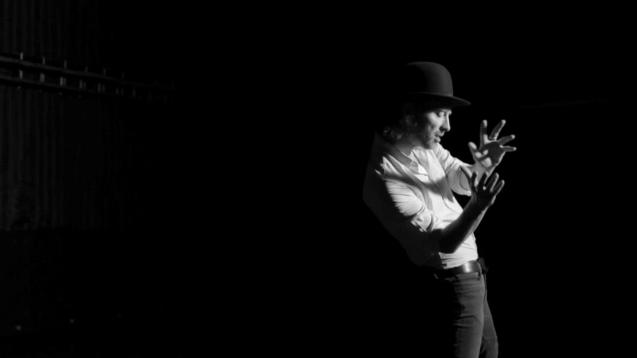
Lotus Flower begins, in back-lit black and white, in a severe looking service tunnel reminiscent of the one featured in Philippe Garrel's silent post-May '68 psychodrama, Le révélateur (1968). It could be described, with total straight-faced honesty, as a "performance video", though not in the industry jargon sense of a band or musician sitting in a room hitting their instruments in-sync with a studio backing track. This is the performance video as a work of legitimate performance art; where the movement of the body, in time and in step with the beats, melodies, counter melodies and chord changes of the song itself creates an expression that articulates, not necessarily what the song is about, but the mood, the atmosphere and the way the song makes us feel.
The feel of any Radiohead song is unmistakable: nocturnal, restless, desolate and claustrophobic; with the sense of technology as both a liberator and facilitator in our own glorious downfall. A cultural year-zero in the beautifully Ballardian notion of consumer meltdown; kingdom come and the myths of the near future. Though the dance is typically a kind of celebration, it is here a solitary expression, performed for the benefit of an audience no doubt alone or connected to the world only by that thin invisible thread that links us, from one machine to the next. As the video develops, moving with each new change in rhythm and tone, the hypnotic convulsions on screen become as mournful and sombre as Yorke's wailing falsetto. At the same time they possess a freedom and a lack of self-consciousness usually reserved for the inner-city drunk or the roadside lunatic. Someone like Denis Lavant's character in the Yorke affiliated Rabbit in Your Headlights video, who finds strength in absolute abandon.
Lotus Flower may not have the immediate awe-factor or something like Just or Street Spirit or Knives Out, with their unanswerable questions, technical virtuosity and endless imagination, but there's something quietly overwhelming about this video that at first seems to be almost thrown-together as an afterthought, but reveals, with subsequent viewings, to be something quite remarkable, fascinating and total alien to anything else currently being produced.
Monday, 7 February 2011
Renault Clio Commercial
Can television commercials be elevated to the creative level of modern art? The new promo for the Renault Clio, currently screening on British television, attempts to establish itself as something a little different from the average car commercial through an adventurous appropriation of both conventional and unconventional references. The result: a 40 second clip that impresses as a work of pure audio-visual experimentation but, like the majority of the kind of modern-art being referenced herein, leaves the audience wondering... what does it all mean?
Mixing contrasting elements of pop-culture and high-art, the ad' plays like a bizarre combination of installation-piece and the trailer to Jean-Luc Godard's recent Film Socialisme (2010). Cross-cutting between stock-footage of movie stars like Audrey Hepburn and Marlon Brando with sequences of the burlesque "performer" Dita Von Teese and the French football player Thierry Henry - while the soundtrack blurs samples of Clare Maguire, David Bowie and Rihanna to create something that adds an enigmatic commentary to the images - the intention of the clip seems to be the presentation of the spectacle of glamour; where art, celebrity and the car itself become objects to be fetishized and admired.
On top of this, oblique inter-titles that work against the images are superimposed on-screen to create an association of ideas. The intent? To hypothesize about the possible meanings behind Renault's famous advertising slogan: "what is va va voom?" At this point, I'm not sure if this commercial really warrants any kind of greater, in-depth analysis (sometimes a commercial is just a commercial), but I did enjoy it; not just as a work of actual video production, but as a rather interesting and impressive piece of contemporary objet d'art.
Monday, 31 January 2011
Triangle
Some notes [spoilers included]:
I. Introduction:
The opening titles introduce the theme of recurrence, and in doing so, create a visual representation of the premonition. Already the film is establishing an emphasis on repeated themes, shifting realities, and the echoes of past and future events. As the words form and fade from screen, each reiteration of the title brings with it a greater clarity. The words, as they drift further away from us, becoming smaller in scale, like the Aeolus as viewed from the capsized yacht, come sharply into focus.
This presentation of text, illustrating the idea of perception through the various layers - as the repetition of the same word brings us closer to the true meaning - is probably one of the most intelligent uses of creative screen-titling seen in recent cinema. It isn't just another instance of style over substance, or an attempt to give an independent UK/Australian co-production a mainstream Hollywood veneer; instead, these titles inform the audience, right from the very beginning, of a particular structure and approach; creating in the mind of the viewer a certain expectation, of narrative, perspective, or the manipulation of events.
The three repetitions of the title, like the three sides of an Isosceles triangle (which itself looks almost like the sail of a ship), are different elements of a single theme. As our mysterious heroine enters this world, which throughout seems to be suspended in time (as if trapped between a moment of life and death), she tries desperately to change the outcome of events, either through the manipulation of other characters, or by leaving clues for any potential future manifestations. However, as with the presentation of the title, each recurrence is not something new, but simply the same thing repeated; an echo of an event, replicated, unceasingly, like the notes of a record caught on an endless loop.
Each return, each re-emergence, is only a new form of repetition. Like the film's central character, the more of these repetitions we grapple with, the closer we get to an actual revelation.
II. Premonitions:
The first image: a toy boat, capsized in a child's paddling pool; already writer/director Christopher Smith is offering the audience a deliberate premonition of events. This toy boat, drifting on the still waters, may seem fairly innocuous, especially as Smith attempts to present the calm, everyday exterior of his suburban location; however, as the film develops, and the narrative twists and turns through fractures and skips that change our interpretation of events with every new progression, this seemingly common, everyday image, will be repeated on a far grander scale. First, as a literal presentation: as the yacht this character sets out on is hit by a particularly violent thunder storm and is capsized. This event is further referenced later in the film, after the mood switches from staggered confusion to an expression of very real life and death violence, where an on-stage mural depicts the sinking of a huge ship, once again caught within the storm.
Of these two echoes, it is the first event - the capsizing of the yacht - that seems to throw the film's narrative into chaos. It is here, in this sequence, where the film plays into probably the greatest association of the title, the infamous Bermuda Triangle.
However, the reference to that particular 'triangle' is deliberately misleading, since the film eventually draws us away from this initial suggestion, establishing a secondary line of thought that is much more interesting and creative. When the character spots a drifting ocean liner, sailing unmanned and unattended through the mists, they (and we) assume that this vessel is an actual ghost ship. Questions are raised; where did the ship come from; where is the crew; where are the passengers? But these questions become less important as the film develops and the characters begin to cogitate about what the ship actually is and more importantly what its name represents.
Victor: The Aeolus?
Downey: Aeolus was the Greek God of the winds and the father of Sisyphus; a man condemned by the Gods to the task of pushing a rock up a mountain, only to see it roll back down again.
Victor: That's a pretty shitty punishment. What did he do?
Sally: He cheated death, or... no. He made a promise to death that he didn't keep.
The discussion here offers a new perspective on the events previously witnessed; the storm, the destruction of the boat, the ocean-liner that appears, miraculously, as if from nowhere; more of an imposing prison ship with its rusted barred exterior than a luxury hotel of the sea. However, it also offers a new significance to the seagull; the bird, first seen drifting across the suburbs of this supposed-to-be west-coast America (but actually Queensland, Australia), and later seen following the boat as it departs from the harbour.
Throughout the film, the significance of the seagull will be one of the main questions that we return to. What does it mean? Initially we might suspect this bird to be a representation of death; the great shadow that hangs over Jess and her friends, seen, backlit against the sun, shortly before the storm and the impending destruction of the boat. However, as the story builds and progresses, we discover a new significance. The bird is not simply a premonition of death; it is a harbinger to the accident - not seen until later in the film - which kills Jess' son and sets the wheels of the plot in motion. Like Jess, this seagull has cheated death and like her is now attempting to find a way out of this maze of false endings and counterfeit realities.
If we attempt to straighten the film's chronology, finding the most convenient in-point as a foundation to this story, then the seagull is with Jess from the very beginning. A different kind of visual premonition in this instance, as later in the film - when the events roll back to what was effectively the first scene - we see on the wall of Jess' house a painting. A painting of two seagulls, backlit by a circular, stylised orb (within an orb) that represents the sun. Is this a retroactive precursor, of one seagull becoming two seagulls: already creating a kind of recurrence; a duplication or repetition, like the various, otherworldly manifestations of Jess?
III. Reflections and Repetitions:
As the events are repeated, each repetition brings with it a new manifestation of the survivors. This element of the plot gives Smith the opportunity to play with the compositional aspects of his film; filling the Aeolus with great floor to ceiling mirrors that literally multiply and fragment characters within the frame. This is given an even greater element of depth by the use of the 2.35:1 aspect ratio, where the general look might recall, on a superficial level, an almost retro 1960s style split-screen effect, or even an actual strip of film. However, the framing, and in particular the use of the full 'scope image, seems intended to overwhelm the audience with the literal, on-screen sense of various recreations of time.
Here, the mirrors aren't simply a visual representation of the repetition or recurrence of events; they illustrate the possibility of parallel realities existing side by side. It is that same sense of worlds within worlds, best illustrated by the dramatic set-up of Lewis Carroll's Alice-adventure Through the Looking-Glass (1871), which hint towards ruptures in the character's psychology. The symbol of the mirror itself, as a portal or a gateway into another realm, is a familiar plot point from earlier horror films, such as Poltergeist III (1988) or John Carpenter's Prince of Darkness (1987), as well as the more familiar personification of Narcissus, and the idea that the mirror exists to entice and eventually trap those who spend too much time studying their own reflected gaze.
Here, the mirror traps these various manifestations of the character and her doomed companions, but the reflection, as in the reflection of events, isn't always a direct recreation. Like all mirror images, there is a sense of physical abstraction; everything transformed left-to-right and right-to-left, creating a copy but also something of a potential doppelganger. This particular idea brings to mind the presentation of the famous painting by the surrealist artist René Magritte, titled in English Not to be Reproduced (La reproduction interdite, 1937), where the idea of the reflected self as a new manifestation (existing in a world within worlds) is made all the more clear.
It isn't simply the repetition of events that creates in the mind of the viewer the connection to the myth of Sisyphus or the role that the Aeolus plays in forcing this character to accept the futility of her own mortality, but the repetition of certain significant objects. If the mirror symbolises the repetition of the self, then these objects present the slowly developing clues that lead, inevitably, to that final revelation. Smith frames these objects with the same repetitiveness; establishing for the benefit of the viewer the noteworthy similarities between, for example, the heart-shaped pendants against the pile of dead seagulls towards the end of the film.
However, these shots, which communicate the central theme of the narrative, also establish a sense of uncertainty pertaining to the main character's emotional state of mind. The psychological aspect, which could be seen as a possible interpretation of events, at least before the film's final twist, is an element that Smith uses to keep the audience on their toes; deliberately misleading us, in the Hitchcockian sense, with these clues and associations that show Jess as a character physically removed and to some extent emotionally withdrawn. Maybe it's in the film's broader references to Stanley Kubrick's adaptation of The Shining (1980) or the deceptive homage to Friday the 13th (1981) that convince the viewer that there is something much more conventional or straightforward to these scenes of horror and suspense; a haunted house/ghost ship story combined with a generic stalk n' slash picture with obvious nods to Knife in the Water (Nóż w wodzie, 1962) or Dead Calm (1989)?
For most of the film, the audience is left wondering whether it is the actual sense of confinement that comes from the ship (here a surrogate for the haunted Overlook is Kubrick's film) or the seemingly dissociative behaviour of Jess that is causing the almost irrational fracturing of events. However, the eventual revelation of the car crash, or the true nature of Jess (as both a mother and a character) in the moments leading up to her death (or what we assume to be a death), reduce these elements to nothing more than knowing nods to the genre; stylistic MacGuffin's that tap into the greater game being played between Smith and his potential audience.
IV. Fractures:
As with the on-screen reflections and repetitions, Smith uses the mise-en-scene to introduce the idea of fractures, or spaces between characters and events. The windows and mirrors that previously showed the recurrence of characters also illustrate the breaks in personality; creating further representations of replication, albeit, as a single, splintered form. The presentation reminds me of a line of dialogue from Dario Argento's horror masterpiece Suspira (1977), which again, hints at the relationship between the self (in the psychological sense) and the power of the mirror as a prison that traps us, exposing our flaws and weaknesses: "bad luck isn't brought by broken mirrors, but broken minds"
Part of Jess' journey in the film is discovering her own strengths and weaknesses through a particular form of self-analysis that comes from the unique ability to observe her own actions from a distance. In witnessing the events play out, again and again, and each time attempting to fix the things that hinder her in the attempts to retroactively save her own son, Jess is able to realise her greatest failing as a human being. We can only assume from this that the death of her son is the fracture that causes the narrative to break off in a different direction; the peak, the point of this triangular bend in time that causes the story to re-start, repeating events, while never quite reaching a conclusion.
It is in this particular idea of the fracture that I feel the significance of the title is most evident. A triangle, which, geometrically, has three sides meeting in the middle, creating a point, is very much like a broken version of a conventional narrative storyline. If we think of a predictable narrative as a straight-line, moving in one direction from beginning to end, then the narrative of Triangle is transformed by events that break the narrative flow at a specific point, causing the story to then repeat itself. Not necessarily from the beginning (as a circular narrative might) but from a significant point in time. This notion of the narrative as something that develops, drops, rolls back and develops again plays into the earlier reference to Sisyphus, pushing his boulder to the top of the mountain (itself an almost triangular shape) only to watch it roll back back, down to the beginning, repeating the same action endlessly.
If the narrative was circular, then all things would converge at the beginning before repeating from start to finish. Instead, the potential bend in the storyline suggests at least three possible beginnings, or at least three possible ends. The story stops and starts repeatedly from several different points in the timeline; sometimes beginning on the boat, other times beginning on the ship, and eventually taking us right the way back to the very first scene of the film, where those once arbitrary artefacts (the toy boat, the spilled ink, the seagull painting) now have a far greater significance on events. However, even here, we're still not sure if this is really the beginning or if there are indeed further ruptures and breaks in this narrative that go deeper, backwards or forwards, through time.
Maybe this all points back to an alternate story; the story of Jess' son: an autistic child with obsessive compulsive disorder, who spends all day, day after day, painting a picture of a ship's rescue; painting and re-painting images on images, each overlapping, until multiple variations exist, layer upon layer of the same thing. It is only then that a new story is revealed.
I. Introduction:
The opening titles introduce the theme of recurrence, and in doing so, create a visual representation of the premonition. Already the film is establishing an emphasis on repeated themes, shifting realities, and the echoes of past and future events. As the words form and fade from screen, each reiteration of the title brings with it a greater clarity. The words, as they drift further away from us, becoming smaller in scale, like the Aeolus as viewed from the capsized yacht, come sharply into focus.
This presentation of text, illustrating the idea of perception through the various layers - as the repetition of the same word brings us closer to the true meaning - is probably one of the most intelligent uses of creative screen-titling seen in recent cinema. It isn't just another instance of style over substance, or an attempt to give an independent UK/Australian co-production a mainstream Hollywood veneer; instead, these titles inform the audience, right from the very beginning, of a particular structure and approach; creating in the mind of the viewer a certain expectation, of narrative, perspective, or the manipulation of events.
The three repetitions of the title, like the three sides of an Isosceles triangle (which itself looks almost like the sail of a ship), are different elements of a single theme. As our mysterious heroine enters this world, which throughout seems to be suspended in time (as if trapped between a moment of life and death), she tries desperately to change the outcome of events, either through the manipulation of other characters, or by leaving clues for any potential future manifestations. However, as with the presentation of the title, each recurrence is not something new, but simply the same thing repeated; an echo of an event, replicated, unceasingly, like the notes of a record caught on an endless loop.
Each return, each re-emergence, is only a new form of repetition. Like the film's central character, the more of these repetitions we grapple with, the closer we get to an actual revelation.
II. Premonitions:
The first image: a toy boat, capsized in a child's paddling pool; already writer/director Christopher Smith is offering the audience a deliberate premonition of events. This toy boat, drifting on the still waters, may seem fairly innocuous, especially as Smith attempts to present the calm, everyday exterior of his suburban location; however, as the film develops, and the narrative twists and turns through fractures and skips that change our interpretation of events with every new progression, this seemingly common, everyday image, will be repeated on a far grander scale. First, as a literal presentation: as the yacht this character sets out on is hit by a particularly violent thunder storm and is capsized. This event is further referenced later in the film, after the mood switches from staggered confusion to an expression of very real life and death violence, where an on-stage mural depicts the sinking of a huge ship, once again caught within the storm.
Of these two echoes, it is the first event - the capsizing of the yacht - that seems to throw the film's narrative into chaos. It is here, in this sequence, where the film plays into probably the greatest association of the title, the infamous Bermuda Triangle.
However, the reference to that particular 'triangle' is deliberately misleading, since the film eventually draws us away from this initial suggestion, establishing a secondary line of thought that is much more interesting and creative. When the character spots a drifting ocean liner, sailing unmanned and unattended through the mists, they (and we) assume that this vessel is an actual ghost ship. Questions are raised; where did the ship come from; where is the crew; where are the passengers? But these questions become less important as the film develops and the characters begin to cogitate about what the ship actually is and more importantly what its name represents.
Victor: The Aeolus?
Downey: Aeolus was the Greek God of the winds and the father of Sisyphus; a man condemned by the Gods to the task of pushing a rock up a mountain, only to see it roll back down again.
Victor: That's a pretty shitty punishment. What did he do?
Sally: He cheated death, or... no. He made a promise to death that he didn't keep.
The discussion here offers a new perspective on the events previously witnessed; the storm, the destruction of the boat, the ocean-liner that appears, miraculously, as if from nowhere; more of an imposing prison ship with its rusted barred exterior than a luxury hotel of the sea. However, it also offers a new significance to the seagull; the bird, first seen drifting across the suburbs of this supposed-to-be west-coast America (but actually Queensland, Australia), and later seen following the boat as it departs from the harbour.
Throughout the film, the significance of the seagull will be one of the main questions that we return to. What does it mean? Initially we might suspect this bird to be a representation of death; the great shadow that hangs over Jess and her friends, seen, backlit against the sun, shortly before the storm and the impending destruction of the boat. However, as the story builds and progresses, we discover a new significance. The bird is not simply a premonition of death; it is a harbinger to the accident - not seen until later in the film - which kills Jess' son and sets the wheels of the plot in motion. Like Jess, this seagull has cheated death and like her is now attempting to find a way out of this maze of false endings and counterfeit realities.
If we attempt to straighten the film's chronology, finding the most convenient in-point as a foundation to this story, then the seagull is with Jess from the very beginning. A different kind of visual premonition in this instance, as later in the film - when the events roll back to what was effectively the first scene - we see on the wall of Jess' house a painting. A painting of two seagulls, backlit by a circular, stylised orb (within an orb) that represents the sun. Is this a retroactive precursor, of one seagull becoming two seagulls: already creating a kind of recurrence; a duplication or repetition, like the various, otherworldly manifestations of Jess?
III. Reflections and Repetitions:
As the events are repeated, each repetition brings with it a new manifestation of the survivors. This element of the plot gives Smith the opportunity to play with the compositional aspects of his film; filling the Aeolus with great floor to ceiling mirrors that literally multiply and fragment characters within the frame. This is given an even greater element of depth by the use of the 2.35:1 aspect ratio, where the general look might recall, on a superficial level, an almost retro 1960s style split-screen effect, or even an actual strip of film. However, the framing, and in particular the use of the full 'scope image, seems intended to overwhelm the audience with the literal, on-screen sense of various recreations of time.
Here, the mirrors aren't simply a visual representation of the repetition or recurrence of events; they illustrate the possibility of parallel realities existing side by side. It is that same sense of worlds within worlds, best illustrated by the dramatic set-up of Lewis Carroll's Alice-adventure Through the Looking-Glass (1871), which hint towards ruptures in the character's psychology. The symbol of the mirror itself, as a portal or a gateway into another realm, is a familiar plot point from earlier horror films, such as Poltergeist III (1988) or John Carpenter's Prince of Darkness (1987), as well as the more familiar personification of Narcissus, and the idea that the mirror exists to entice and eventually trap those who spend too much time studying their own reflected gaze.
Here, the mirror traps these various manifestations of the character and her doomed companions, but the reflection, as in the reflection of events, isn't always a direct recreation. Like all mirror images, there is a sense of physical abstraction; everything transformed left-to-right and right-to-left, creating a copy but also something of a potential doppelganger. This particular idea brings to mind the presentation of the famous painting by the surrealist artist René Magritte, titled in English Not to be Reproduced (La reproduction interdite, 1937), where the idea of the reflected self as a new manifestation (existing in a world within worlds) is made all the more clear.
It isn't simply the repetition of events that creates in the mind of the viewer the connection to the myth of Sisyphus or the role that the Aeolus plays in forcing this character to accept the futility of her own mortality, but the repetition of certain significant objects. If the mirror symbolises the repetition of the self, then these objects present the slowly developing clues that lead, inevitably, to that final revelation. Smith frames these objects with the same repetitiveness; establishing for the benefit of the viewer the noteworthy similarities between, for example, the heart-shaped pendants against the pile of dead seagulls towards the end of the film.
However, these shots, which communicate the central theme of the narrative, also establish a sense of uncertainty pertaining to the main character's emotional state of mind. The psychological aspect, which could be seen as a possible interpretation of events, at least before the film's final twist, is an element that Smith uses to keep the audience on their toes; deliberately misleading us, in the Hitchcockian sense, with these clues and associations that show Jess as a character physically removed and to some extent emotionally withdrawn. Maybe it's in the film's broader references to Stanley Kubrick's adaptation of The Shining (1980) or the deceptive homage to Friday the 13th (1981) that convince the viewer that there is something much more conventional or straightforward to these scenes of horror and suspense; a haunted house/ghost ship story combined with a generic stalk n' slash picture with obvious nods to Knife in the Water (Nóż w wodzie, 1962) or Dead Calm (1989)?
For most of the film, the audience is left wondering whether it is the actual sense of confinement that comes from the ship (here a surrogate for the haunted Overlook is Kubrick's film) or the seemingly dissociative behaviour of Jess that is causing the almost irrational fracturing of events. However, the eventual revelation of the car crash, or the true nature of Jess (as both a mother and a character) in the moments leading up to her death (or what we assume to be a death), reduce these elements to nothing more than knowing nods to the genre; stylistic MacGuffin's that tap into the greater game being played between Smith and his potential audience.
IV. Fractures:
As with the on-screen reflections and repetitions, Smith uses the mise-en-scene to introduce the idea of fractures, or spaces between characters and events. The windows and mirrors that previously showed the recurrence of characters also illustrate the breaks in personality; creating further representations of replication, albeit, as a single, splintered form. The presentation reminds me of a line of dialogue from Dario Argento's horror masterpiece Suspira (1977), which again, hints at the relationship between the self (in the psychological sense) and the power of the mirror as a prison that traps us, exposing our flaws and weaknesses: "bad luck isn't brought by broken mirrors, but broken minds"
Part of Jess' journey in the film is discovering her own strengths and weaknesses through a particular form of self-analysis that comes from the unique ability to observe her own actions from a distance. In witnessing the events play out, again and again, and each time attempting to fix the things that hinder her in the attempts to retroactively save her own son, Jess is able to realise her greatest failing as a human being. We can only assume from this that the death of her son is the fracture that causes the narrative to break off in a different direction; the peak, the point of this triangular bend in time that causes the story to re-start, repeating events, while never quite reaching a conclusion.
It is in this particular idea of the fracture that I feel the significance of the title is most evident. A triangle, which, geometrically, has three sides meeting in the middle, creating a point, is very much like a broken version of a conventional narrative storyline. If we think of a predictable narrative as a straight-line, moving in one direction from beginning to end, then the narrative of Triangle is transformed by events that break the narrative flow at a specific point, causing the story to then repeat itself. Not necessarily from the beginning (as a circular narrative might) but from a significant point in time. This notion of the narrative as something that develops, drops, rolls back and develops again plays into the earlier reference to Sisyphus, pushing his boulder to the top of the mountain (itself an almost triangular shape) only to watch it roll back back, down to the beginning, repeating the same action endlessly.
An illustration of the 'conventional narrative storyline' against the narrative of Triangle, created by the blog author:


If the narrative was circular, then all things would converge at the beginning before repeating from start to finish. Instead, the potential bend in the storyline suggests at least three possible beginnings, or at least three possible ends. The story stops and starts repeatedly from several different points in the timeline; sometimes beginning on the boat, other times beginning on the ship, and eventually taking us right the way back to the very first scene of the film, where those once arbitrary artefacts (the toy boat, the spilled ink, the seagull painting) now have a far greater significance on events. However, even here, we're still not sure if this is really the beginning or if there are indeed further ruptures and breaks in this narrative that go deeper, backwards or forwards, through time.
Maybe this all points back to an alternate story; the story of Jess' son: an autistic child with obsessive compulsive disorder, who spends all day, day after day, painting a picture of a ship's rescue; painting and re-painting images on images, each overlapping, until multiple variations exist, layer upon layer of the same thing. It is only then that a new story is revealed.
Wednesday, 22 December 2010
Jean Rollin
The French film director Jean Rollin, who passed-away on December 15th at the age of 72, was more than just a director of "erotic vampire-fiction"; to many, he was one of most remarkable image-makers in the history of film. Though the titles of his work - with their allusions to violence, fear, death and sexuality - might suggest images of a kind of sleazy, excessive 'grindhouse' cinema, as typified by a film like The Last House on the Left (1972), the general tone of Rollin's work was often far more contemplative, elegiac and surreal. His work - explorations of the fantastique, if anything - present the viewer with a unique, hermetic, fully realised universe, full of codes and symbols that appear and reappear, as if every film offers the spectator a new piece of a vast and never-ending puzzle.
This notion of a grand, unravelling mystery, linked by characters, themes and locations, was of course one of the most interesting facets of Rollin's work; a sense of each film becoming a continuation of a reoccurring dream that the audience can only attempt to grasp or comprehend, but that lingers long in the mind of a collective audience through the sheer, imaginative, transportive power of the pictures on-screen.
Rollin's films are defined by frame after frame of these extraordinary compositions; where each shot, each framed moment or movement manages to conjure the spirit of something powerful enough to reach beyond the mere conventions of narrative or plot; where the images suggest a story, and the reappearance of certain objects or actors or narrative facilitators create a traceable line that runs back-and-forth throughout the director's career.
In Rollin's work, the countryside, the city, the beach, châteaux, cemeteries and the psychiatric hospital hold clues to this endless conundrum; the greater story that exists and develops from one picture to the next. His characters, often gorgeous young women who stumble, Alice-like, into these picturesque, sometimes gothic, sometimes exotic landscapes full of magic and mystery, encounter strange rituals, acts, ceremonies and occurrences that, on some very basic level, work as metaphorical presentations of the art of 'the fantastique'
Here we can see the similarities to other filmmakers of Rollin's generation, who dabbled with the near-supernatural forces of this ancient form of storytelling, albeit, without ever fully surrendering to it. Like the work of Jacques Rivette for example, there is the shared sense of the city as an infernal labyrinth; an endless maze of inter-connected backstreets and alleyways that lead his characters between mysteries and events. His 'vampires', named as much in reference to Feuillade as to Bram Stoker, are enigmatic, decadent and often withdrawn. Like the films of Alain Robbe-Grillet, Rollin's work is full of erotic displays, fantasies, dreams and desires, but is also intelligent, creative, poetic and unique.
The image of the beach, consistent throughout Rollin's career, has been the location for some of his most extraordinary moments. From the youthful explorations of Les amours jaunes (1958) to the evocative visions of his masterpiece The Iron Rose (La Rose de Fer, 1972), this beach, recognisable to anyone who has seen more than one of the director's incredible films, presents an ideal; a vision of somewhere beyond the here and now, or representative even of some emotional or psychological state.
If the form of his work seems, from the surface at least, to be nothing more than pure exploitation, the power of his images, the command of his stories and the experiences of these particular characters nonetheless define Jean Rollin, not just as a legitimate auteur, but as one of the most fascinating French filmmakers of his generation. Even his pornographic movies, produced under a variety of obvious pseudonyms and often made for purely financial reasons, are filled with his usual arcane symbols, masks, role-playing games, and an eye for the unconventional.
The recurring scenarios, of escapees, corruptible innocents and seductive forces weave in and out of these stories, creating a system of figurative strings that lead the audience from his earliest short-features, right the way through to his most recent picture. In this sense, Rollin's cinema is every bit as individual, personal and identifiable as that of Godard's or Garrel's. In these films, Jean Rollin transformed the lurid or the sordid into something beyond words; an elegy for something; innocence perhaps, or a certain kind of dream-state that can only be presented through the smoke and mirrors magic-act of the cinema itself.
All images taken from Jeremy Richey's superior Rollin resource Fascination: The Jean Rollin Experience:


Monday, 13 December 2010
The Horse Soldiers
Any analysis of the work should probably begin with an image that succinctly establishes what the film is primarily about. On this occasion, it is an image of eight men in cavalry uniform devising plans around a table. The two leads are set-apart from their associates by subtle differences in costume: John Wayne's Colonel John Marlowe with his red neckerchief; William Holden's Major Henry Kendall in his clean, white coat. Already, Ford and his costume designer Frank Beetson are establishing these characters through their identifiable professions; Marlowe, a man of combat, Kendall, a man of medicine. The two characters are positioned on opposite sides of the table; one seated, one standing; one with hat, one without. Although these men are essentially on the same side, fighting for the same cause, their position from one another within the frame suggests their obvious differences in both ideology and approach.
From this single screen-capture and the information that it conveys we are being informed, subtly, that this is a film about conflict.
Although essentially a War Film in the Hollywood tradition, the conflict in The Horse Soldiers (1959) is not exclusive to the Civil War backdrop that is seen throughout. Rather, it is in the relationship between these two characters - where one personifies the old and the other personifies the new - and in their dalliances with the beautiful landowner Miss Hannah Hunter of Greenbriar (Constance Towers). Like the majority of Ford's films, specifically his westerns, it is in this conflict between the old and the new that the narrative is fully developed; defining not only the dramatic motivations of the script by John Lee Mahin and Martin Rackin - or even the historical re-enactments of Harold Sinclair's original novel - but in a way, every thought and decision that these characters make and the effect that these decisions have on this world, as it is presented.
The Horse Soldiers is, to a large extent, about a changing world as illustrated by its emphasis on the cross-country journey and how the landscape becomes a signifier to the unspoken emotional connotations apparent in the plot. These themes are central to several of Ford's earlier films, such as the towering masterpiece The Grapes of Wrath (1940), in which the family of characters travel from town to town, city to city; effectively looking for work, but only finding the wounded heart and soul of a country beaten by depression. In that film, the projections of ghost-towns or the wounded, sunken faces of what essentially could be described as the living dead, flicker, apparition-like, on the windscreen of the Joad family wagon, convey the literal desperation and depression of these people looking for a world that no longer exists.
Likewise, the nostalgic reminisces of How Green Was my Valley (1941) and The Quiet Man (1952) show worlds that exist in the memory of their respective narrators brought into violent conflict with the actual, tangible reality of these places and the inevitability of time. There, as well as here, the intentional, bold-strokes of iconography, from the waving of the Confederate flag to the casting of Wayne himself, seem deliberate attempts to express, in the most direct and appropriate way, the vaguest remnants of historical context and the actual machinations of this world, put on screen, vividly by Ford, in a full-colour, 1.66:1 presentation, to make the best of those seemingly never-ending shots of extras - each dressed in authentic cavalry uniform - cutting a path between the two distinct halves of the horizon, or, more literally in fact, cutting the country in two.
In The Horse Soldiers, the river, which is shown in the background of several travelling sequences, becomes shorthand for this great divide; from the north and south to divisions of class, race, gender, and (lastly), the two central characters. America, like many places in the world, is a divided country; divided politically as well as culturally, between both the immigrant and indigenous populations. Ford's film communicates this rift visually, through the actual presentation of the landscape, with its dirt-roads and rivers, and through the purely metaphorical; from a pencil-lined direction on a badly folded map, to the long, stretching shadow of a window frame over the hanging, atlas-like wall plan during a discussion between both parties.
With this in mind, the last act of the film - where the destruction of the bridge illustrates the continual inability for the two sides to meet in the middle - offers one of the most interesting visual metaphors in the entire film. The conflict, both personal and political, traps these characters in their own blinkered perspective, regardless of whether or not their actual opinions on the matter have changed, for better or worse. It is the kind of ending where the closing image, of the woman looking out into the uncertain future, the country disappearing into the horizon, the inevitability of a raging battle that Ford denies us the spectacle of, suggests an almost stoic heroism reminiscent of the iconic final image of Ford's own film The Searchers (1956). However, it also suggests some element of tragedy; the endlessness of war as a machine that moves across the landscape, devouring everything. It is also, in a sense, a deliberate none-ending; these characters may have reached a kind of conclusion, but the journey, and the war itself, still continues.
Through this, we can recognise the thread of identity and the sense of personal responsibility woven througout. The idea of taking characters conditioned into thinking in a specific way - into expecting the world to conform to a certain standard built largely on class, ranking and reputation - and then seeing those beliefs shattered before their very eyes when confronted by the very real consequences of the war itself. That final image, which speaks, on one level, to a certain kind of romantic optimism, as Hannah Hunter is framed - as only John Ford could frame a shot - waving the soldiers off into battle, also carries a certain sense of disillusionment. These young men, heroic into battle, will no doubt return, if lucky, as battered and bruised as the dead-on-their-feet volunteers of the even more restlessly critical Drums Along the Mohawk (1939).
There, in the assumed emotional perspective of characters trapped in the events that exist between the titles of two other Ford movies, The Long Voyage Home (1940) and They Were Expendable (1945), John Martin Feeney makes his second film that dares to ask... What Price Glory?
The subtlety of the film's politics or its subtext jarring against the very obvious iconography of its images and sound is characteristic of Ford's work in this particular genre. The look and feel of the film might seem, at times, to be celebratory, with its bold colours and beautiful compositions combined with the rousing performance and the typical, overwhelming presence of Wayne as an avatar for the real, undying spirit of a subsequently lost America. But there's an obvious level of satire in how Ford uses these elements, which one might almost go as far as to call 'ironic'. The contrasts and conflict between the two central characters, on the page, suggests the kind of macho one-upmanship or characteristic male bonding that many expect of a film from this particular era. Yet, in the presentation, and in the incorporation of these characters into a narrative about conflict, the disparities between the two create an additional commentary on the subject itself.
The doctor's profession is one that saves lives; the soldier's is one that ends them. Through this, Ford suggests elements of guilt, honour, responsibility and a questioning of the kind of misguided patriotism that leads a country to tear itself apart. This conflict, on a personal level, could also tie in with the general themes of self-analysis and reflection; those two memorable shots where characters catch their individual reflections in mirrors, says a great deal about how they, as individuals, view themselves within this world of civil war; implicating them to some extent through ignorance or sheer wrongheadedness, or forcing them to look deeper into the mindset of war and how this conflict has changed them, physically as well as psychologically.
In the first of these moments of reflection, Marlowe, distorted by the convexed shape of the glass, studies his features in the hallway mirror of Hannah Hunter's opulent southern mansion. The distortion reduces Marlowe considerably, pushing him back, further into the distance, while exaggerating the size of the door and the picture behind him. The mirror image literally reduces his stature, revealing a small man at odds with the immovable presence that we expect from Wayne and have previously seen in action. The second shot comes much later in the film, following the death of Hunter's chaperone Lukey (Althea Gibson). Here, Hunter is confronted by the face of a girl she no longer recognises. Literally transformed, she is now no longer the spoilt little rich girl waiting out the conflict back home, but someone else; someone debased by war and reminded of the ugliness of the thing by the cracked and filthy mirror she now finds herself in.
Such shots carry the same kind of sadness expressed in the unforgettable moment of self-reflection/recognition in Ford's aforementioned The Grapes of Wrath; in particular, the scene in which Ma Joad (Jane Darwell) studies her face reflected in a dusty windowpane and enjoys a brief moment of warm contentment brought on by a nostalgia almost immediately snuffed out by the crippling destitution and uncertainty of her all-too-painful existence.
Ford's characters in The Horse Soldiers may not be dreaming of better times, or indeed, taking comfort in nostalgic reminisce, but they're being forced to ask important questions. Moral questions that may have previously never been explored, at least, by these particular characters, but now, when challenged by the perspectives of others and forced to see things from a different point of view, the actuality of their situation is changed considerably. This revelation, as the two male protagonists eventually begin to see the situation through the eyes of the other, is best illustrated by the scene in which Wayne's previously gung-ho, no-nonsense Marlowe tends the bedside of a fatally wounded young soldiers and sees, perhaps for the first time, where this level of patriotism has led him. The subsequent scene, in which the character explodes, emotionally, having been goaded somewhat by Hunter, is one of Wayne's greatest screen performances; as the confliction and the confusion of what he's feeling in relation to how he feels he should feel, is brilliantly communicated.
The tragedy here, hinted at throughout by Ford's clever framing of events, is that the war will continue, long after the closing credits, long after the Civil War and on, into the following centuries. The great divide - be it north or south, east and west - will continue to widen. The visible scars marked in the landscape - from marching soldiers, on horseback or otherwise - connect each generation, from World War II, to Vietnam, to the Falklands, to Iraq and Afghanistan. The propensity for the species to decimate itself is a torch, handed down from generation to generation; from the marching men on horseback that open the film, silhouetted, as if to imply anonymity (the uniform replacing the notion of the individual with the "unit"), to the overpowering sight of the young children, armed and in uniform, marching ever onward, into battle.
Here, the literal thin blue line that once again divides the landscape, splitting the cinematic image into two recognisable 'sides' (contra and pro) suggests the possibility of all future conflicts. These children become the next link in the chain, and their children, and their children's children, will likewise pick up this torch when called upon by their country to do the right-good thing.
What is perhaps most remarkable about Ford's film is its ability to present the gross futility of war while simultaneously suggesting, on one level at least, the necessity of it. However, by denying the audience the lengthy battle sequence that was initially scripted to end the film and choosing instead to close on a somewhat more enigmatic image that seems to suggest so much more than the potential bloodshed and cannon fire ever could, the notion of a commentary on war, or indeed, on conflict in general, is so much more profound. And this is what separates The Horse Soldiers from films like Platoon (1986) or Saving Private Ryan (1998), where the "horrors of war" can only be communicated by presenting the violence as something visceral or intense. However, in presenting this intensity through the medium of cinema, the conflict itself can only become exhilarating for the viewing audience, thus, destroying its intent.
By emphasising this moment of human endurance - with the conflict stretching out, beyond the horizon - these closing scenes from The Horse Soldiers suggests the effect that war has on the individual, as well as the country itself.
Subscribe to:
Posts (Atom)
Schalcken the Painter (1979)
Schalcken the Painter [Schalcken the Painter [Leslie Megahey, 1979]: This is a film I first saw around four years ago. At the time I found...
-
Beginning with a vague preamble on the use of digital video in achieving that contrast between the abstract and the real... One of the mos...
-
A short note on several films by Eric Rohmer I'm not entirely sure if this blog post constitutes a 'return' in the perman...
-
A Mystery? To talk about the cinema's present, one must first acknowledge its past. Roundhay Garden Scene (1888), one of the oldest...