Thursday, 24 September 2009

Visiting Uwe

Visiting Uwe (subtitled: The Uwe Boll Homestory, 2008), is director / presenter Fabian Hübner's sit-down chat with the notorious German film director Uwe Boll; a contentious figure, best known to most viewers for his continually derided videogame adaptations, such as House of the Dead (2003),BloodRayne (2005) and In the Name of the King: A Dungeon Siege Tale (2007).

Although the current vogue amongst cinephiles of the World Wide Web is to dismiss everything Boll has been involved with, not even agreeing to approach it from the perspective of the so-bad-it's-good variety of cinema's guilty treasures, Hübner's film presents itself as a surprisingly sympathetic portrait of the artist as a middle-aged man; offering Boll the platform to defend himself against the criticisms and accusations that have been thrown at him throughout the course of his career, while also giving the audience a chance to get to know the man behind the myth; establishing a personality beyond the provocation, or the outlandish stunts that have been used to undermine the integrity of Boll's work or the legitimacy of his filmmaking intent. It also allows Boll the opportunity to elucidate on the topic of film, something he seems genuinely passionate about; and although many of his opinions run contrary to my own, I was nonetheless surprised at how interesting Boll could be when discussing his cinematic likes and dislikes in this relaxed and impartial environment.

Presented in sparse black and white and cluttered with elements of split-screen and inter-titles to keep the individual segments of conversation on track, Hübner's fifty-minute film is the kind of documentary in which the actual filmmaking apparatus is allowed to intrude upon the scene; making the process of recording this "event" - the meeting of two filmmakers for the basis of cultural curiosity - a kind of film about filmmaking in its self. Of course, we can assume that this particular aesthetic - very hip, but also deliberately nostalgic; looking back to the period of cinéma-vérité or the nouvelle vague for the purposes of fly-on-the-wall observation - is part of Hübner's general modus operandi as established by his work on the web serial AVANT*GARDE (2008), the particular decision to conduct the interview with this approach in place has a more interesting effect than simply appearing cool or cutting-edge. Specifically, it reinforces the image of Boll as a serious filmmaker largely by framing him against a background of the general paraphernalia of his profession: film cameras, microphones, light-stands and monitors, etcetera.

By placing the filmmaker in this environment, Hübner is able to legitimise Boll's opinions; misdirecting the audience away from the obvious points of controversy and disarming us with a constant reminder of the difficulties and dishonesty of cinema production at its most bare and basic form.


Visiting Uwe directed by Fabian Hübner, 2008:

In the first part of the film, we have a sort-of credit sequence, in which we see Hübner leaving his apartment, heading to the airport and boarding a plane to his required destination. This sequence is somewhat unnecessary; edited like a low-budget hip-hop video and scored by some generic emo-rock band - which is hardly representative of the film as a complete piece of work. From here, a brief wander around the Boll family kitchen stressing the importance of the cappuccino machine, before the two men (and Hübner's accompanying camera operator) get down to the business at hand. From this point on, the film is structured primarily around a series of back-and-forth interview sequences inter-cut with more general scenes of Boll showing the interviewer (and the audience) around his home and offices.

Although on-paper, such a description could call to mind something as vacuous as Cribs (2000), the MTV-produced series, wherein a variety of tasteless celebrities encouraged the cameras into their homes and played up to a crude "nouveau riche" persona, the location and the particular emphasis on the objects found in Boll's home, and more specifically his personal archives, help to further develop the reality of the filmmaker away from the hype and the hatred, to create a more human portrait, in which the man, with his hopes and aspirations, is given a kind of perspective by the framing of Hübner's film.

In this sense, I'm reminded of a quote by Jean-Luc Godard that I've used before: "Objects exist, and if one pays more attention to them than to people, it is precisely because they exist more than the people. Dead objects are still alive. Living people are often already dead." It seems apt given the further significance of the subtitle, The Uwe Boll Homestory, as in the "home-story", as in every home tells a story (perhaps?), which gives the film its added weight. These objects that we discover - film canisters, posters, sleeves for forgotten VHS cassettes, promotional material, trailers and teasers, etc - define the Boll persona; reaffirming it, again, away from the negativity or the endless complaints of gamers of the "Uwe Boll destroyed my childhood" variety, and convinces us that the line between a director considered great and a director considered to be (essentially) without merit, is faint.

When Boll pours through the archives, finding the original 35mm print of his first film, the spoof comedy experiment German Fried Movie (1991), or treats the director (and again, the audience) to the newly edited trailer for his then-most-recent film, the Vietnam War drama Tunnel Rats (2008), we begin to see the emerging image of a man who lives for his work, is proud of it, and more importantly, sees it as a real privilege to be able to make a living in a profession that he's dreamed about since the age of ten.


Visiting Uwe directed by Fabian Hübner, 2008:

In approaching the film in such a way, the audience can see Boll as a filmmaker first and foremost. The notion of the director as the most hated in the world "ever" becomes subdued, and we can see and ultimately accept a man who is passionate about what he does and confident enough in his own opinions to know exactly what he wants, regardless of what anyone else might think. He's been nominated for three Golden Raspberry awards thus far (unfairly, in my opinion, but such "awards" are meaningless from any perspective), but when he discusses the nature of cinema, and how in the grand scheme of things it is genre cinema that prevails over the art-house, we buy every word of it. When Boll dismisses Tarkovsky as "refined tedium", Hübner rolls his eyes (no doubt) in tandem with the audience.

However... does Boll have a point? When Little Miss Sunshine (2006) or Juno (2007) can bring in blockbuster style box-office on a $9 million budget, is there really a growing audience for something like Silent Light (Stellet licht, 2007) or The Man from London (A Londoni férfi, 2007); or are these films destined to play to the same niche audiences - never breaking out of the art-film ghetto? In describing the situation, Boll defines his position: "You have to be realistic; in the USA, 90% of people have never heard of Fellini, Antonioni or Bertolucci. Now, you could tell them about La dolce vita (1960), or Marcello Mastroianni, and perhaps a few would understand the reference, but they don't really care."

Statements like this are bound to provoke a response, but is Boll correct in his opinion that the films of John Ford will endure beyond the cinema of Jean-Luc Godard? After all, people like Hitchcock, Kubrick and Leone, who were often dismissed by the majority of mainstream critics at the height of their creative success, are now seen as absolute masters of the medium, more so than any erstwhile-hip, avant-garde deconstructionist or poet of the silver screen. He also points the finger of judgement at directors like Michael Bay and Eli Roth, who are in the position to make challenging, subversive work with a relevant social and political message, but instead produce insipid, generic nonsense designed to woo fans or score points at the box-office.

Whether or not we agree with Boll's statements, there is no denying that there is an element of his personality that seems intent on challenging his detractors by offering them fodder, either by taking on his critics in a boxing match, or through statements of knowing self-deprecation; claiming that his career will be over in fifteen years, or that the secret to winning an Academy Award is to produce the film that kills the most Nazis. It would seem to be part of the Boll persona; this notion of playing into the (negative) expectations of the critics, and then backing away from it, doing something quite radical and arguing your case from the perspective of a misunderstood genius in a way that makes the whole thing appear to be some kind of situationist-inspired stunt. How else can we explain the career trajectory of a man who is set to follow a serious, documentary-style drama about the situation in Darfur with a film called Zombie Massacre?


Visiting Uwe directed by Fabian Hübner, 2008:

Hübner's film is broken up into a series of specific talking points: "idols", "cinema", "art-house", "filmmaker", "critics", etc, in which the filmmaker attempts to draw a more clearly defined picture of Boll and his particular reputation. His answers to these questions are often surprising, from his admiration for Orson Welles, who Boll describes as "the most interesting director ever, not only as an artist, but as a person as well" before reeling off a list of films including Macbeth (1948) and F for Fake (1972), to an interest in the work of John Ford, Lars von Trier, Martin Scorsese and Luis Buñuel. In describing his inspiration for becoming a director, Boll talks about seeing Mutiny on the Bounty (1962) while still in elementary school, and assuming that the life of a film director was comparable to being a ship's captain - like Trevor Howard, steering his crew into uncharted waters in search of new adventures. It explains some of the reckless ambition evident in Boll's work; the image of this small-town kid, pulling together enough money to make a film, setting his sights on Hollywood, and then using tax-breaks and independent investors to set up his own production company operating out of Frankfurt by way of Vancouver. He now has the kind of control and freedom of independence that most directors can only dream about; even though the situation has its downsides - he's generally despised and pre-judged on every film, with the vast majority of critics pre-rating his work a 1/10 on sites like the Internet Database months before the movies have even been released.

For the most part Hübner keeps his distance, allowing Boll to present his side of the story with only the most minimal of argument and interjection. If anything, this could possibly be described as the film's biggest flaw, with the interviewer never forcing the interviewee to explain his opinions in any kind of greater depth. It would have been interesting to see how Boll, as a fairly headstrong and confrontational character, might have worked with a more aggressive approach, but then there's always the risk that the proceedings could have become another adolescent piece of Boll-bating; complaining about the supposed Ed Wood quality of films like House of the Dead or Alone in the Dark (both mediocre films at best, or worst), but offering no real insight or sense of critical worth. Instead, Visiting Uwe positions itself as a rare insight into a genuine pop-culture phenomenon; a director who in less than a decade, has established a reputation as being one of the worst filmmakers in contemporary cinema, and yet, despite the constant protests and online nitpicking, has continued to work prolifically and independently, tackling everything from horror movies, to action films, to state-of-the-world polemics, and even a low-brow comedy.

In this respect, Visiting Uwe is of interest mostly for the perspective that it offers in placing Boll's diverse and often eccentric career choices into some kind of greater context; illustrating that the roots of a film like Postal (2007) can be seen in the German Fried Movie, or how something like Stoic (2008) or the soon to be released Rampage (2009) can be traced back to his earlier exploitation films, such as Amoklauf (Run Amok, 1994).


Visiting Uwe directed by Fabian Hübner, 2008:


Postal directed by Uwe Boll, 2007


Stoic directed by Uwe Boll, 2009

Occasionally the infamous Boll bitterness creeps in, dismissing the criticisms of BloodRayne start Michael Madsen by shifting the focus on to the actor's alleged alcoholism, as well as presenting a lengthy rant against the aforementioned Bay (which had to be censored for legal reasons). However, even here, when Boll reacts with the unfocused venom of a spoilt Victorian child, we can see the tragedy of the man behind the legend. That level of bitterness that runs deeper than any kind of stunt or simple attention seeking; the kind of bitterness prevalent in someone who has achieved so much by their own limitations but still not enough to gain the respect of their public and peers.

Personally, I respect Boll. I can appreciate the work that he puts in to his films. As someone who tries, on occasion, to wear the hat of a film director, I know how hard it is to get funding - to a get a film off the ground without giving away control to the producers who care only about financial success. When you're from a small town, with no family or connections with the industry, such attempts to get a film made, and more importantly released, is an uphill struggle. As Boll protested in a 2007 interview with Chris Kohler of the website Wired; "You should admire that nobody else did what I did in the last ten years. Not one filmmaker out of Germany was able to raise money. All the German money went to the Hollywood studios; I was the only guy doing it. I did one movie after the other, not anybody else. I do my own distribution, my own project development, my own financing and everything. Nobody else did that. But in the opinion of the Boll bashers, I'm a talentless idiot! And you see it exactly the same."

At the end, can we even be sure of the motives for making this film, for interviewing Boll and allowing his personality to dominate, either as a work of ironic opposition - "Boll sucks so we think he's cool", etc - or a private joke between two men smart enough to know how the industry works and how both could benefit from the obvious publicity. Either way, Visiting Uwe is a fascinating interview that works well, precisely because of its unique position. Right down to the title - first name basis, as if visiting a friend; and indeed, between the more important stuff, there's some playful humour between these two characters which feeds back into the feeling that Boll is pulling the strings; manipulating the events to his own advantage, to create his own legacy and his own persona that defines it - like a modern-day Andy Kaufman – which, for me, makes the experience all the more rewarding.

Tuesday, 22 September 2009

Engrenages

Spiral / Cogs

You might be interested to know that Lights in the Dusk has a new favourite television series. The second season of the excellent Spiral (Engrenages, 2005-present) is currently winding down on BBC Four, and I have to say, the word compelling doesn't do it justice. As a crime serial, the progression from one episode to the next is astounding, with the writers successfully managing to weave one single strand of plot through several individual instalments, all the while re-establishing additional layers of drama and interaction as the narrative unfolds. In this sense, the English variation on the title is fitting, as the series presents these characters as existing in a vortex; each crossing paths from both sides of the law and back again, in a manner that relates explicitly to the chaos and confusion of these two particular platforms – the world of law and the world of criminality – as they disruptively coalesce. It also relates to the more literal translation of the title, basically "cogs", where each single component, character or sub-plot, can be seen as part of a much greater whole.

What sets this show apart from other Law and Order-type programmes is hard to define, but I think more than anything I enjoy the honesty of it. There are no real gimmicks or attempts to transcend the medium - which is perfectly fine as it is, and certainly doesn't have to toady to what armchair critics might consider more cinematic, and therefore worthy of praise. Spiral is content enough to offer the viewer solid drama and a plot that is worthy of consideration, precisely because it involves characters that are not only interesting, but more importantly, recognisable as human beings. I would also argue that Spiral is in some ways reminiscent of the harder-edged crime serials that we have in the UK – a grand tradition going as far back as Cracker (1993-1996) by Jimmy McGovern, or Prime Suspect (1991-2006) by Lynda La Plante, or more recently even with the excellent Wire in the Blood (2003-2008) (which I had intended to write something about, but never found the time) and Waking the Dead (2000-2009). It is also reminiscent of the short lived docudrama The Cops (1998-2001); another uncompromising police procedural that stressed a more realistic, street-level approach to the blending of drama and documentary technique.

Although the general style of point-and-shoot, handheld grittiness of the Lars von Trier/Paul Greengrass variety has become somewhat overused (to the point of almost cliché), I still feel that this particular series uses it well; especially with the general style of the show complementing that mixture of characters and locations, moving from the more familiar middle-class suburbs of Paris to the tenements and housing projects overrun by gangs and drug dealers (that generally exists in every major city, but is rarely seen in the more conventional exported media). I would love to eventually write a more in-depth examination of this show at a later date – maybe in the New Year when I should have managed to procure a copy of the first season box set, and ideally, would have more time to really give it the attention that it deserves. Nonetheless, I'm excited to see how the current series plays out over the next couple of weeks.


Spiral, series 2 - episode 4, directed by Gilles Bannier, 2008:

Friday, 4 September 2009

Shame

A key example of Bergman's unparalleled ability to create a kind of cinema of alienation through the rigid and meticulous focus on characters interacting; albeit, not simply through the unblinking point-and-shoot interchanges of dialog, but contained within the seemingly inescapable boundaries of a situation that they've been confined to. In this respect, the confines are further illustrated by the practical presentation of the film itself, with those tightly composed images of faces, acting and then reacting to the events as they unfold, and the always brilliant interplay between light and shadow, which, as ever in Bergman's work, manages to maintain some vague semblance to the natural light that one might expect to find illuminating the area of your nearest windowsill, and yet still managing to offer an obvious visual representation of a kind of conflict that is necessary in a film so preoccupied with the clashing of personalities and ideas.

The most obvious and natural conflict at the pure beating heart of the drama is in the particular reliance on a certain kind of character-type: i.e. an individual with a singular point of view that is at odds with the world around them. In much of Bergman's work, this inability to see eye to eye with other human beings - even on such an intimate or entirely personal level - leads his characters to seek solace and escape; burying their heads in the metaphorical and creating a kind of block that allows them to break from the true psychological horrors that plague them. Alongside these particular concerns we find a number of parallel themes that would be further refined and developed in the series of films that Bergman produced during the same period of creative activity as the film in question, with projects like Persona (1966), Hour of the Wolf (Vargtimmen, 1968) and The Rite (Riten, 1969) continuing the idea of characters existing in a world in which the boundaries between the symbolic and the real, performance and actuality, have become blurred by the perspective of the filmmaker.

In keeping with such deconstructive ideas, this film, Shame (Skammen, 1968), offers the central depiction of war as a literal nightmare that explores (or exploits?) the psychological disintegration of its two central characters. It is in this presentation that the progression of the conflict and the breakdown in society becomes the perfect mirror to the breakdown of the couple's relationship; with each escalating scene of violence or atrocity creating the perfect visual, meta-textual reference-point to a jealous glance or a derisive put down, which wounds the fragile ego as fatally as a bullet to the head. It's a novel approach, with these two characters at war with one another and at war with themselves, further represented by a landscape of cold uncertainty, violence and turmoil. With this in mind, Shame is probably not the easiest of Bergman's films to appreciate on an immediate level, though it remains, nonetheless, one of his most fascinating; especially when we compare it to the similar elements presented in the subsequent Bergman-directed psychodrama, A Passion (En Passion, 1969).


A Passion directed by Ingmar Bergman, 1969:


Shame directed by Ingmar Bergman, 1968:

As with that particular film, Shame offers a story about characters in retreat; in retreat from themselves and from the world around them. In Shame, the idea is given a further charge of dramatic weight by an approaching civil war set to eventually destroy the walls of cowardice and self-preservation that these particular characters have put up to protect themselves from the harsh realities of the world beyond. However, as the walls begin to crumble, these characters begin to show certain elements of their true personalities that have remained hidden or disguised during the idyllic years spent safely hidden away amongst the island community; as the escalating horror of the world itself becomes secondary to the crippling emotional suffocation and psychological collapse of these characters as they strive to escape, both literally, as in from the horrors of war, and metaphorically, as in their own emotionally suffocating relationship.

There are, as one might expect, a number of other, more complex themes developed alongside this central concern, with the usual issues of jealousy, adultery, guilt, impotence, a lack of communication and the inability or unwillingness to see the world for what it truly is all featuring as motivating factors at various points throughout; allowing the audience to appreciate, or at least better recognise the sense of dehumanisation - as the machines of war destroy everything, including the human spirit - and the particular way in which these characters cling to a hope for a return to civilisation, when the actual chance of any kind of palpable reconciliation is plainly impossible. Of course, we can criticise this obvious reading as naive or simply skimming the surface of what is quite clearly a complex and exhaustive piece of work, it still, nonetheless, becomes immediately clear even from this initial single splinter of the film's true meaning; which could, in all honesty, be as simple as what is defined by the experience of viewing the film and the odd, accumulative aspect as each scene builds in intensity, until the rage and frenzy exhausts itself, leaving only a tattered, tired scream.


Shame directed by Ingmar Bergman, 1968:

As one might expect from Bergman (and especially the Bergman of this period), Shame is an outstanding piece of work, both as an experience in the cinematic sense - as in to immerse yourself in the spectacle of the thing - and on a purely technical level too. The production design, editing and cinematography are suitably harsh and gritty, creating a very believable situation, though one that is again filled with a very deliberate form of cinematic abstraction that is formed by the use of the high-contrast black and white. Even so, these elements of artistic/cinematic expression never overwhelm the grain of realism that is filtered through our obvious experiences with TV war-reportage or the conflict in Vietnam, which is used as a kind of shorthand to many of the more confrontational or harrowing scenes featured herein. In presenting these sequences, Bergman is able to sidestep any potentially fatal moments of melodrama or shock-tactics, giving us the torture and insanity of war, without turning it into some kind of after-school polemic.

The film is also notable for what seems like an increased budget - or at least, increased by the standards of many of the filmmaker's more iconic pictures, which generally involve small groups of characters drifting in and out of a tightly-structured chamber-piece framework - with Shame instead offering the audience unforgettable images of aeroplanes spitting machine-gun fire and shells across the tiny island community, a procession of military vehicles stretching back through the village as far as the eye can see, thousands of extras, explosions and costumes, and all to establish this cold and nightmarish world that seems to exist beyond the clearly-defined boundaries of context and time. The fact that Bergman chose to leave the setting of this film a mystery is one of its most interesting aspects of the film and the one that makes it more fascinating to re-evaluate from a contemporary perspective; as the wars in Iraq, Afghanistan, etc, or the continual reports of North Korea flexing its Nuclear weight, remind us that potential future conflicts are still lingering on the horizon.


Shame directed by Ingmar Bergman, 1968:

Although the threat of civil war and some of the more heart wrenching depictions of abuse and degradation might suggest the era of the Second World War, the cars and costumes and central political or personal ideologies are all very much a post-war, 1960s affectation. No information about the war is given, other than the fact that it has split the country in half, and that both sides seem to be employing a regime of violence and threat to manipulate the locals into assisting their own particular cause. The fact that the actual war is seemingly secondary to the war that erupts between the two central characters is, again, a sign that Bergman is using this metaphor to externalise a largely internal story; with the inner-battle between two characters being projected out, against the landscape, and resulting in further elements of interpretation that sets the scene for that previously mentioned Bergman film masterpiece, A Passion.

At the end of A Passion we have a vague and enigmatic scene that not only contextualises the whole of that particular film - and the fate of its two central characters - but also the whole of the film in question. Quite what Bergman was suggesting by this break between the two is ultimately unknown, though naturally one always can speculate as to why things happen, and for what reason. Perhaps this final notion is something that is only truly felt when we watch the two films together, and can then begin to see Bergman's perhaps cruel mocking (or understanding, perhaps?) of his principal characters, and the subtle line in which one painful nightmare bleeds into the next.

Sunday, 23 August 2009

Le vent d'est

Two voices. One French, one American. A political tract concerning the issues of Communism in the workplace and ideals of freedom and equality, post-May, 1968, is recited back and forth over an obscured image of bodies slumbering in what appears to be a garden. The image is pastoral and idyllic in presentation, suggesting an almost abstract quality devoid of time and place. After a series of static images that simply observe these scenarios - largely with no real movement within the frame - we see a small group of actors preparing themselves for a film. As we continue, these actors, who speak Italian and are dressed in period costume, wander through this idyllic location as the narration goes on to discuss a cinema of revolution and the history of politics in cinema dating as far back as Sergei Eisenstein. Through this, the filmmakers are able to reflect on the notions of politics and history in both a cultural and cinematic sense; creating in the process a film that collapses elements of genuine historical fact, and superimposes them over the struggles and issues of the present day.

Two voices. Both French. The film here is one of a handful of collaborative efforts between the filmmakers Jean-Luc Godard and Jean-Pierre Gorin, who under the creative banner of The Group Dziga Vertov, would produce a number of essay-based films that looked specifically at contemporary political issues from a Marxist/Leninist perspective. Unlike Godard's more socially aware films, pre-1967, The Dziga Vertov Group would reject conventional filmmaking practices altogether; focusing instead on a deconstructive approach that relied heavily upon the use found sounds and images that were cut together with the appropriate use of voice over and ironic screen-titles that not only offer some kind of background to the events unfolding, but also worked against the audience, distracting and disarming the viewer from what was happening on screen. This makes the viewing process even more difficult, with the already weighty bombardment of spoken information and the miscommunication of the two voices already alienating those of us unfamiliar with Communist manifestos or the working conditions in Europe in 1969.

Despite the general ideology of the Dziga Vertov Group, which was to reject the claim of authorship that Godard and his generation of critics had previously helped to define, the images of Le vent d'est (The East Wind/The Wind from the East, 1970) are typical of the man who gave us La chinoise (1967), and later Le gai savoir (The Joy of Learning, 1969), with the pastoral settings suggesting elements of the final act of Week End (1967), while the continual punctuation of high-rise apartment buildings and the wheels of industry that feature in the second half of the film call to mind a similar devise used in the earlier 2 or 3 Things I Know About Her (2 ou 3 choses que je sais d'elle, 1967). However, whereas those films had used clever visual metaphors and deconstructive film techniques to tell stories as a means of conveying socio-political satire, they did so with a vague semblance of narrative.

Here, the film is mostly a continual stream of thought over some beautifully composed images. Naturally, there are numerous other devises used that are typical of Godard's work, both before and after his period with the Group, such as the use of repeated images (or motifs), looped dialog (so that the same words or phrases are repeated a number of times throughout), inter-titles (here, illegibly scrawled in marker pen), the presentation of the camera as part of the proceedings (the "general assembly", as Godard puts it) and the natural facade of cinema as presented by print damage, spliced frames and deliberate mistakes (the deconstructive notion of cinema as truth).


Le vent d'est directed by the Dziga Vertov Group, 1970:

Without question, the images of the film are simply astounding, and are easily amongst the most beautiful and provocative scenarios that Godard has ever created; with the single image of these ancient, anachronistic figures, Bergman-like in their presentation of white gowns against green hills, wandering through these glorious fields being a particularly astounding sight, eventually giving way to the more aggressive, deconstructive images of mass graves, construction and the general process of film production itself, pushing us back towards the direction of Week End. However, despite the brilliance of Godard's filmmaking and the range of his ideas, Le vent d'est - like many of these Dziga Vertov Group films - is incredibly difficult to recommend to a potential audience, despite the obvious quality of its production. The continual bombardment of voice-over narration - delivered in a flat, rapid fire Parisian (American?) accent from an unaccredited voice actress - reminds us that this is a visual essay, presented in the form of a radical, experimental film. As a result, most viewers will find the film a complete chore; more so than any other Godard film, all of which require a certain level of cooperation from the audience, but tend to reward our efforts with an element of human concern.

Even when presented in such a way as to be completely obvious to the point of almost agitprop sloganeering, Le vent d'est nonetheless retains some level of ambiguity; drawing parallels between the two winds - the east and the west - and the voices on the soundtrack, with Godard and Gorin again using the film to investigate the present day struggle by way of the past (a past as represented by the cinema itself). The film isn't to be approached in the conventional sense, but rather digested in two or three single sittings, with any real attempt to interpret the film, or pick up on every single topical reference, really requiring a lot more energy and perception as illustrated in this post. Arguable, the film is dated in the political sense - having now become a period piece that looks at a specific era in twentieth-century existence - however, it is also a truly uncompromising work from a collective of filmmakers attempting to communicate something radical through the medium of film. Even if you disregard the experience, you have to marvel at the presentation of Godard's images, and the conviction of his ideals.

Saturday, 22 August 2009

Pravda

Essentially a travelogue of images of the Soviet Union, coupled with a voice-over narration explaining the current political climate of Eastern Europe, delivered by an unaccredited North American voice actor who presents his findings in a formal, matter-of-fact approach that suggests the dictation of a letter. Again, this is a filmed essay; an investigatory piece looking into the whys and wherefores of certain socialist issues of class and employment, and how such factors contribute to a recognisable way of life. This involves everything from cars, jobs, homes and industry; all presented as a rolling collage of images that repeat themselves throughout the course of the film, as the discourse on the soundtrack continues.

Although it has some merit as a period piece, this is probably one of the least interesting films from The Dziga Vertov Group; the outlet for filmmakers Jean-Luc Godard and Jean-Pierre Gorin to analyse certain Marxist-Leninist concepts within the cinematic medium, resulting in a collection of films that are either mildly interesting or completely forgettable, depending on the tastes of the particular viewer.

Pravda (1971), the title being the same as the leading Soviet / Russian newspaper, previously referred to in Godard's own pop-art science fiction film Alphaville (1965), in which the translation, "The Truth", is used as an ironic comment on the part of the filmmakers to the images and ideas on screen, works towards an often slyly amusing contrast between the pictures we see and the voice we hear underlining the intentions of the filmmakers in their quest for understanding. It is presented as a collection of seemingly found images, conspicuous in their typically bold, Godardian use of colour and composition, combined with the use of still photography, archive footage, TV clips and jarring bursts of music. The filmmaking devises are all emblematic of Godard's work, both before and after his time with the Dziga Vertov group, and show the definite stamp of authorship that belies the group manifesto and their rejection of the auteur-based cinema that Godard helped to define.


Pravda directed by The Dziga Vertov Group, 1971:

Unlike other films produced by Godard and Gorin during this highly productive period, Pravda simply doesn't hold up to repeated viewings. Projects like Un Film comme les autres (A Film Like Any Other, 1968), Vladimir and Rosa (1970), Tout va bien (Everything is Going Well, 1972) and Ici et ailleurs (Here and Elsewhere, 1976) (the latter produced from the remnants of an aborted Dziga Vertov project that conspires to pick apart the failings of these particular films) managed to overcome the limitations of their political ideologies and the complete disregard for the recognisable conventions of film-making to show the evolution of Godard from a too-clever-for-his-own-good cinephile into some kind of continually probing film poet; mixing words and images to create deeply felt investigations into love, war, death, religion and the complexities of the human condition. Pravda, on the other hand, is simply an information piece. Unless you're incredibly interested in 1960's politics or montage-film-making then there's very little here to keep us interested; with the continual collection of images and constant reliance on voice-over narration to supply information and opinion eventually becoming tiring, even from the perspective of a dedicated admirer of Godard's work, such as myself.

Although films like Vladimir and Rosa, Tout va bien and Ici et ailleurs are incredibly exhausting experiences, filled with dense thought, expressions, and rejections of conventional film-making, they nonetheless reward the viewer with a style and conviction that is unlike anything else presented in contemporary cinema. Later, Godard would reject many of these Dziga Vertov films as a naive attempt to make sense of things, while the filmmaking techniques would be refined through the creation of the films made in collaboration with Anne-Marie Miéville, such as Numéro deux (1975), Comment ça va? (1976) and the twelve part television series France/Tour/Detour/Deux/Enfants (1978) - some of the most probing, challenging and fascinating works of Godard's career.

Pravda is the Dziga Vertov group at their most obvious; there's none of the bold film-making experiments of Vladimir and Rosa or the daring aggression of the flawed Wind from the East (Le vent d'est, 1969), with the whole thing instead becoming a largely quaint collection of sounds and images. As a result, it will probably be of incredibly limited interest to the majority of viewers, Godard appreciators included.

Friday, 14 August 2009

Blue

A film born out of the artist's own invalidity, as the onset of AIDS robbed him of his most valuable and necessary commodity essential to his craft - chiefly, the gift of sight - and enthused by a sense that the end is drawing near; that time is passing like the memory of the great waves, or those half forgotten encounters, which ultimately remain more meaningful than any legacy that may or may not exist. That Blue (1993) describes for the benefit of the audience the filmmaker's own individual response and reaction to this particularly tragic situation, recited over a saturated blue image that never changes or relents, will possibly pose a problem for those seeking more conventional drama, or indeed more conventional cinema.

Although one can trace a line from Blue to many of the earlier films of its director Derek Jarman, simply by listening to the soundtrack and the ideas that are expressed therein, the decision to place these particular discussions against a single image of nocturnal blue seems like an incredibly audacious move, even by the standards set by Jarman's previous experimental features, such as The Garden (1990) or The Last of England (1987).

However, what initially seems like a novelty when discussed without the boundaries of context or clarification, eventually reveals itself to be a quite deliberate and remarkable stylisation used to evoke the perspective of the filmmaker and the deterioration of his sight; as the painful lesions on his retinas leave only a vague impression of light's soft illumination pulsating through the gaze of eyelids, too sore to open. The use of the colour blue, both as an artistic choice and as a concept that lends itself to certain creative associations, like as blue as the sea reflecting the sky, or blue like the heart that wails in mourning, work as a kind of shorthand to explain the sensation of sightlessness, or the feeling of the human body in the late stages of disease. The sensation of staring at this empty space filled only by colour, not blue like the moon, but blue like Picasso, becomes a sensory experience. Our eyes, transfixed on an endless image of cool blue, calming blue - the blue of winter or the blue sleep - as the voices on the soundtrack recount this story, suggesting the images that the ailing filmmaker was unable to create.

Although often fragmented by poetic expression, wordplay, quotations and personal reflection, the dialogue of Blue offers the most honest and straight-forward narrative of any of Jarman's work, relating specifically to the difficulties faced by the individual living with AIDS, the loss of his friends and loved ones, the loss of his sight and the realisation that life will soon be lost, like petals to the breeze. In this respect, the film is an important document, expressing Jarman's thoughts on and experiences with the disease at a time when the hostility surrounding the so-called "gay plague" was at its most frenzied, and combined with an already fierce criticism of the British political structure and its views on homosexuality, which found an outlet in previous films such as The Garden or Edward II (1991).


The Garden directed by Derek Jarman, 1990:


Edward II directed by Derek Jarman, 1991:

What ultimately reinforces Blue as a relevant work is its detailed description of the illness from the perspective of someone attempting to survive it. The lengthy dialog about hospital visits and medication, as memories, fading like the sight, are suggested by the subtle use of sound and music; or the continual asides and interjections of the actors John Quentin, Nigel Terry and Tilda Swinton, who offer their voices alongside Jarman's own to flesh out this dialogue, or to further establish this implied world as it exists in the dark of our imagination.

The prose throughout is beautiful; rich in detail, honest but self-deprecating. It's tragic, without descending into mawkish sentimentality, and remorseful without succumbing to wanton self-pity. In discussing his illness, Jarman pulls no punches as he talks about a virus that "rages fierce." Later, he talks about the toll this illness has taken on his body and the side-effect of being one of the many statistics, slowly dying, watching others die, but unable to do anything about it. He says - "I have no friends now who are not dead or dying. Like a blue frost it caught them. At work, at the cinema - on marches and on beaches. In churches on their knees, running, flying, silent or shouting protest." The particular suggestion of death as the blue frost - everything blue, for better or worse, like the images on screen - is the central theme that runs throughout, as the coming to terms with death is contrasted with life's rich memories, finding expression, perhaps for the final time.

In the closing verse, after the horror stories of hospitals and deterioration - the continuing high-wire act between life and death - peace is found in a half-remembered sexual encounter, which, for one brief moment, offers a reprieve from the suffering; as sweet memories - personal (we assume) to the author, but nonetheless recognisable to the viewer, despite the specifics of sexuality - calm the fires of outrage and ennui.

It is one of Jarman's most remarkable evocations as a filmmaker, made all the more astounding given only the suggestion of the image; as soft music combines with the lapping of waves and the caw of seagulls, as pebbles crush underfoot. The sex is passionate and intense, though Jarman speaks of it as a voyeur, looking back at a specific time and place; a blissful moment, un moment de bonheur, drifting through the memory like a cloud. The notions of time and time passing are reinforced in the final word, which moves us, precisely because of its simplicity, being the perfect counterpoint to the complicated soundscape of thoughts and fears, or the beauty and richness of Jarman's text as it unfolds on the screen.


Pearl fishers in azure seas
Deep waters washing the isle of the dead
In coral harbours amphora spill gold across the still seabed
We lie there
Fanned by the billowing sails of forgotten ships
Tossed by the mournful winds of the deep
Lost Boys, sleep forever
In a dear embrace - salt lips touching
In submarine gardens, cool marble fingers touch an antique smile
Shell sounds whisper, deep love
Drifting on the tide forever
The smell of him
Dead good looking
In beauty's summer
His blue jeans around his ankles
Bliss, in my ghostly eye
Kiss me on the lips
On the eyes
Our name will be forgotten
In time
No one will remember our work
Our life will pass like the traces of a cloud
And be scattered like mist that is chased by the rays of the sun
For our time is the passing of a shadow
And our lives will run like sparks through the stubble.

I place a delphinium, Blue, upon your grave


Blue directed by Derek Jarman, 1993:

Naturally, there will be viewers who balk at the idea of watching a plain blue screen for close to eighty minutes. Needless to say, there is already enough criticism about Jarman's supposed audacity to "release a radio play with visual accompaniment" on various sites around the net: but such reactions are to be expected when a film or filmmaker strays so far from convention, even if such experiments are made out of necessity, rather than choice. But the use of blue, essential in creating a mood that we can associate with the feelings of sadness and regret, is beautiful, and far more rewarding than any of the cluttered, conventional mise-en-scene currently on display at any local multiplex. It doesn't deserve to be denigrated simply because it refuses to compete with the figures in a frame, shot/reverse-shot, close up to wide shot conventions that we've come to accept as the requirements of the moving picture. If one, as a filmmaker, is encouraged to express their ideas visually, or to offer a visual experience for the viewer that is unique to the medium, then Blue is as valid as any other work in which the visual design is intended to stir emotion or response.

Like much of Jarman's work it is a film worth returning to; where the impact of the drama is intensely personal, but in no way private. It is open to the projections of an audience, who can read into the filmmaker's own thoughts and meditations and try to take something away from the experience. Whether it is the plight of the dying man, reduced to painting in broad-strokes, away from the complexity of his previous work, rich in visual splendour; or the simple fact that life and love hang in the balance – the dream, where everything dies. That life must pass "like the traces of a cloud", or that in the face of death, it is the combination of the mundane, new shoes in a shop window, and the memory, a life that runs "like sparks through the stubble", that we cling to. Where the chiming clock-like sounds and sustained notes, meshing with a continuation of seaside reminisce, lingers during the closing credits, suggesting... an elegy.


Éloge de l'amour directed by Jean-Luc Godard, 2001:

"The measure of love is to love without measure"


If ever I dreamed of my dead name
High in the heart of London, unsurpassed
By Time for ever, and the Fugitive, Fame
There seeking a long sanctuary at last

I better that; and recollect with shame
How once I longed to hide it from life's heats
Under those holy cypresses, the same
That shade, always, the quiet place of Keats

Now rather thank I God there is no risk
Of gravers scoring it with florid screed
But let my death be memoried on this disc
Wear it, sweet friend. Inscribe no date nor deed
But may thy heart-beat kiss it night and day
Until the name grow vague and wear away.

- Wilfred Owen, With An Identity Disc


Blue Monochrome by Yves Klein, 1961:

Sunday, 2 August 2009

Rabbit Heart

This is a gift / it comes with a price / Who is the lamb and who is the knife? / Midas is king and he holds me so tight / And turns me to gold in the sunlight...

By far the best music video I've seen this year, Rabbit Heart (Raise it Up by Florence and the Machine sidesteps the current video trend of 1980s style minimalism as filtered through a post-millennium sense of misplaced nostalgia, and instead goes for the more immediate figures in a frame style explosion of artistic revelry that plays like a miniature narrative. Instead of the emphasis on the conceptual element, of lines, shapes, colours and contrasts that we've seen in recent videos by Calvin Harris, Hot Chip, Ladyhawke, The Ting Tings and La Roux (the majority of which have started to look like photo shoots for PIG or i-D magazine), Rabbit Heart is a magic hour happening that transforms itself midway through into a funeral dirge; expressing the lyrical references to sacrificial offerings (Raise it Up) and the bravery of the lion-hearted girl who, willing to make the final step (rushing towards the skyline), throws herself at the rushing waters that run from blue to red.

Such emotive lyrical concerns, sung so convincingly that one almost forgets that this is a major label release, are expressed through the glowing, pastoral imagery - of a river lit by candles, or a banquet that recalls the forest gathering of Jan Němec's The Party and the Guests (O slavnosti a hostec, 1966) by way of the frolicking, celebratory scenes that feature towards the end of Valerie and Her Week of Wonders (Valerie a týden divů, 1970) or The Wicker Man (1973) - in which the seesawing between ecstasy and agony transforms the murder into a celebration of death.

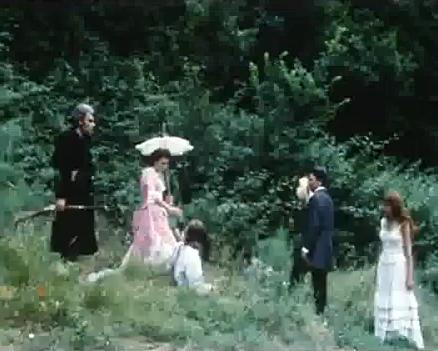
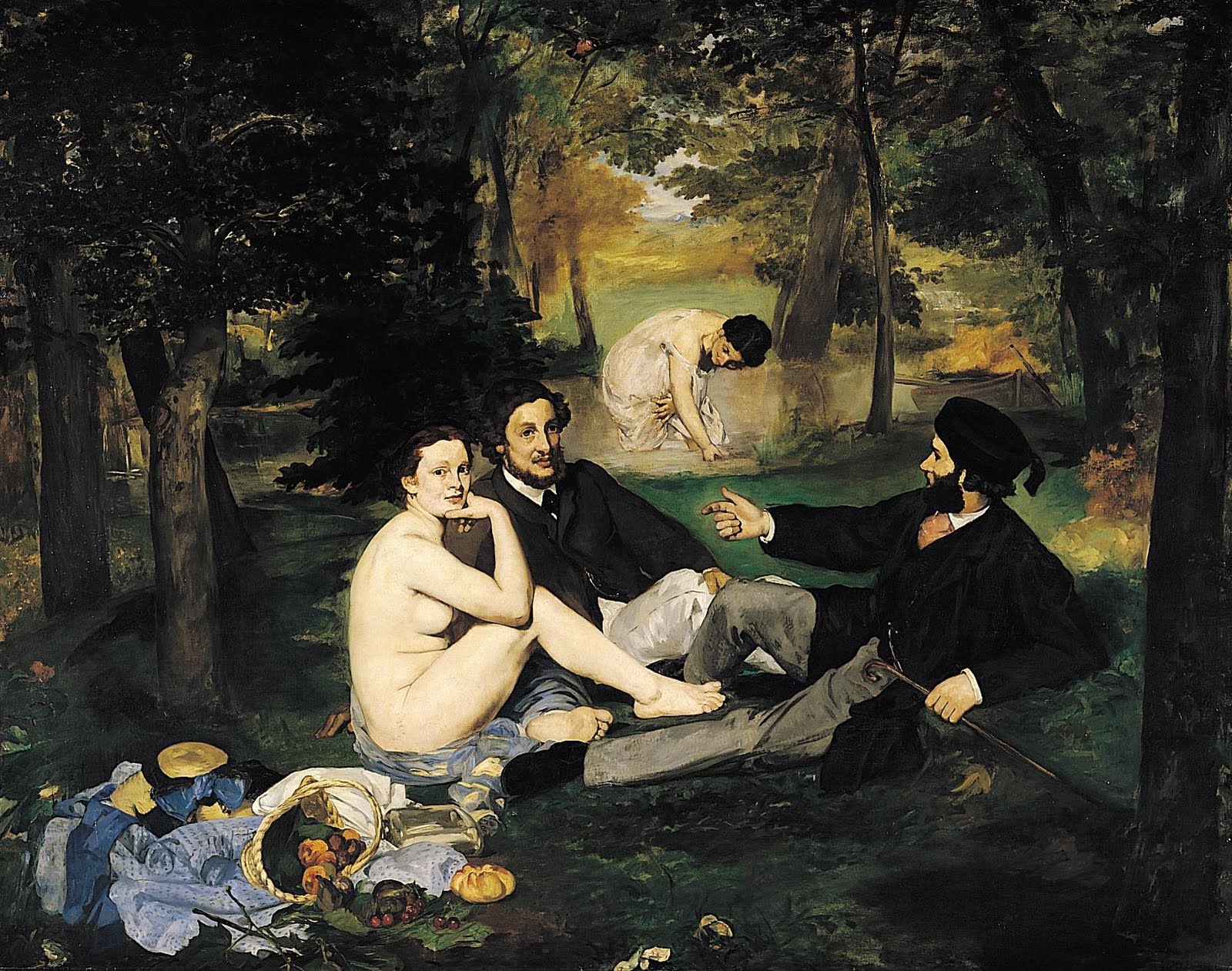
Of course, I'd generally be sold on any video in which a gorgeous redhead, kissed by the evening sun and dressed in a billowing gown, parades herself amongst a vibrant commune of decadent revellers while recasting some of the magic found in Édouard Manet's classic scene of riverbank self-indulgence Le déjeuner sur l'herbe (The Lunch on the Grass, 1862-1863), but even so, this video is impressive; and in three minutes and thirty-eight seconds manages to make us forget that these things are more often promotional tools created for no other reason than to shift units, instead showing us something that transcends time, trends, and everything in-between.


Rabbit Heart (Raise It Up) directed by Tom Beard & Tabitha Denholm, 2009:


The Luncheon on the Grass by Édouard Manet, 1863:

Schalcken the Painter (1979)

Schalcken the Painter [Schalcken the Painter [Leslie Megahey, 1979]: This is a film I first saw around four years ago. At the time I found...