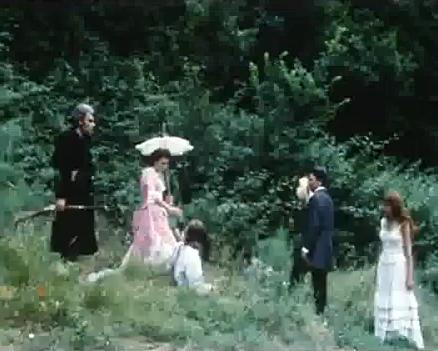
Two voices. One French, one American. A political tract concerning the issues of Communism in the workplace and ideals of freedom and equality, post-May, 1968, is recited back and forth over an obscured image of bodies slumbering in what appears to be a garden. The image is pastoral and idyllic in presentation, suggesting an almost abstract quality devoid of time and place. After a series of static images that simply observe these scenarios - largely with no real movement within the frame - we see a small group of actors preparing themselves for a film. As we continue, these actors, who speak Italian and are dressed in period costume, wander through this idyllic location as the narration goes on to discuss a cinema of revolution and the history of politics in cinema dating as far back as Sergei Eisenstein. Through this, the filmmakers are able to reflect on the notions of politics and history in both a cultural and cinematic sense; creating in the process a film that collapses elements of genuine historical fact, and superimposes them over the struggles and issues of the present day.
Two voices. Both French. The film here is one of a handful of collaborative efforts between the filmmakers Jean-Luc Godard and Jean-Pierre Gorin, who under the creative banner of The Group Dziga Vertov, would produce a number of essay-based films that looked specifically at contemporary political issues from a Marxist/Leninist perspective. Unlike Godard's more socially aware films, pre-1967, The Dziga Vertov Group would reject conventional filmmaking practices altogether; focusing instead on a deconstructive approach that relied heavily upon the use found sounds and images that were cut together with the appropriate use of voice over and ironic screen-titles that not only offer some kind of background to the events unfolding, but also worked against the audience, distracting and disarming the viewer from what was happening on screen. This makes the viewing process even more difficult, with the already weighty bombardment of spoken information and the miscommunication of the two voices already alienating those of us unfamiliar with Communist manifestos or the working conditions in Europe in 1969.
Despite the general ideology of the Dziga Vertov Group, which was to reject the claim of authorship that Godard and his generation of critics had previously helped to define, the images of Le vent d'est (The East Wind/The Wind from the East, 1970) are typical of the man who gave us La chinoise (1967), and later Le gai savoir (The Joy of Learning, 1969), with the pastoral settings suggesting elements of the final act of Week End (1967), while the continual punctuation of high-rise apartment buildings and the wheels of industry that feature in the second half of the film call to mind a similar devise used in the earlier 2 or 3 Things I Know About Her (2 ou 3 choses que je sais d'elle, 1967). However, whereas those films had used clever visual metaphors and deconstructive film techniques to tell stories as a means of conveying socio-political satire, they did so with a vague semblance of narrative.
Here, the film is mostly a continual stream of thought over some beautifully composed images. Naturally, there are numerous other devises used that are typical of Godard's work, both before and after his period with the Group, such as the use of repeated images (or motifs), looped dialog (so that the same words or phrases are repeated a number of times throughout), inter-titles (here, illegibly scrawled in marker pen), the presentation of the camera as part of the proceedings (the "general assembly", as Godard puts it) and the natural facade of cinema as presented by print damage, spliced frames and deliberate mistakes (the deconstructive notion of cinema as truth).
Without question, the images of the film are simply astounding, and are easily amongst the most beautiful and provocative scenarios that Godard has ever created; with the single image of these ancient, anachronistic figures, Bergman-like in their presentation of white gowns against green hills, wandering through these glorious fields being a particularly astounding sight, eventually giving way to the more aggressive, deconstructive images of mass graves, construction and the general process of film production itself, pushing us back towards the direction of Week End. However, despite the brilliance of Godard's filmmaking and the range of his ideas, Le vent d'est - like many of these Dziga Vertov Group films - is incredibly difficult to recommend to a potential audience, despite the obvious quality of its production. The continual bombardment of voice-over narration - delivered in a flat, rapid fire Parisian (American?) accent from an unaccredited voice actress - reminds us that this is a visual essay, presented in the form of a radical, experimental film. As a result, most viewers will find the film a complete chore; more so than any other Godard film, all of which require a certain level of cooperation from the audience, but tend to reward our efforts with an element of human concern.
Even when presented in such a way as to be completely obvious to the point of almost agitprop sloganeering, Le vent d'est nonetheless retains some level of ambiguity; drawing parallels between the two winds - the east and the west - and the voices on the soundtrack, with Godard and Gorin again using the film to investigate the present day struggle by way of the past (a past as represented by the cinema itself). The film isn't to be approached in the conventional sense, but rather digested in two or three single sittings, with any real attempt to interpret the film, or pick up on every single topical reference, really requiring a lot more energy and perception as illustrated in this post. Arguable, the film is dated in the political sense - having now become a period piece that looks at a specific era in twentieth-century existence - however, it is also a truly uncompromising work from a collective of filmmakers attempting to communicate something radical through the medium of film. Even if you disregard the experience, you have to marvel at the presentation of Godard's images, and the conviction of his ideals.
Sunday, 23 August 2009
Saturday, 22 August 2009
Pravda
Essentially a travelogue of images of the Soviet Union, coupled with a voice-over narration explaining the current political climate of Eastern Europe, delivered by an unaccredited North American voice actor who presents his findings in a formal, matter-of-fact approach that suggests the dictation of a letter. Again, this is a filmed essay; an investigatory piece looking into the whys and wherefores of certain socialist issues of class and employment, and how such factors contribute to a recognisable way of life. This involves everything from cars, jobs, homes and industry; all presented as a rolling collage of images that repeat themselves throughout the course of the film, as the discourse on the soundtrack continues.
Although it has some merit as a period piece, this is probably one of the least interesting films from The Dziga Vertov Group; the outlet for filmmakers Jean-Luc Godard and Jean-Pierre Gorin to analyse certain Marxist-Leninist concepts within the cinematic medium, resulting in a collection of films that are either mildly interesting or completely forgettable, depending on the tastes of the particular viewer.
Pravda (1971), the title being the same as the leading Soviet / Russian newspaper, previously referred to in Godard's own pop-art science fiction film Alphaville (1965), in which the translation, "The Truth", is used as an ironic comment on the part of the filmmakers to the images and ideas on screen, works towards an often slyly amusing contrast between the pictures we see and the voice we hear underlining the intentions of the filmmakers in their quest for understanding. It is presented as a collection of seemingly found images, conspicuous in their typically bold, Godardian use of colour and composition, combined with the use of still photography, archive footage, TV clips and jarring bursts of music. The filmmaking devises are all emblematic of Godard's work, both before and after his time with the Dziga Vertov group, and show the definite stamp of authorship that belies the group manifesto and their rejection of the auteur-based cinema that Godard helped to define.
Unlike other films produced by Godard and Gorin during this highly productive period, Pravda simply doesn't hold up to repeated viewings. Projects like Un Film comme les autres (A Film Like Any Other, 1968), Vladimir and Rosa (1970), Tout va bien (Everything is Going Well, 1972) and Ici et ailleurs (Here and Elsewhere, 1976) (the latter produced from the remnants of an aborted Dziga Vertov project that conspires to pick apart the failings of these particular films) managed to overcome the limitations of their political ideologies and the complete disregard for the recognisable conventions of film-making to show the evolution of Godard from a too-clever-for-his-own-good cinephile into some kind of continually probing film poet; mixing words and images to create deeply felt investigations into love, war, death, religion and the complexities of the human condition. Pravda, on the other hand, is simply an information piece. Unless you're incredibly interested in 1960's politics or montage-film-making then there's very little here to keep us interested; with the continual collection of images and constant reliance on voice-over narration to supply information and opinion eventually becoming tiring, even from the perspective of a dedicated admirer of Godard's work, such as myself.
Although films like Vladimir and Rosa, Tout va bien and Ici et ailleurs are incredibly exhausting experiences, filled with dense thought, expressions, and rejections of conventional film-making, they nonetheless reward the viewer with a style and conviction that is unlike anything else presented in contemporary cinema. Later, Godard would reject many of these Dziga Vertov films as a naive attempt to make sense of things, while the filmmaking techniques would be refined through the creation of the films made in collaboration with Anne-Marie Miéville, such as Numéro deux (1975), Comment ça va? (1976) and the twelve part television series France/Tour/Detour/Deux/Enfants (1978) - some of the most probing, challenging and fascinating works of Godard's career.
Pravda is the Dziga Vertov group at their most obvious; there's none of the bold film-making experiments of Vladimir and Rosa or the daring aggression of the flawed Wind from the East (Le vent d'est, 1969), with the whole thing instead becoming a largely quaint collection of sounds and images. As a result, it will probably be of incredibly limited interest to the majority of viewers, Godard appreciators included.
Although it has some merit as a period piece, this is probably one of the least interesting films from The Dziga Vertov Group; the outlet for filmmakers Jean-Luc Godard and Jean-Pierre Gorin to analyse certain Marxist-Leninist concepts within the cinematic medium, resulting in a collection of films that are either mildly interesting or completely forgettable, depending on the tastes of the particular viewer.
Pravda (1971), the title being the same as the leading Soviet / Russian newspaper, previously referred to in Godard's own pop-art science fiction film Alphaville (1965), in which the translation, "The Truth", is used as an ironic comment on the part of the filmmakers to the images and ideas on screen, works towards an often slyly amusing contrast between the pictures we see and the voice we hear underlining the intentions of the filmmakers in their quest for understanding. It is presented as a collection of seemingly found images, conspicuous in their typically bold, Godardian use of colour and composition, combined with the use of still photography, archive footage, TV clips and jarring bursts of music. The filmmaking devises are all emblematic of Godard's work, both before and after his time with the Dziga Vertov group, and show the definite stamp of authorship that belies the group manifesto and their rejection of the auteur-based cinema that Godard helped to define.
Unlike other films produced by Godard and Gorin during this highly productive period, Pravda simply doesn't hold up to repeated viewings. Projects like Un Film comme les autres (A Film Like Any Other, 1968), Vladimir and Rosa (1970), Tout va bien (Everything is Going Well, 1972) and Ici et ailleurs (Here and Elsewhere, 1976) (the latter produced from the remnants of an aborted Dziga Vertov project that conspires to pick apart the failings of these particular films) managed to overcome the limitations of their political ideologies and the complete disregard for the recognisable conventions of film-making to show the evolution of Godard from a too-clever-for-his-own-good cinephile into some kind of continually probing film poet; mixing words and images to create deeply felt investigations into love, war, death, religion and the complexities of the human condition. Pravda, on the other hand, is simply an information piece. Unless you're incredibly interested in 1960's politics or montage-film-making then there's very little here to keep us interested; with the continual collection of images and constant reliance on voice-over narration to supply information and opinion eventually becoming tiring, even from the perspective of a dedicated admirer of Godard's work, such as myself.
Although films like Vladimir and Rosa, Tout va bien and Ici et ailleurs are incredibly exhausting experiences, filled with dense thought, expressions, and rejections of conventional film-making, they nonetheless reward the viewer with a style and conviction that is unlike anything else presented in contemporary cinema. Later, Godard would reject many of these Dziga Vertov films as a naive attempt to make sense of things, while the filmmaking techniques would be refined through the creation of the films made in collaboration with Anne-Marie Miéville, such as Numéro deux (1975), Comment ça va? (1976) and the twelve part television series France/Tour/Detour/Deux/Enfants (1978) - some of the most probing, challenging and fascinating works of Godard's career.
Pravda is the Dziga Vertov group at their most obvious; there's none of the bold film-making experiments of Vladimir and Rosa or the daring aggression of the flawed Wind from the East (Le vent d'est, 1969), with the whole thing instead becoming a largely quaint collection of sounds and images. As a result, it will probably be of incredibly limited interest to the majority of viewers, Godard appreciators included.
Friday, 14 August 2009
Blue
A film born out of the artist's own invalidity, as the onset of AIDS robbed him of his most valuable and necessary commodity essential to his craft - chiefly, the gift of sight - and enthused by a sense that the end is drawing near; that time is passing like the memory of the great waves, or those half forgotten encounters, which ultimately remain more meaningful than any legacy that may or may not exist. That Blue (1993) describes for the benefit of the audience the filmmaker's own individual response and reaction to this particularly tragic situation, recited over a saturated blue image that never changes or relents, will possibly pose a problem for those seeking more conventional drama, or indeed more conventional cinema.
Although one can trace a line from Blue to many of the earlier films of its director Derek Jarman, simply by listening to the soundtrack and the ideas that are expressed therein, the decision to place these particular discussions against a single image of nocturnal blue seems like an incredibly audacious move, even by the standards set by Jarman's previous experimental features, such as The Garden (1990) or The Last of England (1987).
However, what initially seems like a novelty when discussed without the boundaries of context or clarification, eventually reveals itself to be a quite deliberate and remarkable stylisation used to evoke the perspective of the filmmaker and the deterioration of his sight; as the painful lesions on his retinas leave only a vague impression of light's soft illumination pulsating through the gaze of eyelids, too sore to open. The use of the colour blue, both as an artistic choice and as a concept that lends itself to certain creative associations, like as blue as the sea reflecting the sky, or blue like the heart that wails in mourning, work as a kind of shorthand to explain the sensation of sightlessness, or the feeling of the human body in the late stages of disease. The sensation of staring at this empty space filled only by colour, not blue like the moon, but blue like Picasso, becomes a sensory experience. Our eyes, transfixed on an endless image of cool blue, calming blue - the blue of winter or the blue sleep - as the voices on the soundtrack recount this story, suggesting the images that the ailing filmmaker was unable to create.
Although often fragmented by poetic expression, wordplay, quotations and personal reflection, the dialogue of Blue offers the most honest and straight-forward narrative of any of Jarman's work, relating specifically to the difficulties faced by the individual living with AIDS, the loss of his friends and loved ones, the loss of his sight and the realisation that life will soon be lost, like petals to the breeze. In this respect, the film is an important document, expressing Jarman's thoughts on and experiences with the disease at a time when the hostility surrounding the so-called "gay plague" was at its most frenzied, and combined with an already fierce criticism of the British political structure and its views on homosexuality, which found an outlet in previous films such as The Garden or Edward II (1991).
What ultimately reinforces Blue as a relevant work is its detailed description of the illness from the perspective of someone attempting to survive it. The lengthy dialog about hospital visits and medication, as memories, fading like the sight, are suggested by the subtle use of sound and music; or the continual asides and interjections of the actors John Quentin, Nigel Terry and Tilda Swinton, who offer their voices alongside Jarman's own to flesh out this dialogue, or to further establish this implied world as it exists in the dark of our imagination.
The prose throughout is beautiful; rich in detail, honest but self-deprecating. It's tragic, without descending into mawkish sentimentality, and remorseful without succumbing to wanton self-pity. In discussing his illness, Jarman pulls no punches as he talks about a virus that "rages fierce." Later, he talks about the toll this illness has taken on his body and the side-effect of being one of the many statistics, slowly dying, watching others die, but unable to do anything about it. He says - "I have no friends now who are not dead or dying. Like a blue frost it caught them. At work, at the cinema - on marches and on beaches. In churches on their knees, running, flying, silent or shouting protest." The particular suggestion of death as the blue frost - everything blue, for better or worse, like the images on screen - is the central theme that runs throughout, as the coming to terms with death is contrasted with life's rich memories, finding expression, perhaps for the final time.
In the closing verse, after the horror stories of hospitals and deterioration - the continuing high-wire act between life and death - peace is found in a half-remembered sexual encounter, which, for one brief moment, offers a reprieve from the suffering; as sweet memories - personal (we assume) to the author, but nonetheless recognisable to the viewer, despite the specifics of sexuality - calm the fires of outrage and ennui.
It is one of Jarman's most remarkable evocations as a filmmaker, made all the more astounding given only the suggestion of the image; as soft music combines with the lapping of waves and the caw of seagulls, as pebbles crush underfoot. The sex is passionate and intense, though Jarman speaks of it as a voyeur, looking back at a specific time and place; a blissful moment, un moment de bonheur, drifting through the memory like a cloud. The notions of time and time passing are reinforced in the final word, which moves us, precisely because of its simplicity, being the perfect counterpoint to the complicated soundscape of thoughts and fears, or the beauty and richness of Jarman's text as it unfolds on the screen.
Pearl fishers in azure seas
Deep waters washing the isle of the dead
In coral harbours amphora spill gold across the still seabed
We lie there
Fanned by the billowing sails of forgotten ships
Tossed by the mournful winds of the deep
Lost Boys, sleep forever
In a dear embrace - salt lips touching
In submarine gardens, cool marble fingers touch an antique smile
Shell sounds whisper, deep love
Drifting on the tide forever
The smell of him
Dead good looking
In beauty's summer
His blue jeans around his ankles
Bliss, in my ghostly eye
Kiss me on the lips
On the eyes
Our name will be forgotten
In time
No one will remember our work
Our life will pass like the traces of a cloud
And be scattered like mist that is chased by the rays of the sun
For our time is the passing of a shadow
And our lives will run like sparks through the stubble.
I place a delphinium, Blue, upon your grave
Naturally, there will be viewers who balk at the idea of watching a plain blue screen for close to eighty minutes. Needless to say, there is already enough criticism about Jarman's supposed audacity to "release a radio play with visual accompaniment" on various sites around the net: but such reactions are to be expected when a film or filmmaker strays so far from convention, even if such experiments are made out of necessity, rather than choice. But the use of blue, essential in creating a mood that we can associate with the feelings of sadness and regret, is beautiful, and far more rewarding than any of the cluttered, conventional mise-en-scene currently on display at any local multiplex. It doesn't deserve to be denigrated simply because it refuses to compete with the figures in a frame, shot/reverse-shot, close up to wide shot conventions that we've come to accept as the requirements of the moving picture. If one, as a filmmaker, is encouraged to express their ideas visually, or to offer a visual experience for the viewer that is unique to the medium, then Blue is as valid as any other work in which the visual design is intended to stir emotion or response.
Like much of Jarman's work it is a film worth returning to; where the impact of the drama is intensely personal, but in no way private. It is open to the projections of an audience, who can read into the filmmaker's own thoughts and meditations and try to take something away from the experience. Whether it is the plight of the dying man, reduced to painting in broad-strokes, away from the complexity of his previous work, rich in visual splendour; or the simple fact that life and love hang in the balance – the dream, where everything dies. That life must pass "like the traces of a cloud", or that in the face of death, it is the combination of the mundane, new shoes in a shop window, and the memory, a life that runs "like sparks through the stubble", that we cling to. Where the chiming clock-like sounds and sustained notes, meshing with a continuation of seaside reminisce, lingers during the closing credits, suggesting... an elegy.
Although one can trace a line from Blue to many of the earlier films of its director Derek Jarman, simply by listening to the soundtrack and the ideas that are expressed therein, the decision to place these particular discussions against a single image of nocturnal blue seems like an incredibly audacious move, even by the standards set by Jarman's previous experimental features, such as The Garden (1990) or The Last of England (1987).
However, what initially seems like a novelty when discussed without the boundaries of context or clarification, eventually reveals itself to be a quite deliberate and remarkable stylisation used to evoke the perspective of the filmmaker and the deterioration of his sight; as the painful lesions on his retinas leave only a vague impression of light's soft illumination pulsating through the gaze of eyelids, too sore to open. The use of the colour blue, both as an artistic choice and as a concept that lends itself to certain creative associations, like as blue as the sea reflecting the sky, or blue like the heart that wails in mourning, work as a kind of shorthand to explain the sensation of sightlessness, or the feeling of the human body in the late stages of disease. The sensation of staring at this empty space filled only by colour, not blue like the moon, but blue like Picasso, becomes a sensory experience. Our eyes, transfixed on an endless image of cool blue, calming blue - the blue of winter or the blue sleep - as the voices on the soundtrack recount this story, suggesting the images that the ailing filmmaker was unable to create.
Although often fragmented by poetic expression, wordplay, quotations and personal reflection, the dialogue of Blue offers the most honest and straight-forward narrative of any of Jarman's work, relating specifically to the difficulties faced by the individual living with AIDS, the loss of his friends and loved ones, the loss of his sight and the realisation that life will soon be lost, like petals to the breeze. In this respect, the film is an important document, expressing Jarman's thoughts on and experiences with the disease at a time when the hostility surrounding the so-called "gay plague" was at its most frenzied, and combined with an already fierce criticism of the British political structure and its views on homosexuality, which found an outlet in previous films such as The Garden or Edward II (1991).
What ultimately reinforces Blue as a relevant work is its detailed description of the illness from the perspective of someone attempting to survive it. The lengthy dialog about hospital visits and medication, as memories, fading like the sight, are suggested by the subtle use of sound and music; or the continual asides and interjections of the actors John Quentin, Nigel Terry and Tilda Swinton, who offer their voices alongside Jarman's own to flesh out this dialogue, or to further establish this implied world as it exists in the dark of our imagination.
The prose throughout is beautiful; rich in detail, honest but self-deprecating. It's tragic, without descending into mawkish sentimentality, and remorseful without succumbing to wanton self-pity. In discussing his illness, Jarman pulls no punches as he talks about a virus that "rages fierce." Later, he talks about the toll this illness has taken on his body and the side-effect of being one of the many statistics, slowly dying, watching others die, but unable to do anything about it. He says - "I have no friends now who are not dead or dying. Like a blue frost it caught them. At work, at the cinema - on marches and on beaches. In churches on their knees, running, flying, silent or shouting protest." The particular suggestion of death as the blue frost - everything blue, for better or worse, like the images on screen - is the central theme that runs throughout, as the coming to terms with death is contrasted with life's rich memories, finding expression, perhaps for the final time.
In the closing verse, after the horror stories of hospitals and deterioration - the continuing high-wire act between life and death - peace is found in a half-remembered sexual encounter, which, for one brief moment, offers a reprieve from the suffering; as sweet memories - personal (we assume) to the author, but nonetheless recognisable to the viewer, despite the specifics of sexuality - calm the fires of outrage and ennui.
It is one of Jarman's most remarkable evocations as a filmmaker, made all the more astounding given only the suggestion of the image; as soft music combines with the lapping of waves and the caw of seagulls, as pebbles crush underfoot. The sex is passionate and intense, though Jarman speaks of it as a voyeur, looking back at a specific time and place; a blissful moment, un moment de bonheur, drifting through the memory like a cloud. The notions of time and time passing are reinforced in the final word, which moves us, precisely because of its simplicity, being the perfect counterpoint to the complicated soundscape of thoughts and fears, or the beauty and richness of Jarman's text as it unfolds on the screen.
Pearl fishers in azure seas
Deep waters washing the isle of the dead
In coral harbours amphora spill gold across the still seabed
We lie there
Fanned by the billowing sails of forgotten ships
Tossed by the mournful winds of the deep
Lost Boys, sleep forever
In a dear embrace - salt lips touching
In submarine gardens, cool marble fingers touch an antique smile
Shell sounds whisper, deep love
Drifting on the tide forever
The smell of him
Dead good looking
In beauty's summer
His blue jeans around his ankles
Bliss, in my ghostly eye
Kiss me on the lips
On the eyes
Our name will be forgotten
In time
No one will remember our work
Our life will pass like the traces of a cloud
And be scattered like mist that is chased by the rays of the sun
For our time is the passing of a shadow
And our lives will run like sparks through the stubble.
I place a delphinium, Blue, upon your grave
Naturally, there will be viewers who balk at the idea of watching a plain blue screen for close to eighty minutes. Needless to say, there is already enough criticism about Jarman's supposed audacity to "release a radio play with visual accompaniment" on various sites around the net: but such reactions are to be expected when a film or filmmaker strays so far from convention, even if such experiments are made out of necessity, rather than choice. But the use of blue, essential in creating a mood that we can associate with the feelings of sadness and regret, is beautiful, and far more rewarding than any of the cluttered, conventional mise-en-scene currently on display at any local multiplex. It doesn't deserve to be denigrated simply because it refuses to compete with the figures in a frame, shot/reverse-shot, close up to wide shot conventions that we've come to accept as the requirements of the moving picture. If one, as a filmmaker, is encouraged to express their ideas visually, or to offer a visual experience for the viewer that is unique to the medium, then Blue is as valid as any other work in which the visual design is intended to stir emotion or response.
Like much of Jarman's work it is a film worth returning to; where the impact of the drama is intensely personal, but in no way private. It is open to the projections of an audience, who can read into the filmmaker's own thoughts and meditations and try to take something away from the experience. Whether it is the plight of the dying man, reduced to painting in broad-strokes, away from the complexity of his previous work, rich in visual splendour; or the simple fact that life and love hang in the balance – the dream, where everything dies. That life must pass "like the traces of a cloud", or that in the face of death, it is the combination of the mundane, new shoes in a shop window, and the memory, a life that runs "like sparks through the stubble", that we cling to. Where the chiming clock-like sounds and sustained notes, meshing with a continuation of seaside reminisce, lingers during the closing credits, suggesting... an elegy.
"The measure of love is to love without measure"
If ever I dreamed of my dead name
High in the heart of London, unsurpassed
By Time for ever, and the Fugitive, Fame
There seeking a long sanctuary at last
I better that; and recollect with shame
How once I longed to hide it from life's heats
Under those holy cypresses, the same
That shade, always, the quiet place of Keats
Now rather thank I God there is no risk
Of gravers scoring it with florid screed
But let my death be memoried on this disc
Wear it, sweet friend. Inscribe no date nor deed
But may thy heart-beat kiss it night and day
Until the name grow vague and wear away.
- Wilfred Owen, With An Identity Disc
If ever I dreamed of my dead name
High in the heart of London, unsurpassed
By Time for ever, and the Fugitive, Fame
There seeking a long sanctuary at last
I better that; and recollect with shame
How once I longed to hide it from life's heats
Under those holy cypresses, the same
That shade, always, the quiet place of Keats
Now rather thank I God there is no risk
Of gravers scoring it with florid screed
But let my death be memoried on this disc
Wear it, sweet friend. Inscribe no date nor deed
But may thy heart-beat kiss it night and day
Until the name grow vague and wear away.
- Wilfred Owen, With An Identity Disc
Sunday, 2 August 2009
Rabbit Heart
This is a gift / it comes with a price / Who is the lamb and who is the knife? / Midas is king and he holds me so tight / And turns me to gold in the sunlight...
By far the best music video I've seen this year, Rabbit Heart (Raise it Up by Florence and the Machine sidesteps the current video trend of 1980s style minimalism as filtered through a post-millennium sense of misplaced nostalgia, and instead goes for the more immediate figures in a frame style explosion of artistic revelry that plays like a miniature narrative. Instead of the emphasis on the conceptual element, of lines, shapes, colours and contrasts that we've seen in recent videos by Calvin Harris, Hot Chip, Ladyhawke, The Ting Tings and La Roux (the majority of which have started to look like photo shoots for PIG or i-D magazine), Rabbit Heart is a magic hour happening that transforms itself midway through into a funeral dirge; expressing the lyrical references to sacrificial offerings (Raise it Up) and the bravery of the lion-hearted girl who, willing to make the final step (rushing towards the skyline), throws herself at the rushing waters that run from blue to red.
Such emotive lyrical concerns, sung so convincingly that one almost forgets that this is a major label release, are expressed through the glowing, pastoral imagery - of a river lit by candles, or a banquet that recalls the forest gathering of Jan Němec's The Party and the Guests (O slavnosti a hostec, 1966) by way of the frolicking, celebratory scenes that feature towards the end of Valerie and Her Week of Wonders (Valerie a týden divů, 1970) or The Wicker Man (1973) - in which the seesawing between ecstasy and agony transforms the murder into a celebration of death.
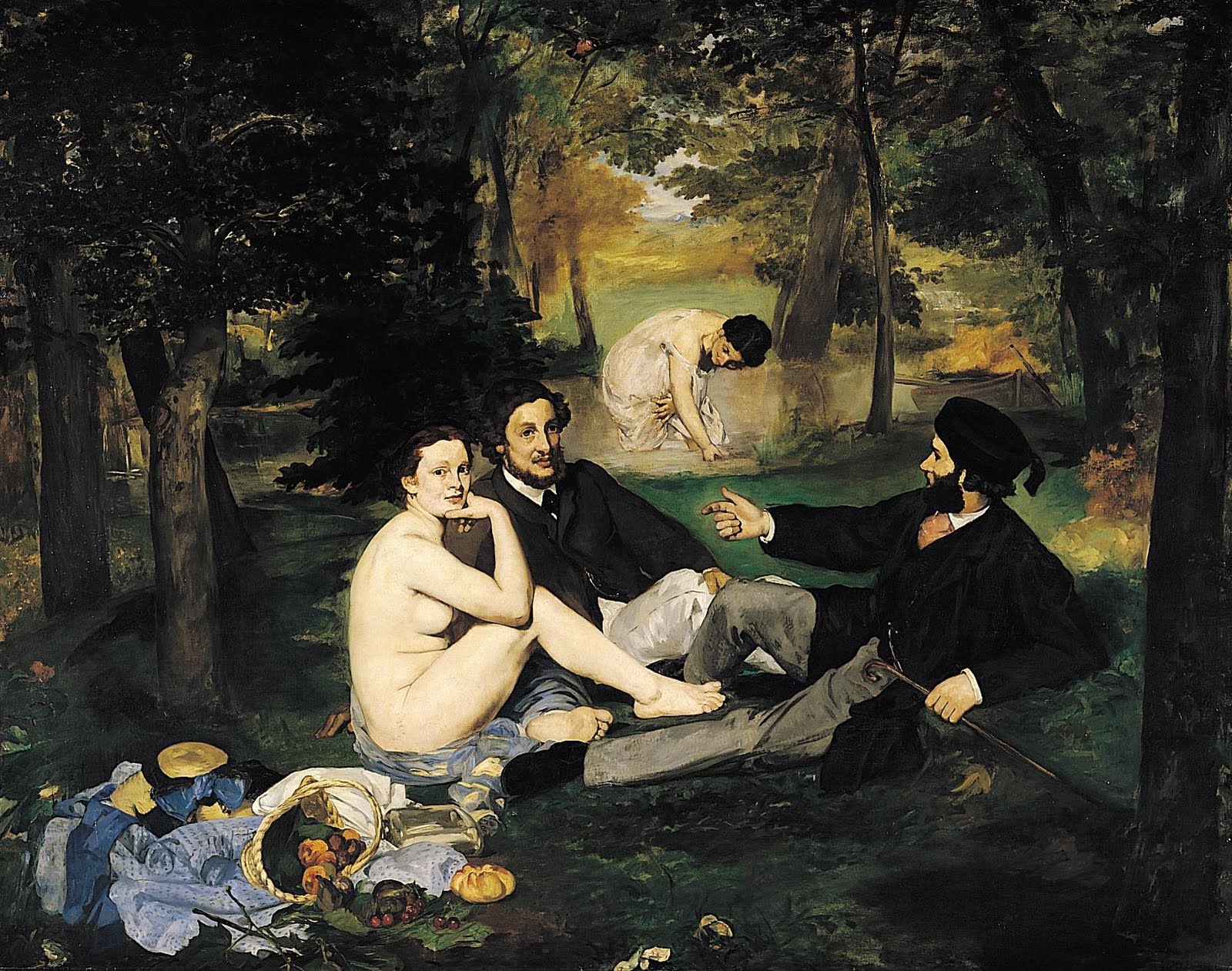
Of course, I'd generally be sold on any video in which a gorgeous redhead, kissed by the evening sun and dressed in a billowing gown, parades herself amongst a vibrant commune of decadent revellers while recasting some of the magic found in Édouard Manet's classic scene of riverbank self-indulgence Le déjeuner sur l'herbe (The Lunch on the Grass, 1862-1863), but even so, this video is impressive; and in three minutes and thirty-eight seconds manages to make us forget that these things are more often promotional tools created for no other reason than to shift units, instead showing us something that transcends time, trends, and everything in-between.
By far the best music video I've seen this year, Rabbit Heart (Raise it Up by Florence and the Machine sidesteps the current video trend of 1980s style minimalism as filtered through a post-millennium sense of misplaced nostalgia, and instead goes for the more immediate figures in a frame style explosion of artistic revelry that plays like a miniature narrative. Instead of the emphasis on the conceptual element, of lines, shapes, colours and contrasts that we've seen in recent videos by Calvin Harris, Hot Chip, Ladyhawke, The Ting Tings and La Roux (the majority of which have started to look like photo shoots for PIG or i-D magazine), Rabbit Heart is a magic hour happening that transforms itself midway through into a funeral dirge; expressing the lyrical references to sacrificial offerings (Raise it Up) and the bravery of the lion-hearted girl who, willing to make the final step (rushing towards the skyline), throws herself at the rushing waters that run from blue to red.
Such emotive lyrical concerns, sung so convincingly that one almost forgets that this is a major label release, are expressed through the glowing, pastoral imagery - of a river lit by candles, or a banquet that recalls the forest gathering of Jan Němec's The Party and the Guests (O slavnosti a hostec, 1966) by way of the frolicking, celebratory scenes that feature towards the end of Valerie and Her Week of Wonders (Valerie a týden divů, 1970) or The Wicker Man (1973) - in which the seesawing between ecstasy and agony transforms the murder into a celebration of death.
Of course, I'd generally be sold on any video in which a gorgeous redhead, kissed by the evening sun and dressed in a billowing gown, parades herself amongst a vibrant commune of decadent revellers while recasting some of the magic found in Édouard Manet's classic scene of riverbank self-indulgence Le déjeuner sur l'herbe (The Lunch on the Grass, 1862-1863), but even so, this video is impressive; and in three minutes and thirty-eight seconds manages to make us forget that these things are more often promotional tools created for no other reason than to shift units, instead showing us something that transcends time, trends, and everything in-between.
Thursday, 23 July 2009
Puce Moment
The images, forever beyond comment or criticism, exist without context. Any meaning that is tangible enough to be put into words is placed there by the viewer, who can choose to see the film as silent, as it may have appeared in 1949, or with the Jonathan Halper folk-tunes that were added in 1970 to offer a vaguely ironic juxtaposition between the implied 1920's decadence - and the Garbo-like suggestions of glamour that are central to the film's design - against the somewhat psychedelic, heart-on-sleeve longing of a strummed acoustic rhythm, backed by an electric lead.
That Puce Moment (1949) was originally created as a rough sketch for a planned but never completed feature-length project to-be-titled Puce Women is in no way a mark against its character. Even in its surviving form of a minuscule six-minutes and fourteen seconds of screen time in total, the actual filmmaking technique, and the way in which the audience is able to tease out a story, however vague it might be, is never less than fascinating; drawing on our natural associations with the aforementioned G. Garbo, whose request to be left alone saw her self-imposed seclusion in a New York City penthouse, or of the world of a film like Sunset Blvd. (1950), where the faded glamour and existence in the shadow of Hollywood writ large becomes a world of illusion, between dream and insanity.
As a complete work and in its own right, Puce Moment is a mesmerizing spectacle; an absolute marvel of colour and composition, lighting and shadow - as the swishing gowns that open the film take on an almost kaleidoscopic approach, where collage turns to montage and the accumulative effect of these images becomes absolutely astounding. However, when viewed within the context of the Anger filmogaphy as a whole, one could argue that the film doesn't quite compare to the genius of projects like Fireworks (1947), Inauguration of the Pleasure Dome (1954) or Scorpio Rising (1963), which feel like complete works, as opposed to unfinished sketches. In contrast, Puce Moment, like the brilliant Kustom Kar Kommandos (1965), probably plays more like a music video than as a comprehensive piece of work, especially when we view it from a contemporary perspective of MTV.
However, this isn't to take anything away from the film or the experience that is offered, with the sheer fact that Puce Moment predates the music video industry by several decades being further proof of its incredible Proustian ability to transcend the notions of time. Not only in terms of the basic form, but in the sense that this is a film that feels like something from the 1960's, produced in the late 1940's, looking back to the 1920's, and one that still holds up as a fascinating example of the true power of cinema at its most basic level (of sound applied to image) sixty-years after it was first conceived.
It is, as the title might suggest, a burst of lush, feminine colour; a mirror ball reflection - either critical or celebratory - of ornate grandeur (a house on the hill) and days that are filled with sleep and nothing. Where the preening excess of the central character, as played by Yvonne Marquis, becomes an evocation of life's great emptiness - the act of getting herself ready and looking fabulous for walking the dogs or lounging listlessly on the veranda - or an ode to the vacuous vice of vanity. Although Puce Moment, as a truncated demo-piece, suggests one of the many great could-have-been moments in the career of Kenneth Anger, it nonetheless remains a intriguing insight into the working mind of one of the most exciting and integral filmmakers that ever lived.
That Puce Moment (1949) was originally created as a rough sketch for a planned but never completed feature-length project to-be-titled Puce Women is in no way a mark against its character. Even in its surviving form of a minuscule six-minutes and fourteen seconds of screen time in total, the actual filmmaking technique, and the way in which the audience is able to tease out a story, however vague it might be, is never less than fascinating; drawing on our natural associations with the aforementioned G. Garbo, whose request to be left alone saw her self-imposed seclusion in a New York City penthouse, or of the world of a film like Sunset Blvd. (1950), where the faded glamour and existence in the shadow of Hollywood writ large becomes a world of illusion, between dream and insanity.
As a complete work and in its own right, Puce Moment is a mesmerizing spectacle; an absolute marvel of colour and composition, lighting and shadow - as the swishing gowns that open the film take on an almost kaleidoscopic approach, where collage turns to montage and the accumulative effect of these images becomes absolutely astounding. However, when viewed within the context of the Anger filmogaphy as a whole, one could argue that the film doesn't quite compare to the genius of projects like Fireworks (1947), Inauguration of the Pleasure Dome (1954) or Scorpio Rising (1963), which feel like complete works, as opposed to unfinished sketches. In contrast, Puce Moment, like the brilliant Kustom Kar Kommandos (1965), probably plays more like a music video than as a comprehensive piece of work, especially when we view it from a contemporary perspective of MTV.
However, this isn't to take anything away from the film or the experience that is offered, with the sheer fact that Puce Moment predates the music video industry by several decades being further proof of its incredible Proustian ability to transcend the notions of time. Not only in terms of the basic form, but in the sense that this is a film that feels like something from the 1960's, produced in the late 1940's, looking back to the 1920's, and one that still holds up as a fascinating example of the true power of cinema at its most basic level (of sound applied to image) sixty-years after it was first conceived.
It is, as the title might suggest, a burst of lush, feminine colour; a mirror ball reflection - either critical or celebratory - of ornate grandeur (a house on the hill) and days that are filled with sleep and nothing. Where the preening excess of the central character, as played by Yvonne Marquis, becomes an evocation of life's great emptiness - the act of getting herself ready and looking fabulous for walking the dogs or lounging listlessly on the veranda - or an ode to the vacuous vice of vanity. Although Puce Moment, as a truncated demo-piece, suggests one of the many great could-have-been moments in the career of Kenneth Anger, it nonetheless remains a intriguing insight into the working mind of one of the most exciting and integral filmmakers that ever lived.
Wednesday, 8 July 2009
Les hautes solitudes
In keeping with the vast majority of the films of its writer/director, Philippe Garrel, Les hautes solitudes (1974) is an intensely personal experience. A film in which characters thrown together in empty rooms stung by silence drift between fleeting glances, reacting or not reacting as the case may be to what is said, what isn't said, and everything in-between. It is, as one might expect given its technical presentation, a fairly impenetrable work, though one that we're free to carry with us; ruminating on each tattered scene as we gather up our thoughts like raindrops, either during the experience of viewing or afterwards, and inevitably projecting our own thoughts and feelings (or personal preconceptions) onto the images, or its central characters, who remain vague and elusive; indistinguishable from the actors who play them and whose faces dominate each single-shot close-up composition, used throughout to establish a story - or a sense of narrative that exists between sleep and nothing - to reveal a sense of the great loneliness that the title of the film so perfectly describes.
Although the intentions of Les hautes solitudes remain unclear, obscured by the closeness of the compositions or the complete lack of any kind of conventional soundtrack to make explicit those stolen moments of thought, we can at least take the film to be a kind of silent-study of its three individual characters; the actresses Jean Seberg and Tina Aumont, and the singer and musician Nico, whose decade-long relationship with Garrel has become a spectre that haunts the very framework of his cinema, stretching as far back as her earliest appearance in the abstract, esoteric drama The Inner Scar (La cicatrice intérieure, 1972), to the recollections of her spirit and the void left in her absence in films like Emergency Kisses (Les baisers de secours, 1989) or I Don't Hear the Guitar Any More (J'entends plus la guitar, 1991).
In Les hautes solitudes, it is Nico's face that we see first, slumped in a kind of morose contemplation as the images flicker with a Murnau-like intensity, as the antique quality of the composition reminds us, subconsciously, of the world of Faust (1926) or Nosferatu (1922); suggesting that feeling of the supernatural, gothic and severe, or of a nocturnal underworld devoid of time and place. As was the case with Garrel's earlier silent film, Le révélateur (1968), there is that sense of a world in which life has stopped dead; where we witness these characters interacting, thinking - the expressions on their faces telling a story in the loosest possible sense - but they, like us, are still waiting; waiting for something (anything) to happen. Good or bad, we don't quite know, but there is a continual feeling that the world around them has fallen away, leaving only the four-walls, floors and ceilings of the apartment, the empty street bellow and those other spaces, rubble and mirrors, that seem to be beyond our basic comprehension.
In this sense, the film becomes a sort of ghost story in which the inability of one character to relate to another character is conveyed through the intensity of those exhausting compositions of actors attempting to express thoughts and emotions - or the basic human need to a feel a part of something meaningful or substantial - but silenced, literally, by Garrel's particular filmmaking approach. By removing the soundtrack completely, so that not even a musical score or a drone of ambient white-noise can block out our own thoughts (either on the subject of the film, or our thoughts in general), Garrel makes the breakdown in communication between his four central characters - the three women and the actor Laurent Terzieff - all the more palpable; as lips move and the eyes dart back and forth from one side of the frame to another in a parody of conversation while the scene remains silent. The words literally cannot express the complexity of the emotions felt or experienced by these four lead protagonists, just as they fail to fully express our own relationship with them or with the film in question.
We never know if these actors are playing characters, or instead playing themselves, or even if their relationships extend beyond the actual beginning and end of the drama. Such questions remain on our mind throughout the film, as we watch these dramas play-out in bedrooms and kitchens, filled with looks and smiles which could be genuine - as in developing naturally from the drama and the interactions of the characters - or could be a cheat, as in those stolen moments, taken between takes and continuing the often Brechtian, deconstructive aspect that Garrel employs throughout. The accumulative effect of these images is eventually closer to the avant-garde of Stan Brakhage than the cinema of Vigo or Jean Eusrache, as the film becomes an installation piece, just there, in front of us, but beyond a reasonable grasp.
It is an impossible film to really pin-down and explain what is what without the benefit of further reading; with each reaction or spontaneous smile following a scene of full-face emotion disarming us, throwing our interpretations into confusion, leading to greater questions, thoughts and misunderstandings, etcetera. At certain points it seems like a depressing film, as Seberg, still beautiful, but quite clearly a world-away from the lively young girl of Bonjour Tristesse (1958) or À bout de souffle (1960), breaks down in tears and is comforted by Aumont, who reminds us of what a great and expressive actress she was away from the dull exploitation of films like Torso (I corpi presentano tracce di violenza carnale/Bodies Bear Traces of Carnal Violence, 1973) or The Howl (L'urlo, 1970). However, at other times the mood is playful, as we sense some of the fun and the frivolity of this collective of likeminded individuals, friends and collaborators, producing a film, a personal and to some extents private work (as Garrel's work often seems to be), in the solitude of a rented apartment building.
Despite such moments, which could very easily be another example of Garrel's deconstruction of the film, allowing shots to run further than the moment of the cut - or the way in which the whole thing becomes about the process of filmmaking itself - it is the gloom and the inability of the characters to communicate that we eventually come back to. A haunted film in many respects, in which characters are introduced, either slumbering or on the precipice of sleep (Nico and Seberg) or instead gazing into windows or pools of mirrored reflections (Aumont and Terzieff); or where the high-contrast black and white and the fragmented framing of images, as half-lit faces, hands and arms, expressions hidden, either by the characters themselves or by the doorways that get in the way of the action as we intrude, silently, upon the scene, becomes yet another barrier.
Beyond this, we're left with Seberg's face, which dominates the film, full of expression, even if the ability to plainly express in words seems to be beyond her. The fact that Seberg would be dead by the end of the decade, just three months shy of her 41st birthday, gives the film an added sense of tragedy that may not have been the intention. And when we take into consideration the early deaths of Nico (1938-1988) and Aumont (1946-2006), the idea of a ghost story, or a haunted film, becomes all the more concrete. Such ideas become manifest when combined with the cinematography, the sparseness of the locations and the feeling that time has become a mere affectation. From the first appearance of Seberg seven-minutes into the film, tossing and turning in bed and appearing to eventually fall asleep (in real-time) before a fade to black implies the passage between night and day, the narrative seems suspended, as moments pass, but with no real urgency, nothing to move along to besides the same old rooms and faces.
As a study for Serberg, or of Seberg, the film is absolutely riveting, as we watch with complete fascination the bombardment of emotions, or facial expressions, of acting at its most naked and unrefined, being projected as Garrel cuts in and out of these blurred relationships, where each look to the camera, beyond the camera, to the empty spaces that mock us with their vacant austerity, reminding us of the windows where life should be. Can we take hope from that penultimate shot, which lasts for several minutes and shows Seberg, bathed in glowing light and buried beneath an attractive sunhat, as she coyly expresses a range of conflicted facial expressions as if putting on an audition (for Garrel, and by extension the audience), or is the hope destroyed by the final plunging retreat into backlit melancholia? A silhouetted pose, cigarette smoke and "Les hautes solitudes", as Seberg returns to the darkness, away from the bright white light that filters in through the bedroom window; away from the fantasy ideal of what could have been, or should have been, if only things had been different.
It is that particular presentation of characters in a state of trance, fearfully in danger, which makes it impossible not to be reminded of Nico's music; with the mood and tone reflecting songs like 'Innocent and Vain' or 'Frozen Warnings', or the lyrical reflections of 'Afraid'; as her voice, an aching monotone, reassures us, but also hold the mirror to the heartbreaking line "you are beautiful and you are alone." Such associations are impossible to ignore given the intensity of these two individuals and their relationship, which dominated a period of creativity that resulted in the conception of great music and great cinema (and the spaces between the two). Let's not forget that a colour-tinted still of the film even featured on the cover of Nico's album The End (1973), or that Garrel originally intended to use segments of Nico's music as a soundtrack to the film, before Seberg suggested that the images remain silent.
As the film ends we're left with as many questions as when it began; basic questions, like who are these people and what do they want? What were the intentions of the filmmaker? What role does the supposed influence of Nietzsche's The Antichrist (first published, 1888) have on the world of the film or the development of its narrative? ...And so on. The only thing we're really sure of is Seberg's brilliance and Garrel's genius, creating a film that is entirely dependent on the interpretations of the audience, as we project our own thoughts and feelings in an attempt to understand these characters and their complex interrelationships. In introducing his own work, Nietzsche wrote that "In order to understand the book, one must be honest in intellectual matters to the point of harshness to so much as endure my seriousness, my passion." "Let us look one another in the face." These words, which resonate on a monumental level when watching the reactions of these three no-longer-with us cult-icons, could just as easily be the introduction to Garrel's intensely personal film.
Although the intentions of Les hautes solitudes remain unclear, obscured by the closeness of the compositions or the complete lack of any kind of conventional soundtrack to make explicit those stolen moments of thought, we can at least take the film to be a kind of silent-study of its three individual characters; the actresses Jean Seberg and Tina Aumont, and the singer and musician Nico, whose decade-long relationship with Garrel has become a spectre that haunts the very framework of his cinema, stretching as far back as her earliest appearance in the abstract, esoteric drama The Inner Scar (La cicatrice intérieure, 1972), to the recollections of her spirit and the void left in her absence in films like Emergency Kisses (Les baisers de secours, 1989) or I Don't Hear the Guitar Any More (J'entends plus la guitar, 1991).
In Les hautes solitudes, it is Nico's face that we see first, slumped in a kind of morose contemplation as the images flicker with a Murnau-like intensity, as the antique quality of the composition reminds us, subconsciously, of the world of Faust (1926) or Nosferatu (1922); suggesting that feeling of the supernatural, gothic and severe, or of a nocturnal underworld devoid of time and place. As was the case with Garrel's earlier silent film, Le révélateur (1968), there is that sense of a world in which life has stopped dead; where we witness these characters interacting, thinking - the expressions on their faces telling a story in the loosest possible sense - but they, like us, are still waiting; waiting for something (anything) to happen. Good or bad, we don't quite know, but there is a continual feeling that the world around them has fallen away, leaving only the four-walls, floors and ceilings of the apartment, the empty street bellow and those other spaces, rubble and mirrors, that seem to be beyond our basic comprehension.
Les hautes solitudes directed by Philippe Garrel, 1974:
Nosferatu directed by F.W. Murnau, 1922:
Le révélateur directed by Philippe Garrel, 1968:

Nosferatu directed by F.W. Murnau, 1922:
Le révélateur directed by Philippe Garrel, 1968:

In this sense, the film becomes a sort of ghost story in which the inability of one character to relate to another character is conveyed through the intensity of those exhausting compositions of actors attempting to express thoughts and emotions - or the basic human need to a feel a part of something meaningful or substantial - but silenced, literally, by Garrel's particular filmmaking approach. By removing the soundtrack completely, so that not even a musical score or a drone of ambient white-noise can block out our own thoughts (either on the subject of the film, or our thoughts in general), Garrel makes the breakdown in communication between his four central characters - the three women and the actor Laurent Terzieff - all the more palpable; as lips move and the eyes dart back and forth from one side of the frame to another in a parody of conversation while the scene remains silent. The words literally cannot express the complexity of the emotions felt or experienced by these four lead protagonists, just as they fail to fully express our own relationship with them or with the film in question.
We never know if these actors are playing characters, or instead playing themselves, or even if their relationships extend beyond the actual beginning and end of the drama. Such questions remain on our mind throughout the film, as we watch these dramas play-out in bedrooms and kitchens, filled with looks and smiles which could be genuine - as in developing naturally from the drama and the interactions of the characters - or could be a cheat, as in those stolen moments, taken between takes and continuing the often Brechtian, deconstructive aspect that Garrel employs throughout. The accumulative effect of these images is eventually closer to the avant-garde of Stan Brakhage than the cinema of Vigo or Jean Eusrache, as the film becomes an installation piece, just there, in front of us, but beyond a reasonable grasp.
It is an impossible film to really pin-down and explain what is what without the benefit of further reading; with each reaction or spontaneous smile following a scene of full-face emotion disarming us, throwing our interpretations into confusion, leading to greater questions, thoughts and misunderstandings, etcetera. At certain points it seems like a depressing film, as Seberg, still beautiful, but quite clearly a world-away from the lively young girl of Bonjour Tristesse (1958) or À bout de souffle (1960), breaks down in tears and is comforted by Aumont, who reminds us of what a great and expressive actress she was away from the dull exploitation of films like Torso (I corpi presentano tracce di violenza carnale/Bodies Bear Traces of Carnal Violence, 1973) or The Howl (L'urlo, 1970). However, at other times the mood is playful, as we sense some of the fun and the frivolity of this collective of likeminded individuals, friends and collaborators, producing a film, a personal and to some extents private work (as Garrel's work often seems to be), in the solitude of a rented apartment building.
Despite such moments, which could very easily be another example of Garrel's deconstruction of the film, allowing shots to run further than the moment of the cut - or the way in which the whole thing becomes about the process of filmmaking itself - it is the gloom and the inability of the characters to communicate that we eventually come back to. A haunted film in many respects, in which characters are introduced, either slumbering or on the precipice of sleep (Nico and Seberg) or instead gazing into windows or pools of mirrored reflections (Aumont and Terzieff); or where the high-contrast black and white and the fragmented framing of images, as half-lit faces, hands and arms, expressions hidden, either by the characters themselves or by the doorways that get in the way of the action as we intrude, silently, upon the scene, becomes yet another barrier.
Beyond this, we're left with Seberg's face, which dominates the film, full of expression, even if the ability to plainly express in words seems to be beyond her. The fact that Seberg would be dead by the end of the decade, just three months shy of her 41st birthday, gives the film an added sense of tragedy that may not have been the intention. And when we take into consideration the early deaths of Nico (1938-1988) and Aumont (1946-2006), the idea of a ghost story, or a haunted film, becomes all the more concrete. Such ideas become manifest when combined with the cinematography, the sparseness of the locations and the feeling that time has become a mere affectation. From the first appearance of Seberg seven-minutes into the film, tossing and turning in bed and appearing to eventually fall asleep (in real-time) before a fade to black implies the passage between night and day, the narrative seems suspended, as moments pass, but with no real urgency, nothing to move along to besides the same old rooms and faces.
As a study for Serberg, or of Seberg, the film is absolutely riveting, as we watch with complete fascination the bombardment of emotions, or facial expressions, of acting at its most naked and unrefined, being projected as Garrel cuts in and out of these blurred relationships, where each look to the camera, beyond the camera, to the empty spaces that mock us with their vacant austerity, reminding us of the windows where life should be. Can we take hope from that penultimate shot, which lasts for several minutes and shows Seberg, bathed in glowing light and buried beneath an attractive sunhat, as she coyly expresses a range of conflicted facial expressions as if putting on an audition (for Garrel, and by extension the audience), or is the hope destroyed by the final plunging retreat into backlit melancholia? A silhouetted pose, cigarette smoke and "Les hautes solitudes", as Seberg returns to the darkness, away from the bright white light that filters in through the bedroom window; away from the fantasy ideal of what could have been, or should have been, if only things had been different.
Les hautes solitudes directed by Philippe Garrel, 1974:
The End... by Nico, 1974:
Les hautes solitudes directed by Philippe Garrel, 1974:

The End... by Nico, 1974:
Les hautes solitudes directed by Philippe Garrel, 1974:

It is that particular presentation of characters in a state of trance, fearfully in danger, which makes it impossible not to be reminded of Nico's music; with the mood and tone reflecting songs like 'Innocent and Vain' or 'Frozen Warnings', or the lyrical reflections of 'Afraid'; as her voice, an aching monotone, reassures us, but also hold the mirror to the heartbreaking line "you are beautiful and you are alone." Such associations are impossible to ignore given the intensity of these two individuals and their relationship, which dominated a period of creativity that resulted in the conception of great music and great cinema (and the spaces between the two). Let's not forget that a colour-tinted still of the film even featured on the cover of Nico's album The End (1973), or that Garrel originally intended to use segments of Nico's music as a soundtrack to the film, before Seberg suggested that the images remain silent.
As the film ends we're left with as many questions as when it began; basic questions, like who are these people and what do they want? What were the intentions of the filmmaker? What role does the supposed influence of Nietzsche's The Antichrist (first published, 1888) have on the world of the film or the development of its narrative? ...And so on. The only thing we're really sure of is Seberg's brilliance and Garrel's genius, creating a film that is entirely dependent on the interpretations of the audience, as we project our own thoughts and feelings in an attempt to understand these characters and their complex interrelationships. In introducing his own work, Nietzsche wrote that "In order to understand the book, one must be honest in intellectual matters to the point of harshness to so much as endure my seriousness, my passion." "Let us look one another in the face." These words, which resonate on a monumental level when watching the reactions of these three no-longer-with us cult-icons, could just as easily be the introduction to Garrel's intensely personal film.
Friday, 26 June 2009
Hard Labour
Released this past month as part of the Mike Leigh at the BBC box-set, Hard Labour (first broadcast, 12th March, 1973) was the now-highly acclaimed director's second feature length work and his first for the company's long running Play for Today series, to which he would later contribute the more highly-regarded films Nuts in May (1976), The Kiss of Death (1977), Abigail's Party (1977) and Home Sweet Home (1982). As with his debut feature, the stifled, claustrophobic chamber piece Bleak Moments (1971), Hard Labour is a strictly downbeat affair, with the usual characteristic Leigh sense of humour, so brilliantly developed in films like Grown Ups (1980), Life is Sweet (1991) and Happy-Go-Lucky (2008), being in the formative stages throughout.
Although the humour is mostly absent, the recognisable emphasis on the day-to-day comings and goings of characters living and working through these various situations is as bold and affective as it has remained, thirty-years on; with the natural talent of Leigh as a filmmaker, preoccupied with the minute details that make up the greater whole managing to bring these separate elements together in a way that is intelligent and completely affecting. It is a film that, at its most basic and recognisable, offers us a simple story, or, more specifically, a window into the world of its central character, the middle-aged cleaning lady Mrs. Thornley (Liz Smith). While the character is deliberately refused a first name by the filmmaker, we can nonetheless recognise certain character traits that mark her out as is an even more bedraggled forerunner to the titular Vera Drake; with the poor posture and the softly-spoken voice, barely audible over the constant of family arguments or the distant ambience of the industrial working-class milieu, defining a tone that permeates every second of the drama; from the seemingly pointless conversations to the quiet moments where characters sit and think in stone-faced contemplation.
From this initial set up, Leigh is able to maintain his drama through the continual interaction between the characters; as these scenes of dialog, or the quieter instances where the camera simply holds on a actor's face and they share a moment, bleak or otherwise, are used to suggest deeper, more universal themes that go beyond the characters presented on screen and suggest something recognisably human and relevant to the world in which we live. It's subtle, even without the use of humour to distract us from the otherwise crushing sense of despair, while the development of the characters and the situations they've found themselves in feel very authentic; especially in regards to the world of the film and the motivations of the characters.


As one might expect given the usual implications of the title, Leigh's general approach to the film is to show and then contrast the working life with the family life; opening with a series of short scene-punctuations that perfectly establish the various drab, everyday rituals that make up the routine of this galley of protagonists, as the camera, static and composed, observes in great detail the general running of this dysfunctional lower class family at the start of an average day. These early sequences establish a particular rhythm, with the obvious reiteration of things, as the character asks twice for her husband to lift his feet as she runs the small vacuum cleaner past the chair, across the faded floral carpet - and almost immediately we wonder how many times she's asked and asked again for her husband to shift his legs while she performs this crushing, domestic rite. Back and forth over the carpet with the vacuum cleaner while the husband, weary from work or back from an afternoon of heavy drinking, barks orders or chips away at the character's already tattered self-esteem.


These sequences are captured, like much of the film, in a characteristically loose, narrative-vignette approach that highlights Leigh's continual emphasis on character and observation as a means to explore the deeper, more expressive themes at work beneath the surface. In keeping with such a notion, the film is, in essence, concerned, or obsessed (?), with the little close-up details that make up the bigger picture. Just as the natural accumulation of one day to the next, month on month, year on year, creates the endless spiral of existence as it unfolds, so too does the repetition of scenes that suggest so perfectly that sense of a life in-progress that survives beyond the parameters of the film's frame - beginning and end, opening title to closing credits - creating the sense that the world has turned and continues to turn long after the screen has faded.
Although the film grants an equal amount of screen-time to several characters, both within the family and on the periphery of the drama, it is the perspective of Mrs. Thornley as the family's quiet matriarch who dominates the proceedings; either as a kind of facilitator, offering the characters a chance to meet and interact - bridging the gap so to speak through her job and her commitments between work and home, the suburbs and the sink estate - or simply observing the conflicts and drama, quiet and dignified, though her face, with the sunken eyes and hollowed mouth, revealing everything. The rest of the characters exist around her, and their attitudes and interactions, both in regards to her and the characters around them are largely filtered through this quiet perspective of a character watching from the corners of the frame.

Throughout the film, Leigh cuts back and forth between scenes of Mrs. Thornley at work - polishing the silverware or struggling to carry large bundles of clothes up and down winding carpeted stairs - and the domestic scenes, as she dotes on her chauvinistic husband Jim (Clifford Kershaw), a night watchman who complains endlessly about his bad back and uncomfortable shoes between loveless putdowns and perpetual scowls, and her two grown-up children, Ann (Polly Hemmingway), who still lives at home, though very much has a life of her own, and Edward (Bernard Hill), a car mechanic getting comfortable in one of those new council estates with his bossy young wife Veronica (Alison Steadman). The integration of these characters, as they meet over lunch or Sunday dinner, or during the general progression of an average day, creates the usual clashes of generation, class and personality that we've come to expect from Leigh's cinema; as the petty squabbles and sometimes deep-seated jealousies and anxieties are revealed through the scenes of passive-aggressive confrontation, as one character instinctively taunts the other character to breaking point, either deliberately, or simply because it's possible and part of the natural interaction between characters within a family environment far too comfortable in the company of one and other.


In such sequences, we can see the Leigh of Who's Who (1978), or Meantime (1984), or High Hopes (1988) and even the comparatively recent Vera Drake (2004), and all of these strands passing back and forth through the previously mentioned Abigail's Party to the presentation of scenes herein; scenes in which characters from both ends of the social spectrum are thrown together and allowed to contrast and conflict in a way that not only reveals something about themselves, as characters, but also about the world (this world or Leigh's?) in which they continue to exist.
Though there are several other themes explored in the film, the real emphasis here is on the coexistence of these characters under the broader classification of "the family". Immediately, we can recognise this as a key theme in Leigh's work, in which the differences between these people, connected, but nonetheless at odds, becomes magnified; as that accumulation of time as defined above, exaggerates each characteristic tic or quirk until the idea of simply being in the room with these people is like negotiating a particularly cluttered minefield. As ever with Leigh, the point of such scenes isn't merely the exterior level - the things said between two characters under the pretence of conversation - but the things implied by these sequences - the things going on beneath the surface. Are they really relevant, these discussions of what kind of cheese to get from the precinct or a pair of boots one size too small, or can such conversations fill in the blanks about the relationships between these various characters; their approach to life and, more importantly, their approach to one another?
Take the brief scene between Mrs. Thornley and her daughter at the outdoor-market as one single example. A scene lasting no more than a minute or two of screen time in which the two women sift through piles of half-price underwear on a cluttered weekend market stall. Again, is it important that Ann wants the purple bra? Does it move the narrative forward in a way that creates compelling, exciting drama? No, of course not! But it establishes the contrasts between the mother and her daughter, showing a young woman who exists in a world of fashion and sexuality - a world where sex is a recreational pursuit, to be enjoyed - and a world away from the generation of Mrs. Thornley, where the closest thing to intimacy or affection is being pawed by a husband looking for a drunken post-pub leg-over. The sad desperation of those early evenings, pretending to be asleep to spare her the agony of another awkward assault, as the husband moans and gropes and writhes around beneath the sheets because, in the days before women's lib or god-given-notions of equality, that was his right.


There are the little things too, like the relationship between Ann and her sister-in-law Veronica, both of the same background and generation, who were most probably school friends before Veronica was wooed or pursued her best-friend's (?) brother and now makes life difficult for everyone by projecting her own middle-class aspirations onto this surrogate family, expecting them to reach some higher level of living through economic gain, social-status, and those all important outward appearances. As ever with Leigh, we can view these as the typical concerns with class, which still dominate much of British art and British attitudes, as we glorify the working class, pity those who have achieved some worth in a middle-class sense, though obviously not enough to rank as highly as the smart-set, who we pretend to hate, but really hold enthral. Nonetheless, this class emphasis is really just one of Leigh's many devises, like satire or character improvisation, that is used to map the psychology of characters, developed to a staggering degree from months of intricate pre-production meetings and rehearsal workshops until the creation of a completely functioning character, from birth until the moment that they appear on screen, is formed.
This interest in mapping out the parameters of his characters also extends as far as the world that Leigh creates, which, in a number of ways, seems exactly like the world in which we live, and yet even then there is some process of stylisation or creative abstraction, which is unavoidable. Though many critics continue to cite Leigh as a social-realist, lazily comparing him to the much more socially aware and politically motivated Ken Loach, his work has much more in common with filmmakers like Yasujirō Ozu, Maurice Pialat or Rainer Werner Fassbinder; with the emphasis on looking, observing, sometimes dethatched, but concerned with the outcome of these characters; letting the little details of the rooms and the way they're captured tell a story. The small, cramped, two-bedroom house with its outdoor toilet and kitchen too small to move around in; the flowery wallpaper and radios offering nameless songs that could recall seaside romance but instead mock the soot-lined streets and drudgery that waits around each corner; 30p an hour, 3 hours and five mornings, polishing silverware while the lady of the house looks you over, eagle-eyed behind those horn-rimmed spectacles.


With Hard Labour, Leigh creates a rough-around-the-edges film that not only manages to operate in a storytelling capacity - presenting the usual look at character concerns and intricate personal-relationships - but one that also manages to say a great deal about the time and place in which it is set. That particular evocation of the cobble-stone streets and cluttered back alleyways where dogs wander, catching a scent and then off again, bringing to mind the desolate existential landscapes of Tarkovsky or Béla Tarr; with the grit and the grime and the overcast skies recalling a film like Stalker (1979) or Damnation (Kárhozat, 1988). But this isn't science-fiction or expressionist-noir, but the real life dramatisation of a specific time and place; chiefly, Salford, Greater Manchester, in the early 1970's. A changing world, captured so vividly in Morrissey's controversial song Bengali in Platforms from his debut solo album Viva Hate (1989), and in turn the world of The Buddha of Suburbia, with the character of Naseem (Ben Kingsley) and a seemingly secondary sub-plot about back-street abortions, making the relationship with Vera Drake an explicit one, while giving weight to Ann's all-of-a-sudden interest in the particulars of child-birth and her mother's sage advice; "you have to suffer to bring children into the world."
We can recognise these characters, just as we can recognise that sense of domestic drudgery; from the banging on the ceiling with the broom-handle to stir the old-enough-to-know-better daughter, to the "shut up/no you shut up" exchanges of dialog; as dad puts the world to rights through a mouthful of soggy toast. The natural repetition of these scenes repeated, breakfast, lunch and dinner, as Mrs. Thornley, desperate to please, let's her dinner go cold on the table as her husband and daughter shovel it down and ask for more. We can recognise the disappointment of this life from the very first scene, but it is only as the film edges towards its closing moments, and in particular the penultimate scene, that we realise Mrs. Thornley feels it too.

In perhaps the most famous scene in the film, the character attends her Sunday morning confession and reveals to the priest that her dissatisfaction with life and her inability to love or connect with the people around her has become too much to bear. In true Leigh form, this scene, which is brilliantly performed by Smith and shot by the filmmaker with a direct, uncomplicated precision, is emotionally honest and just the right side of painful; as the inability of Mrs. Thornley to express her problem is greeted by half-hearted 'Hail Mary's' and again, that attitude of chauvinism, as yet another man fails to recognise the pain of a woman boxed into a corner and unable to escape. However, in this very obvious mocking of religion, with its agendas and advice that goes nowhere, Leigh actually succeeds in creating a moment that is wickedly funny, if, again, no less painful. Although I maintain that the usual Leigh sense of humour is lacking here, the last-minute reveal of the Priest, flicking through his Sunday newspaper as Mrs. Thornley bares her soul as best she can, does hint at the direction that much of Leigh's work would take following the liberation of the subsequent Nuts in May and the later emphasis on comedy (often black-comedy, or the comedy of everyday life) to undercut the more harrowing moments of personal pain.
These are themes that will become more important as the progression of Leigh as a filmmaker continues on, with the idea of the family and the emotional split between the husband and wife in particular reminding us of the dysfunctional relationships and quiet, inarticulate characters in films like Secrets and Lies (1996) and All or Nothing (2002); where the simple process of sharing a moment over the kitchen table when resentments and anxieties get in the way of our natural instincts to care for one another becomes a form of hard labour in itself. In this respect, the title of Leigh's film not only expresses the daily grind of the character's life as she is forced to care for and pick up after her family and the snobbish middle-class housewives whose posh, Mock-Tudor houses she cleans for a living, but also the notion of life, and in particular married life, as a kind of prison sentence.
Although the humour is mostly absent, the recognisable emphasis on the day-to-day comings and goings of characters living and working through these various situations is as bold and affective as it has remained, thirty-years on; with the natural talent of Leigh as a filmmaker, preoccupied with the minute details that make up the greater whole managing to bring these separate elements together in a way that is intelligent and completely affecting. It is a film that, at its most basic and recognisable, offers us a simple story, or, more specifically, a window into the world of its central character, the middle-aged cleaning lady Mrs. Thornley (Liz Smith). While the character is deliberately refused a first name by the filmmaker, we can nonetheless recognise certain character traits that mark her out as is an even more bedraggled forerunner to the titular Vera Drake; with the poor posture and the softly-spoken voice, barely audible over the constant of family arguments or the distant ambience of the industrial working-class milieu, defining a tone that permeates every second of the drama; from the seemingly pointless conversations to the quiet moments where characters sit and think in stone-faced contemplation.
From this initial set up, Leigh is able to maintain his drama through the continual interaction between the characters; as these scenes of dialog, or the quieter instances where the camera simply holds on a actor's face and they share a moment, bleak or otherwise, are used to suggest deeper, more universal themes that go beyond the characters presented on screen and suggest something recognisably human and relevant to the world in which we live. It's subtle, even without the use of humour to distract us from the otherwise crushing sense of despair, while the development of the characters and the situations they've found themselves in feel very authentic; especially in regards to the world of the film and the motivations of the characters.


As one might expect given the usual implications of the title, Leigh's general approach to the film is to show and then contrast the working life with the family life; opening with a series of short scene-punctuations that perfectly establish the various drab, everyday rituals that make up the routine of this galley of protagonists, as the camera, static and composed, observes in great detail the general running of this dysfunctional lower class family at the start of an average day. These early sequences establish a particular rhythm, with the obvious reiteration of things, as the character asks twice for her husband to lift his feet as she runs the small vacuum cleaner past the chair, across the faded floral carpet - and almost immediately we wonder how many times she's asked and asked again for her husband to shift his legs while she performs this crushing, domestic rite. Back and forth over the carpet with the vacuum cleaner while the husband, weary from work or back from an afternoon of heavy drinking, barks orders or chips away at the character's already tattered self-esteem.


These sequences are captured, like much of the film, in a characteristically loose, narrative-vignette approach that highlights Leigh's continual emphasis on character and observation as a means to explore the deeper, more expressive themes at work beneath the surface. In keeping with such a notion, the film is, in essence, concerned, or obsessed (?), with the little close-up details that make up the bigger picture. Just as the natural accumulation of one day to the next, month on month, year on year, creates the endless spiral of existence as it unfolds, so too does the repetition of scenes that suggest so perfectly that sense of a life in-progress that survives beyond the parameters of the film's frame - beginning and end, opening title to closing credits - creating the sense that the world has turned and continues to turn long after the screen has faded.
Although the film grants an equal amount of screen-time to several characters, both within the family and on the periphery of the drama, it is the perspective of Mrs. Thornley as the family's quiet matriarch who dominates the proceedings; either as a kind of facilitator, offering the characters a chance to meet and interact - bridging the gap so to speak through her job and her commitments between work and home, the suburbs and the sink estate - or simply observing the conflicts and drama, quiet and dignified, though her face, with the sunken eyes and hollowed mouth, revealing everything. The rest of the characters exist around her, and their attitudes and interactions, both in regards to her and the characters around them are largely filtered through this quiet perspective of a character watching from the corners of the frame.

Throughout the film, Leigh cuts back and forth between scenes of Mrs. Thornley at work - polishing the silverware or struggling to carry large bundles of clothes up and down winding carpeted stairs - and the domestic scenes, as she dotes on her chauvinistic husband Jim (Clifford Kershaw), a night watchman who complains endlessly about his bad back and uncomfortable shoes between loveless putdowns and perpetual scowls, and her two grown-up children, Ann (Polly Hemmingway), who still lives at home, though very much has a life of her own, and Edward (Bernard Hill), a car mechanic getting comfortable in one of those new council estates with his bossy young wife Veronica (Alison Steadman). The integration of these characters, as they meet over lunch or Sunday dinner, or during the general progression of an average day, creates the usual clashes of generation, class and personality that we've come to expect from Leigh's cinema; as the petty squabbles and sometimes deep-seated jealousies and anxieties are revealed through the scenes of passive-aggressive confrontation, as one character instinctively taunts the other character to breaking point, either deliberately, or simply because it's possible and part of the natural interaction between characters within a family environment far too comfortable in the company of one and other.


In such sequences, we can see the Leigh of Who's Who (1978), or Meantime (1984), or High Hopes (1988) and even the comparatively recent Vera Drake (2004), and all of these strands passing back and forth through the previously mentioned Abigail's Party to the presentation of scenes herein; scenes in which characters from both ends of the social spectrum are thrown together and allowed to contrast and conflict in a way that not only reveals something about themselves, as characters, but also about the world (this world or Leigh's?) in which they continue to exist.
Though there are several other themes explored in the film, the real emphasis here is on the coexistence of these characters under the broader classification of "the family". Immediately, we can recognise this as a key theme in Leigh's work, in which the differences between these people, connected, but nonetheless at odds, becomes magnified; as that accumulation of time as defined above, exaggerates each characteristic tic or quirk until the idea of simply being in the room with these people is like negotiating a particularly cluttered minefield. As ever with Leigh, the point of such scenes isn't merely the exterior level - the things said between two characters under the pretence of conversation - but the things implied by these sequences - the things going on beneath the surface. Are they really relevant, these discussions of what kind of cheese to get from the precinct or a pair of boots one size too small, or can such conversations fill in the blanks about the relationships between these various characters; their approach to life and, more importantly, their approach to one another?
Take the brief scene between Mrs. Thornley and her daughter at the outdoor-market as one single example. A scene lasting no more than a minute or two of screen time in which the two women sift through piles of half-price underwear on a cluttered weekend market stall. Again, is it important that Ann wants the purple bra? Does it move the narrative forward in a way that creates compelling, exciting drama? No, of course not! But it establishes the contrasts between the mother and her daughter, showing a young woman who exists in a world of fashion and sexuality - a world where sex is a recreational pursuit, to be enjoyed - and a world away from the generation of Mrs. Thornley, where the closest thing to intimacy or affection is being pawed by a husband looking for a drunken post-pub leg-over. The sad desperation of those early evenings, pretending to be asleep to spare her the agony of another awkward assault, as the husband moans and gropes and writhes around beneath the sheets because, in the days before women's lib or god-given-notions of equality, that was his right.


There are the little things too, like the relationship between Ann and her sister-in-law Veronica, both of the same background and generation, who were most probably school friends before Veronica was wooed or pursued her best-friend's (?) brother and now makes life difficult for everyone by projecting her own middle-class aspirations onto this surrogate family, expecting them to reach some higher level of living through economic gain, social-status, and those all important outward appearances. As ever with Leigh, we can view these as the typical concerns with class, which still dominate much of British art and British attitudes, as we glorify the working class, pity those who have achieved some worth in a middle-class sense, though obviously not enough to rank as highly as the smart-set, who we pretend to hate, but really hold enthral. Nonetheless, this class emphasis is really just one of Leigh's many devises, like satire or character improvisation, that is used to map the psychology of characters, developed to a staggering degree from months of intricate pre-production meetings and rehearsal workshops until the creation of a completely functioning character, from birth until the moment that they appear on screen, is formed.
This interest in mapping out the parameters of his characters also extends as far as the world that Leigh creates, which, in a number of ways, seems exactly like the world in which we live, and yet even then there is some process of stylisation or creative abstraction, which is unavoidable. Though many critics continue to cite Leigh as a social-realist, lazily comparing him to the much more socially aware and politically motivated Ken Loach, his work has much more in common with filmmakers like Yasujirō Ozu, Maurice Pialat or Rainer Werner Fassbinder; with the emphasis on looking, observing, sometimes dethatched, but concerned with the outcome of these characters; letting the little details of the rooms and the way they're captured tell a story. The small, cramped, two-bedroom house with its outdoor toilet and kitchen too small to move around in; the flowery wallpaper and radios offering nameless songs that could recall seaside romance but instead mock the soot-lined streets and drudgery that waits around each corner; 30p an hour, 3 hours and five mornings, polishing silverware while the lady of the house looks you over, eagle-eyed behind those horn-rimmed spectacles.


With Hard Labour, Leigh creates a rough-around-the-edges film that not only manages to operate in a storytelling capacity - presenting the usual look at character concerns and intricate personal-relationships - but one that also manages to say a great deal about the time and place in which it is set. That particular evocation of the cobble-stone streets and cluttered back alleyways where dogs wander, catching a scent and then off again, bringing to mind the desolate existential landscapes of Tarkovsky or Béla Tarr; with the grit and the grime and the overcast skies recalling a film like Stalker (1979) or Damnation (Kárhozat, 1988). But this isn't science-fiction or expressionist-noir, but the real life dramatisation of a specific time and place; chiefly, Salford, Greater Manchester, in the early 1970's. A changing world, captured so vividly in Morrissey's controversial song Bengali in Platforms from his debut solo album Viva Hate (1989), and in turn the world of The Buddha of Suburbia, with the character of Naseem (Ben Kingsley) and a seemingly secondary sub-plot about back-street abortions, making the relationship with Vera Drake an explicit one, while giving weight to Ann's all-of-a-sudden interest in the particulars of child-birth and her mother's sage advice; "you have to suffer to bring children into the world."
We can recognise these characters, just as we can recognise that sense of domestic drudgery; from the banging on the ceiling with the broom-handle to stir the old-enough-to-know-better daughter, to the "shut up/no you shut up" exchanges of dialog; as dad puts the world to rights through a mouthful of soggy toast. The natural repetition of these scenes repeated, breakfast, lunch and dinner, as Mrs. Thornley, desperate to please, let's her dinner go cold on the table as her husband and daughter shovel it down and ask for more. We can recognise the disappointment of this life from the very first scene, but it is only as the film edges towards its closing moments, and in particular the penultimate scene, that we realise Mrs. Thornley feels it too.

In perhaps the most famous scene in the film, the character attends her Sunday morning confession and reveals to the priest that her dissatisfaction with life and her inability to love or connect with the people around her has become too much to bear. In true Leigh form, this scene, which is brilliantly performed by Smith and shot by the filmmaker with a direct, uncomplicated precision, is emotionally honest and just the right side of painful; as the inability of Mrs. Thornley to express her problem is greeted by half-hearted 'Hail Mary's' and again, that attitude of chauvinism, as yet another man fails to recognise the pain of a woman boxed into a corner and unable to escape. However, in this very obvious mocking of religion, with its agendas and advice that goes nowhere, Leigh actually succeeds in creating a moment that is wickedly funny, if, again, no less painful. Although I maintain that the usual Leigh sense of humour is lacking here, the last-minute reveal of the Priest, flicking through his Sunday newspaper as Mrs. Thornley bares her soul as best she can, does hint at the direction that much of Leigh's work would take following the liberation of the subsequent Nuts in May and the later emphasis on comedy (often black-comedy, or the comedy of everyday life) to undercut the more harrowing moments of personal pain.
These are themes that will become more important as the progression of Leigh as a filmmaker continues on, with the idea of the family and the emotional split between the husband and wife in particular reminding us of the dysfunctional relationships and quiet, inarticulate characters in films like Secrets and Lies (1996) and All or Nothing (2002); where the simple process of sharing a moment over the kitchen table when resentments and anxieties get in the way of our natural instincts to care for one another becomes a form of hard labour in itself. In this respect, the title of Leigh's film not only expresses the daily grind of the character's life as she is forced to care for and pick up after her family and the snobbish middle-class housewives whose posh, Mock-Tudor houses she cleans for a living, but also the notion of life, and in particular married life, as a kind of prison sentence.
Subscribe to:
Posts (Atom)
Schalcken the Painter (1979)
Schalcken the Painter [Schalcken the Painter [Leslie Megahey, 1979]: This is a film I first saw around four years ago. At the time I found...
-
Beginning with a vague preamble on the use of digital video in achieving that contrast between the abstract and the real... One of the mos...
-
A short note on several films by Eric Rohmer I'm not entirely sure if this blog post constitutes a 'return' in the perman...
-
A Mystery? To talk about the cinema's present, one must first acknowledge its past. Roundhay Garden Scene (1888), one of the oldest...