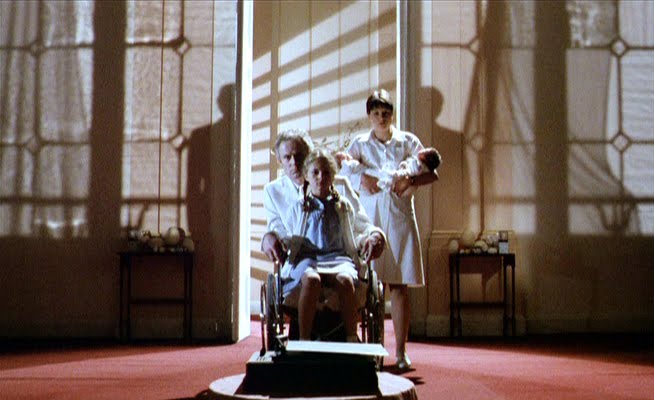
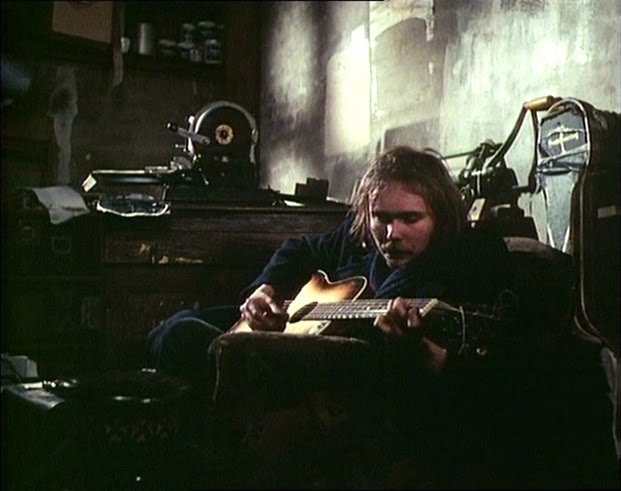
The images, forever beyond comment or criticism, exist without context. Any meaning that is tangible enough to be put into words is placed there by the viewer, who can choose to see the film as silent, as it may have appeared in 1949, or with the Jonathan Halper folk-tunes that were added in 1970 to offer a vaguely ironic juxtaposition between the implied 1920's decadence - and the Garbo-like suggestions of glamour that are central to the film's design - against the somewhat psychedelic, heart-on-sleeve longing of a strummed acoustic rhythm, backed by an electric lead.
That Puce Moment (1949) was originally created as a rough sketch for a planned but never completed feature-length project to-be-titled Puce Women is in no way a mark against its character. Even in its surviving form of a minuscule six-minutes and fourteen seconds of screen time in total, the actual filmmaking technique, and the way in which the audience is able to tease out a story, however vague it might be, is never less than fascinating; drawing on our natural associations with the aforementioned G. Garbo, whose request to be left alone saw her self-imposed seclusion in a New York City penthouse, or of the world of a film like Sunset Blvd. (1950), where the faded glamour and existence in the shadow of Hollywood writ large becomes a world of illusion, between dream and insanity.
As a complete work and in its own right, Puce Moment is a mesmerizing spectacle; an absolute marvel of colour and composition, lighting and shadow - as the swishing gowns that open the film take on an almost kaleidoscopic approach, where collage turns to montage and the accumulative effect of these images becomes absolutely astounding. However, when viewed within the context of the Anger filmogaphy as a whole, one could argue that the film doesn't quite compare to the genius of projects like Fireworks (1947), Inauguration of the Pleasure Dome (1954) or Scorpio Rising (1963), which feel like complete works, as opposed to unfinished sketches. In contrast, Puce Moment, like the brilliant Kustom Kar Kommandos (1965), probably plays more like a music video than as a comprehensive piece of work, especially when we view it from a contemporary perspective of MTV.
However, this isn't to take anything away from the film or the experience that is offered, with the sheer fact that Puce Moment predates the music video industry by several decades being further proof of its incredible Proustian ability to transcend the notions of time. Not only in terms of the basic form, but in the sense that this is a film that feels like something from the 1960's, produced in the late 1940's, looking back to the 1920's, and one that still holds up as a fascinating example of the true power of cinema at its most basic level (of sound applied to image) sixty-years after it was first conceived.
It is, as the title might suggest, a burst of lush, feminine colour; a mirror ball reflection - either critical or celebratory - of ornate grandeur (a house on the hill) and days that are filled with sleep and nothing. Where the preening excess of the central character, as played by Yvonne Marquis, becomes an evocation of life's great emptiness - the act of getting herself ready and looking fabulous for walking the dogs or lounging listlessly on the veranda - or an ode to the vacuous vice of vanity. Although Puce Moment, as a truncated demo-piece, suggests one of the many great could-have-been moments in the career of Kenneth Anger, it nonetheless remains a intriguing insight into the working mind of one of the most exciting and integral filmmakers that ever lived.
Thursday, 23 July 2009
Wednesday, 8 July 2009
Les hautes solitudes
In keeping with the vast majority of the films of its writer/director, Philippe Garrel, Les hautes solitudes (1974) is an intensely personal experience. A film in which characters thrown together in empty rooms stung by silence drift between fleeting glances, reacting or not reacting as the case may be to what is said, what isn't said, and everything in-between. It is, as one might expect given its technical presentation, a fairly impenetrable work, though one that we're free to carry with us; ruminating on each tattered scene as we gather up our thoughts like raindrops, either during the experience of viewing or afterwards, and inevitably projecting our own thoughts and feelings (or personal preconceptions) onto the images, or its central characters, who remain vague and elusive; indistinguishable from the actors who play them and whose faces dominate each single-shot close-up composition, used throughout to establish a story - or a sense of narrative that exists between sleep and nothing - to reveal a sense of the great loneliness that the title of the film so perfectly describes.
Although the intentions of Les hautes solitudes remain unclear, obscured by the closeness of the compositions or the complete lack of any kind of conventional soundtrack to make explicit those stolen moments of thought, we can at least take the film to be a kind of silent-study of its three individual characters; the actresses Jean Seberg and Tina Aumont, and the singer and musician Nico, whose decade-long relationship with Garrel has become a spectre that haunts the very framework of his cinema, stretching as far back as her earliest appearance in the abstract, esoteric drama The Inner Scar (La cicatrice intérieure, 1972), to the recollections of her spirit and the void left in her absence in films like Emergency Kisses (Les baisers de secours, 1989) or I Don't Hear the Guitar Any More (J'entends plus la guitar, 1991).
In Les hautes solitudes, it is Nico's face that we see first, slumped in a kind of morose contemplation as the images flicker with a Murnau-like intensity, as the antique quality of the composition reminds us, subconsciously, of the world of Faust (1926) or Nosferatu (1922); suggesting that feeling of the supernatural, gothic and severe, or of a nocturnal underworld devoid of time and place. As was the case with Garrel's earlier silent film, Le révélateur (1968), there is that sense of a world in which life has stopped dead; where we witness these characters interacting, thinking - the expressions on their faces telling a story in the loosest possible sense - but they, like us, are still waiting; waiting for something (anything) to happen. Good or bad, we don't quite know, but there is a continual feeling that the world around them has fallen away, leaving only the four-walls, floors and ceilings of the apartment, the empty street bellow and those other spaces, rubble and mirrors, that seem to be beyond our basic comprehension.
In this sense, the film becomes a sort of ghost story in which the inability of one character to relate to another character is conveyed through the intensity of those exhausting compositions of actors attempting to express thoughts and emotions - or the basic human need to a feel a part of something meaningful or substantial - but silenced, literally, by Garrel's particular filmmaking approach. By removing the soundtrack completely, so that not even a musical score or a drone of ambient white-noise can block out our own thoughts (either on the subject of the film, or our thoughts in general), Garrel makes the breakdown in communication between his four central characters - the three women and the actor Laurent Terzieff - all the more palpable; as lips move and the eyes dart back and forth from one side of the frame to another in a parody of conversation while the scene remains silent. The words literally cannot express the complexity of the emotions felt or experienced by these four lead protagonists, just as they fail to fully express our own relationship with them or with the film in question.
We never know if these actors are playing characters, or instead playing themselves, or even if their relationships extend beyond the actual beginning and end of the drama. Such questions remain on our mind throughout the film, as we watch these dramas play-out in bedrooms and kitchens, filled with looks and smiles which could be genuine - as in developing naturally from the drama and the interactions of the characters - or could be a cheat, as in those stolen moments, taken between takes and continuing the often Brechtian, deconstructive aspect that Garrel employs throughout. The accumulative effect of these images is eventually closer to the avant-garde of Stan Brakhage than the cinema of Vigo or Jean Eusrache, as the film becomes an installation piece, just there, in front of us, but beyond a reasonable grasp.
It is an impossible film to really pin-down and explain what is what without the benefit of further reading; with each reaction or spontaneous smile following a scene of full-face emotion disarming us, throwing our interpretations into confusion, leading to greater questions, thoughts and misunderstandings, etcetera. At certain points it seems like a depressing film, as Seberg, still beautiful, but quite clearly a world-away from the lively young girl of Bonjour Tristesse (1958) or À bout de souffle (1960), breaks down in tears and is comforted by Aumont, who reminds us of what a great and expressive actress she was away from the dull exploitation of films like Torso (I corpi presentano tracce di violenza carnale/Bodies Bear Traces of Carnal Violence, 1973) or The Howl (L'urlo, 1970). However, at other times the mood is playful, as we sense some of the fun and the frivolity of this collective of likeminded individuals, friends and collaborators, producing a film, a personal and to some extents private work (as Garrel's work often seems to be), in the solitude of a rented apartment building.
Despite such moments, which could very easily be another example of Garrel's deconstruction of the film, allowing shots to run further than the moment of the cut - or the way in which the whole thing becomes about the process of filmmaking itself - it is the gloom and the inability of the characters to communicate that we eventually come back to. A haunted film in many respects, in which characters are introduced, either slumbering or on the precipice of sleep (Nico and Seberg) or instead gazing into windows or pools of mirrored reflections (Aumont and Terzieff); or where the high-contrast black and white and the fragmented framing of images, as half-lit faces, hands and arms, expressions hidden, either by the characters themselves or by the doorways that get in the way of the action as we intrude, silently, upon the scene, becomes yet another barrier.
Beyond this, we're left with Seberg's face, which dominates the film, full of expression, even if the ability to plainly express in words seems to be beyond her. The fact that Seberg would be dead by the end of the decade, just three months shy of her 41st birthday, gives the film an added sense of tragedy that may not have been the intention. And when we take into consideration the early deaths of Nico (1938-1988) and Aumont (1946-2006), the idea of a ghost story, or a haunted film, becomes all the more concrete. Such ideas become manifest when combined with the cinematography, the sparseness of the locations and the feeling that time has become a mere affectation. From the first appearance of Seberg seven-minutes into the film, tossing and turning in bed and appearing to eventually fall asleep (in real-time) before a fade to black implies the passage between night and day, the narrative seems suspended, as moments pass, but with no real urgency, nothing to move along to besides the same old rooms and faces.
As a study for Serberg, or of Seberg, the film is absolutely riveting, as we watch with complete fascination the bombardment of emotions, or facial expressions, of acting at its most naked and unrefined, being projected as Garrel cuts in and out of these blurred relationships, where each look to the camera, beyond the camera, to the empty spaces that mock us with their vacant austerity, reminding us of the windows where life should be. Can we take hope from that penultimate shot, which lasts for several minutes and shows Seberg, bathed in glowing light and buried beneath an attractive sunhat, as she coyly expresses a range of conflicted facial expressions as if putting on an audition (for Garrel, and by extension the audience), or is the hope destroyed by the final plunging retreat into backlit melancholia? A silhouetted pose, cigarette smoke and "Les hautes solitudes", as Seberg returns to the darkness, away from the bright white light that filters in through the bedroom window; away from the fantasy ideal of what could have been, or should have been, if only things had been different.
It is that particular presentation of characters in a state of trance, fearfully in danger, which makes it impossible not to be reminded of Nico's music; with the mood and tone reflecting songs like 'Innocent and Vain' or 'Frozen Warnings', or the lyrical reflections of 'Afraid'; as her voice, an aching monotone, reassures us, but also hold the mirror to the heartbreaking line "you are beautiful and you are alone." Such associations are impossible to ignore given the intensity of these two individuals and their relationship, which dominated a period of creativity that resulted in the conception of great music and great cinema (and the spaces between the two). Let's not forget that a colour-tinted still of the film even featured on the cover of Nico's album The End (1973), or that Garrel originally intended to use segments of Nico's music as a soundtrack to the film, before Seberg suggested that the images remain silent.
As the film ends we're left with as many questions as when it began; basic questions, like who are these people and what do they want? What were the intentions of the filmmaker? What role does the supposed influence of Nietzsche's The Antichrist (first published, 1888) have on the world of the film or the development of its narrative? ...And so on. The only thing we're really sure of is Seberg's brilliance and Garrel's genius, creating a film that is entirely dependent on the interpretations of the audience, as we project our own thoughts and feelings in an attempt to understand these characters and their complex interrelationships. In introducing his own work, Nietzsche wrote that "In order to understand the book, one must be honest in intellectual matters to the point of harshness to so much as endure my seriousness, my passion." "Let us look one another in the face." These words, which resonate on a monumental level when watching the reactions of these three no-longer-with us cult-icons, could just as easily be the introduction to Garrel's intensely personal film.
Although the intentions of Les hautes solitudes remain unclear, obscured by the closeness of the compositions or the complete lack of any kind of conventional soundtrack to make explicit those stolen moments of thought, we can at least take the film to be a kind of silent-study of its three individual characters; the actresses Jean Seberg and Tina Aumont, and the singer and musician Nico, whose decade-long relationship with Garrel has become a spectre that haunts the very framework of his cinema, stretching as far back as her earliest appearance in the abstract, esoteric drama The Inner Scar (La cicatrice intérieure, 1972), to the recollections of her spirit and the void left in her absence in films like Emergency Kisses (Les baisers de secours, 1989) or I Don't Hear the Guitar Any More (J'entends plus la guitar, 1991).
In Les hautes solitudes, it is Nico's face that we see first, slumped in a kind of morose contemplation as the images flicker with a Murnau-like intensity, as the antique quality of the composition reminds us, subconsciously, of the world of Faust (1926) or Nosferatu (1922); suggesting that feeling of the supernatural, gothic and severe, or of a nocturnal underworld devoid of time and place. As was the case with Garrel's earlier silent film, Le révélateur (1968), there is that sense of a world in which life has stopped dead; where we witness these characters interacting, thinking - the expressions on their faces telling a story in the loosest possible sense - but they, like us, are still waiting; waiting for something (anything) to happen. Good or bad, we don't quite know, but there is a continual feeling that the world around them has fallen away, leaving only the four-walls, floors and ceilings of the apartment, the empty street bellow and those other spaces, rubble and mirrors, that seem to be beyond our basic comprehension.
Les hautes solitudes directed by Philippe Garrel, 1974:
Nosferatu directed by F.W. Murnau, 1922:
Le révélateur directed by Philippe Garrel, 1968:

Nosferatu directed by F.W. Murnau, 1922:
Le révélateur directed by Philippe Garrel, 1968:

In this sense, the film becomes a sort of ghost story in which the inability of one character to relate to another character is conveyed through the intensity of those exhausting compositions of actors attempting to express thoughts and emotions - or the basic human need to a feel a part of something meaningful or substantial - but silenced, literally, by Garrel's particular filmmaking approach. By removing the soundtrack completely, so that not even a musical score or a drone of ambient white-noise can block out our own thoughts (either on the subject of the film, or our thoughts in general), Garrel makes the breakdown in communication between his four central characters - the three women and the actor Laurent Terzieff - all the more palpable; as lips move and the eyes dart back and forth from one side of the frame to another in a parody of conversation while the scene remains silent. The words literally cannot express the complexity of the emotions felt or experienced by these four lead protagonists, just as they fail to fully express our own relationship with them or with the film in question.
We never know if these actors are playing characters, or instead playing themselves, or even if their relationships extend beyond the actual beginning and end of the drama. Such questions remain on our mind throughout the film, as we watch these dramas play-out in bedrooms and kitchens, filled with looks and smiles which could be genuine - as in developing naturally from the drama and the interactions of the characters - or could be a cheat, as in those stolen moments, taken between takes and continuing the often Brechtian, deconstructive aspect that Garrel employs throughout. The accumulative effect of these images is eventually closer to the avant-garde of Stan Brakhage than the cinema of Vigo or Jean Eusrache, as the film becomes an installation piece, just there, in front of us, but beyond a reasonable grasp.
It is an impossible film to really pin-down and explain what is what without the benefit of further reading; with each reaction or spontaneous smile following a scene of full-face emotion disarming us, throwing our interpretations into confusion, leading to greater questions, thoughts and misunderstandings, etcetera. At certain points it seems like a depressing film, as Seberg, still beautiful, but quite clearly a world-away from the lively young girl of Bonjour Tristesse (1958) or À bout de souffle (1960), breaks down in tears and is comforted by Aumont, who reminds us of what a great and expressive actress she was away from the dull exploitation of films like Torso (I corpi presentano tracce di violenza carnale/Bodies Bear Traces of Carnal Violence, 1973) or The Howl (L'urlo, 1970). However, at other times the mood is playful, as we sense some of the fun and the frivolity of this collective of likeminded individuals, friends and collaborators, producing a film, a personal and to some extents private work (as Garrel's work often seems to be), in the solitude of a rented apartment building.
Despite such moments, which could very easily be another example of Garrel's deconstruction of the film, allowing shots to run further than the moment of the cut - or the way in which the whole thing becomes about the process of filmmaking itself - it is the gloom and the inability of the characters to communicate that we eventually come back to. A haunted film in many respects, in which characters are introduced, either slumbering or on the precipice of sleep (Nico and Seberg) or instead gazing into windows or pools of mirrored reflections (Aumont and Terzieff); or where the high-contrast black and white and the fragmented framing of images, as half-lit faces, hands and arms, expressions hidden, either by the characters themselves or by the doorways that get in the way of the action as we intrude, silently, upon the scene, becomes yet another barrier.
Beyond this, we're left with Seberg's face, which dominates the film, full of expression, even if the ability to plainly express in words seems to be beyond her. The fact that Seberg would be dead by the end of the decade, just three months shy of her 41st birthday, gives the film an added sense of tragedy that may not have been the intention. And when we take into consideration the early deaths of Nico (1938-1988) and Aumont (1946-2006), the idea of a ghost story, or a haunted film, becomes all the more concrete. Such ideas become manifest when combined with the cinematography, the sparseness of the locations and the feeling that time has become a mere affectation. From the first appearance of Seberg seven-minutes into the film, tossing and turning in bed and appearing to eventually fall asleep (in real-time) before a fade to black implies the passage between night and day, the narrative seems suspended, as moments pass, but with no real urgency, nothing to move along to besides the same old rooms and faces.
As a study for Serberg, or of Seberg, the film is absolutely riveting, as we watch with complete fascination the bombardment of emotions, or facial expressions, of acting at its most naked and unrefined, being projected as Garrel cuts in and out of these blurred relationships, where each look to the camera, beyond the camera, to the empty spaces that mock us with their vacant austerity, reminding us of the windows where life should be. Can we take hope from that penultimate shot, which lasts for several minutes and shows Seberg, bathed in glowing light and buried beneath an attractive sunhat, as she coyly expresses a range of conflicted facial expressions as if putting on an audition (for Garrel, and by extension the audience), or is the hope destroyed by the final plunging retreat into backlit melancholia? A silhouetted pose, cigarette smoke and "Les hautes solitudes", as Seberg returns to the darkness, away from the bright white light that filters in through the bedroom window; away from the fantasy ideal of what could have been, or should have been, if only things had been different.
Les hautes solitudes directed by Philippe Garrel, 1974:
The End... by Nico, 1974:
Les hautes solitudes directed by Philippe Garrel, 1974:

The End... by Nico, 1974:
Les hautes solitudes directed by Philippe Garrel, 1974:

It is that particular presentation of characters in a state of trance, fearfully in danger, which makes it impossible not to be reminded of Nico's music; with the mood and tone reflecting songs like 'Innocent and Vain' or 'Frozen Warnings', or the lyrical reflections of 'Afraid'; as her voice, an aching monotone, reassures us, but also hold the mirror to the heartbreaking line "you are beautiful and you are alone." Such associations are impossible to ignore given the intensity of these two individuals and their relationship, which dominated a period of creativity that resulted in the conception of great music and great cinema (and the spaces between the two). Let's not forget that a colour-tinted still of the film even featured on the cover of Nico's album The End (1973), or that Garrel originally intended to use segments of Nico's music as a soundtrack to the film, before Seberg suggested that the images remain silent.
As the film ends we're left with as many questions as when it began; basic questions, like who are these people and what do they want? What were the intentions of the filmmaker? What role does the supposed influence of Nietzsche's The Antichrist (first published, 1888) have on the world of the film or the development of its narrative? ...And so on. The only thing we're really sure of is Seberg's brilliance and Garrel's genius, creating a film that is entirely dependent on the interpretations of the audience, as we project our own thoughts and feelings in an attempt to understand these characters and their complex interrelationships. In introducing his own work, Nietzsche wrote that "In order to understand the book, one must be honest in intellectual matters to the point of harshness to so much as endure my seriousness, my passion." "Let us look one another in the face." These words, which resonate on a monumental level when watching the reactions of these three no-longer-with us cult-icons, could just as easily be the introduction to Garrel's intensely personal film.
Friday, 26 June 2009
Hard Labour
Released this past month as part of the Mike Leigh at the BBC box-set, Hard Labour (first broadcast, 12th March, 1973) was the now-highly acclaimed director's second feature length work and his first for the company's long running Play for Today series, to which he would later contribute the more highly-regarded films Nuts in May (1976), The Kiss of Death (1977), Abigail's Party (1977) and Home Sweet Home (1982). As with his debut feature, the stifled, claustrophobic chamber piece Bleak Moments (1971), Hard Labour is a strictly downbeat affair, with the usual characteristic Leigh sense of humour, so brilliantly developed in films like Grown Ups (1980), Life is Sweet (1991) and Happy-Go-Lucky (2008), being in the formative stages throughout.
Although the humour is mostly absent, the recognisable emphasis on the day-to-day comings and goings of characters living and working through these various situations is as bold and affective as it has remained, thirty-years on; with the natural talent of Leigh as a filmmaker, preoccupied with the minute details that make up the greater whole managing to bring these separate elements together in a way that is intelligent and completely affecting. It is a film that, at its most basic and recognisable, offers us a simple story, or, more specifically, a window into the world of its central character, the middle-aged cleaning lady Mrs. Thornley (Liz Smith). While the character is deliberately refused a first name by the filmmaker, we can nonetheless recognise certain character traits that mark her out as is an even more bedraggled forerunner to the titular Vera Drake; with the poor posture and the softly-spoken voice, barely audible over the constant of family arguments or the distant ambience of the industrial working-class milieu, defining a tone that permeates every second of the drama; from the seemingly pointless conversations to the quiet moments where characters sit and think in stone-faced contemplation.
From this initial set up, Leigh is able to maintain his drama through the continual interaction between the characters; as these scenes of dialog, or the quieter instances where the camera simply holds on a actor's face and they share a moment, bleak or otherwise, are used to suggest deeper, more universal themes that go beyond the characters presented on screen and suggest something recognisably human and relevant to the world in which we live. It's subtle, even without the use of humour to distract us from the otherwise crushing sense of despair, while the development of the characters and the situations they've found themselves in feel very authentic; especially in regards to the world of the film and the motivations of the characters.


As one might expect given the usual implications of the title, Leigh's general approach to the film is to show and then contrast the working life with the family life; opening with a series of short scene-punctuations that perfectly establish the various drab, everyday rituals that make up the routine of this galley of protagonists, as the camera, static and composed, observes in great detail the general running of this dysfunctional lower class family at the start of an average day. These early sequences establish a particular rhythm, with the obvious reiteration of things, as the character asks twice for her husband to lift his feet as she runs the small vacuum cleaner past the chair, across the faded floral carpet - and almost immediately we wonder how many times she's asked and asked again for her husband to shift his legs while she performs this crushing, domestic rite. Back and forth over the carpet with the vacuum cleaner while the husband, weary from work or back from an afternoon of heavy drinking, barks orders or chips away at the character's already tattered self-esteem.


These sequences are captured, like much of the film, in a characteristically loose, narrative-vignette approach that highlights Leigh's continual emphasis on character and observation as a means to explore the deeper, more expressive themes at work beneath the surface. In keeping with such a notion, the film is, in essence, concerned, or obsessed (?), with the little close-up details that make up the bigger picture. Just as the natural accumulation of one day to the next, month on month, year on year, creates the endless spiral of existence as it unfolds, so too does the repetition of scenes that suggest so perfectly that sense of a life in-progress that survives beyond the parameters of the film's frame - beginning and end, opening title to closing credits - creating the sense that the world has turned and continues to turn long after the screen has faded.
Although the film grants an equal amount of screen-time to several characters, both within the family and on the periphery of the drama, it is the perspective of Mrs. Thornley as the family's quiet matriarch who dominates the proceedings; either as a kind of facilitator, offering the characters a chance to meet and interact - bridging the gap so to speak through her job and her commitments between work and home, the suburbs and the sink estate - or simply observing the conflicts and drama, quiet and dignified, though her face, with the sunken eyes and hollowed mouth, revealing everything. The rest of the characters exist around her, and their attitudes and interactions, both in regards to her and the characters around them are largely filtered through this quiet perspective of a character watching from the corners of the frame.

Throughout the film, Leigh cuts back and forth between scenes of Mrs. Thornley at work - polishing the silverware or struggling to carry large bundles of clothes up and down winding carpeted stairs - and the domestic scenes, as she dotes on her chauvinistic husband Jim (Clifford Kershaw), a night watchman who complains endlessly about his bad back and uncomfortable shoes between loveless putdowns and perpetual scowls, and her two grown-up children, Ann (Polly Hemmingway), who still lives at home, though very much has a life of her own, and Edward (Bernard Hill), a car mechanic getting comfortable in one of those new council estates with his bossy young wife Veronica (Alison Steadman). The integration of these characters, as they meet over lunch or Sunday dinner, or during the general progression of an average day, creates the usual clashes of generation, class and personality that we've come to expect from Leigh's cinema; as the petty squabbles and sometimes deep-seated jealousies and anxieties are revealed through the scenes of passive-aggressive confrontation, as one character instinctively taunts the other character to breaking point, either deliberately, or simply because it's possible and part of the natural interaction between characters within a family environment far too comfortable in the company of one and other.


In such sequences, we can see the Leigh of Who's Who (1978), or Meantime (1984), or High Hopes (1988) and even the comparatively recent Vera Drake (2004), and all of these strands passing back and forth through the previously mentioned Abigail's Party to the presentation of scenes herein; scenes in which characters from both ends of the social spectrum are thrown together and allowed to contrast and conflict in a way that not only reveals something about themselves, as characters, but also about the world (this world or Leigh's?) in which they continue to exist.
Though there are several other themes explored in the film, the real emphasis here is on the coexistence of these characters under the broader classification of "the family". Immediately, we can recognise this as a key theme in Leigh's work, in which the differences between these people, connected, but nonetheless at odds, becomes magnified; as that accumulation of time as defined above, exaggerates each characteristic tic or quirk until the idea of simply being in the room with these people is like negotiating a particularly cluttered minefield. As ever with Leigh, the point of such scenes isn't merely the exterior level - the things said between two characters under the pretence of conversation - but the things implied by these sequences - the things going on beneath the surface. Are they really relevant, these discussions of what kind of cheese to get from the precinct or a pair of boots one size too small, or can such conversations fill in the blanks about the relationships between these various characters; their approach to life and, more importantly, their approach to one another?
Take the brief scene between Mrs. Thornley and her daughter at the outdoor-market as one single example. A scene lasting no more than a minute or two of screen time in which the two women sift through piles of half-price underwear on a cluttered weekend market stall. Again, is it important that Ann wants the purple bra? Does it move the narrative forward in a way that creates compelling, exciting drama? No, of course not! But it establishes the contrasts between the mother and her daughter, showing a young woman who exists in a world of fashion and sexuality - a world where sex is a recreational pursuit, to be enjoyed - and a world away from the generation of Mrs. Thornley, where the closest thing to intimacy or affection is being pawed by a husband looking for a drunken post-pub leg-over. The sad desperation of those early evenings, pretending to be asleep to spare her the agony of another awkward assault, as the husband moans and gropes and writhes around beneath the sheets because, in the days before women's lib or god-given-notions of equality, that was his right.


There are the little things too, like the relationship between Ann and her sister-in-law Veronica, both of the same background and generation, who were most probably school friends before Veronica was wooed or pursued her best-friend's (?) brother and now makes life difficult for everyone by projecting her own middle-class aspirations onto this surrogate family, expecting them to reach some higher level of living through economic gain, social-status, and those all important outward appearances. As ever with Leigh, we can view these as the typical concerns with class, which still dominate much of British art and British attitudes, as we glorify the working class, pity those who have achieved some worth in a middle-class sense, though obviously not enough to rank as highly as the smart-set, who we pretend to hate, but really hold enthral. Nonetheless, this class emphasis is really just one of Leigh's many devises, like satire or character improvisation, that is used to map the psychology of characters, developed to a staggering degree from months of intricate pre-production meetings and rehearsal workshops until the creation of a completely functioning character, from birth until the moment that they appear on screen, is formed.
This interest in mapping out the parameters of his characters also extends as far as the world that Leigh creates, which, in a number of ways, seems exactly like the world in which we live, and yet even then there is some process of stylisation or creative abstraction, which is unavoidable. Though many critics continue to cite Leigh as a social-realist, lazily comparing him to the much more socially aware and politically motivated Ken Loach, his work has much more in common with filmmakers like Yasujirō Ozu, Maurice Pialat or Rainer Werner Fassbinder; with the emphasis on looking, observing, sometimes dethatched, but concerned with the outcome of these characters; letting the little details of the rooms and the way they're captured tell a story. The small, cramped, two-bedroom house with its outdoor toilet and kitchen too small to move around in; the flowery wallpaper and radios offering nameless songs that could recall seaside romance but instead mock the soot-lined streets and drudgery that waits around each corner; 30p an hour, 3 hours and five mornings, polishing silverware while the lady of the house looks you over, eagle-eyed behind those horn-rimmed spectacles.


With Hard Labour, Leigh creates a rough-around-the-edges film that not only manages to operate in a storytelling capacity - presenting the usual look at character concerns and intricate personal-relationships - but one that also manages to say a great deal about the time and place in which it is set. That particular evocation of the cobble-stone streets and cluttered back alleyways where dogs wander, catching a scent and then off again, bringing to mind the desolate existential landscapes of Tarkovsky or Béla Tarr; with the grit and the grime and the overcast skies recalling a film like Stalker (1979) or Damnation (Kárhozat, 1988). But this isn't science-fiction or expressionist-noir, but the real life dramatisation of a specific time and place; chiefly, Salford, Greater Manchester, in the early 1970's. A changing world, captured so vividly in Morrissey's controversial song Bengali in Platforms from his debut solo album Viva Hate (1989), and in turn the world of The Buddha of Suburbia, with the character of Naseem (Ben Kingsley) and a seemingly secondary sub-plot about back-street abortions, making the relationship with Vera Drake an explicit one, while giving weight to Ann's all-of-a-sudden interest in the particulars of child-birth and her mother's sage advice; "you have to suffer to bring children into the world."
We can recognise these characters, just as we can recognise that sense of domestic drudgery; from the banging on the ceiling with the broom-handle to stir the old-enough-to-know-better daughter, to the "shut up/no you shut up" exchanges of dialog; as dad puts the world to rights through a mouthful of soggy toast. The natural repetition of these scenes repeated, breakfast, lunch and dinner, as Mrs. Thornley, desperate to please, let's her dinner go cold on the table as her husband and daughter shovel it down and ask for more. We can recognise the disappointment of this life from the very first scene, but it is only as the film edges towards its closing moments, and in particular the penultimate scene, that we realise Mrs. Thornley feels it too.

In perhaps the most famous scene in the film, the character attends her Sunday morning confession and reveals to the priest that her dissatisfaction with life and her inability to love or connect with the people around her has become too much to bear. In true Leigh form, this scene, which is brilliantly performed by Smith and shot by the filmmaker with a direct, uncomplicated precision, is emotionally honest and just the right side of painful; as the inability of Mrs. Thornley to express her problem is greeted by half-hearted 'Hail Mary's' and again, that attitude of chauvinism, as yet another man fails to recognise the pain of a woman boxed into a corner and unable to escape. However, in this very obvious mocking of religion, with its agendas and advice that goes nowhere, Leigh actually succeeds in creating a moment that is wickedly funny, if, again, no less painful. Although I maintain that the usual Leigh sense of humour is lacking here, the last-minute reveal of the Priest, flicking through his Sunday newspaper as Mrs. Thornley bares her soul as best she can, does hint at the direction that much of Leigh's work would take following the liberation of the subsequent Nuts in May and the later emphasis on comedy (often black-comedy, or the comedy of everyday life) to undercut the more harrowing moments of personal pain.
These are themes that will become more important as the progression of Leigh as a filmmaker continues on, with the idea of the family and the emotional split between the husband and wife in particular reminding us of the dysfunctional relationships and quiet, inarticulate characters in films like Secrets and Lies (1996) and All or Nothing (2002); where the simple process of sharing a moment over the kitchen table when resentments and anxieties get in the way of our natural instincts to care for one another becomes a form of hard labour in itself. In this respect, the title of Leigh's film not only expresses the daily grind of the character's life as she is forced to care for and pick up after her family and the snobbish middle-class housewives whose posh, Mock-Tudor houses she cleans for a living, but also the notion of life, and in particular married life, as a kind of prison sentence.
Although the humour is mostly absent, the recognisable emphasis on the day-to-day comings and goings of characters living and working through these various situations is as bold and affective as it has remained, thirty-years on; with the natural talent of Leigh as a filmmaker, preoccupied with the minute details that make up the greater whole managing to bring these separate elements together in a way that is intelligent and completely affecting. It is a film that, at its most basic and recognisable, offers us a simple story, or, more specifically, a window into the world of its central character, the middle-aged cleaning lady Mrs. Thornley (Liz Smith). While the character is deliberately refused a first name by the filmmaker, we can nonetheless recognise certain character traits that mark her out as is an even more bedraggled forerunner to the titular Vera Drake; with the poor posture and the softly-spoken voice, barely audible over the constant of family arguments or the distant ambience of the industrial working-class milieu, defining a tone that permeates every second of the drama; from the seemingly pointless conversations to the quiet moments where characters sit and think in stone-faced contemplation.
From this initial set up, Leigh is able to maintain his drama through the continual interaction between the characters; as these scenes of dialog, or the quieter instances where the camera simply holds on a actor's face and they share a moment, bleak or otherwise, are used to suggest deeper, more universal themes that go beyond the characters presented on screen and suggest something recognisably human and relevant to the world in which we live. It's subtle, even without the use of humour to distract us from the otherwise crushing sense of despair, while the development of the characters and the situations they've found themselves in feel very authentic; especially in regards to the world of the film and the motivations of the characters.


As one might expect given the usual implications of the title, Leigh's general approach to the film is to show and then contrast the working life with the family life; opening with a series of short scene-punctuations that perfectly establish the various drab, everyday rituals that make up the routine of this galley of protagonists, as the camera, static and composed, observes in great detail the general running of this dysfunctional lower class family at the start of an average day. These early sequences establish a particular rhythm, with the obvious reiteration of things, as the character asks twice for her husband to lift his feet as she runs the small vacuum cleaner past the chair, across the faded floral carpet - and almost immediately we wonder how many times she's asked and asked again for her husband to shift his legs while she performs this crushing, domestic rite. Back and forth over the carpet with the vacuum cleaner while the husband, weary from work or back from an afternoon of heavy drinking, barks orders or chips away at the character's already tattered self-esteem.


These sequences are captured, like much of the film, in a characteristically loose, narrative-vignette approach that highlights Leigh's continual emphasis on character and observation as a means to explore the deeper, more expressive themes at work beneath the surface. In keeping with such a notion, the film is, in essence, concerned, or obsessed (?), with the little close-up details that make up the bigger picture. Just as the natural accumulation of one day to the next, month on month, year on year, creates the endless spiral of existence as it unfolds, so too does the repetition of scenes that suggest so perfectly that sense of a life in-progress that survives beyond the parameters of the film's frame - beginning and end, opening title to closing credits - creating the sense that the world has turned and continues to turn long after the screen has faded.
Although the film grants an equal amount of screen-time to several characters, both within the family and on the periphery of the drama, it is the perspective of Mrs. Thornley as the family's quiet matriarch who dominates the proceedings; either as a kind of facilitator, offering the characters a chance to meet and interact - bridging the gap so to speak through her job and her commitments between work and home, the suburbs and the sink estate - or simply observing the conflicts and drama, quiet and dignified, though her face, with the sunken eyes and hollowed mouth, revealing everything. The rest of the characters exist around her, and their attitudes and interactions, both in regards to her and the characters around them are largely filtered through this quiet perspective of a character watching from the corners of the frame.

Throughout the film, Leigh cuts back and forth between scenes of Mrs. Thornley at work - polishing the silverware or struggling to carry large bundles of clothes up and down winding carpeted stairs - and the domestic scenes, as she dotes on her chauvinistic husband Jim (Clifford Kershaw), a night watchman who complains endlessly about his bad back and uncomfortable shoes between loveless putdowns and perpetual scowls, and her two grown-up children, Ann (Polly Hemmingway), who still lives at home, though very much has a life of her own, and Edward (Bernard Hill), a car mechanic getting comfortable in one of those new council estates with his bossy young wife Veronica (Alison Steadman). The integration of these characters, as they meet over lunch or Sunday dinner, or during the general progression of an average day, creates the usual clashes of generation, class and personality that we've come to expect from Leigh's cinema; as the petty squabbles and sometimes deep-seated jealousies and anxieties are revealed through the scenes of passive-aggressive confrontation, as one character instinctively taunts the other character to breaking point, either deliberately, or simply because it's possible and part of the natural interaction between characters within a family environment far too comfortable in the company of one and other.


In such sequences, we can see the Leigh of Who's Who (1978), or Meantime (1984), or High Hopes (1988) and even the comparatively recent Vera Drake (2004), and all of these strands passing back and forth through the previously mentioned Abigail's Party to the presentation of scenes herein; scenes in which characters from both ends of the social spectrum are thrown together and allowed to contrast and conflict in a way that not only reveals something about themselves, as characters, but also about the world (this world or Leigh's?) in which they continue to exist.
Though there are several other themes explored in the film, the real emphasis here is on the coexistence of these characters under the broader classification of "the family". Immediately, we can recognise this as a key theme in Leigh's work, in which the differences between these people, connected, but nonetheless at odds, becomes magnified; as that accumulation of time as defined above, exaggerates each characteristic tic or quirk until the idea of simply being in the room with these people is like negotiating a particularly cluttered minefield. As ever with Leigh, the point of such scenes isn't merely the exterior level - the things said between two characters under the pretence of conversation - but the things implied by these sequences - the things going on beneath the surface. Are they really relevant, these discussions of what kind of cheese to get from the precinct or a pair of boots one size too small, or can such conversations fill in the blanks about the relationships between these various characters; their approach to life and, more importantly, their approach to one another?
Take the brief scene between Mrs. Thornley and her daughter at the outdoor-market as one single example. A scene lasting no more than a minute or two of screen time in which the two women sift through piles of half-price underwear on a cluttered weekend market stall. Again, is it important that Ann wants the purple bra? Does it move the narrative forward in a way that creates compelling, exciting drama? No, of course not! But it establishes the contrasts between the mother and her daughter, showing a young woman who exists in a world of fashion and sexuality - a world where sex is a recreational pursuit, to be enjoyed - and a world away from the generation of Mrs. Thornley, where the closest thing to intimacy or affection is being pawed by a husband looking for a drunken post-pub leg-over. The sad desperation of those early evenings, pretending to be asleep to spare her the agony of another awkward assault, as the husband moans and gropes and writhes around beneath the sheets because, in the days before women's lib or god-given-notions of equality, that was his right.


There are the little things too, like the relationship between Ann and her sister-in-law Veronica, both of the same background and generation, who were most probably school friends before Veronica was wooed or pursued her best-friend's (?) brother and now makes life difficult for everyone by projecting her own middle-class aspirations onto this surrogate family, expecting them to reach some higher level of living through economic gain, social-status, and those all important outward appearances. As ever with Leigh, we can view these as the typical concerns with class, which still dominate much of British art and British attitudes, as we glorify the working class, pity those who have achieved some worth in a middle-class sense, though obviously not enough to rank as highly as the smart-set, who we pretend to hate, but really hold enthral. Nonetheless, this class emphasis is really just one of Leigh's many devises, like satire or character improvisation, that is used to map the psychology of characters, developed to a staggering degree from months of intricate pre-production meetings and rehearsal workshops until the creation of a completely functioning character, from birth until the moment that they appear on screen, is formed.
This interest in mapping out the parameters of his characters also extends as far as the world that Leigh creates, which, in a number of ways, seems exactly like the world in which we live, and yet even then there is some process of stylisation or creative abstraction, which is unavoidable. Though many critics continue to cite Leigh as a social-realist, lazily comparing him to the much more socially aware and politically motivated Ken Loach, his work has much more in common with filmmakers like Yasujirō Ozu, Maurice Pialat or Rainer Werner Fassbinder; with the emphasis on looking, observing, sometimes dethatched, but concerned with the outcome of these characters; letting the little details of the rooms and the way they're captured tell a story. The small, cramped, two-bedroom house with its outdoor toilet and kitchen too small to move around in; the flowery wallpaper and radios offering nameless songs that could recall seaside romance but instead mock the soot-lined streets and drudgery that waits around each corner; 30p an hour, 3 hours and five mornings, polishing silverware while the lady of the house looks you over, eagle-eyed behind those horn-rimmed spectacles.


With Hard Labour, Leigh creates a rough-around-the-edges film that not only manages to operate in a storytelling capacity - presenting the usual look at character concerns and intricate personal-relationships - but one that also manages to say a great deal about the time and place in which it is set. That particular evocation of the cobble-stone streets and cluttered back alleyways where dogs wander, catching a scent and then off again, bringing to mind the desolate existential landscapes of Tarkovsky or Béla Tarr; with the grit and the grime and the overcast skies recalling a film like Stalker (1979) or Damnation (Kárhozat, 1988). But this isn't science-fiction or expressionist-noir, but the real life dramatisation of a specific time and place; chiefly, Salford, Greater Manchester, in the early 1970's. A changing world, captured so vividly in Morrissey's controversial song Bengali in Platforms from his debut solo album Viva Hate (1989), and in turn the world of The Buddha of Suburbia, with the character of Naseem (Ben Kingsley) and a seemingly secondary sub-plot about back-street abortions, making the relationship with Vera Drake an explicit one, while giving weight to Ann's all-of-a-sudden interest in the particulars of child-birth and her mother's sage advice; "you have to suffer to bring children into the world."
We can recognise these characters, just as we can recognise that sense of domestic drudgery; from the banging on the ceiling with the broom-handle to stir the old-enough-to-know-better daughter, to the "shut up/no you shut up" exchanges of dialog; as dad puts the world to rights through a mouthful of soggy toast. The natural repetition of these scenes repeated, breakfast, lunch and dinner, as Mrs. Thornley, desperate to please, let's her dinner go cold on the table as her husband and daughter shovel it down and ask for more. We can recognise the disappointment of this life from the very first scene, but it is only as the film edges towards its closing moments, and in particular the penultimate scene, that we realise Mrs. Thornley feels it too.

In perhaps the most famous scene in the film, the character attends her Sunday morning confession and reveals to the priest that her dissatisfaction with life and her inability to love or connect with the people around her has become too much to bear. In true Leigh form, this scene, which is brilliantly performed by Smith and shot by the filmmaker with a direct, uncomplicated precision, is emotionally honest and just the right side of painful; as the inability of Mrs. Thornley to express her problem is greeted by half-hearted 'Hail Mary's' and again, that attitude of chauvinism, as yet another man fails to recognise the pain of a woman boxed into a corner and unable to escape. However, in this very obvious mocking of religion, with its agendas and advice that goes nowhere, Leigh actually succeeds in creating a moment that is wickedly funny, if, again, no less painful. Although I maintain that the usual Leigh sense of humour is lacking here, the last-minute reveal of the Priest, flicking through his Sunday newspaper as Mrs. Thornley bares her soul as best she can, does hint at the direction that much of Leigh's work would take following the liberation of the subsequent Nuts in May and the later emphasis on comedy (often black-comedy, or the comedy of everyday life) to undercut the more harrowing moments of personal pain.
These are themes that will become more important as the progression of Leigh as a filmmaker continues on, with the idea of the family and the emotional split between the husband and wife in particular reminding us of the dysfunctional relationships and quiet, inarticulate characters in films like Secrets and Lies (1996) and All or Nothing (2002); where the simple process of sharing a moment over the kitchen table when resentments and anxieties get in the way of our natural instincts to care for one another becomes a form of hard labour in itself. In this respect, the title of Leigh's film not only expresses the daily grind of the character's life as she is forced to care for and pick up after her family and the snobbish middle-class housewives whose posh, Mock-Tudor houses she cleans for a living, but also the notion of life, and in particular married life, as a kind of prison sentence.
Monday, 22 June 2009
A Zed & Two Noughts
An obsession with symmetry - of repetition and mirror images; of a creation and creativity suggested by the continual contrast between the theories of Charles Darwin and the artistic expressions of Johannes Vermeer - and in the recurring juxtapositions between light and dark, loss and longing, composition (visual) and decomposition (physical), to tell an engaging and often curiously appealing story about the mindset of bereavement and the ultimate unification that resonates on a level far more personal and emotionally rewarding than many viewers might expect given the director's sometimes justifiable reputation for cold, intellectual dissertation.
On the surface, the film presents its "two noughts" of the title as Oswald and Oliver Deuce (played by the real-life siblings Brian and Eric Deacon) - a literal expression of the "double-oh two" as alluded to in the reverse shot of the film's title, "OO2" (OOZ/e), etc - who offer yet another representation of the theme of twinship that will reoccur throughout. We also have the theme of anthropological study, as we examine these characters as one single facet of a much larger tapestry of ideas and ruminations that Greenaway is using in order to explore the various themes behind the film; while the characters themselves, in turn, examine the objects within the film - such as the various decomposing organisms that hold the secrets to life after death - as well as their own thoughts and feelings brought on by the deaths of their respective wives in a horribly macabre road accident.
From this, the actual presentation of the film, including its title, A Zed & Two Noughts (1985), works on several levels of interpretation; as Greenaway cleverly explores elements of meta-fiction, self-reference and intertextuality to continually construct, deconstruct and eventually reconstruct the film in a deliberate approach that seems designed to take apart the very basic thematic components of the narrative in order to draw a greater attention to their own manufactured artificiality. This involves the natural juxtaposition between his flat, tableau vivant compositions, and the bounding, highly intricate score by the always inventive Michael Nyman, which here, as indeed in the majority of these early Nyman-Greenaway collaborations, enlivens the film in a rhythmic sense, without losing that notion of the repetitive, highly formal approach to experimentation.
This particular combination, or contrast, as one contradictory element is placed against the other, can also be found in the director's bold use of narration (or the appropriation of such). In a brilliant stroke, Greenaway rejects the spoken text as literary mode as it is most often used in the cinema - brilliantly, for instance in Kubrick's Barry Lyndon (1975) or Scorsese's Taxi Driver (1976) - and instead takes the audio directly from the groundbreaking television series Life on Earth (first broadcast, 16th January, 1979) - in which the famed naturalist and documentary-maker Sir David Attenborough travelled the globe in order to trace the evolution of life on this planet. As a result, the use of narration, particularly in such a knowingly ironic way, seems designed to turn the events of the film into some kind of postmodernist post-mortem study; in which the characters become subjects, watched with a detached scientific curiosity, in a clear attempt to place them within a much larger and more intricate sphere of existence beyond our natural comprehension.
This dry, scientific investigatory device is again contrasted by the opulent production design of the film and the lush cinematography of Alain Resnais's frequent collaborator Sacha Vierny; as he and Greenaway experiment (primarily) with various film-lighting sources, including (but not limited to) bright fluorescents, flashlights, car headlamps, sodium bulbs, television monitors and, in one particular sequence, the reflections of an artificial rainbow.
These techniques are mostly used in an attempt to add a separate layer of interpretation to the compositions; which naturally, given the secondary themes explored within the film, draw on the presentation of the twenty-six featured paintings of the aforementioned Vermeer. It also ties in nicely with Greenaway's own interests in visual symmetry, twin ship and the interplay between light and dark (all of which relates explicitly to the themes and ideas developed within the script itself). There are also further obsessions with the number 26 and how it relates to the (English-language) Alphabet - which is recited throughout by a character as part of a game that is used to list the names of various zoo animals - as well as the twenty-six ways of lighting a scene, as previously alluded to.
As a result of this onslaught of onscreen information, it could be beneficial (either before or after seeing the film) to read up on the working life of the Dutch-born Baroque painter Johannes Vermeer; one of the central influences on the film and its aesthetic presentation. Throughout the film, Greenaway makes cryptic references to Vermeer's life and work, including his marriage to Catherina Bolenes and the existence of the infamous art-forger Han van Meegeren, as well as designing aspects of the film to match the actual interiors of Vermeer's own studio in Delft (or at least as it appears in his work). In fact, so fastidious was Greenaway in his attention to detail that he even made sure that the floor-tiling was smudged and slightly skewed in order to perfectly match the floors in Vermeer's own work - case in point, The Concert (Musicerend trio, 1664); one particularly good example of the "x-marks the spot" type effect.
[The two brothers, identified by their positioning beneath the Vermeer paintings, The Geographer and The Astronomer (1668/69), discuss their plans with the film's own faker (and a possible model for the director), Van Meegeren]
[A facsimile of Vermeer's masterpiece The Art of Painting (1666), with the physical model taken from his later piece, The Girl with a Red Hat (1668) being brought in to portray Catherina Bolenes, though here exposing her pubic hair in one of Greenaway's many audacious examples of artistic deconstruction]
The film also explores various ideas lifted from the theories of Desmond Morris, the author of the books The Naked Ape: A Zoologist's Study of the Human Animal (1967) and The Human Zoo (1969); the particular adaptation of which can be seen in the character of Venus de Milo (Frances Barber) - who's eroticised nature and bestial urges find expression behind the barred gates of the Rotterdam Zoo - and in the odd relationship between Alba Bewick (Andréa Ferréol) and Felipe Arc-en-Ciel (Wold Kahler), who find themselves both without legs (symmetry/two noughts/e-t-c) and considering a romantic liaison, given the fact that they've essentially become an equivalent species.
Naturally, there are the usual abstractions and games that Greenaway weaves into the drama, as well as the somewhat unconventional approach to the casting of the film; with the classically trained Joss Ackland appearing alongside the vulgar comedian Jim Davidson; the untrained child-actor Agnés Brulet alongside familiar television actor Geoffrey Palmer; and the lead casting of brothers Brian and Eric Deacon, playing twins, but actually born a few years apart. All of these devises are further examples of Greenaway's deconstruction of the preconceptions that many viewers might have in approaching a film that toys with the themes of loss and dislocation.
[Presentations of twinship: Oswald and Oliver bind themselves together using the tape that littered the crash-site where the car, driven by Alba, containing their wives, careened off the road and into a striped black and white lamppost; while below, the mise-en-scene of Greenaway and Vierny conspires to tear them apart]
As ever with Greenaway's work, there will be many who see it as an empty self-indulgence, or worse, pretentious self-satisfaction - as the allusions to art and creation are woven into a storyline with numerous references to science and evolution, all of which is used to foreground a very modest, almost melodramatic narrative about these two brothers reunited through grief. However, even if you cannot accept the idiosyncratic twists or deliberately deconstructive moments that are often at the forefront of Greenaway's creative intentions, there is simply no denying the enormous filmmaking ability that is demonstrated by the use of location and production design, the masterful shot compositions, the extraordinary use of sound and music and the sheer weight of ideas that the filmmaker is able to seamlessly layer into the proceedings; offering the usual esoteric, essayist predilections as the characters ponder and pontificate, and yet still managing to anchor the film to the obsessions and desires at the heart of these characters lives.
All of these various factors and ideas are brought together to tell the central story of the film, which in a precursor to the later film 8 ½ Women (1999), deals with the notions of grief and bereavement and how these various characters deal with such devastation; retreating into themselves and into one another to reclaim that connection to the world that has since been severed. Again, if we disregard Greenaway's intellectual experiments and visual eccentricities, the film can easily be approached as a tragic if somewhat reserved story about the collapse of these two related characters following the loss of their beloved partners, and of the eventual descent into both regression and obsession that is perfectly accompanied by the stunning mise-en-scene.
On the surface, the film presents its "two noughts" of the title as Oswald and Oliver Deuce (played by the real-life siblings Brian and Eric Deacon) - a literal expression of the "double-oh two" as alluded to in the reverse shot of the film's title, "OO2" (OOZ/e), etc - who offer yet another representation of the theme of twinship that will reoccur throughout. We also have the theme of anthropological study, as we examine these characters as one single facet of a much larger tapestry of ideas and ruminations that Greenaway is using in order to explore the various themes behind the film; while the characters themselves, in turn, examine the objects within the film - such as the various decomposing organisms that hold the secrets to life after death - as well as their own thoughts and feelings brought on by the deaths of their respective wives in a horribly macabre road accident.
From this, the actual presentation of the film, including its title, A Zed & Two Noughts (1985), works on several levels of interpretation; as Greenaway cleverly explores elements of meta-fiction, self-reference and intertextuality to continually construct, deconstruct and eventually reconstruct the film in a deliberate approach that seems designed to take apart the very basic thematic components of the narrative in order to draw a greater attention to their own manufactured artificiality. This involves the natural juxtaposition between his flat, tableau vivant compositions, and the bounding, highly intricate score by the always inventive Michael Nyman, which here, as indeed in the majority of these early Nyman-Greenaway collaborations, enlivens the film in a rhythmic sense, without losing that notion of the repetitive, highly formal approach to experimentation.
This particular combination, or contrast, as one contradictory element is placed against the other, can also be found in the director's bold use of narration (or the appropriation of such). In a brilliant stroke, Greenaway rejects the spoken text as literary mode as it is most often used in the cinema - brilliantly, for instance in Kubrick's Barry Lyndon (1975) or Scorsese's Taxi Driver (1976) - and instead takes the audio directly from the groundbreaking television series Life on Earth (first broadcast, 16th January, 1979) - in which the famed naturalist and documentary-maker Sir David Attenborough travelled the globe in order to trace the evolution of life on this planet. As a result, the use of narration, particularly in such a knowingly ironic way, seems designed to turn the events of the film into some kind of postmodernist post-mortem study; in which the characters become subjects, watched with a detached scientific curiosity, in a clear attempt to place them within a much larger and more intricate sphere of existence beyond our natural comprehension.
This dry, scientific investigatory device is again contrasted by the opulent production design of the film and the lush cinematography of Alain Resnais's frequent collaborator Sacha Vierny; as he and Greenaway experiment (primarily) with various film-lighting sources, including (but not limited to) bright fluorescents, flashlights, car headlamps, sodium bulbs, television monitors and, in one particular sequence, the reflections of an artificial rainbow.
These techniques are mostly used in an attempt to add a separate layer of interpretation to the compositions; which naturally, given the secondary themes explored within the film, draw on the presentation of the twenty-six featured paintings of the aforementioned Vermeer. It also ties in nicely with Greenaway's own interests in visual symmetry, twin ship and the interplay between light and dark (all of which relates explicitly to the themes and ideas developed within the script itself). There are also further obsessions with the number 26 and how it relates to the (English-language) Alphabet - which is recited throughout by a character as part of a game that is used to list the names of various zoo animals - as well as the twenty-six ways of lighting a scene, as previously alluded to.
As a result of this onslaught of onscreen information, it could be beneficial (either before or after seeing the film) to read up on the working life of the Dutch-born Baroque painter Johannes Vermeer; one of the central influences on the film and its aesthetic presentation. Throughout the film, Greenaway makes cryptic references to Vermeer's life and work, including his marriage to Catherina Bolenes and the existence of the infamous art-forger Han van Meegeren, as well as designing aspects of the film to match the actual interiors of Vermeer's own studio in Delft (or at least as it appears in his work). In fact, so fastidious was Greenaway in his attention to detail that he even made sure that the floor-tiling was smudged and slightly skewed in order to perfectly match the floors in Vermeer's own work - case in point, The Concert (Musicerend trio, 1664); one particularly good example of the "x-marks the spot" type effect.
[The two brothers, identified by their positioning beneath the Vermeer paintings, The Geographer and The Astronomer (1668/69), discuss their plans with the film's own faker (and a possible model for the director), Van Meegeren]
[A facsimile of Vermeer's masterpiece The Art of Painting (1666), with the physical model taken from his later piece, The Girl with a Red Hat (1668) being brought in to portray Catherina Bolenes, though here exposing her pubic hair in one of Greenaway's many audacious examples of artistic deconstruction]
The film also explores various ideas lifted from the theories of Desmond Morris, the author of the books The Naked Ape: A Zoologist's Study of the Human Animal (1967) and The Human Zoo (1969); the particular adaptation of which can be seen in the character of Venus de Milo (Frances Barber) - who's eroticised nature and bestial urges find expression behind the barred gates of the Rotterdam Zoo - and in the odd relationship between Alba Bewick (Andréa Ferréol) and Felipe Arc-en-Ciel (Wold Kahler), who find themselves both without legs (symmetry/two noughts/e-t-c) and considering a romantic liaison, given the fact that they've essentially become an equivalent species.
A Zed & Two Noughts directed by Peter Greenaway, 1985:

["In the land of the legless the one-legged woman is queen" - Alba Bewick]


["In the land of the legless the one-legged woman is queen" - Alba Bewick]

Naturally, there are the usual abstractions and games that Greenaway weaves into the drama, as well as the somewhat unconventional approach to the casting of the film; with the classically trained Joss Ackland appearing alongside the vulgar comedian Jim Davidson; the untrained child-actor Agnés Brulet alongside familiar television actor Geoffrey Palmer; and the lead casting of brothers Brian and Eric Deacon, playing twins, but actually born a few years apart. All of these devises are further examples of Greenaway's deconstruction of the preconceptions that many viewers might have in approaching a film that toys with the themes of loss and dislocation.
[Presentations of twinship: Oswald and Oliver bind themselves together using the tape that littered the crash-site where the car, driven by Alba, containing their wives, careened off the road and into a striped black and white lamppost; while below, the mise-en-scene of Greenaway and Vierny conspires to tear them apart]
As ever with Greenaway's work, there will be many who see it as an empty self-indulgence, or worse, pretentious self-satisfaction - as the allusions to art and creation are woven into a storyline with numerous references to science and evolution, all of which is used to foreground a very modest, almost melodramatic narrative about these two brothers reunited through grief. However, even if you cannot accept the idiosyncratic twists or deliberately deconstructive moments that are often at the forefront of Greenaway's creative intentions, there is simply no denying the enormous filmmaking ability that is demonstrated by the use of location and production design, the masterful shot compositions, the extraordinary use of sound and music and the sheer weight of ideas that the filmmaker is able to seamlessly layer into the proceedings; offering the usual esoteric, essayist predilections as the characters ponder and pontificate, and yet still managing to anchor the film to the obsessions and desires at the heart of these characters lives.
All of these various factors and ideas are brought together to tell the central story of the film, which in a precursor to the later film 8 ½ Women (1999), deals with the notions of grief and bereavement and how these various characters deal with such devastation; retreating into themselves and into one another to reclaim that connection to the world that has since been severed. Again, if we disregard Greenaway's intellectual experiments and visual eccentricities, the film can easily be approached as a tragic if somewhat reserved story about the collapse of these two related characters following the loss of their beloved partners, and of the eventual descent into both regression and obsession that is perfectly accompanied by the stunning mise-en-scene.
Sunday, 10 May 2009
Bleak Moments
The title, Bleak Moments (1971), is as accurate a two-word description of the general feeling and tone of the finished film that one could ever hope to find; expressing, at its most basic, the feelings of hopelessness and desperation that accumulate throughout the course of the film as these characters simply pass the time in their cramped, domestic living-spaces, looking out at a world in the hope of finding the warmth and colour of everyday life, only to find instead the sad rejection and emptiness of their own situations reflected back at them. It is the endless spiral of social anxiety presented at its most unforgiving, as each attempt to break out of this kind of self-imposed purgatory and confront the boundaries of life head-on leads only to more embarrassment and failure; where the only respite is those brief moments when the characters find the time to take their minds off the gruelling responsibilities or anticipations of life and just think.
Described on its initial release by Roger Ebert as a "new kind of movie", one that "considers, with almost frightening perceptiveness, the ways people really behave towards each other", Bleak Moments would mark the arrival of the now-highly acclaimed director Mike Leigh, who developed the film - his first film for cinema - from his earlier stage-production of the same name. Although one could argue that as a complete picture this debut film lacks much of Leigh's later creative subtly and that sense of the sweetness of life to undercut the more uncomfortable feelings of quiet desperation so central to the lives of his characters and the various situations that they have been placed in, we can at least recognise the typical Leigh aesthetic in the mining of everyday life to create the parameters of engaging drama, or perhaps in the entirely convincing performances of his actors, who embody these roles, largely because they were able to develop them alongside the director, living these lives and drawing on their own experiences to make the actions of the characters and the pain that they feel all the more believable.
In keeping with the greater emphasis on character interaction the plot is incredibly straightforward. Essentially a brief snapshot into the life of Sylvia (Anne Raitt), a lonely secretary who shares her suburban home with a disabled sister, Hilda (Sarah Stephenson), who she is expected to offer round the clock supervision to, often at the expense of her own happiness or social satisfaction. Her downtime, if any, is spent entertaining her ditzy friend and co-worker Pat (Joolia Cappleman) or, if possible, attempting to forge a relationship with the shy grammar school teacher Peter (Eric Allen), who drifts in and out of her life. There is also the character of the lodger, Norman (Mike Bradwell), a shy young man, head-down, hair covering his face and further muffling his already softly-spoken northern accent, who lives in a makeshift bedsit in the character's garage where he alternates between printing fliers for his bosses at work or strumming out yearning folk songs on his battered old guitar.
These characters meet regularly but rarely speak, choosing instead to linger on the fringes of the frame, making pained attempts at conversation that go nowhere. To accentuate the discomfort of these scenes, the shots are allowed to play out for what seems like an eternity; establishing a particular rhythm that perfectly underlines that feeling of the awkward - why didn't I say it - sense of inarticulate longing. Expressing perfectly that failure to express through the recognisable pattern of failed conversation - the think, open mouth, a sigh, a false start, conversation stalling, think again, a look, a nod of approval, an uttered word, hushed and mumbled, a pause, a false start, a look of confusion - repeating itself until the words begin to take shape. In this vision of loneliness and repressed desperation the whole film becomes suffocating to watch; with that think and heavy, pregnant with the anticipation of something mood never alleviating throughout its stifling 111 minute running time, as the accretion of these bleak moments creates a depressing and overwhelming effect.
Ebert defined this quality as such: "Bleak Momentsis not entertaining in any conventional way. This is not to say for a moment that it is boring or difficult to watch; on the contrary, it is impossible not to watch. [But] This movie deals so basically with the pain and utter frustration of life that we may, after all, find it too much to take." It is in this almost searing social-anguish, as this collection of characters attempt to co-exist in the everyday world, though ill-equipped to deal with the various pitfalls as a result of their own self-conscious quirks and idiosyncrasies, that the characteristics of the film is defined. Not simply in terms of the general structure of scenes or the goals and ambitions of these characters, but in the actual putrid air that Leigh is able to create through his presentation of rooms haunted by characters unable or unwilling to interact with life; all the while being crippled and torn apart by their repressed feelings of guilt, love, longing and loss, all brought painfully into focus in the numerous extended sequences of uncomfortable silence and embarrassing personal confession.
In this respect, the film is as much a social chronicle of a certain kind of lifestyle as it is a dramatisation, presented in a densely atmospheric, heavily stylised and deeply austere cinematic manner, in which every tool at Leigh's disposal is used to prolong the quiet suffering of these characters and their endless days of drift and nothing. Although there is a sense of humour to certain aspects - the particular absurdity of situations and the natural comedy of life as characters crack jokes or cringe at their own suffering faux pas' - the film remains much more serious in tone than many of Leigh's more widely seen films: with the general feeling being closer to something like Meantime (1984) or Naked (1993), though even that was marked by Johnny's (David Thewlis) constant quips and puns. Like those films, the drama of Bleak Moments is captured within an exhausting, highly minimalist mise en scene that recalls the Fassbinder of Why Does Herr. R Run Amok? (Warum läuft Herr R. Amok?, 1970), the Bergman of Cries and Whispers (Viskningar och rop, 1972) and the Pialat of La Gueule ouverte (The Slack-Jawed Mug, 1974); where the location and production design and the closeness between characters unable to feel intimacy is explored.
From this, there's no escape for Sylvia, who tires valiantly to connect with the shy Peter and the lodging Norman, but finds both men too damaged or too introvert to really get to grips with. The drama reaches an apex with two of the most painful scenes of Leigh's cinema to date. In the first scene, Sylvia and Peter go for a meal at an over-lit, largely vacant Chinese restaurant. Once there, Peter becomes agitated, berating the snooty waiter over trivial reactions and off-setting the atmosphere with his constant, ill-at-ease scowl. As the evening progresses the couple barely speak; with Sylvia instead left to ponder and observe the solitary serenity of the restaurants only other customer, who sits huddled in the corner, happy in the company of himself. This scene acts as the catalyst for the second scene, in which the couple go back to Sylvia's house for coffee and chat. During the scene, the sense of desperation welling up within Sylvia comes close to breaking point, as she confesses her desires for Peter and extends an invitation to bed. Peter, affronted and somewhat disgusted at such baseless, brazen provocation, leaves; making a painful, humiliating and emotionally raw sequence all the more heartbreaking.
Throughout the film these characters attempt as best they can to improved their social situation, but instead, end up repeating the same mistakes ad infinitum. In achieving the requisite emotional pull from this cold and loveless film, Leigh's genius, apparent even at this early stage of his career, is to allow his actors the room to move between the different emotional shades, letting the characters drift from moments of cold resentment to painful longing, often within the confines of a single scene. To emphasise this feeling, the direction of the film, in the technical sense, seems intent on stripping away all (if any) of the extraneous baggage that might reduce these situations to the level of mere melodrama; with Leigh muting the colours of the costumes and production design to the level or near monochrome, so that these characters are quite literally existing, or attempting to exist, in this grey and depressing milieu.
This particular aspect is brilliantly defined by Fernando F. Croce who evocatively describes "figures shambling down overcast London streets with leafless trees, or pinned against greenish domestic interiors." Leigh exaggerates this by reducing the score to the brief acoustic interludes of Norman, as he spends his nights cocooned in Sylvia's garage, plucking and strumming his guitar as the world continues to turn. In these scenes one may feel oddly compelled to describe the mood as 'intimate', and yet it becomes clear very early into the film that these characters are incapable of experiencing such frank, emotional honesty. The only characters that seem free from these rigid and soul destroying social restraints are Sylvia's sister Hilda, whose mental disorder offers a certain ignorance to the pressures of everyday life, and the mother of Sylvia's workmate Pat, who is forced to spend her life cooped up in bed, oblivious to the social climate of the time.
Described on its initial release by Roger Ebert as a "new kind of movie", one that "considers, with almost frightening perceptiveness, the ways people really behave towards each other", Bleak Moments would mark the arrival of the now-highly acclaimed director Mike Leigh, who developed the film - his first film for cinema - from his earlier stage-production of the same name. Although one could argue that as a complete picture this debut film lacks much of Leigh's later creative subtly and that sense of the sweetness of life to undercut the more uncomfortable feelings of quiet desperation so central to the lives of his characters and the various situations that they have been placed in, we can at least recognise the typical Leigh aesthetic in the mining of everyday life to create the parameters of engaging drama, or perhaps in the entirely convincing performances of his actors, who embody these roles, largely because they were able to develop them alongside the director, living these lives and drawing on their own experiences to make the actions of the characters and the pain that they feel all the more believable.
In keeping with the greater emphasis on character interaction the plot is incredibly straightforward. Essentially a brief snapshot into the life of Sylvia (Anne Raitt), a lonely secretary who shares her suburban home with a disabled sister, Hilda (Sarah Stephenson), who she is expected to offer round the clock supervision to, often at the expense of her own happiness or social satisfaction. Her downtime, if any, is spent entertaining her ditzy friend and co-worker Pat (Joolia Cappleman) or, if possible, attempting to forge a relationship with the shy grammar school teacher Peter (Eric Allen), who drifts in and out of her life. There is also the character of the lodger, Norman (Mike Bradwell), a shy young man, head-down, hair covering his face and further muffling his already softly-spoken northern accent, who lives in a makeshift bedsit in the character's garage where he alternates between printing fliers for his bosses at work or strumming out yearning folk songs on his battered old guitar.
These characters meet regularly but rarely speak, choosing instead to linger on the fringes of the frame, making pained attempts at conversation that go nowhere. To accentuate the discomfort of these scenes, the shots are allowed to play out for what seems like an eternity; establishing a particular rhythm that perfectly underlines that feeling of the awkward - why didn't I say it - sense of inarticulate longing. Expressing perfectly that failure to express through the recognisable pattern of failed conversation - the think, open mouth, a sigh, a false start, conversation stalling, think again, a look, a nod of approval, an uttered word, hushed and mumbled, a pause, a false start, a look of confusion - repeating itself until the words begin to take shape. In this vision of loneliness and repressed desperation the whole film becomes suffocating to watch; with that think and heavy, pregnant with the anticipation of something mood never alleviating throughout its stifling 111 minute running time, as the accretion of these bleak moments creates a depressing and overwhelming effect.
Ebert defined this quality as such: "Bleak Momentsis not entertaining in any conventional way. This is not to say for a moment that it is boring or difficult to watch; on the contrary, it is impossible not to watch. [But] This movie deals so basically with the pain and utter frustration of life that we may, after all, find it too much to take." It is in this almost searing social-anguish, as this collection of characters attempt to co-exist in the everyday world, though ill-equipped to deal with the various pitfalls as a result of their own self-conscious quirks and idiosyncrasies, that the characteristics of the film is defined. Not simply in terms of the general structure of scenes or the goals and ambitions of these characters, but in the actual putrid air that Leigh is able to create through his presentation of rooms haunted by characters unable or unwilling to interact with life; all the while being crippled and torn apart by their repressed feelings of guilt, love, longing and loss, all brought painfully into focus in the numerous extended sequences of uncomfortable silence and embarrassing personal confession.
In this respect, the film is as much a social chronicle of a certain kind of lifestyle as it is a dramatisation, presented in a densely atmospheric, heavily stylised and deeply austere cinematic manner, in which every tool at Leigh's disposal is used to prolong the quiet suffering of these characters and their endless days of drift and nothing. Although there is a sense of humour to certain aspects - the particular absurdity of situations and the natural comedy of life as characters crack jokes or cringe at their own suffering faux pas' - the film remains much more serious in tone than many of Leigh's more widely seen films: with the general feeling being closer to something like Meantime (1984) or Naked (1993), though even that was marked by Johnny's (David Thewlis) constant quips and puns. Like those films, the drama of Bleak Moments is captured within an exhausting, highly minimalist mise en scene that recalls the Fassbinder of Why Does Herr. R Run Amok? (Warum läuft Herr R. Amok?, 1970), the Bergman of Cries and Whispers (Viskningar och rop, 1972) and the Pialat of La Gueule ouverte (The Slack-Jawed Mug, 1974); where the location and production design and the closeness between characters unable to feel intimacy is explored.
From this, there's no escape for Sylvia, who tires valiantly to connect with the shy Peter and the lodging Norman, but finds both men too damaged or too introvert to really get to grips with. The drama reaches an apex with two of the most painful scenes of Leigh's cinema to date. In the first scene, Sylvia and Peter go for a meal at an over-lit, largely vacant Chinese restaurant. Once there, Peter becomes agitated, berating the snooty waiter over trivial reactions and off-setting the atmosphere with his constant, ill-at-ease scowl. As the evening progresses the couple barely speak; with Sylvia instead left to ponder and observe the solitary serenity of the restaurants only other customer, who sits huddled in the corner, happy in the company of himself. This scene acts as the catalyst for the second scene, in which the couple go back to Sylvia's house for coffee and chat. During the scene, the sense of desperation welling up within Sylvia comes close to breaking point, as she confesses her desires for Peter and extends an invitation to bed. Peter, affronted and somewhat disgusted at such baseless, brazen provocation, leaves; making a painful, humiliating and emotionally raw sequence all the more heartbreaking.
Throughout the film these characters attempt as best they can to improved their social situation, but instead, end up repeating the same mistakes ad infinitum. In achieving the requisite emotional pull from this cold and loveless film, Leigh's genius, apparent even at this early stage of his career, is to allow his actors the room to move between the different emotional shades, letting the characters drift from moments of cold resentment to painful longing, often within the confines of a single scene. To emphasise this feeling, the direction of the film, in the technical sense, seems intent on stripping away all (if any) of the extraneous baggage that might reduce these situations to the level of mere melodrama; with Leigh muting the colours of the costumes and production design to the level or near monochrome, so that these characters are quite literally existing, or attempting to exist, in this grey and depressing milieu.
This particular aspect is brilliantly defined by Fernando F. Croce who evocatively describes "figures shambling down overcast London streets with leafless trees, or pinned against greenish domestic interiors." Leigh exaggerates this by reducing the score to the brief acoustic interludes of Norman, as he spends his nights cocooned in Sylvia's garage, plucking and strumming his guitar as the world continues to turn. In these scenes one may feel oddly compelled to describe the mood as 'intimate', and yet it becomes clear very early into the film that these characters are incapable of experiencing such frank, emotional honesty. The only characters that seem free from these rigid and soul destroying social restraints are Sylvia's sister Hilda, whose mental disorder offers a certain ignorance to the pressures of everyday life, and the mother of Sylvia's workmate Pat, who is forced to spend her life cooped up in bed, oblivious to the social climate of the time.
Saturday, 2 May 2009
Visitor Q
Beginning with a vague preamble on the use of digital video in achieving that contrast between the abstract and the real...
One of the most interesting developments to occur in contemporary cinema over the course of the last ten years has been the increase in availability of digital filmmaking technology and the obvious benefit that this has offered to filmmakers, not least in terms of reducing budgets and production schedules, but in looking at the world from a new perspective. From Lars von Trier's The Idiots (Idioterne, 1998) to David Lynch's Inland Empire (2006), the look and more importantly the feel of digital photography has further obscured the recognisable line between drama (i.e. artifice: the filming of a performance within a carefully constructed frame) and reality. The "look", as it were, is closer to a perceived realism as presented by that of reality television, docudrama or a fly on the wall; the sense that we are seeing something closer to reality because the sparseness of its images, the relaxed nature of its performances and the awkward passages usually removed or tightened by the editing process remind us of the unrehearsed spontaneity of everyday life.
The feel of digital cinema (discounting the more pioneering digital work of films like Attack of the Clones (2002) or Zodiac (2007), in which the attempt is to make digital look as glossy and well-defined as 35mm celluloid) is the stuff of wedding videos or the filmed performances of a high school musical. The effect is more recognisable to our own (non-professional?) experiments with filmmaking in the domestic sense; something that worked in favour of a film like Thomas Vinterberg's masterful Dogme95 experiment Festen (The Celebration, 1997), in which the appearance of a self-shot family portrait plays on the idea of documenting family celebrations in order to preserve that particular memory or occasion. By adopting this specific style, the filmmaker is able to make convincing those scenes that may have previously overwhelmed us, or become an obstruction as a result of their melodramatic superfluities.
Would an audience have believed Christian's (Ulrich Thomsen) fraught dinnertime speech delivered to his father (Henning Moritzen) or the anxious quaver of desperation as he revealed the tragic back-story of his suicidal twin-sister to a room-full of dumbfounded relatives and guests in Vinterberg's aforementioned magnum-opus if it had been shot with all the beauty and grace of a Merchant-Ivory production? Or does the recognisable candid-camera-like intrusion that digital video presents create a more reasonable window into the world in which the exaggerated melodrama of the plot becomes almost plausible?
The use of video implies "realism", but only because of these associations and the natural shock of seeing images stripped of their usual cinematic-gloss. However, it also possesses a more powerful contrast; with the actual look of video, in comparison to 35mm film (or even Super8 or 16mm film) actually becoming more abstract and surreal in both texture and appearance. Although we might identify something apparently truthful (i.e. recognisable) in the presentation of these digital pictures, there is also that alien quality, which exaggerates and distorts.
This particular contrast works perfectly in director Takashi Miike's gloriously subversive satire, Visitor Q (Bijitā Kyū, 2001); a film in which the required use of digital video actually shapes, not only the look and feel of the film, but the actual development of its narrative. The film, best described as a chaotic snapshot of contemporary middle-class Japanese domesticity, is essentially a demented pastiche of the Italian filmmaker Pier Paolo Pasolini's classic psychological drama, Teorema (1968); a film in which the notion of a seductive young corruptor of innocence - as personified in that particular film by a calculated Terrance Stamp - is here turned upside down; with Miike and his screenwriter Itaru Era turning a stifled, claustrophobic investigation into the unspoken psychosexual desires of a family of Italian intellectuals into a slapstick farce of animated subtleties and stark, almost Buñuelian satirical intentions.
In both films the plot could be described in a single-line; "A stranger is accepted into a normal family and becomes a catalyst for radical change." As the critic Chris Campion notes in his short-essay included with the Tartan Video Region 2 DVD release of the film, "Pasolini's movie can be seen as both a political and religious allegory; the disintegration of the nuclear family symbolising the rejection of bourgeois values."
In Visitor Q, this initial set-up is turned inside out. In the Pasolini film, the change is for the worse, and the tone of the movie is bleak and filled with deception. However, in Miike's film, the change is for the better, and although this is a picture filled with violence and brutality, the tone is ultimately hopeful. You can feel it in the warm swell of Kôji Endô's subtle score as it lifts the scenes at disarming moments throughout; turning the flashes of degradation and dismemberment into acts of tender mercies.
In Miike's film, the wandering stranger, played here by the actor and director Kazushi Watanabe, positions himself at the heart of the Yamazaki household, where the family, consisting of father Kiyoshi (Kenichi Endo), mother Keiko (Shungiku Uchida), daughter Miki (Reiko Matsuo, billed here as 'Fujiko') and son Takuya (Jun Mutô) are on the precipice of absolute chaos. The lingering air of apocalyptic dread, dysfunction, disorder and disarray is established in the very first scene, with the character of Miki boldly asking the question on-camera, but also to-camera (and by extension, questioning the natural voyeurism of the cinema and the home-cinema audience) - "You wanna know the truth about the youth of today... to predict the future of Japan... this hopeless future?" Miike's provocative inter-title, which then audaciously asks "have you ever done it with your dad?" establishes the dominant tone of the film, finding the middle-ground between absurd parody and actual documentary; polemic and pastiche.
Beyond the more immediate display of the film's humour and approach, Visitor Q demonstrates a keen awareness of the various societal concerns and issues currently facing the modern Japan. It touches on all the major issues, including sexual abuse, prostitution, drug-dependency, schoolyard bullying and the gradual erosion of the archetypical family unit, in which father and mother are no longer in a position to fulfil the basic requirements of the patriarch/matriarch model of maintaining an efficient, well-functioning household.
It is not simply a work of empty shock or spectacle (although it can - no doubt - be approached on such a level), but rather a film that should be appreciated and experienced as a serious commentary on the cycle of violence as illustrated by a family in which the roles of the father and mother have become debased and obscured. A world in which the father is a disgraced news reporter exploiting the decline of his family as way to claw back a sense of respect from his associates and peers, and where the mother has become a tortured heroin addict, turning tricks in order to fund a habit that allows an escape from the regular beatings of her wayward teenage son.
The film implicates the failure of the parents in the failure of their children; for instance, the father's emasculation/humiliation at the hands of a gang of teenage hoodlums' gives way to the son's own torment from the ritualistic abuse of his classmates. This in turn is expressed through his own violent attacks on his mother, who now finds solace in the needle, or in the loveless embrace of anonymous sex-starved salary men, and the obvious parallels here with her own daughter, lost in the big city and also selling sex, until the cycle of failure and abuse, as it is passed back and forth between the generations, becomes painfully clear.
We can see similar issues presented in other Japanese films released around the same period as Miike's film, including the director's own off-the-wall musical satire The Happiness of the Katakuris (Katakuri-ke no kōfuku, 2001), in which the notion of the family in the traditional sense is again documented with a perverse and darkly comic approach that obscures the underlining seriousness of its message. Added to this a film like Shinya Tsukamoto's blistering Bullet Ballet (1998), in which the growing divide between the generations and the punishing loneliness of middle-class Japanese existence is projected against a plot that riffs on Taxi Driver (1976) and Neil Jordan's Mona Lisa (1986); as the characters find escape in nihilistic violence and self-punishment to awake them from the numbing slumber of everyday life.
Such concerns are also very much apparent in the J-horror movement of the late 1990s and early 2000s, as films like Ring (1998) and Pulse (Kairo, 2001) depict the growing disconnection between a generation who find comfort in technology; consigned to a world in which even our ghosts are forced to wander the streets in a lonesome, never-ending limbo. The issues facing the youth of Japan, as alluded to by the presentation of the son, Takuya, are also documented in Shunji Iwai's great film, All About Lily Chou-Chou (Rirī Shushu no Subete, 2001); another picture that uses digital video to abstract the presentation of the world but to also create a vague association with reality.
If Miike's use of video abstracts the presentation, then the line between the viewer and the viewed is further obscured by the position of the lead character, who himself is seen documenting the proceedings with his own pocket-video camera; creating an odd sense of confusion as the story literally consumes itself. The footage shot by the character is as much a part of the film as the footage shot by Miike's frequent cinematographer Hideo Yamamoto, with the distinction between the two forms creating a further blurring of perspectives, as we are forced to question if the strange shifts into more abstract or fantastical moments of surreal expression are real or simply symbolic.
As the writer Tom Mes suggests in his book Agitator: The Films of Takashi Miike (FAB Press, 2003), the shifts in the narrative and the construction of these characters are nothing less than allegorical. Although it all seems incredibly haphazard and thrown together with a complete disregard for convention, there is a strange kind of logic at work in which the more outrageous or absurd the situations in the film become, the more the whole thing - from the quietest of conversations to the sight of the son, bathing in his mother's seemingly endless river of lactation - begins to make sense.
If the film is shocking or grotesque, it is a deliberate effort on the part of the Miike to show the extent of the decline of their society as the filmmakers see it. By taking these characters to the furthest possible extreme, beyond the merely dysfunctional, Miike and his collaborators seem to be making a deliberate comment on the level of absurdity and horror to which the situation within the family unit has transformed.
In many respects, this is Miike, as filmmaker, working in much the same way as the eponymous Visitor; offering a wakeup call to his characters and his audience in an attempt to stir a reaction. He isn't simply standing back, like Kiyoshi, observing with his video camera as the home fires burn (figuratively) to the ground, but is instead taking an active part in the disintegration; documenting with glee the fall from grace of these characters as they slide into outright insanity, though never once questioning their actions or passing comment until the very end. It is only then, after they've gone beyond all reason that they can step back and look at themselves in a new light, to see what they've become.
If these scenes of rape, domestic abuse and general degradation might lead some to fall back on the well worn criticism that Miike is a vicious misogynist, it is important to remember that the unification and eventual rebirth of the family into a happy, well-functioning unit, comes not from the stranger in the leather trousers and Hawaiian shirt, but from the wounded mother; the symbol of Japanese modernity: the form from which each of us are born. It is only at the end of the film, in which the father and daughter, draped in sheets of glistening blue plastic, suckle the breast as mother floats on a cosmic-calm of post-coital serenity that the order is finally restored.
These sequences, which can be seen as empty provocation if we buy into the image of Miike as the sadistic wildman of films like Dead or Alive (1999) and Ichi the Killer (Koroshiya 1, 2001) - and not the intelligent, socially-aware filmmaker of The Bird People in China (Chûgoku no chôjin, 1998) and his two "Young Thugs" movies, Innocent Blood (Chikemuri junjō-hen, 1997) and Nostalgia (Bōkyō, 1998) - always serve a purpose within the narrative. The disgrace of the father, exaggerated in the worst possible way, makes him unable to offer a model for his disconnected teenage son; a boy who takes the vile abuse of his bullies and turns it against his mother - herself, a hopeless, heavily in-denial heroin addict who has turned to the murky-world of prostitution in order to feed her addiction. Without the model of domestic stability in place the daughter has gone AWOL, finding affection from a succession of lecherous strangers with no way of return. And of course, if the only way that she can find love and tenderness from her own father is in seducing (and eventually mocking his lack of prowess), then that's the obvious extreme that she's been pushed to.
Nonetheless, the real power of Visitor Q is not in its scenes of spectacle and provocation, but in the odd moments of transcendent beauty that are formed from the most improbable presentation of events. For example, a single reaction shot of Keiko, the mother, coming home to an empty dinner-table, tells us all we need to know about this character - her hopes and disappointments - as the absence of the family that once existed in some form of unity is now spiralling out into the cosmos. Similarly, the closing scene, which captures the reaction of Miki as she discovers the unification between mother and father as if emerging from some kind of somnambulist-like trance - again, viewed telling through the rectangular frame of a window - as the music swells and the camera drifts ever forward to a moment of potential reconciliation.
Although it is filled with exaggerated, over-the-top farce and a mocking humour, the film also possesses this more personal quality, explicit in the fearless performances of the cast and the sheer jaw-dropping ethereal grandeur of its closing scene.
One of the most interesting developments to occur in contemporary cinema over the course of the last ten years has been the increase in availability of digital filmmaking technology and the obvious benefit that this has offered to filmmakers, not least in terms of reducing budgets and production schedules, but in looking at the world from a new perspective. From Lars von Trier's The Idiots (Idioterne, 1998) to David Lynch's Inland Empire (2006), the look and more importantly the feel of digital photography has further obscured the recognisable line between drama (i.e. artifice: the filming of a performance within a carefully constructed frame) and reality. The "look", as it were, is closer to a perceived realism as presented by that of reality television, docudrama or a fly on the wall; the sense that we are seeing something closer to reality because the sparseness of its images, the relaxed nature of its performances and the awkward passages usually removed or tightened by the editing process remind us of the unrehearsed spontaneity of everyday life.
The feel of digital cinema (discounting the more pioneering digital work of films like Attack of the Clones (2002) or Zodiac (2007), in which the attempt is to make digital look as glossy and well-defined as 35mm celluloid) is the stuff of wedding videos or the filmed performances of a high school musical. The effect is more recognisable to our own (non-professional?) experiments with filmmaking in the domestic sense; something that worked in favour of a film like Thomas Vinterberg's masterful Dogme95 experiment Festen (The Celebration, 1997), in which the appearance of a self-shot family portrait plays on the idea of documenting family celebrations in order to preserve that particular memory or occasion. By adopting this specific style, the filmmaker is able to make convincing those scenes that may have previously overwhelmed us, or become an obstruction as a result of their melodramatic superfluities.
Would an audience have believed Christian's (Ulrich Thomsen) fraught dinnertime speech delivered to his father (Henning Moritzen) or the anxious quaver of desperation as he revealed the tragic back-story of his suicidal twin-sister to a room-full of dumbfounded relatives and guests in Vinterberg's aforementioned magnum-opus if it had been shot with all the beauty and grace of a Merchant-Ivory production? Or does the recognisable candid-camera-like intrusion that digital video presents create a more reasonable window into the world in which the exaggerated melodrama of the plot becomes almost plausible?
Visitor Q directed by Takashi Miike, 2001:

Festen directed by Thomas Vinterberg, 1998:

The Remains of the Day directed by James Ivory, 1993:


Festen directed by Thomas Vinterberg, 1998:

The Remains of the Day directed by James Ivory, 1993:

The use of video implies "realism", but only because of these associations and the natural shock of seeing images stripped of their usual cinematic-gloss. However, it also possesses a more powerful contrast; with the actual look of video, in comparison to 35mm film (or even Super8 or 16mm film) actually becoming more abstract and surreal in both texture and appearance. Although we might identify something apparently truthful (i.e. recognisable) in the presentation of these digital pictures, there is also that alien quality, which exaggerates and distorts.
This particular contrast works perfectly in director Takashi Miike's gloriously subversive satire, Visitor Q (Bijitā Kyū, 2001); a film in which the required use of digital video actually shapes, not only the look and feel of the film, but the actual development of its narrative. The film, best described as a chaotic snapshot of contemporary middle-class Japanese domesticity, is essentially a demented pastiche of the Italian filmmaker Pier Paolo Pasolini's classic psychological drama, Teorema (1968); a film in which the notion of a seductive young corruptor of innocence - as personified in that particular film by a calculated Terrance Stamp - is here turned upside down; with Miike and his screenwriter Itaru Era turning a stifled, claustrophobic investigation into the unspoken psychosexual desires of a family of Italian intellectuals into a slapstick farce of animated subtleties and stark, almost Buñuelian satirical intentions.
Teorema directed by Pier Paolo Pasolini, 1968:

Visitor Q directed by Takashi Miike, 2001:

Teorema directed by Pier Paolo Pasolini, 1968:

Visitor Q directed by Takashi Miike, 2001:


Visitor Q directed by Takashi Miike, 2001:

Teorema directed by Pier Paolo Pasolini, 1968:

Visitor Q directed by Takashi Miike, 2001:

In both films the plot could be described in a single-line; "A stranger is accepted into a normal family and becomes a catalyst for radical change." As the critic Chris Campion notes in his short-essay included with the Tartan Video Region 2 DVD release of the film, "Pasolini's movie can be seen as both a political and religious allegory; the disintegration of the nuclear family symbolising the rejection of bourgeois values."
In Visitor Q, this initial set-up is turned inside out. In the Pasolini film, the change is for the worse, and the tone of the movie is bleak and filled with deception. However, in Miike's film, the change is for the better, and although this is a picture filled with violence and brutality, the tone is ultimately hopeful. You can feel it in the warm swell of Kôji Endô's subtle score as it lifts the scenes at disarming moments throughout; turning the flashes of degradation and dismemberment into acts of tender mercies.
In Miike's film, the wandering stranger, played here by the actor and director Kazushi Watanabe, positions himself at the heart of the Yamazaki household, where the family, consisting of father Kiyoshi (Kenichi Endo), mother Keiko (Shungiku Uchida), daughter Miki (Reiko Matsuo, billed here as 'Fujiko') and son Takuya (Jun Mutô) are on the precipice of absolute chaos. The lingering air of apocalyptic dread, dysfunction, disorder and disarray is established in the very first scene, with the character of Miki boldly asking the question on-camera, but also to-camera (and by extension, questioning the natural voyeurism of the cinema and the home-cinema audience) - "You wanna know the truth about the youth of today... to predict the future of Japan... this hopeless future?" Miike's provocative inter-title, which then audaciously asks "have you ever done it with your dad?" establishes the dominant tone of the film, finding the middle-ground between absurd parody and actual documentary; polemic and pastiche.
Beyond the more immediate display of the film's humour and approach, Visitor Q demonstrates a keen awareness of the various societal concerns and issues currently facing the modern Japan. It touches on all the major issues, including sexual abuse, prostitution, drug-dependency, schoolyard bullying and the gradual erosion of the archetypical family unit, in which father and mother are no longer in a position to fulfil the basic requirements of the patriarch/matriarch model of maintaining an efficient, well-functioning household.
It is not simply a work of empty shock or spectacle (although it can - no doubt - be approached on such a level), but rather a film that should be appreciated and experienced as a serious commentary on the cycle of violence as illustrated by a family in which the roles of the father and mother have become debased and obscured. A world in which the father is a disgraced news reporter exploiting the decline of his family as way to claw back a sense of respect from his associates and peers, and where the mother has become a tortured heroin addict, turning tricks in order to fund a habit that allows an escape from the regular beatings of her wayward teenage son.
The film implicates the failure of the parents in the failure of their children; for instance, the father's emasculation/humiliation at the hands of a gang of teenage hoodlums' gives way to the son's own torment from the ritualistic abuse of his classmates. This in turn is expressed through his own violent attacks on his mother, who now finds solace in the needle, or in the loveless embrace of anonymous sex-starved salary men, and the obvious parallels here with her own daughter, lost in the big city and also selling sex, until the cycle of failure and abuse, as it is passed back and forth between the generations, becomes painfully clear.
We can see similar issues presented in other Japanese films released around the same period as Miike's film, including the director's own off-the-wall musical satire The Happiness of the Katakuris (Katakuri-ke no kōfuku, 2001), in which the notion of the family in the traditional sense is again documented with a perverse and darkly comic approach that obscures the underlining seriousness of its message. Added to this a film like Shinya Tsukamoto's blistering Bullet Ballet (1998), in which the growing divide between the generations and the punishing loneliness of middle-class Japanese existence is projected against a plot that riffs on Taxi Driver (1976) and Neil Jordan's Mona Lisa (1986); as the characters find escape in nihilistic violence and self-punishment to awake them from the numbing slumber of everyday life.
Such concerns are also very much apparent in the J-horror movement of the late 1990s and early 2000s, as films like Ring (1998) and Pulse (Kairo, 2001) depict the growing disconnection between a generation who find comfort in technology; consigned to a world in which even our ghosts are forced to wander the streets in a lonesome, never-ending limbo. The issues facing the youth of Japan, as alluded to by the presentation of the son, Takuya, are also documented in Shunji Iwai's great film, All About Lily Chou-Chou (Rirī Shushu no Subete, 2001); another picture that uses digital video to abstract the presentation of the world but to also create a vague association with reality.
If Miike's use of video abstracts the presentation, then the line between the viewer and the viewed is further obscured by the position of the lead character, who himself is seen documenting the proceedings with his own pocket-video camera; creating an odd sense of confusion as the story literally consumes itself. The footage shot by the character is as much a part of the film as the footage shot by Miike's frequent cinematographer Hideo Yamamoto, with the distinction between the two forms creating a further blurring of perspectives, as we are forced to question if the strange shifts into more abstract or fantastical moments of surreal expression are real or simply symbolic.
As the writer Tom Mes suggests in his book Agitator: The Films of Takashi Miike (FAB Press, 2003), the shifts in the narrative and the construction of these characters are nothing less than allegorical. Although it all seems incredibly haphazard and thrown together with a complete disregard for convention, there is a strange kind of logic at work in which the more outrageous or absurd the situations in the film become, the more the whole thing - from the quietest of conversations to the sight of the son, bathing in his mother's seemingly endless river of lactation - begins to make sense.
If the film is shocking or grotesque, it is a deliberate effort on the part of the Miike to show the extent of the decline of their society as the filmmakers see it. By taking these characters to the furthest possible extreme, beyond the merely dysfunctional, Miike and his collaborators seem to be making a deliberate comment on the level of absurdity and horror to which the situation within the family unit has transformed.
In many respects, this is Miike, as filmmaker, working in much the same way as the eponymous Visitor; offering a wakeup call to his characters and his audience in an attempt to stir a reaction. He isn't simply standing back, like Kiyoshi, observing with his video camera as the home fires burn (figuratively) to the ground, but is instead taking an active part in the disintegration; documenting with glee the fall from grace of these characters as they slide into outright insanity, though never once questioning their actions or passing comment until the very end. It is only then, after they've gone beyond all reason that they can step back and look at themselves in a new light, to see what they've become.
If these scenes of rape, domestic abuse and general degradation might lead some to fall back on the well worn criticism that Miike is a vicious misogynist, it is important to remember that the unification and eventual rebirth of the family into a happy, well-functioning unit, comes not from the stranger in the leather trousers and Hawaiian shirt, but from the wounded mother; the symbol of Japanese modernity: the form from which each of us are born. It is only at the end of the film, in which the father and daughter, draped in sheets of glistening blue plastic, suckle the breast as mother floats on a cosmic-calm of post-coital serenity that the order is finally restored.
These sequences, which can be seen as empty provocation if we buy into the image of Miike as the sadistic wildman of films like Dead or Alive (1999) and Ichi the Killer (Koroshiya 1, 2001) - and not the intelligent, socially-aware filmmaker of The Bird People in China (Chûgoku no chôjin, 1998) and his two "Young Thugs" movies, Innocent Blood (Chikemuri junjō-hen, 1997) and Nostalgia (Bōkyō, 1998) - always serve a purpose within the narrative. The disgrace of the father, exaggerated in the worst possible way, makes him unable to offer a model for his disconnected teenage son; a boy who takes the vile abuse of his bullies and turns it against his mother - herself, a hopeless, heavily in-denial heroin addict who has turned to the murky-world of prostitution in order to feed her addiction. Without the model of domestic stability in place the daughter has gone AWOL, finding affection from a succession of lecherous strangers with no way of return. And of course, if the only way that she can find love and tenderness from her own father is in seducing (and eventually mocking his lack of prowess), then that's the obvious extreme that she's been pushed to.
Nonetheless, the real power of Visitor Q is not in its scenes of spectacle and provocation, but in the odd moments of transcendent beauty that are formed from the most improbable presentation of events. For example, a single reaction shot of Keiko, the mother, coming home to an empty dinner-table, tells us all we need to know about this character - her hopes and disappointments - as the absence of the family that once existed in some form of unity is now spiralling out into the cosmos. Similarly, the closing scene, which captures the reaction of Miki as she discovers the unification between mother and father as if emerging from some kind of somnambulist-like trance - again, viewed telling through the rectangular frame of a window - as the music swells and the camera drifts ever forward to a moment of potential reconciliation.
Although it is filled with exaggerated, over-the-top farce and a mocking humour, the film also possesses this more personal quality, explicit in the fearless performances of the cast and the sheer jaw-dropping ethereal grandeur of its closing scene.
Subscribe to:
Posts (Atom)
Schalcken the Painter (1979)
Schalcken the Painter [Schalcken the Painter [Leslie Megahey, 1979]: This is a film I first saw around four years ago. At the time I found...
-
Beginning with a vague preamble on the use of digital video in achieving that contrast between the abstract and the real... One of the mos...
-
A short note on several films by Eric Rohmer I'm not entirely sure if this blog post constitutes a 'return' in the perman...
-
A Mystery? To talk about the cinema's present, one must first acknowledge its past. Roundhay Garden Scene (1888), one of the oldest...