Sunday, 10 May 2009

Bleak Moments

The title, Bleak Moments (1971), is as accurate a two-word description of the general feeling and tone of the finished film that one could ever hope to find; expressing, at its most basic, the feelings of hopelessness and desperation that accumulate throughout the course of the film as these characters simply pass the time in their cramped, domestic living-spaces, looking out at a world in the hope of finding the warmth and colour of everyday life, only to find instead the sad rejection and emptiness of their own situations reflected back at them. It is the endless spiral of social anxiety presented at its most unforgiving, as each attempt to break out of this kind of self-imposed purgatory and confront the boundaries of life head-on leads only to more embarrassment and failure; where the only respite is those brief moments when the characters find the time to take their minds off the gruelling responsibilities or anticipations of life and just think.

Described on its initial release by Roger Ebert as a "new kind of movie", one that "considers, with almost frightening perceptiveness, the ways people really behave towards each other", Bleak Moments would mark the arrival of the now-highly acclaimed director Mike Leigh, who developed the film - his first film for cinema - from his earlier stage-production of the same name. Although one could argue that as a complete picture this debut film lacks much of Leigh's later creative subtly and that sense of the sweetness of life to undercut the more uncomfortable feelings of quiet desperation so central to the lives of his characters and the various situations that they have been placed in, we can at least recognise the typical Leigh aesthetic in the mining of everyday life to create the parameters of engaging drama, or perhaps in the entirely convincing performances of his actors, who embody these roles, largely because they were able to develop them alongside the director, living these lives and drawing on their own experiences to make the actions of the characters and the pain that they feel all the more believable.

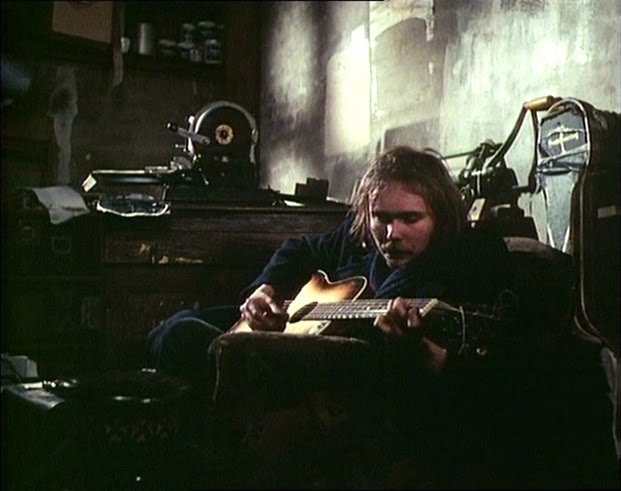
In keeping with the greater emphasis on character interaction the plot is incredibly straightforward. Essentially a brief snapshot into the life of Sylvia (Anne Raitt), a lonely secretary who shares her suburban home with a disabled sister, Hilda (Sarah Stephenson), who she is expected to offer round the clock supervision to, often at the expense of her own happiness or social satisfaction. Her downtime, if any, is spent entertaining her ditzy friend and co-worker Pat (Joolia Cappleman) or, if possible, attempting to forge a relationship with the shy grammar school teacher Peter (Eric Allen), who drifts in and out of her life. There is also the character of the lodger, Norman (Mike Bradwell), a shy young man, head-down, hair covering his face and further muffling his already softly-spoken northern accent, who lives in a makeshift bedsit in the character's garage where he alternates between printing fliers for his bosses at work or strumming out yearning folk songs on his battered old guitar.


Bleak Moments directed by Mike Leigh, 1971:

These characters meet regularly but rarely speak, choosing instead to linger on the fringes of the frame, making pained attempts at conversation that go nowhere. To accentuate the discomfort of these scenes, the shots are allowed to play out for what seems like an eternity; establishing a particular rhythm that perfectly underlines that feeling of the awkward - why didn't I say it - sense of inarticulate longing. Expressing perfectly that failure to express through the recognisable pattern of failed conversation - the think, open mouth, a sigh, a false start, conversation stalling, think again, a look, a nod of approval, an uttered word, hushed and mumbled, a pause, a false start, a look of confusion - repeating itself until the words begin to take shape. In this vision of loneliness and repressed desperation the whole film becomes suffocating to watch; with that think and heavy, pregnant with the anticipation of something mood never alleviating throughout its stifling 111 minute running time, as the accretion of these bleak moments creates a depressing and overwhelming effect.


Bleak Moments directed by Mike Leigh, 1971:
Ebert defined this quality as such: "Bleak Momentsis not entertaining in any conventional way. This is not to say for a moment that it is boring or difficult to watch; on the contrary, it is impossible not to watch. [But] This movie deals so basically with the pain and utter frustration of life that we may, after all, find it too much to take." It is in this almost searing social-anguish, as this collection of characters attempt to co-exist in the everyday world, though ill-equipped to deal with the various pitfalls as a result of their own self-conscious quirks and idiosyncrasies, that the characteristics of the film is defined. Not simply in terms of the general structure of scenes or the goals and ambitions of these characters, but in the actual putrid air that Leigh is able to create through his presentation of rooms haunted by characters unable or unwilling to interact with life; all the while being crippled and torn apart by their repressed feelings of guilt, love, longing and loss, all brought painfully into focus in the numerous extended sequences of uncomfortable silence and embarrassing personal confession.

In this respect, the film is as much a social chronicle of a certain kind of lifestyle as it is a dramatisation, presented in a densely atmospheric, heavily stylised and deeply austere cinematic manner, in which every tool at Leigh's disposal is used to prolong the quiet suffering of these characters and their endless days of drift and nothing. Although there is a sense of humour to certain aspects - the particular absurdity of situations and the natural comedy of life as characters crack jokes or cringe at their own suffering faux pas' - the film remains much more serious in tone than many of Leigh's more widely seen films: with the general feeling being closer to something like Meantime (1984) or Naked (1993), though even that was marked by Johnny's (David Thewlis) constant quips and puns. Like those films, the drama of Bleak Moments is captured within an exhausting, highly minimalist mise en scene that recalls the Fassbinder of Why Does Herr. R Run Amok? (Warum läuft Herr R. Amok?, 1970), the Bergman of Cries and Whispers (Viskningar och rop, 1972) and the Pialat of La Gueule ouverte (The Slack-Jawed Mug, 1974); where the location and production design and the closeness between characters unable to feel intimacy is explored.

From this, there's no escape for Sylvia, who tires valiantly to connect with the shy Peter and the lodging Norman, but finds both men too damaged or too introvert to really get to grips with. The drama reaches an apex with two of the most painful scenes of Leigh's cinema to date. In the first scene, Sylvia and Peter go for a meal at an over-lit, largely vacant Chinese restaurant. Once there, Peter becomes agitated, berating the snooty waiter over trivial reactions and off-setting the atmosphere with his constant, ill-at-ease scowl. As the evening progresses the couple barely speak; with Sylvia instead left to ponder and observe the solitary serenity of the restaurants only other customer, who sits huddled in the corner, happy in the company of himself. This scene acts as the catalyst for the second scene, in which the couple go back to Sylvia's house for coffee and chat. During the scene, the sense of desperation welling up within Sylvia comes close to breaking point, as she confesses her desires for Peter and extends an invitation to bed. Peter, affronted and somewhat disgusted at such baseless, brazen provocation, leaves; making a painful, humiliating and emotionally raw sequence all the more heartbreaking.


Bleak Moments directed by Mike Leigh, 1971:

Throughout the film these characters attempt as best they can to improved their social situation, but instead, end up repeating the same mistakes ad infinitum. In achieving the requisite emotional pull from this cold and loveless film, Leigh's genius, apparent even at this early stage of his career, is to allow his actors the room to move between the different emotional shades, letting the characters drift from moments of cold resentment to painful longing, often within the confines of a single scene. To emphasise this feeling, the direction of the film, in the technical sense, seems intent on stripping away all (if any) of the extraneous baggage that might reduce these situations to the level of mere melodrama; with Leigh muting the colours of the costumes and production design to the level or near monochrome, so that these characters are quite literally existing, or attempting to exist, in this grey and depressing milieu.

This particular aspect is brilliantly defined by Fernando F. Croce who evocatively describes "figures shambling down overcast London streets with leafless trees, or pinned against greenish domestic interiors." Leigh exaggerates this by reducing the score to the brief acoustic interludes of Norman, as he spends his nights cocooned in Sylvia's garage, plucking and strumming his guitar as the world continues to turn. In these scenes one may feel oddly compelled to describe the mood as 'intimate', and yet it becomes clear very early into the film that these characters are incapable of experiencing such frank, emotional honesty. The only characters that seem free from these rigid and soul destroying social restraints are Sylvia's sister Hilda, whose mental disorder offers a certain ignorance to the pressures of everyday life, and the mother of Sylvia's workmate Pat, who is forced to spend her life cooped up in bed, oblivious to the social climate of the time.

Saturday, 2 May 2009

Visitor Q

Beginning with a vague preamble on the use of digital video in achieving that contrast between the abstract and the real...

One of the most interesting developments to occur in contemporary cinema over the course of the last ten years has been the increase in availability of digital filmmaking technology and the obvious benefit that this has offered to filmmakers, not least in terms of reducing budgets and production schedules, but in looking at the world from a new perspective. From Lars von Trier's The Idiots (Idioterne, 1998) to David Lynch's Inland Empire (2006), the look and more importantly the feel of digital photography has further obscured the recognisable line between drama (i.e. artifice: the filming of a performance within a carefully constructed frame) and reality. The "look", as it were, is closer to a perceived realism as presented by that of reality television, docudrama or a fly on the wall; the sense that we are seeing something closer to reality because the sparseness of its images, the relaxed nature of its performances and the awkward passages usually removed or tightened by the editing process remind us of the unrehearsed spontaneity of everyday life.

The feel of digital cinema (discounting the more pioneering digital work of films like Attack of the Clones (2002) or Zodiac (2007), in which the attempt is to make digital look as glossy and well-defined as 35mm celluloid) is the stuff of wedding videos or the filmed performances of a high school musical. The effect is more recognisable to our own (non-professional?) experiments with filmmaking in the domestic sense; something that worked in favour of a film like Thomas Vinterberg's masterful Dogme95 experiment Festen (The Celebration, 1997), in which the appearance of a self-shot family portrait plays on the idea of documenting family celebrations in order to preserve that particular memory or occasion. By adopting this specific style, the filmmaker is able to make convincing those scenes that may have previously overwhelmed us, or become an obstruction as a result of their melodramatic superfluities.

Would an audience have believed Christian's (Ulrich Thomsen) fraught dinnertime speech delivered to his father (Henning Moritzen) or the anxious quaver of desperation as he revealed the tragic back-story of his suicidal twin-sister to a room-full of dumbfounded relatives and guests in Vinterberg's aforementioned magnum-opus if it had been shot with all the beauty and grace of a Merchant-Ivory production? Or does the recognisable candid-camera-like intrusion that digital video presents create a more reasonable window into the world in which the exaggerated melodrama of the plot becomes almost plausible?


Visitor Q directed by Takashi Miike, 2001:


Festen directed by Thomas Vinterberg, 1998:


The Remains of the Day directed by James Ivory, 1993:

The use of video implies "realism", but only because of these associations and the natural shock of seeing images stripped of their usual cinematic-gloss. However, it also possesses a more powerful contrast; with the actual look of video, in comparison to 35mm film (or even Super8 or 16mm film) actually becoming more abstract and surreal in both texture and appearance. Although we might identify something apparently truthful (i.e. recognisable) in the presentation of these digital pictures, there is also that alien quality, which exaggerates and distorts.

This particular contrast works perfectly in director Takashi Miike's gloriously subversive satire, Visitor Q (Bijitā Kyū, 2001); a film in which the required use of digital video actually shapes, not only the look and feel of the film, but the actual development of its narrative. The film, best described as a chaotic snapshot of contemporary middle-class Japanese domesticity, is essentially a demented pastiche of the Italian filmmaker Pier Paolo Pasolini's classic psychological drama, Teorema (1968); a film in which the notion of a seductive young corruptor of innocence - as personified in that particular film by a calculated Terrance Stamp - is here turned upside down; with Miike and his screenwriter Itaru Era turning a stifled, claustrophobic investigation into the unspoken psychosexual desires of a family of Italian intellectuals into a slapstick farce of animated subtleties and stark, almost Buñuelian satirical intentions.


Teorema directed by Pier Paolo Pasolini, 1968:


Visitor Q directed by Takashi Miike, 2001:


Teorema directed by Pier Paolo Pasolini, 1968:


Visitor Q directed by Takashi Miike, 2001:

In both films the plot could be described in a single-line; "A stranger is accepted into a normal family and becomes a catalyst for radical change." As the critic Chris Campion notes in his short-essay included with the Tartan Video Region 2 DVD release of the film, "Pasolini's movie can be seen as both a political and religious allegory; the disintegration of the nuclear family symbolising the rejection of bourgeois values."

In Visitor Q, this initial set-up is turned inside out. In the Pasolini film, the change is for the worse, and the tone of the movie is bleak and filled with deception. However, in Miike's film, the change is for the better, and although this is a picture filled with violence and brutality, the tone is ultimately hopeful. You can feel it in the warm swell of Kôji Endô's subtle score as it lifts the scenes at disarming moments throughout; turning the flashes of degradation and dismemberment into acts of tender mercies.

In Miike's film, the wandering stranger, played here by the actor and director Kazushi Watanabe, positions himself at the heart of the Yamazaki household, where the family, consisting of father Kiyoshi (Kenichi Endo), mother Keiko (Shungiku Uchida), daughter Miki (Reiko Matsuo, billed here as 'Fujiko') and son Takuya (Jun Mutô) are on the precipice of absolute chaos. The lingering air of apocalyptic dread, dysfunction, disorder and disarray is established in the very first scene, with the character of Miki boldly asking the question on-camera, but also to-camera (and by extension, questioning the natural voyeurism of the cinema and the home-cinema audience) - "You wanna know the truth about the youth of today... to predict the future of Japan... this hopeless future?" Miike's provocative inter-title, which then audaciously asks "have you ever done it with your dad?" establishes the dominant tone of the film, finding the middle-ground between absurd parody and actual documentary; polemic and pastiche.

Beyond the more immediate display of the film's humour and approach, Visitor Q demonstrates a keen awareness of the various societal concerns and issues currently facing the modern Japan.  It touches on all the major issues, including sexual abuse, prostitution, drug-dependency, schoolyard bullying and the gradual erosion of the archetypical family unit, in which  father and mother are no longer in a position to fulfil the basic requirements of the patriarch/matriarch model of maintaining an efficient, well-functioning household.


Visitor Q directed by Takashi Miike, 2001:

It is not simply a work of empty shock or spectacle (although it can - no doubt - be approached on such a level), but rather a film that should be appreciated and experienced as a serious commentary on the cycle of violence as illustrated by a family in which the roles of the father and mother have become debased and obscured. A world in which the father is a disgraced news reporter exploiting the decline of his family as way to claw back a sense of respect from his associates and peers, and where the mother has become a tortured heroin addict, turning tricks in order to fund a habit that allows an escape from the regular beatings of her wayward teenage son.

The film implicates the failure of the parents in the failure of their children; for instance, the father's emasculation/humiliation at the hands of a gang of teenage hoodlums' gives way to the son's own torment from the ritualistic abuse of his classmates. This in turn is expressed through his own violent attacks on his mother, who now finds solace in the needle, or in the loveless embrace of anonymous sex-starved salary men, and the obvious parallels here with her own daughter, lost in the big city and also selling sex, until the cycle of failure and abuse, as it is passed back and forth between the generations, becomes painfully clear.

We can see similar issues presented in other Japanese films released around the same period as Miike's film, including the director's own off-the-wall musical satire The Happiness of the Katakuris (Katakuri-ke no kōfuku, 2001), in which the notion of the family in the traditional sense is again documented with a perverse and darkly comic approach that obscures the underlining seriousness of its message. Added to this a film like Shinya Tsukamoto's blistering Bullet Ballet (1998), in which the growing divide between the generations and the punishing loneliness of middle-class Japanese existence is projected against a plot that riffs on Taxi Driver (1976) and Neil Jordan's Mona Lisa (1986); as the characters find escape in nihilistic violence and self-punishment to awake them from the numbing slumber of everyday life.

Such concerns are also very much apparent in the J-horror movement of the late 1990s and early 2000s, as films like Ring (1998) and Pulse (Kairo, 2001) depict the growing disconnection between a generation who find comfort in technology; consigned to a world in which even our ghosts are forced to wander the streets in a lonesome, never-ending limbo. The issues facing the youth of Japan, as alluded to by the presentation of the son, Takuya, are also documented in Shunji Iwai's great film, All About Lily Chou-Chou (Rirī Shushu no Subete, 2001); another picture that uses digital video to abstract the presentation of the world but to also create a vague association with reality.

If Miike's use of video abstracts the presentation, then the line between the viewer and the viewed is further obscured by the position of the lead character, who himself is seen documenting the proceedings with his own pocket-video camera; creating an odd sense of confusion as the story literally consumes itself. The footage shot by the character is as much a part of the film as the footage shot by Miike's frequent cinematographer Hideo Yamamoto, with the distinction between the two forms creating a further blurring of perspectives, as we are forced to question if the strange shifts into more abstract or fantastical moments of surreal expression are real or simply symbolic.


Visitor Q directed by Takashi Miike, 2001:

As the writer Tom Mes suggests in his book Agitator: The Films of Takashi Miike (FAB Press, 2003), the shifts in the narrative and the construction of these characters are nothing less than allegorical. Although it all seems incredibly haphazard and thrown together with a complete disregard for convention, there is a strange kind of logic at work in which the more outrageous or absurd the situations in the film become, the more the whole thing - from the quietest of conversations to the sight of the son, bathing in his mother's seemingly endless river of lactation - begins to make sense.

If the film is shocking or grotesque, it is a deliberate effort on the part of the Miike to show the extent of the decline of their society as the filmmakers see it. By taking these characters to the furthest possible extreme, beyond the merely dysfunctional, Miike and his collaborators seem to be making a deliberate comment on the level of absurdity and horror to which the situation within the family unit has transformed.

In many respects, this is Miike, as filmmaker, working in much the same way as the eponymous Visitor; offering a wakeup call to his characters and his audience in an attempt to stir a reaction. He isn't simply standing back, like Kiyoshi, observing with his video camera as the home fires burn (figuratively) to the ground, but is instead taking an active part in the disintegration; documenting with glee the fall from grace of these characters as they slide into outright insanity, though never once questioning their actions or passing comment until the very end. It is only then, after they've gone beyond all reason that they can step back and look at themselves in a new light, to see what they've become.

If these scenes of rape, domestic abuse and general degradation might lead some to fall back on the well worn criticism that Miike is a vicious misogynist, it is important to remember that the unification and eventual rebirth of the family into a happy, well-functioning unit, comes not from the stranger in the leather trousers and Hawaiian shirt, but from the wounded mother; the symbol of Japanese modernity: the form from which each of us are born. It is only at the end of the film, in which the father and daughter, draped in sheets of glistening blue plastic, suckle the breast as mother floats on a cosmic-calm of post-coital serenity that the order is finally restored.


Visitor Q directed by Takashi Miike, 2001:

These sequences, which can be seen as empty provocation if we buy into the image of Miike as the sadistic wildman of films like Dead or Alive (1999) and Ichi the Killer (Koroshiya 1, 2001) - and not the intelligent, socially-aware filmmaker of The Bird People in China (Chûgoku no chôjin, 1998) and his two "Young Thugs" movies, Innocent Blood (Chikemuri junjō-hen, 1997) and Nostalgia (Bōkyō, 1998) - always serve a purpose within the narrative. The disgrace of the father, exaggerated in the worst possible way, makes him unable to offer a model for his disconnected teenage son; a boy who takes the vile abuse of his bullies and turns it against his mother - herself, a hopeless, heavily in-denial heroin addict who has turned to the murky-world of prostitution in order to feed her addiction. Without the model of domestic stability in place the daughter has gone AWOL, finding affection from a succession of lecherous strangers with no way of return. And of course, if the only way that she can find love and tenderness from her own father is in seducing (and eventually mocking his lack of prowess), then that's the obvious extreme that she's been pushed to.

Nonetheless, the real power of Visitor Q is not in its scenes of spectacle and provocation, but in the odd moments of transcendent beauty that are formed from the most improbable presentation of events. For example, a single reaction shot of Keiko, the mother, coming home to an empty dinner-table, tells us all we need to know about this character - her hopes and disappointments - as the absence of the family that once existed in some form of unity is now spiralling out into the cosmos. Similarly, the closing scene, which captures the reaction of Miki as she discovers the unification between mother and father as if emerging from some kind of somnambulist-like trance - again, viewed telling through the rectangular frame of a window - as the music swells and the camera drifts ever forward to a moment of potential reconciliation.

Although it is filled with exaggerated, over-the-top farce and a mocking humour, the film also possesses this more personal quality, explicit in the fearless performances of the cast and the sheer jaw-dropping ethereal grandeur of its closing scene.

Thursday, 2 April 2009

[REC]

In George A. Romero's Diary of the Dead (2007), the recent trend for confessional, self-shot horror cinema, post The Blair Witch Project (1999), was satirised as yet another extension of the current generation's supposed obsession with exhibitionism and self-analysis. A kind of egotistical self-infatuation facilitated, to some extent, by websites such as YouTube, Facebook and Twitter, where even the most personal or upsetting events of a person's life can be exploited in an attempt to create insight or entertainment for an unseen, possibly voyeuristic audience, no longer able to feel anything unless distanced by a television monitor or computer screen.

The concept - and Romero's presentation of it - puts me in mind of a quote by Guy Debord, which helps to contextualise the particular commentary being woven, consciously or unconsciously, throughout. "In societies where modern conditions of production prevail, all of life presents itself as an immense accumulation of spectacles. Everything that was directly lived has moved away into a representation"


Diary of the Dead directed by George A. Romero, 2007:

Although [REC] (2007) has no such higher ambitions, the ideology at work is nonetheless similar to the Romero film. In both instances, it is the characters' perseverance and obsession with documenting the proceedings at all costs that pushes the narrative forwards. The motivation of these characters to capture, for whatever reason, the carnage and the bloodshed, inspires the real dramatic incentive to pursue this story, even if it means putting themselves (and others) in danger. It is this personal motivation that effectively transforms a routine trash-TV exposé into the lives of Barcelona fire-fighters into a self-reflexive examination into the power of the image (not only as a spectacle, but as a means of documentation: the RECording of the title), and the more important relationship between the camera, the viewer and the subject in-between.


[REC] directed by Jaume Balagueró & Paco Plaza, 2007:

If [REC], as a companion piece to the Romero film, is ultimately derivative in concept - with the snappy banner on the back of the DVD-sleeve ably (or idly?) surmising the film's creative intentions as "The Blair Witch meets 28 Days Later..." - it nonetheless succeeds over many of these similarly constructed "found-footage" experiments as a result of its authenticity. Whereas Romero's film suffered greatly from implausibility - not simply in terms of the general motivation of its characters or the development of its plot, but in the kind of situations actually being recorded (especially if we're to believe that these so-called film students are operating on a limited power-supply and budget) - [REC], by comparison, really does feel like an authentic, low-budget piece of late-night television info-fodder.

It also helps that the film is genuinely appealing, both in its themes and in its creative development; with the more outlandish twists of the plot finding an anchor through the believable performances of a cast that play on subtlety, and a general feeling of dread and uncertainty that is elevated by the skilful editing; managing to retain the obvious genre expectations of the jumps and jolts, but still remaining true to the overall creative intentions of the directors and their crew.

The appeal of [REC], beyond the more obvious genre paraphernalia, is therefore this sense of placing the spectator directly within the action via the first-person associations of the camera's eye.


Man with a Movie Camera directed by Dziga Vertov, 1929:


[REC] directed by Jaume Balagueró & Paco Plaza, 2007:

Whereas conventionally the director creates a shot, and within the frame of this shot places various objects and characters of significance to what the film or the scene is about, the self-shot/found-footage format obscures the hand of directorial control, making the audience feel as if we're discovering something that is real; something that hasn't been manufactured. We're still seeing exactly what the filmmaker wants us to see, but in a way that is much less obvious. Instead of the carefully composed images of films like The Exorcist (1973), Halloween (1978), The Shining (1980) or The Sixth Sense (1999), where there is a very clear sense of how to frame these moments of shock and suspense in order to satisfy audience anticipation, the chaos of these images, and the sometimes difficulty of having to squint out the significance, adds to the general confusion of the situation.


Halloween directed by John Carpenter, 1978:


The Shining directed by Stanley Kubrick, 1980:


The Sixth Sense directed by M. Night Shyamalan, 1999:


[REC] directed by Jaume Balagueró & Paco Plaza, 2007:

It makes the viewer more active, placing us, as spectator, into the situation; not only forcing us to experience this horror as the characters themselves might experience it, but exaggerating the anticipation by deliberately obscuring some of the more important information on screen.

Many of these stylisations could be considered emblematic of a continual interest on the part of a contemporary audience for what is perceived to be a greater sense of realism. From the introduction of reality television in the early part of the decade - which itself was a lead-off from the previously popular docusoap format - a kind of real-life soap opera form of cinema vérité - audiences have demanded images that resonate on a recognisable level.

The reality-TV culture thrives on the authenticity of real laughter, real tears and real emotions; where the process of manipulation is understated, and where the usually recognisable limitations of the fourth-wall are almost entirely removed. If the filmmakers can convince us during these opening scenes that these characters are real people doing real things, then the eventual shift into the more outlandish genre territory of zombies and potential government conspiracies will be given a greater hit of plausibility. We accept the scenario as being far more convincing if placed within this style of heightened faux-documentary realism than if it were shown with all the gothic, romanticised style of the Hammer Horror-movies, or the incredibly beautiful or conventionally more cinematic terror of Bava, Kubrick or Argento.


Suspiria directed by Dario Argento, 1977:


[REC] directed by Jaume Balagueró & Paco Plaza, 2007:

It could be argued that this particular style of film, in which the audience is thrown headlong into the action, and into the horror, helps to overcome some of the less original aspects of the plot. Had the film been presented in the more conventional approach - of wide-shot, to mid-shot to close-up, etc - the continual reliance on the work of Romero - specifically Dawn of the Dead (1978) and The Crazies (1973) - as well as the early films of David Cronenberg - such as Shivers (1975) and Rabid (1977) - might have plunged the film into the same kind of hollow, artless predictability of the average Hollywood remake.

Instead, the wide contrast between the content, which is generic, and the approach, which isn't, help us to identify and experience these clichés and predictable accoutrements from an entirely fresh perspective. It gives a kind of greater plausibility to the general "what if..." scenario that the horror movie, as a phenomenon, has exploited since day one. So "what if..." a local access-all-areas television crew were there to document the unfolding of a film like Rabid, or The Crazies; "what if..." something like that really did happen; how would we react, etc.

At a time when most of the human race is documenting their own lives on camera phones or video recording equipment, putting these feelings on the web in order to form a connection with the world as a twenty-first equivalent of a message in a bottle (and yes, this blog functions on a similar level), the idea of someone just being there to capture this chaos is not only close to actuality, it's an acceptable truth. You only have to look at the news coverage of any recent disaster, terrorist attack or major event, from the horrors of 9/11 to the natural wonder of the recent eruption of Eyjafjallajökull, the documentation of these spectacles is captured, in the absence of a professional crew, by the every-day man on the street.

This is what gives the film its recognisable weight; "real people" in "real peril". It works, but only because the thing is so well-made. It elevates itself from the usual low-budget horror cinema, not by looking down on the genre, of thinking that it's somehow better or more relevant than any other film using the same techniques, but by actually engaging the audience in its scenes of terror, in its plot, and the lives of its characters.


[REC] directed by Jaume Balagueró & Paco Plaza, 2007:

The film draws the audience in slowly, establishing a believable context in which local television news reporter Ángela Vidal (Manuela Velasco) and her never-seen cameraman Pablo (Pablo Rosso) interview the staff of a small Barcelona fire department. In the opening scenes, we see Ángela, sometimes unsuccessfully attempt to engage the fire fighters in a conversation in the hope of getting to the heart of what it is they actually do. As Pablo pans back and forth with his shoulder-mounted video camera, recording these men and women filling out paperwork, or eating, sleeping and playing sports, Ángela and the viewer are secretly hoping for something (more exciting) to happen. Eventually, a call comes in; a disturbance at a small apartment building on the outskirts of city.

From this point on, anyone familiar with how horror movies work will have a good idea of what to expect from the narrative development of the film. The pressure-cooker atmosphere of the residents gathered together in the foyer, confused and agitated - concerned for the wellbeing of the old lady locked in her apartment but also frightened - is conspicuous from their initial introduction. It is obvious that as the horror builds and becomes more focused and frenzied that this tension between the ranks will feed into the general chaos and confusion, causing mistakes to be made, loved ones to be lost and our "heroes" (for lack of a better word) to be put at risk.

As the storyline develops, and the horror-movie aspect becomes much more pronounced, the style of the film and the way it is used to reveal or obscure the elements of the plot, is perfectly utilised, as the audience are placed into these situations, witnessing them from the first-person POV vantage point of the camera, thus putting us right on the frontline. It helps that the co-directors Jaume Balagueró and Paco Plaza chose to have the film's actual cinematographer stand in as the character of Pablo, meaning that we really do get the sense of an actual camera man at work, framing the shots as best he can, as a professional, but also trying to keep himself and others safe in this incredibly hostile environment.


[REC] directed by Jaume Balagueró & Paco Plaza, 2007:

As with the Romero film, one can choose to see [REC] as a commentary on the power of the screen-image and how it has been used in the first part of the twenty-first century, not just as a kind of confessional, but as a way of desensitising characters to their own suffering or peril. Ángela doesn't have to keep filming. She could put the camera down. She could free up her arms making it easier for her to run up and down the winding staircases, or down those long shadowy corridors. But she doesn't. Why? Does the camera remain turned on for our benefit or for hers? Again, it's that misguided sense of duty that these characters feel they need a recording of this event for whatever reason. It's also, on some level, the act of looking at the world through the viewfinder of a camera to create a filter to reality. It also shows the voyeuristic nature of the characters, and by extension the audience itself; more concerned with documenting the violence and the suffering as it happens, instead of attempting to get away from it.

If [REC] lacks Romero's pointed social commentary, it is no less representative of this curious new subgenre. As Ángela's direction to "just keep filming" is offered as a hollow echo as the final scene fades to black, we find ourselves in the world where characters feel they must record everything. It shows the genre moving further and further away from the usual self sacrifice/self preservation preoccupations that have so often triumphed in the structure and conventions of the horror movie narrative, as we expect our protagonists to escape from this evil, to flee from it, as we cheer their escape or eventual re-capture. It replaces this with a fascinating if largely observational sense of self-absorption; as the walls of civilisation come tumbling down we begin to turn the cameras, not on the event, but on ourselves, to fulfil some kind of vague misguided sense of purpose, before our own moment of expiration.

Sunday, 29 March 2009

8 ½ Women

As with Greenaway's earlier film, A Zed and Two Noughts (1985), 8 ½ Women (1999) develops around the notion of grief (and of overcoming grief), which is here expressed in the filmmaker's typically ornate and clinical approach, in which his characters are rendered as artefacts, placed beneath the microscope for the viewer's consideration. As an experiment, it is less successful than the earlier film, which was able to combine elements of obvious provocation and theoretical deconstruction with an interesting narrative and characters that registered beyond the form of mere ideological constructs there to voice ideas in a kind of back-and-forth dialogue between the filmmaker and his audience.

Although far from conventional, the characters in A Zed and Two Noughts were at least recognisably human; with the greater themes at work within the narrative, and the sense of devastation and loss that reverberates throughout, managing to overcome the self-conscious performances of the two lead actors, or the mannered approach of Greenaway and his crew, to at least present something that captures the imagination and creates drama rather than dissertation. In comparison, 8 ½ Women feels inflated and unfocused; as if Greenaway is attempting to express a series of personal issues - or at least, issues more personal than many of his other films of this period, such as Prospero's Books (1991) or The Baby of Mâcon (1993) - but still retaining that dry, theatrical, deconstructive approach that those particular films had employed to great effect.

Suffice to say, the combination simply doesn't work. Greenaway is a filmmaker at his best when playing games with his audience and revelling in the spectacle of expression. There are elements of that still present in 8 ½ Women, but mostly we have an attempt to express the themes of the film, not through the presentation of the production itself, but through the appearance (and theoretical notions) of character. It is perfectly fine to attempt such experiments when adapting Shakespeare or playing with the meta-fictional notions of viewing and storytelling (as in the two films aforementioned), but the idea that this is somehow a character driven film - and that the experiments of the filmmaker are entirely reliant on these characters - is the major flaw at the centre of the movie.

Whereas A Zed and Two Noughts unfolded around the clever idea of twin zoologists each questioning the nature of evolution and the fragility of the human body (in a de-compositional sense) following the death of their respective wives in the same tragic car-accident, 8 ½ Women focuses on the bereavement felt by a wealthy investment banker and his grown-up son - the characters Philip and Storey Emmenthal - after the sudden passing of the family's beloved matriarch. Inspired by Federico Fellini's film 8 ½ (1963), the father and son decide to open their own private harem at their mansion in Geneva, populated by (literally) 8 ½ Women (itself a perverse joke), including the actresses Polly Walker, Amanda Plummer, Toni Collette, Vivian Wu and Kirina Mano.

If we think about many of Greenaway's previous films, such as The Draughtsman's Contract (1982), Drowning By Numbers (1988), The Cook, The Thief, His Wife and Her Lover (1989) and The Pillow Book (1996), the characters served a purpose within the narrative; offering a number of multi-layered interpretations of various themes and archetypes that were a continuation of the highly stylised world in which the films unfolded. You can see a similar notion here in the presentation of the 8 ½ women of the title; with each one becoming a model that represents something far greater than the narrative itself. However, where the film really does fall flat is in the creation of the two central characters, the father and son played by John Standing and Mathew Delamere, who are used to express the more "human" ideas at work within the drama, as well as the perhaps more important idea of the male gaze (especially in how it pertains to the viewing and creation of art).


When placed front and centre, the limitations of these characters in the traditional, narrative sense, is overwhelmed by the flat, austere and highly formal presentation of the imagery. We're supposed to warm to these people, or at least take some kind of interest in their actions, but the coldness of the performances, the knowing, self-absorption of the dialog and Greenaway's stylistic techniques put us at a distance. It's unfortunate, but the characters simply aren't as interesting as the rest of the film; dwarfed by the ironic presentation of the images and the overwhelming technicality of Greenaway's approach to cinema. In this respect, we could probably argue that there is simply far too much going on - both within the frame and within the lives of these two characters - for the film to work on either level. As a result, the film is unable to affect us on a personal level, leaving the central notion of the film (grief and overcoming it) floundering amidst the more interesting depictions of the women and how they are used and subverted by the film itself.


Of course, there are all kinds of interpretations that we can find here, including the idea of archetypes and stereotypes and the presentation of women as depicted in classical art (with the conventional, if controversial notions of the mother, the whore, the angel, the cripple, the dominatrix and the submissive, etc), as well as the various ideas of masculinity (presented here as a combination of near-incestuous homoeroticism, narcissism and self infatuation), dependence and the always prevalent reflections on life and death. Into this, there is also a commentary on the nature of cinema; in viewing images, finding inspiration, taking a model (physical) and attempting to create a model (living) around it.


Despite the criticisms from those at odds with Greenaway's work - i.e. the kind of viewers who throw around the "p-word" and take offence with his fairly far-out ideas about what cinema is and what cinema should aspire to - the filmmaker has adequately demonstrated in the past that he is just as capable of conveying human emotion and moments of great drama as well as the more obvious intellectual/academic experiments that he is perhaps more famous for. His best films all manage to convey such elements of human nature and human emotion alongside the experiments with the form and presentation; offering the viewer something that not only has the ability to make us think, but to also make us feel. In many of his films this is conveyed in the expression itself; in which a world is created and sustained and ideas are developed that become as engaging (if not more engaging) as any laboured plot twist, narrative development or deus ex machina.

This element seems to be missing from 8 ½ Women, which is perhaps Greenaway's most character-oriented work and, we assume, his most personal. It seems to express many of his own thoughts and feelings about life (he had recently divorced and moved to the Netherlands) and perhaps cinema (the continual references to Fellini and his great triumph, the aforementioned 8 ½), with a number of deeper interpretations that are still there, if perhaps not quite as fully formed. It also lacks the filmmaker's marvellous sense of humour, which was perfectly realised in his most famous film, the pitch-black parable The Cook, The Thief, His Wife and Her Lover, in which Greenaway once again illustrated his ability to create memorable characters with complex emotions alongside a fully realised visual approach, in which continuity, staging and CinemaScope photography (in opulent colours that referenced Hitchcock's Vertigo, 1958) were each used to help create a world that complimented his characters and their internal or external space.

On its initial premier at the Cannes Film Festival in May 1999, the film was greeted with some of the worst reviews of Greenaway's already highly contentious career. Since then, the filmmaker has remained decidedly low-key. His multi-part, multi-media project The Tulse Luper Suitcases (2003) suffered from poor distribution and seemed to be at least five or six years ahead of its time, leaving many audiences lost and confused. Similarly, his most recent narrative film, the satirical art-mystery Nightwatching (2007) (a portrait of the artist Rembrandt and his enigmatic work The Night Watch, 1642) seems to have vanished without a trace.

However, none of this changes the fact that 8 ½ Women is essentially a failure, if, perhaps, an interesting one, worthy of some thought and consideration. As critic Geoff Andrew wrote in Time Out, "The film has the usual collage of lists, perverse conceits, strange images, arcane illusions and nudity; but far more lazily assembled than previously. The writing is without wit, the pacing clumsy, the 'surrealism' forced and the whole, pretty pointless." I don't particularly think it is "pointless", as Andrew would suggest, although it certainly seems more lazily assembled than previously. Instead, I'd be more inclined to agree with the sentiments of Roger Ebert, who wrote, "It is not possible to 'like' this film, although one admires it, and is intrigued."

Friday, 20 March 2009

British Sounds

"Photography is not the reflection of reality... it is the reality of the reflection."

Quoted above is one of the many confrontational ideologies at the political and philosophical centre of British Sounds (1970) - the Dziga Vertov Group's lengthy polemic on socialism, feminism, equality and the class struggle, post May 1968 - in which the creative emphasis is placed on a continual conflict between the content and the presentation, illustrated in this instance by the further conflict between the film and the viewer. A film where the particular struggle is created by a continually warring juxtaposition between sound and image; with the drab, straightforward formalism of the filmmaker's sub-documentary style arrangement of the images conflicting with the often avant-garde approach to the soundtrack, which here combines lengthy snippets of dialogue and discussions on the various topical subjects listed above, amidst a continual background cacophony of nondescript sounds, musical tones and electronic textures.

The contrast is most apparent in the first half of the film, in which the filmmakers illustrate the central struggle within the narrative by a lengthy tracking-shot through the MG assembly line at the British Motor Car Company in Cowley, Oxford, wherein a barrage of contradictory sounds seem determined in their attempt to make the experience of viewing the film as dissonant and jarring as possible. However, as the film progresses, the idea of contrast - as one idea discussed on the soundtrack is placed against another idea presented on screen - will eventually reveal itself to be one of the central creative concerns of the film. As one would no doubt expect from such a presentation, British Sounds abandons any obvious notion of character and narrative in the conventional sense, with the film instead structured around six major sequences each presented in a similar approach, in which an uncomplicated visual tableau is set against a complicated soundtrack of ideas and expressions to illustrate and eventually educate the audience on the cultural issues of the day.

In a somewhat similar scenario to Godard's earlier film, Le gai savoir (The Joy of Learning, 1969), British Sounds was originally created for television - in this instance the UK's London Weekend Television (or LWT) - though was never officially broadcast as a result of the unconventional approach of its production and the challenging nature of its ideas. This fact is immediately recognisable from the opening sequences, in which Godard and his collaborator Jean Henri Roger confront us with a prolonged ten-minute track through the process of industrial manufacture, over which we hear various recorded arguments on worker's rights and ethics, a back and forth dialog between an adult and a child (further expressing the idea of education) and excerpts from the Communist manifesto being recited on the soundtrack.

Amidst this confusion the screen is occasionally disrupted by examples of agitprop sloganeering to punctuate the monotony of the images, with call and response statements like "what is work?" and "work is struggle" crudely hand-written in black marker pen to draw the obvious parallels with the student protestors and their home-made placards featured later in the film.


British Sounds directed by the Dziga Vertov Group, 1970:


Le gai savoir directed by Jean-Luc Godard, 1969:

This opening sequence is an important one and as a result remains perhaps the most iconic moment in the film. It illustrates the political subtext of the project and the central idea of socialism in action: as the workers toil in the factories, producing cars that they'll never afford, for customers that will never appreciate the work or the craftsmanship that goes into their creation. It also plays on the symbol of the MG itself, of old England, of a certain kind of person and lifestyle that we never see depicted herein, but an idea that is contrasted perfectly by the later sequence in which we witness the workers engaging in a lengthy discussion about their rights in a capitalist society, and how the bourgeoisie, in opposition to a socialist regime, have harvested the power and wealth away from the working class proletarians in order to greater benefit for themselves. The argument presented in this scene, and the conviction and emotion of these people arguing a case for a structure that they believe in, is entirely compelling and no doubt convincing enough to inspire a serious desire on the part of the audience to read more into socialist politics and the subjects at hand.

The opening scene also works on a different level; in illustrating the creative act at its most honest and unpretentious. Like the writing of Sympathy for the Devil in the earlier Godard-directed One Plus One (1968), the tracking shot illustrates the spirit of creation and collaboration as the ultimate metaphor for the politics of the filmmakers and for the dynamics of the film itself; as the images are literally manufactured before our very eyes, documenting the creative process through its various stages until we end on a shot of the final, finished product. It allows us to contemplate the level of work, the creation of this everyday object - the motorcar, something that we so often take for granted - and see the process of work and deliberation that goes into its completion. On a personal level, it also brings to mind the infamous tracking shot in Godard's own masterpiece Week End (1967), establishing the rather perverse idea of where these cars are going, the congestion and confusion, and the image of the MG driven by the lover of Juliet Berto crushed under the weight of an industrial tractor.


British Sounds directed by the Dziga Vertov Group, 1970:


Week End directed by Jean-Luc Godard, 1967:

Along with the opening scene in the car factory and the discussion between the proletarians that will eventually follow, the other key sequence here is the discussion between the student protestors who, once again, in a show of the creative cycle as presented on film, attempt to rewrite a contemporary pop song in a way that better represents the turbulent social and political climate of the day. As they strum guitars and stencil out placards and banners, we're immediately back in the realms of La Chinoise (1967); with Godard and Roger taking these kids with big ideas and good intentions and exposing the ultimate emptiness of their actions and the smug, pretentious, romanticised view of the working classes by these upper-middle class students, slumming it in an attempt to gain self-gratification from their "comrades" and peers. For all their desire for change and their belief in a socialist system, they are a world away from the hard-working proletarians; separated by class and circumstance, sat writing their trivial songs and making ironic slogans while the real working-classes are toiling in the factories and in the fields. No time for protest; they work because they have to, to make a living for themselves and for their families


British Sounds directed by the Dziga Vertov Group, 1970:

In the later sequences, we have an even more obvious attempt to deconstruct the film, with staged news bulletins offering the anti-socialist sentiment of the bourgeois classes, with the bile and vitriol expressed in these sequences tying into the ideologies of someone like Enoch Powell and his infamous "rivers of blood" speech of April 1968; as well as prefiguring the rise of the conservative party, the reign of Margaret Thatcher, the arrival of New Labour and the empty promise that "things can only get better." Such sequences are obvious perhaps, taking the film into the realms of pure agitprop and sitting uncomfortably alongside the other sequences described above, not to mention the lengthy sequence of post-feminist deconstruction presented in the second half of the film. Here, the filmmakers take the image of the naked female form and attempts to desexualise it through a continual soundtrack of sexual politics, equality and discussions about the objectification of women, voiced by a female student in a flat, upper-middle class accent, again showing the slant of the so-called educated thinker as the bourgeoisie.

As it stands, British Sounds, like much of the work of the Dziga Vertov Group, remains a fascinating if inconsistent look into the social climate and political situations of the late 1960s and early 1970s. Its appeal will therefore be limited; with the constant reliance on the voiceover to explain the situations, the presentation will no doubt turn many potential viewers away from the film, with many perhaps becoming bored by the endless representations of socialism, communism and Marxist-Leninist concepts (the alternative title for the film is "See You at Mao!") that are expressed throughout. Nonetheless, it is an oddly absorbing film, filled with ideas and images that have the power to inspire everything from thought to criticism, dismissal and debate, as the overriding notion of a cinema of life as it appears is articulated in Godard's typical style of direct and indirect expression.

Saturday, 28 February 2009

Wanted on DVD [Region 2 Edition]

In which the master-thief, Irma Vep, is enlisted by the author to help raid the vaults and offices of the world's major distributors, in a futile attempt to reclaim the missing treasures of the silver screen.


Inspired by the highly interesting "M.I.A. on Region 1 DVD Tribute Month", currently winding itself down at the five-star blogspot Moon in the Gutter, I decided to compile my own short list of currently unavailable DVD titles - albeit, in the PAL/Region 2 format. This was an obvious decision, simply for the fact that I'm not entirely sure what is and is not available in the NTSC sector, but also because I would like to highlight how comparatively ill-served the British home-cinema market has often seemed (in comparison to France, Germany, Canada and the United States) when it comes to the release of even the most mainstream of challenging, thought-provoking cinema. 

It goes without saying that viewers in the US get a far better deal than those of us in the UK. After all, this is a country that had to wait almost thirty years to see the likes of A Clockwork Orange (1971), The Exorcist (1973) and The Texas Chain Saw Massacre (1974) find a release on VHS (by which time we were well into the age of the Digital Versatile Disc). However, the last few years have seen a massive increase in the number of previously hard to find works by filmmakers such as Rainer Werner Fassbinder, Leos Carax, Miklós Jancsó, Maurice Pialat, Nagisa Oshima, Kaneto Shindō, Hiroshi Teshigahara, Louis Feuillade and F. W. Murnau, to name a select few. The fact that you can now walk into any major high-street DVD retailer (or browse online) and pick up a copy of Bela Tarr's seven-hour masterpiece Sátántangó (1994), or the complete Les Vampires (1915), or Matsumoto's dazzling Funeral Parade of Roses (Bara no soretsu, 1969), or the uncut version of Histoire(s) du cinema (1988-1998) suggest to me that the release of such films discussed or alluded to in this particular post will someday become a reality. 

After all, it's hard to believe that as recent as six years ago there wasn't a single Fassbinder release on the UK market. Now, there are four box-sets available (comprising 25 films in total) from the companies Arrow Films and Artificial Eye. Not to mention the complete 15½ hour version of the television series Berlin Alexanderplatz (1980) released by Second Sight Films Ltd. Likewise, the always interesting Jacques Rivette, who, for many years was considered the unsung member of the Nouvelle Vague/Cahiers du cinéma group, is now spoken of alongside Godard as the most remarkable filmmaker to emerge during that entire period (more so than the immediately successful Truffaut). Nine of Rivette's films are currently available on Region 2 release, including his best known film, the playful, surrealist mystery Céline and Julie Go Boating (Céline et Julie vont en bateau, 1974): a film that I will eventually be writing about on this very blog. The release of Rivette on DVD is a big deal; especially when we begin to see little-known gems such as Love on the Ground (L'Amour par terre, 1984) and The Gang of Four (La Bande des quatre, 1988) getting the full-blown director's cut treatment. It makes me hopeful that one day soon we may see a definitive release of the near-legendary L'Amour fou (1969), or the unwieldy, thirteen-part, made for television serial, Out 1 (1971).

For the time being, I have chosen to concentrate on only five films that rank (for whatever reason) amongst my personal favourites, and which I have enough of an opinion/understanding of to be able to write a short explanation that will better elucidate WHY these films (more than any) deserve the attention currently denied to them by the lack of domestic availability.


Possession (1981)


Directed by Andrzej Zulawski, this terrifying psychological drama remains one of the most unforgettable horror films produced during the period that would later become synonymous (at least in the UK) with the rise of the "video nasties". However, to compare Zulawski's film to something like The Burning (1981) or Lucio Fulci's The New York Ripper (Lo squartatore di New York, 1982) does, in my mind, a great disservice to the enormous power of Zulawski's work and to the film in question. Despite its reputation, Possession is a staggering experience worthy of discussion alongside the creative output of masters like Bergman and Antonioni; with Zulawski channelling that same feeling of internal, existential crisis and spatial alienation central to such films as Persona (1966) or The Red Desert (Il deserto rosso, 1964), to create a film that is rich with moments of unbridled cinematic expression, passion and imagination.

Drawing on the end of his own marriage to the actress Małgorzata Braunek for inspiration, Zulawski was able to document the breakdown in communication between his two central characters - Anna and Mark, the rapidly disintegrating couple brilliantly portrayed by Isabelle Adjani and Sam Neil - with a great sense of drama and compassion. He is smart enough to maintain focus on this particular thread of the narrative throughout; allowing it to define not only the interaction between the characters, but also those later shifts into darker, more surreal and disturbing territories, which remain the film's most talked about feature. To add to the overall tense, paranoid atmosphere, Zulawski shot the film on location in Berlin at a time when the wall was still standing: creating an eerie, suffocating feeling in a number of scenes made all the more impressive by the director's use of harsh, brightly lit interior and exteriors spaces to contrast vividly with the darker, more disturbing aspects of the plot. This particular approach would famously inspire the visual design of Italian filmmaker Dario Argento's Giallo masterpiece Tenebrae (1982) released the following year.

Despite being one of the most unique and provocative filmmakers of his generation, Zulawski's work has been largely neglected by DVD distributors in the UK: with only his debut film, the mesmerising The Third Part of the Night (Trzecia część nocy, 1971) getting a Region 0 release from the excellent Second Run. Possession was released on PAL VHS ten years ago by the company ILC Prime, and was also shown numerous times on the now defunct subscription channel Film Four Extreme, where it was preceded by the obligatory introduction by British film critic and television personality Mark Kermode. However, for some reason, the DVD release never went ahead. Hopefully we might one day see a box-set release of Zulawski's work, including (the also unavailable) The Devil (Diabel, 1972), The Most Important Thing: Love (L'important c'est d'aimer, 1975), La femme publique (1984) and Szamanka (1996), etc, etc.

Filled with the usual, grotesque visual abstraction and that underlining air of menace and paranoia that can be found in several of the filmmaker's most notable films, Possession is a truly startling piece of work that manages to move seamlessly from moments of heart-stopping terror, to violent dysfunction, to believable human drama, without ever compromising the overall mood or totality of the film as a complete, consistent whole.


Je vous salue, Marie (1985)


Although the vast majority of Godard's work from the 1960's is now available to own in the UK - including the often neglected features, Made in U.S.A. (1966) and One Plus One (Sympathy for the Devil, 1968) - his more interesting (and by extension, challenging) work produced between the release of Week End (1967) and the climax of Histoire(s) du cinema (1988-1998) has, for some reason, failed to materialise. Although it should be noted that the company Optimum Home Entertainment has released the unconventional crime-thriller Détective (1985) alongside the personal masterpiece Hélas pour moi (1993), there is still very little else available from the period between Sauve qui peut (la vie) (1980) - released in the UK by Artificial Eye under the title Slow Motion - and the more recent productions, Éloge de l'amour (2001) and Notre Musique (Our Music, 2004), again, released by Optimum.

This means no Le Gai Savoir (1969), no Numéro deux (1975), no Ici et ailleurs (1976), no King Lear (1987), no Soigne ta droite (1987), no Nouvelle Vague (1990), no Germany Year 90 Nine Zero (1991), no For Ever Mozart (1997), etc. If you're interested, many of these titles are available on Region 1 or in France (sans subtitles) or can be tracked down on second-hand VHS cassettes or through torrents (or other such slightly clandestine means).

In regards to the film in question, 'Je vous salue, Marie' (Hail Mary, 1985) is characteristic of Godard's creative peak of the mid 1980's; a period characterised by the preceding films, Passion (1982) and Prénom Carmen (First Name: Carmen, 1983). As with much of the filmmaker's work from this era, the central focus is on the juxtaposition of an archaic legend when updated to a contemporary setting and used as a platform to discuss the nature of life and creative expression. In the film, Marie (Myriem Roussel), an average student and keen athlete, finds herself mysteriously pregnant despite the continual assertion that she is still a virgin. Roussel, who had previously appeared in both Passion and Prénom Carmen, claimed that Godard had been planning the film with her in mind for several years. She is quoted as saying: "We worked with video. Godard forced me to write down a diary of my thoughts. Not regular writing, but from my depths. I had no religious education, so I had to study the Bible. I watched Pasolini's film, The Gospel According to St. Matthew, and also Carl Dreyer's The Passion of Joan of Arc. Godard loves that film, and I understand why he loves it. And I had to learn basketball. Godard wanted to do a basketball scene very much because basketball has symbolic, spiritual associations: "the moon, and the stomach when you are pregnant."

'Je vous salue, Marie' remains, to this day, one of Godard's most controversial films; drawing criticism from Pope John Paul II, who claimed that it "deeply wounds the religious sentiments of believers the world over", and inciting violent reactions from the general public. Famously, at its original showing at the 1985 Cannes Film Festival, a middle-aged man jumped security and hurled a cake topped with shaving cream at Godard, forcing the filmmaker to question whether or not it was wise to release the film in Rome as was initially scheduled. Godard maintained that the film wasn't really about the Virgin Mary, but about "a young woman named Mary who, at a certain moment in her life, finds herself part of an exceptional event that she would never have wished for herself." Contradicting himself somewhat, Godard later explained - "It's a real story; Mary's story about life coming down from the sky. We've had lots of films about Jesus and the Bible, but none about Mary. Why? The Church should have made this film."

Critical opinion of Godard's picture still remains divided; with some of the user-comments on the Internet Movie Database for example showing that even keen admirers of the director's work consider this film to be a mistake (one comment even describes it as "boring and laughable"). As with Possession, 'Je vous salue, Marie' has been shown on UK television in the past (the last showing was as recent as 2003), but its crying out for a DVD release from a company like Eureka/Masters of Cinema, who will not only take the film seriously enough to present it in the best possible form, but will also lend Godard's late-period work a sense of prestige that is unfortunately lacking. Too many professional critics choose to reduce the filmmaker's career to the level of a footnote that runs from 1959 to 1967, neglecting the brilliant and progressive work that he has produced since, and continues to produce to this day.

N.B. With the little-seen Une femme mariée (A Married Woman, 1964) getting a Region 2 release from Eureka video in April as part of their on-going Masters of Cinema series, one can only hope that this will pave the way for yet more Godard titles from the company; creating a relationship somewhere along the lines of their recent releases of the work of Kenji Mizoguchi and Maurice Pialat.


Kafka (1991)


Director Steven Soderbergh's follow-up to his massively successful, Palme d'Or winning directorial debut, Sex, Lies and Videotape (1989), was a self-consciously abstract project quickly dismissed by an audience no doubt looking for a more conventional film about the famed-writer and his work. Opting for a more expressionist, esoteric reading, Soderbergh himself has said that the film's critical and commercial failure confined him to the "art-house ghetto" for several years; with his critical reputation as a filmmaker (in the mainstream sense) only really restored by the surprise success of his excellent adaptation of the Elmore Leonard novel, Out of Sight (1998) (three years later he would be nominated for the Academy Award for two films in a single year).

As a biographical film, Kafka (1991) could be considered alongside Paul Schrader's (also unavailable) Mishima: A Life in Four Chapters (1985), David Cronenberg's Naked Lunch (1991), Steven Shainberg's Fur: An Imaginary Portrait of Diane Arbus (2006) and the Todd Haynes film I'm Not There (2007). As with those particular films, the intention here is to take an actual historical personality and filter the biographical details of their life through the legend and iconography of their work. As a result the plot is intricate: filled with references to the books The Trial (1925) and The Castle (1926), as well as a number of casual references to Kafka's personal dissatisfaction with his own work; the indifference and lack of support from his friends and family; his relationship with Felice Bauer; his work as an insurance company representative; and the final revelation of his illness. As with the similar films aforementioned, the script by Lem Dobbs presents the writer's life as if he were a character in his own fiction, inventing himself and expressing his own silent anguish through the process of metaphor and abstraction.

Visually, the film draws on the combined influence of Carol Reed's The Third Man (1949), the brilliant Orson Welles adaptation of Kafka's own iconic work The Trial (1962), and Terry Gilliam's dazzling, dystopian-set sci-fi satire Brazil (1985), while the incredible use of gothic, eastern-European locations, the exotic score, the incredible attention to period detail and the slowly unravelling plot ensure that Kafka is, above all-else, a great, surrealist experience. Added to this a fine leading performance by the actor Jeremy Irons and a supporting cast that includes Theresa Russell, Ian Holm, Jeroen Krabbé, Joel Grey, Brian Glover, Keith Allen, Armin Mueller-Stahl and Alec Guinness, and we have a film that stands as one the most striking and imaginative American produced motion-pictures of the last twenty-years.

Although subsequently he's admitted to being less than satisfied with the finished product (even announcing a radical re-edited director's cut that never saw the light of day), Kafka nonetheless remains one of Soderbergh's greatest achievements as a filmmaker; easily worthy of discussion alongside the director's greatest film, the brilliant, depression-set coming of age memoir, King of the Hill (1993).


The Butcher Boy (1998)


Although a contentious figure for some, Irish filmmaker Neil Jordan has produced several films that for me rate amongst the very finest of contemporary, English-language cinema; including amongst them the expressionist horror fantasy The Company of Wolves (1984), the dark, prostitution-themed character study, Mona Lisa (1986), the quiet, Irish-set youth-drama, The Miracle (1991), his passionate adaptation of the Graham Greene novel The End of the Affair (1999), and his highly underrated crime caper/Jean-Pierre Melville homage, The Good Thief (2002). However, none of these films rate as highly as the director's little-seen adaptation of the Patrick McCabe novel The Butcher Boy (1998); a twisted, coming-of-age, black-comic fantasy about the escapades of troubled Irish teenager Francie Brady.

Mixing humour, horror and nostalgic reflection to fantastic effect, The Butcher Boy is a film rife with 50's-style sci-fi paranoia, small-town ennui and the vivid imagination of a young boy rapidly losing his mind. Here, every aspect of the film - from the imaginative cinematography, authentic design and ironic use of music - is used to serve the story and create this slightly skewed perspective representative of the central character's spiralling state of mind. However, what really impresses, beyond Jordan's fantastic approach to the production, is the extraordinary lead performance from the young actor Eamon Owens in his first screen role. The fact that he has (so far, ten years on) failed to find a project that matches up to the depth and the calibre of the film in question, despite showing himself to be one of the most talented and naturally charismatic performers of his generation, is a tragedy of enormous proportions.

The esteemed supporting cast includes Jordan regular Stephen Rea as Francie's violent, neglectful father, Aisling O'Sullivan as his manic-depressive ma', Ian Hart as the boisterous Uncle Alo and Fiona Shaw as the monstrous (but never two-dimensional) Mrs. Nugent. There's also an eclectic line up of cameo appearances from Brendan Gleeson, Milo O'Shea, Tom Hickey, Ardal O'Hanlon, Sean Hughes and the pop singer Sinéad O'Connor, who gives a surprising turn as an incredibly earthy manifestation of the Virgin Mary in one of Francie's progressively more worrying hallucinations.

Again, Jordan's approach to the film is superb; perfectly evoking the idyllic moments of childhood fantasy and carefree bliss - as Francie and his best friend Joe (Alan Boyle) waste away summer afternoons by the river, reading comic books or stealing apples - before progressing into the darker, more depressing aspects that immediately follow. The balance between the gritty humour of McCabe's book and the sensitive lyricism of Jordan's direction is perfectly judged: moving back and forth from scenes of lively Christmas parties, to the boy's reformatory, to the animated moments of Cowboys and Indians, to frightening visions of the apocalypse that bring to mind John Schlesinger's brilliant Hollywood satire The Day of the Locust (1974). Once deemed worthy enough for a release on PAL VHS (pan and scan, naturally) in the late 1990's and currently available to buy on NTSC Region 1, The Butcher Boy remains one of the great films about childhood dysfunction, and the power of imagination in general.


I Want You (1998)


Released at the tail-end of the 1990's, at the end of the so-called renascence of UK film - after all, Trainspotting (1996) and The Full Monty (1997) had been huge hits - British director Michael Winterbottom's gloomy, colour-saturated murder mystery was naturally greeted by a majority of hostile and indifferent reviews (with the short write-up in the November 1998 issue of Sight and Sound claiming that "the over-stylisation of the piece ultimately sabotages what little narrative coherence there was in the first place"). However, if viewed with right frame of mind, Winterbottom's work can possibly be seen as an enthralling mosaic of shady characters and seedy situations; making great use of the film's atmospheric locations and the impeccable, other-worldly cinematography of former Krzysztof Kieślowski collaborator Sławomir Idziak.

At its most basic level, the film centres on a bizarre, tangled-web of relationships between four central characters in a fictional seaside-town (actually filmed in Hastings). The four characters can be broken up into two couples. The first, brother and sister Honda (Luka Petrusic) and Smokey (Labina Mitevska) are eastern-European immigrants. Honda has been left mute after witnessing the suicide of his mother and now spends his days secretly recording conversations and editing together the snippets of audio to create complex narratives of atmosphere and sound. Smokey is sexually promiscuous; looking for some kind of connection or validation of her own sense of self-worth from the variety of men that she takes back to the dilapidated beach-front home that she shares with her brother. Into this already complicated plot we have the appearance of Martin (Alessandro Nivola) and Helen (Rachel Weisz). Martin is a mysterious drifter, recently released from prison and hoping to make contact with Helen; his former girlfriend from the days when the couple shared an intense and dangerous pseudo-Badlands (1973) style relationship.

As the characters continue to intersect, the plot becomes more and more fragmented; drawing on several unreliable narrators and a fractured chronology, so that we're never entirely sure if what we are seeing is something from the past replayed, or something from the present. Added to this, we have Winterbottom's skilful handling of the character of Honda, and his habit of creating aural sketches from the sampling of everyday life. This particular device allows the filmmaker to blur the recognisable lines of the material even further; forcing the audience to ask themselves whether the film (as we see it, as it unfolds) is real, or perhaps some kind of mad collage-construction of Honda at his most quietly disturbed. It is also worth mentioning the incredible use of the song 'I Want You' by Elvis Costello & The Attractions - featured on the singer/songwriter's 1986 album Blood & Chocolate - which, in several scenes, is used as a counterpoint to the emotional intensity of Martin, and the duplicitous nature of Helen as she drifts through the lives of these lost and desperate characters.

Once again, this is another film that I own on VHS, which is unfortunately of an incredibly poor quality. However, the fact that one of the UK's leading movie channels recently broadcast the film in a pristine print, framed correctly in its original 2:35.1 anamorphic widescreen ratio, suggests to me that there must be a DVD release available somewhere, or perhaps there's one in the works?


****

These are just a few personal favourites that I would like to see released sometime before we begin to see the same wave of previously available films being re-released (yet-again) on Blu-Ray, or any other potential future formats. Certainly, you could also add to this list about 90% of the work of Ken Russell, particularly those of his extravagant period in the 1970's, when he produced the likes of The Music Lovers (1970), The Devils (1971), The Boy Friend (1971) and Savage Messiah (1972); the key films of Alain Robbe-Grillet, Youssef Chahine and Philippe Garrel; numerous releases from Juraj Herz, Walerian Borowczyk and the partnership of Straub-Huillet; definitive releases of High Heels (Tacones Lejanos, 1991) by Pedro Almodóvar, Four Flies on Grey Velvet (4 mosche di velluto grigio, 1971) and Inferno (1980) by Dario Argento; the second box-set of Mario Bava films already available in the US; Shinya Tsukamoto's Gemini (Sôseiji, 1999), and numerous films by the maverick Takashi Miike: including one of his greatest works, The Bird People in China (Chûgoku no chôjin, 1998).


I also wanted to mention (in depth) Lars von Trier's experimental version of the Euripides play Medea (1988) - shot on video from a script by the late Carl Theodor Dreyer, and featuring a number of creative abstractions that would be used again in his defining film of this early career stage, the mesmerising Europa (1991) - however, unfortunately due to constant rewrites, delays and re-evaluations, I just didn't have the time.

Schalcken the Painter (1979)

Schalcken the Painter [Schalcken the Painter [Leslie Megahey, 1979]: This is a film I first saw around four years ago. At the time I found...