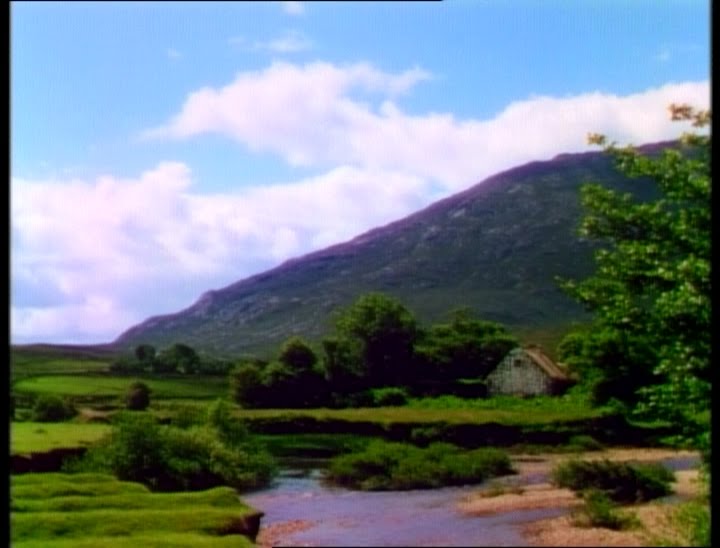
John Ford's Academy Award winning film The Quiet Man (1952) is, in many ways, a story about place and the rediscovery of it. In the film, the expatriate Irish-American Sean Thornton (John Wayne) returns to the village of 'Innisfree' to reclaim his family home. However, his journey has less to do with the actual reclaiming of the property and more to do with the rediscovery of the past through a literal journey in a time. This place, where the character was born and where he eventually hopes to die, is significant, but is somewhere that has only previously existed in the memory and imagination. A second-hand Ireland passed down through the tall tales and fond reminisces of parents and grandparents, where the greens are a little too green, the people a little too broad and the atmosphere closer to caricature. It is Ford's Ireland as much as it is the Ireland of Thornton; this larger than life place presented to us in an idealised fashion that has no bearing on the actual Ireland as it existed in 1952, where the director goes to great lengths to exaggerate every detail, as memories are exaggerated in the mind.
Our first glimpse of this traditional Ireland - a horse and cart, signalling the switch from the modern to the old-fashioned - is shared with the central character, as both he and we catch a glimpse of it through the railway station window. In the literal sense, the framing of this shot as a window into another world becomes an invitation, both to the character and to the audience. This horse and cart are therefore not only a reminder of the archaic, or the out-dated, but a means of transportation, from our world into the next.
This contrast, between the old and the new, will be made explicit in the following shot, as the horse and cart, situated in the foreground, make their way beneath the arch of the railway bridge on their way into the village. As the locomotive thunders overhead, marking the horizon where the blue of the sky meets the green of the valley, the film is signalling the shift from the contemporary world of this character (represented by the train) to the otherworld of the film.
As the buggy departs, the Greek-chorus of characters, peering out from over the wall and indulging in gossip and idle chit-chat, become an immediate surrogate for the viewing audience. Asking questions about this character, who at this point in the story is still unknown and without conventional introduction, while also establishing the thread of community - as in, a world defined by these characters - that will be further explored throughout.
Although in some aspects the film could be seen as playing up to the perceived stereotype of the Irish - in keeping with subsequent Hollywood movies, such as Darby O'Gill and the Little People (1959) and Finian's Rainbow (1968) - the film nonetheless illustrates Ford's great warmth and tremendous affection for these characters; over-embellished, as characters in Ford's films often were, but only as a means of turning even the most humble of supporting players into a bold, heroic figure, commanding the landscape as if it were a part of them.
Adapted from a short story by the Irish writer Maurice Walsh, The Quiet Man is a film often referred to, simplistically speaking, as a romantic melodrama, with the main selling point being the relationship between Thornton and the beautiful spinster Mary Kate Danaher (Maureen O'Hara). However, this surface layer - or selling point - is only one component of a film that has far greater themes beyond whatever was the more popular reading of the time. The romantic element might admittedly be a fairly large component of the story - in the sense that it is motivated by all the other elements at play - it is nonetheless a storyline that sits side-by-side with the other themes, which are perhaps more representative of Ford's own interests as both an artist and a storyteller. Obviously, we recognise immediately the presence of John Wayne, who appeared in countless films by Ford - often as various rough around the edges frontiersmen, soldiers and cavalrymen - but the actual image of the actor in this environment, and in this particular romantic narrative, seems to suggest something slightly off about his character from the very first scene. A hidden depth that will eventually be explained in the second act of the film, but which nonetheless adds subtle shades to our interpretation of him and the general questions that we (and that sort-of Greek chorus) ask ourselves during those opening few minutes.
As a result, the film has an air of mystery to it, as we're left to wonder why Thornton has decided to return to Ireland now, at this point in time, and why he seems so reluctant to engage in the merriment and the frivolity of the local booze hounds as they delight in pulling half-remembered stories of the Thornton ancestry from the murky puddles of the past. Has the character really come back to this place to reclaim the house where he was born, or is there some other motivating factor; some secret shame that has forced him to abscond and find solace in the last place anyone would ever think to look for him?
Ford amplifies this uncertainly through the blocking of scenes, as characters with half-smiles dart their eyes back and forth to one another in a silent judgement, or in the earlier sequences of characters rummaging through Thornton's rucksack as if there's something more to this than simply the shock of the new. However, in a later scene, in which Thornton returns to his newly purchased farm, only to find the fire still burning and the dust and grime swept into a pile in the centre of the room, we think, momentarily, that the past-life of this character has finally caught up with him. The look of this scene, with its vivid studio lighting and special effects to simulate a violent thunder storm, seems closer to the eventual cinema of the Italian director Mario Bava; with the splashes of yellow and purple on the farmhouse wall, and that billowing curtain as it dances in the draught of a broken window, seeming entirely removed from the usual, more characteristic Fordian quirks.
Eventually, the threat turns out to be none other than Mary Kate, and the scene climaxes with one of the most famous and iconic screen kisses in cinema history. However, the lead up to this moment, and that tangible sense of a character backed into a corner and ready to lash out for the purposes of self-preservation, confirm our suspicions that there is more to this Sean Thornton than his far too convenient back-story might suggest.
The revelation of this hidden character is eventually covered in the film's second act, in a bravura flashback sequence that remains one of the most incredible pieces of cinema that Ford ever created. Without question, the most jarring moment in the film, this flashback of Thornton's to the tragic boxing match that ended his career and forced him to leave America, is a marvel of purely visual storytelling, character building and pure filmmaking ingenuity. As the character is KO'd by the right-hook of the mean-tempered landowner "Red" Will Danaher (Victor McLaglen) on the day of his wedding, Ford cuts back from Thornton's prone frame to the blinding spotlight as it cools on a shot of Thornton, as pugilist, traumatised and unnerved; looking down at the audience - or through us - at the wounded body of his foe. The actual structure of this scene, with its deliberately odd framing and disorientating use of montage, particularly of expressionless faces, can be seen as an influence on everyone from Jean-Luc Godard to Martin Scorsese, with the editing in films like A Married Woman (Une femme mariée, 1964) and Raging Bull (1980) in particular showing the influence of Ford, and specifically this sequence of shots.
The scene seems deliberately structured to disrupt the narrative, throwing both the audience and the character into a kind of chaos. Before this scene, we sort of have a sense of where the film is going, or who this character really is, and yet, through this short series of shots, the film has completely undermined the romantic aspect of the story; pushing the film back towards the figure of Thornton as this "quiet man", and the question of why the image of Ireland - and the need to reclaim or rediscover that second-hand existence - has become so important to him. Therefore, the film, beyond this point, is largely about defining this place; this creation of Ford's, as he delights in documenting the layers of this society, its rules and inner-workings, and how these factors or ideas add to the romantic element, creating comedy or drama from the often farcical interactions of his characters. The film, in this sense, shows Ford at his most self-indulgent (perhaps for the first time in his career), as instead of moving the film on or bringing the audience closer to a natural conclusion, he allows these scenes to play out; letting the audience bask in the atmosphere or the richness of these scenes of the world simply existing.
There's a painterly quality to many of these scenes, as moments of social interaction take on an element of still life. We can look at these frames, robbed of movement, devoid of subtext or narrative chronology, and nonetheless read their specific intentions. An image of a man playing an accordion, while another man looks on approvingly; an elderly man, half-cut, gazing into his pint glass and wondering if it's half full or half empty; the scenes of characters making small talk in drawing rooms, or tending the bedside of a dying man, have an affinity to Velázquez, or the early work of Vincent Van Gogh; where the framing of these moments, and the lighting of cinematographer Winton C. Hoch, help to suggest a story, or the relationship between characters, in the most basic, visual sense.
These interior scenes, where their low-lighting and largely subdued colour schemes of browns, blacks, greys and yellows, are wonderfully contrasted by the natural beauty of the exterior locations; where the overwhelming greenery of the hills and the valleys, or the pale blues of an endless sky, remind us of Monet's great landscapes, rich in colour and texture.
These scenes of blarney and adventure are intercut with the less characteristic elements of melodrama; where the courtship between the two central characters and the particular sense of longing is illustrated in Ford's typical expressive style: e.g. as thunderstorms, or raindrops on a window. This is, on the one hand, that old Hollywood approach of showing a character's vulnerability without having them cry on camera; where the should-be tears of Thornton or Mary Kate are exaggerated in such a way that this outpouring of emotion becomes an actual physical presence; an expression of such magnitude that it becomes a manifestation of nature itself.
Through scenes such as this one, Ford is not only telling the story of these two characters in the conventional sense, but further exploring the workings of this society or the mood of a particular location. We might look at the scene of Thornton and Mary Kate's courtship and see it as two characters simply falling in love but overcome by emotion at the realisation that this world will never let their romance flourish... but then we're also seeing a kind of travelogue of the country's most beautiful haunts. We're also seeing the contrast between these two characters as representations of their individual worlds. As Thornton looks on with a quiet shock and disapproval as Mary Kate removes her stockings - and momentarily reveals her thighs - before running bare-footed through the clear stream, we're seeing the staid, officious Americanism of Thornton against the more free-spirited "Irishness" of Mary Kate; as her unashamed disregard for what Thornton sees as socially acceptable simply illustrates her more primal connection to the country that surrounds her.
This same sense can be seen in the initial meeting between Thornton and Mary Kate, as she wanders into the frame, and into the midst of this pastoral abstraction, beautifully lit and framed in a way that once again demonstrates Ford's total command of his location. Here, the blue of her shawl and the red of her hair stand out against the green field, as she finds herself surrounded by sheep in a circular, almost love-heart formation, once again illustrating the connection that these characters, Irish-born, seem to have with a world that Thornton (and Ford) will never truly comprehend.
Once again, this sequence is not simply about the moment of falling in love between two characters, but about the power of the location; or, more importantly, of rediscovering the kind of heroic romance that exists in these stories of Ireland that are passed down from generation to generation.
The film ends with a celebration of these characters and this world, as they wave and curtsy to the camera; again, acknowledging the notion that we are visitors in this imaginary universe, but now, unlike the central character, who has made a home for himself, we must leave, and return to our own less idealised reality. Although The Quiet Man is far from John Ford's greatest achievement as a filmmaker, its place within the broader categorisation of his career as a completely personal project makes it something that is worth experiencing. Simply, the appeal of The Quiet Man goes back to that notion of the still life - of time and its endless stories being recorded for the benefit of future generations - as Ford succeeds in capturing this landscape; not as it existed, but as he must have always imagined it, in his heart and mind.
Saturday, 8 May 2010
Friday, 30 April 2010
Cries and Whispers
Perhaps the most striking thing about Cries and Whispers, beyond the actual look of the film, is the incredible use of silence to draw out that particular evocation of characters waiting for the inevitable. It is within these prolonged moments of images robbed of sound that the filmmaker is able to establish the sense of confinement; of characters disengaged, not only from the family or from the people closest to them, but somehow disconnect from their own emotional responses to these events as they unfold. It is through this continual near-silence that Bergman creates a suitably clandestine environment for this claustrophobic chamber film to develop; fully aware that any brief release of emotion, any spilled secret or slip of the mask, will resonate throughout the house and through the barriers that have formed between these distant characters haunted by the past.
The silence of Cries and Whispers could be taken as a deliberate obstruction, as disarming - in the sense of engaging the film through the greater lives of these characters - as the Brechtian elements of previous Bergman dramas like Persona (1966) or A Passion (En Passion, 1969); two films in which the director succeeded in placing the audience at an arm's length, aware of the situation and privy to the reactions of the characters and the drama that surrounds them, but also transfixed by the filmmaking technique and how it relates explicitly to the fate of these lives that drift in the balance. It could also be seen as a way of keeping the audience observant; misdirecting us as to what might actually happen, and thus creating a palpable tension; where the build up to a certain scene is prolonged to the point of almost abstract absurdity as we spend the first few minutes of the film hoping and waiting for someone to speak, or some sound beyond that of the distant ticking clock and all its mocking allusions to time and of life slowly slipping away, to break through and offer some sort of respite from the strangulating despair that Bergman carefully creates.
When the silence does break - finally stirring with the early morning light to fracture this impenetrable wall of stillness - it is not a note of hope or of comfort, but instead a scream of pain and anguish: the first suffering cry before the inevitable unravelling of thoughts, feelings and deceits that eventually unfold.
The titles of Bergman's films were always incredibly descriptive, giving the potential audience a sense of the central theme of the film or the particular physical or psychological malady that plagued his central characters, but also defining a tone. Blunt and descriptive titles like Shame (Skammen, 1966), The Touch (Beröringen, 1971) and Face to Face (Ansikte mot ansikte, 1976) to name only a select few, get to the very core of the drama in a way that covers both the physical and emotional perspectives of his protagonists. Much like the title of this film, which again creates a suggestion in the mind of the potential audience as to what kind of film they could expect - Cries and Whispers, or from the literal Swedish translation, Whispers and Cries - in which the slow-death of the middle-aged Agnes (Harriet Andersson) is contrasted against the thoughts, fears and regrets of her sisters Karin (Ingrid Thulin) and Maria (Liv Ullmann), and her maid turned personal carer Anna (Kari Sylwan), as the ghosts of the past chatter about this bleak house and we, as an audience, try to make sense of the thing.
It is the combination of sounds and silence - and the spaces between words that say so much more than conventional dialog ever could - that coerce us through this tragedy. Maintaining that incredibly numbing atmosphere, filled with illness and disease, Bergman envisions a painful world where the death-rattle choke of Agnes speaks volumes, not only about her own character, but of the feelings of the other three women who tend to her draconian-like deathbed. As is often the case with Bergman, the drama here is localised mostly to a single location; in this case a large family manor house in the autumnal Swedish countryside, where characters congregate in some kind of seclusion, plagued by the many sinful, unspoken and embarrassing secrets that seem to permeate from the guilt and despair of these three very different women. It is this sense of inner pain that embodies the house with a shocking red hue, offering the fairly obvious though no less powerful associations to the colour or blood, the colour of sickness and the colour of rage.
The continual image of black and white-clad figures against a backdrop of piercing deep reds is near iconic within the Bergman filmography, combing that visualisation of a particular shared psychological space that is only broken at the end of the film, when a pastoral garden scene offers some kind of relief or reflection of how things were, or how things could have been. There is also the continual device of the fade to red; a fairly novel use of a scene punctuation/transition, which not only announces the movements between memory and reality, but in some way further stresses the idea of characters being swallowed up by the acrid stench of death that clings to them. This approach, combined with Bergman's extraordinary use of the close-up shot, creates an experience that is all the more punishing; as each full-face composition offers the audience the opportunity to study these characters, their faces and the look of fear or duplicity in their worried eyes, and cast judgement or pity upon them as we see it.
It also allows us to study the performances of these four female leads - Harriet Andersson, Ingrid Thulin, Kari Sylwan and Liv Ullman - who each give superlative performances as these women dealing with the passing of time, memory and death, and their reactions to all of the above. In this sense, the use of silence is much more notable, not only for its element of deconstructing the natural rhythm that we might normally expect, but in the way in which it establishes the mood of tragedy, of the pre-mortem and post-mortem limbo that traps these characters in tortured suffocation, infusing the very core of the film's visual identity and the way that we, as an audience, interpret it.
Wednesday, 21 April 2010
The Book of Mary
On the soundtrack, a dialogue between a man and a woman plays out against an aural backdrop of exaggerated birdsong effects. An accompanying montage of images establishes the central location - an affluent, neatly furnished house overlooking Lake Geneva - and the more important presentation of the "home" in the purely traditional, theoretical sense of the word. By beginning the film with the argument at its most pitiless, establishing the discordance of the family relationship and the general disharmony of the central character's turbulent home life - and therefore personifying the dialogue through the particular iconography of the domestic milieu - writer/director Anne-Marie Miéville brilliantly cuts right to the very core of this subtle yet entirely enriching story; perfectly illustrating the very obvious notion that every home tells a story, specifically when such stories, like recollections of a certain event, are recalled from the memory of a child.
In The Book of Mary (Le livre de Marie, 1984), the effect of divorce on the life of a precocious young girl, who hides the trauma of her parent's separation by disappearing into the imagined worlds of books and music, is captured by Miéville with an uncompromising rigour that places the characters at a distance from the audience, stressing a kind of detached observation. Through the flat, locked-off compositions, in which the camera records, unobtrusively, often cutting between short conversational vignettes that establish the particular post-break-up mindset of the family as a whole, the director creates a sense of reality, closer to documentary than fiction, where these over-the-kitchen-table-top discussions between the family-unity have a feeling of unrehearsed, emotional spontaneity. However, through this approach, Miéville is able to extract a greater truth from the material without the usual manipulation or gimmickry that directors exploit when making films about family dysfunction or childhood in general; offering a feeling of empathy and understanding for her characters, simply by giving them the room to grow and develop naturally over the course of the film.


Through the opening sequence of shots, with the suggestion of time passing from night to early morning - while the camera picks out and focuses on these seemingly innocuous everyday domestic items of flower arrangements, vases and table-top ornaments - Miéville brings to mind, perhaps superficially, the opening sequence of director Michelangelo Antonioni's great masterwork L'eclisse (The Eclipse, 1962). Both films begin with the break-up of a couple in the early hours of the morning, where the discussion between the characters is framed by the iconography of the location and the relics of the home. However, whereas Antonioni has his camera explore this location, framing his characters within it in a way that both obscures and reveals the various push/pull dynamics of their central relationship, Miéville has her dialogue take place over mostly empty frames, further pointing towards that suggestion of the absentee family, and again the sense of the recollection of an event as seen through the eyes of a child.
As is often the case in life, the disagreements between husband and wife/father and mother aren't always seen by children, but are heard or felt; they're experienced from behind closed doors, or drowned out, partially, by the general cacophony of the radio or the television set. These static images of a house, largely vacant, suggest the power of these objects as subconscious recording devices. If these walls could talk, people say... referring to the story behind each accumulated piece of furniture, or the particular mark of time that clings to them. In any relationship, we gather shared objects and attach a meaning to them; a picture purchased on the morning of an argument, a keepsake bought on the night of the first kiss, etc. These objects/images hold a story. However, they also create a larger narrative: the story of the various human beings that inhabit this domestic space, and define it.


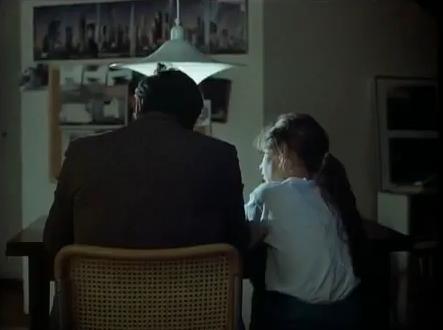
Miéville, like her more famous partner/collaborator Jean-Luc Godard, seems interested in the relationship between men and women and the roles that they play: in this instance, both as facilitators in their own happiness or unhappiness, as well as in the notion of parents with a shared responsibility. This idea runs throughout the film, complementing the more immediate story of the young girl, while also adding a psychological depth to the quiet anguish of the marital situation. The story, in this sense, is anchored by three sequences of family interaction. The first, a roundtable discussion, in which the notion of the "fatal truth" is suggested by a line of dialogue that recalls Woody Allen: "Nothing can stay the same. When a thing stops moving, it's dead!" The second and third of these scenes explore the relationship between the girl and her parents: first, lounging in the bathtub with her mother, attempting to recall the "strength of love", which is "impossible without going backwards", and later working on a homework assignment with her dad.
These scenes show that, despite the volatile situation with the couple, both mum and dad are committed to raising and looking after their child; that this relationship isn't just a caricature, or something like Varda's Le bonheur (Happiness, 1965), where the characters exist for the purpose of social commentary and little else, but something that is real and entirely believable. Therefore, these three people, the mother, father and daughter, become like the geometric shapes that Le Père draws on his daughter's homework assignment; the jagged lines that change direction by forming a new angle where two lines meet.


The 'battle of the sexes'-type call and response of the earlier scenes perhaps remind us, to some extent, of the work of Godard, despite the fact that these characters have a weight and a responsibility that his own characters often don't. In a Godard film, the central protagonists usually possess a youthful exuberance; a naivety that exaggerates the emotional spontaneity of people that exist on the knife's edge of a sensation, turning every embrace into the last embrace, every kiss into the kiss of death. In The Book of Mary, these characters, as a family, are real and convincing. We believe that this man and this woman have loved for long enough and that the responsibilities of the home and the cultivation of a comfortable middle-class existence has taken some of the initial shine and vitality off a relationship that Godard may have depicted through the chaos of l'amour fou. These are tired characters already at the end of something. Even when Godard depicts the decline of a relationship, as he does in nearly all of his films, he's still at the beginning of things. There's no end for his characters. Even if some kind of climax can be found in the romanticised self-destruction of his protagonists; Tis better to have loved and lost... et cetera.
Miéville herself acknowledges this connection in an early scene in which we see Mary, in a tableau-vivant composition, watching, on a small portable television set, a pan and scan copy of Godard's early masterpiece Le mépris (Contempt, 1963). The full 'scope of Godard's images torn apart by the home video restrictions of the early 1980s, dislocating the two characters even further from one another, reducing them to single figures in a 1.37:1 frame, while this bickering between rooms, both here and on the television, is once again soundtracked - this time less obviously - by the beautiful music of Georges Delerue. It draws a line, self-consciously, from one movie to the next, revealing the enormous if subtle differences between these two great filmmakers, whilst also, on a more important level, showing how the subtext of these arguments are changed from the playful to the destructive once the wellbeing of a child becomes at risk.


In the film's most famous sequence, Mary, having spent the day in the company of her separated parents - first the mother, then the father - comes home to the empty house, with its open doors and its brightly lit spaces, and puts a record on. Almost immediately, she begins to act out the music, the sensation of it; the rush of feeling, overwhelming both the character and the audience, and giving us that burst of actual, physical expression that we so desperately needed. As a sequence, it functions on a similar level to the extraordinary scene in the Leos Carax film Mauvais sang (Bad Blood/The Night is Young, 1986), where the character played by Denis Lavant is compelled into action by the sound of David Bowie's then contemporary hit single Modern Love. The music burns a hole through this character, placing his feelings into a greater perspective, and turning his movements, both jubilant and terrifying, into a kind of expression.

Like Lavant in that subsequent film, the child cannot put into words the hurly-burly of this situation. This is what makes the experience of childhood so unusual; we can't always understand or appreciate the position we're in. Things might affect us on a profound level, either at the time or much later in life, but we can nonetheless escape into worlds, through words and music, or games of imagined fantasy. As the notes of Symphony No. 2 by Gustav Mahler start up on the stereo, the power of the music is enough to kick-start a spark of life that allows this young character to articulate her feelings of confusion or tragedy through the literal movements of the music. The sound of these instruments together, creating melodies that we can attach ourselves to, becomes a different kind of facilitator; a means of transcending the dreariness of her own reality. The character, wearing her emotions down to nothing, until there's no more expression; no more movement or emotion left to convey.
At this point, the character chooses to play dead (like Björk, "...it stops the hurting"), and we sense that the weight of feeling conveyed in this dance of death has been enough to exorcise those feelings of hopelessness and confusion. The child is reborn. The end of the film suggests, not so much the beginning of a new chapter - the family surrogated, rebuilt, again, as in the Varda film aforementioned - but in the sense that things will continue on, still fractured, still somewhat up in the air, but now these characters at least have a clarity enough to cope with the confusion. In describing The Book of Mary, one critic writes: "There is something of Rossellini in this project, which is modest and ambitious at the same time. The film attains a dry and pure emotion, and a new truth, about the end of childhood." The description perfectly explains the strengths of Miéville's presentation, which is absolutely to the point, and yet filled with subtle depths, textures and nuances, that transform a thing that could have easily been seen as rather distant and reserved, into something that is truly remarkable.
In The Book of Mary (Le livre de Marie, 1984), the effect of divorce on the life of a precocious young girl, who hides the trauma of her parent's separation by disappearing into the imagined worlds of books and music, is captured by Miéville with an uncompromising rigour that places the characters at a distance from the audience, stressing a kind of detached observation. Through the flat, locked-off compositions, in which the camera records, unobtrusively, often cutting between short conversational vignettes that establish the particular post-break-up mindset of the family as a whole, the director creates a sense of reality, closer to documentary than fiction, where these over-the-kitchen-table-top discussions between the family-unity have a feeling of unrehearsed, emotional spontaneity. However, through this approach, Miéville is able to extract a greater truth from the material without the usual manipulation or gimmickry that directors exploit when making films about family dysfunction or childhood in general; offering a feeling of empathy and understanding for her characters, simply by giving them the room to grow and develop naturally over the course of the film.


Through the opening sequence of shots, with the suggestion of time passing from night to early morning - while the camera picks out and focuses on these seemingly innocuous everyday domestic items of flower arrangements, vases and table-top ornaments - Miéville brings to mind, perhaps superficially, the opening sequence of director Michelangelo Antonioni's great masterwork L'eclisse (The Eclipse, 1962). Both films begin with the break-up of a couple in the early hours of the morning, where the discussion between the characters is framed by the iconography of the location and the relics of the home. However, whereas Antonioni has his camera explore this location, framing his characters within it in a way that both obscures and reveals the various push/pull dynamics of their central relationship, Miéville has her dialogue take place over mostly empty frames, further pointing towards that suggestion of the absentee family, and again the sense of the recollection of an event as seen through the eyes of a child.
As is often the case in life, the disagreements between husband and wife/father and mother aren't always seen by children, but are heard or felt; they're experienced from behind closed doors, or drowned out, partially, by the general cacophony of the radio or the television set. These static images of a house, largely vacant, suggest the power of these objects as subconscious recording devices. If these walls could talk, people say... referring to the story behind each accumulated piece of furniture, or the particular mark of time that clings to them. In any relationship, we gather shared objects and attach a meaning to them; a picture purchased on the morning of an argument, a keepsake bought on the night of the first kiss, etc. These objects/images hold a story. However, they also create a larger narrative: the story of the various human beings that inhabit this domestic space, and define it.


Miéville, like her more famous partner/collaborator Jean-Luc Godard, seems interested in the relationship between men and women and the roles that they play: in this instance, both as facilitators in their own happiness or unhappiness, as well as in the notion of parents with a shared responsibility. This idea runs throughout the film, complementing the more immediate story of the young girl, while also adding a psychological depth to the quiet anguish of the marital situation. The story, in this sense, is anchored by three sequences of family interaction. The first, a roundtable discussion, in which the notion of the "fatal truth" is suggested by a line of dialogue that recalls Woody Allen: "Nothing can stay the same. When a thing stops moving, it's dead!" The second and third of these scenes explore the relationship between the girl and her parents: first, lounging in the bathtub with her mother, attempting to recall the "strength of love", which is "impossible without going backwards", and later working on a homework assignment with her dad.
These scenes show that, despite the volatile situation with the couple, both mum and dad are committed to raising and looking after their child; that this relationship isn't just a caricature, or something like Varda's Le bonheur (Happiness, 1965), where the characters exist for the purpose of social commentary and little else, but something that is real and entirely believable. Therefore, these three people, the mother, father and daughter, become like the geometric shapes that Le Père draws on his daughter's homework assignment; the jagged lines that change direction by forming a new angle where two lines meet.


The 'battle of the sexes'-type call and response of the earlier scenes perhaps remind us, to some extent, of the work of Godard, despite the fact that these characters have a weight and a responsibility that his own characters often don't. In a Godard film, the central protagonists usually possess a youthful exuberance; a naivety that exaggerates the emotional spontaneity of people that exist on the knife's edge of a sensation, turning every embrace into the last embrace, every kiss into the kiss of death. In The Book of Mary, these characters, as a family, are real and convincing. We believe that this man and this woman have loved for long enough and that the responsibilities of the home and the cultivation of a comfortable middle-class existence has taken some of the initial shine and vitality off a relationship that Godard may have depicted through the chaos of l'amour fou. These are tired characters already at the end of something. Even when Godard depicts the decline of a relationship, as he does in nearly all of his films, he's still at the beginning of things. There's no end for his characters. Even if some kind of climax can be found in the romanticised self-destruction of his protagonists; Tis better to have loved and lost... et cetera.
Miéville herself acknowledges this connection in an early scene in which we see Mary, in a tableau-vivant composition, watching, on a small portable television set, a pan and scan copy of Godard's early masterpiece Le mépris (Contempt, 1963). The full 'scope of Godard's images torn apart by the home video restrictions of the early 1980s, dislocating the two characters even further from one another, reducing them to single figures in a 1.37:1 frame, while this bickering between rooms, both here and on the television, is once again soundtracked - this time less obviously - by the beautiful music of Georges Delerue. It draws a line, self-consciously, from one movie to the next, revealing the enormous if subtle differences between these two great filmmakers, whilst also, on a more important level, showing how the subtext of these arguments are changed from the playful to the destructive once the wellbeing of a child becomes at risk.

[The world turned upside-down]

In the film's most famous sequence, Mary, having spent the day in the company of her separated parents - first the mother, then the father - comes home to the empty house, with its open doors and its brightly lit spaces, and puts a record on. Almost immediately, she begins to act out the music, the sensation of it; the rush of feeling, overwhelming both the character and the audience, and giving us that burst of actual, physical expression that we so desperately needed. As a sequence, it functions on a similar level to the extraordinary scene in the Leos Carax film Mauvais sang (Bad Blood/The Night is Young, 1986), where the character played by Denis Lavant is compelled into action by the sound of David Bowie's then contemporary hit single Modern Love. The music burns a hole through this character, placing his feelings into a greater perspective, and turning his movements, both jubilant and terrifying, into a kind of expression.

Like Lavant in that subsequent film, the child cannot put into words the hurly-burly of this situation. This is what makes the experience of childhood so unusual; we can't always understand or appreciate the position we're in. Things might affect us on a profound level, either at the time or much later in life, but we can nonetheless escape into worlds, through words and music, or games of imagined fantasy. As the notes of Symphony No. 2 by Gustav Mahler start up on the stereo, the power of the music is enough to kick-start a spark of life that allows this young character to articulate her feelings of confusion or tragedy through the literal movements of the music. The sound of these instruments together, creating melodies that we can attach ourselves to, becomes a different kind of facilitator; a means of transcending the dreariness of her own reality. The character, wearing her emotions down to nothing, until there's no more expression; no more movement or emotion left to convey.
At this point, the character chooses to play dead (like Björk, "...it stops the hurting"), and we sense that the weight of feeling conveyed in this dance of death has been enough to exorcise those feelings of hopelessness and confusion. The child is reborn. The end of the film suggests, not so much the beginning of a new chapter - the family surrogated, rebuilt, again, as in the Varda film aforementioned - but in the sense that things will continue on, still fractured, still somewhat up in the air, but now these characters at least have a clarity enough to cope with the confusion. In describing The Book of Mary, one critic writes: "There is something of Rossellini in this project, which is modest and ambitious at the same time. The film attains a dry and pure emotion, and a new truth, about the end of childhood." The description perfectly explains the strengths of Miéville's presentation, which is absolutely to the point, and yet filled with subtle depths, textures and nuances, that transform a thing that could have easily been seen as rather distant and reserved, into something that is truly remarkable.
Saturday, 20 March 2010
Architecture in NYC
One of my favourite moments in Woody Allen's Academy Award Winning Hannah and Her Sisters (1986), is the scene in which Sam Waterston's character takes Dianne Wiest and Carrie Fisher on a whirlwind tour of New York City to visit some of his favourite architectural sights. The scene is notable because it illustrates, on a very basic level, what I love most about Allen's work. The seeming simplicity of it, the wit, the imagination, the sleight of hand, the effortless inventiveness and the ability to take moments and images that are present at any point in our daily lives - on any street, place or person - and transform them into moments of great cinema.
The scene in question is a delightful little moment that could have easily been included in the film for no other reason than to provide a brief interval or interlude between the more complicated or exhausting relationship dramas that occur throughout. Instead, it is a scene that communicates a great deal about the relationship between these two friends (the characters played by Wiest and Fisher) as they attempt to feign interest in this travelogue of buildings and places simply as a way of getting to know this dashing and successful young architect. Their reactions to these great buildings demonstrate a desperate attempt to agree or disagree with whatever Waterston's character is speaking of, while also offering a much more amusing insight into the dynamics of this relationship, as both women attempt to outdo one another for the offer of a ride home.
As with any great moment from the films of Woody Allen, this particular scene seems to me to offer a remarkable example of what cinema can achieve, precisely because it is something that could only be communicated through the cinematic form. This scene is further proof of Allen's obvious talent for expressing moments of immense depth and human emotion through incredibly simple though no less ingenious methods, and stands out, in my mind at least, as one single moment of invention from a film seemingly full of them.
The scene in question is a delightful little moment that could have easily been included in the film for no other reason than to provide a brief interval or interlude between the more complicated or exhausting relationship dramas that occur throughout. Instead, it is a scene that communicates a great deal about the relationship between these two friends (the characters played by Wiest and Fisher) as they attempt to feign interest in this travelogue of buildings and places simply as a way of getting to know this dashing and successful young architect. Their reactions to these great buildings demonstrate a desperate attempt to agree or disagree with whatever Waterston's character is speaking of, while also offering a much more amusing insight into the dynamics of this relationship, as both women attempt to outdo one another for the offer of a ride home.
As with any great moment from the films of Woody Allen, this particular scene seems to me to offer a remarkable example of what cinema can achieve, precisely because it is something that could only be communicated through the cinematic form. This scene is further proof of Allen's obvious talent for expressing moments of immense depth and human emotion through incredibly simple though no less ingenious methods, and stands out, in my mind at least, as one single moment of invention from a film seemingly full of them.
Tuesday, 2 March 2010
Pauline at the Beach
Given the recent passing of the legendary filmmaker Éric Rohmer, it seems only fair to offer a few words of consideration on possibly my favourite of the director's films; the quietly observed and brilliantly performed ensemble drama, Pauline at the Beach (Pauline à la plage, 1983). As an introduction to Rohmer's incredibly rich and often surprisingly varied body of work, Pauline at the Beach is essential; perfectly illustrating the thoughtful, often leisurely and conversational approach that defines many of the director's greatest films, such as Love in the Afternoon (L'Amour l'après-midi, 1972) or Four Adventures of Reinette and Mirabelle (Quatre aventures de Reinette et Mirabelle, 1987), which for me reach beyond the mere pleasantries of the character study or the vague categorisations of dramatisation to offer something altogether more difficult to define.
In this sense, describing the typical Eric Rohmer experience can be daunting, especially since much of what stands out in Rohmer's work is the emphasis on character interaction, location and mood. Attempting to explain the appeal of such an approach, beyond the obvious personal appeal that resonates during the actual course of viewing, seems almost irresponsible. The work, as it stands, is best experienced, so that an audience can savour the subtle development of these dramas that occur around the narrative, developing naturally from the interactions between characters, or the natural charm or personality of a particular location.
In attempting to intellectualise or over-analyse such factors the reviewer can distract from the often simple pleasures that are presented to an audience when merely spending some time in the company of these characters; getting to know them, becoming privy to their innermost thoughts and feelings, or the often-complicated web of relationships that grow and develop as they stumble in and out of various social events; or simply pass the time on beaches, in cafés or in the garden, or huddled around a television set on a warm afternoon.
In Pauline at the Beach, this concept of being in the company of characters as they fumble around the edges of a social predicament is perfectly illustrated through the development of that always interesting narrative facilitator: the summer holiday. The great motivator in many of Rohmer's pictures, because (we assume?) it allows the audience the room to indulge in these scenarios; to take our minds off the more urgent concerns of narrative development, action and plot, and instead see the characters at their most relaxed and apparently carefree. This as an idea is in keeping with Rohmer's central ideology of "thoughts rather than actions", dealing "less with what people do than what is going on in their minds while they're doing it." So, with Pauline at the Beach, we have characters taking a break from the rat race of work or school (or whatever) and using the getaway as an excuse to seek out relationships, connections (meaningful or not) and moments of recreation. The film, both for the characters and for the audience, is therefore an escapist pursuit, where we disengage from our own lives and instead observe the comings and goings of this particular social circle as they wrestling with the complications of everyday life.
Keeping this particular approach in mind, Pauline at the Beach could, like many of Rohmer's other, contemporary-based character dramas, be defined by the literary term "in medias res"; meaning that the drama is already pre-established and in some respect without conclusion. Instead of presenting a clear and conventional three-act structure of beginning, middle and end, Rohmer instead cuts into a story where the characters are already clearly defined (amongst themselves, at least), and where we, as an audience, have to play catch up; teasing out even the most basic of information - including who these people are and what they're actually doing here - from their earliest interactions. What this does beyond allowing the drama to unfold naturally without the usual concessions to conventional narrative storytelling is make the audience feel as though we've been invited into this scenario, into these rooms and houses, and again, been allowed to spend a limited period of time with these characters, eavesdropping on their conversations, or gathering up information as they go about their daily routines.
Illustrating this idea of a story already in progress, the film begins with the arrival of Pauline (Amanda Langlet) and her older cousin Marion (Arielle Dombasle) at the Normandy summer house where the story plays out. Rohmer wastes no time in cutting to a conversation between these two characters as they settle in the garden; with the dialogue soon establishing the theme of romance and relationships, and in particular the contrasts between the two individuals in how they approach these specific concerns.
Marion, a recent divorcée, seems to crave intense relationships; relationships with the power to move, but also the power to destroy. Pauline on the other hand is far more pragmatic, viewing relationships in a realistic context, hopeful, but also somewhat cynical. The contrast between these two characters is immediately apparent, with Marion, the eldest of the two, really seeming to be the more naive and perhaps even more adolescent in her view of male and female courtship, while Pauline, still in puberty, already knows what she wants and what to expect. As the story progresses we're introduced to the various characters that exist within this world; chiefly, Henri (Féodor Atkine), a single father and womaniser who Marion begins a casual relationship with, and Pierre (Pascal Greggory), a wind-surf instructor who is besotted with Marion, but eventually ends up spending more time with Pauline as a kind of unintentional confidant.
Pauline at the Beach was the third instalment in Rohmer's highly acclaimed series of films grouped together under the collective banner of the Comedies and Proverbs; an otherwise unrelated series of films each based on (or inspired by) a specific proverbial phrase. In the case of Pauline at the Beach, it is the opening quote from Chrétien de Troyes that establishes the theme; 'A wagging tongue bites itself.' The quote introduces not only the conversational structure of Rohmer's film (or the broader conventions of his character dramas in general), but also the various he said/she said situations, where gossip and hearsay are motivators for the plot. To further illustrate this notion, Rohmer develops a story that is, on the one hand, a relationship drama - focusing on a complicated series of inter-relationships, including two couples of differing age-groups and at least two potentially inter-linking love triangles - and on the other, a coming of age story. In presenting both aspects of this dilemma, Rohmer is able to utilise the element of comic misunderstanding, as these characters distort truths and misinformation leading to the usual arguments and falling outs that are typical of the genre.
Through Rohmer's approach to his characters is at times distant - as they are positioned as fully realised human beings, independent of any potential manipulation of the filmmaker - there is nonetheless a very real feeling for these people; a warmth and a charisma that is obvious, even if the more apparent character traits, such as vanity, deceit or self-delusion offer less attractive aspects of their true personalities. Nonetheless, these people, already formed and well developed before the first introductory scene, are allowed to express themselves naturally as characters, revealing their thoughts, feelings and philosophies, either through dialogue or through the choices they make. The clothes they wear, the cars they drive, the people they choose to meet and hook up with all add texture to these characterisations, giving a greater weight to their creation as people that exist beyond the self-contained drama that takes place between the first scene and the last; reinforcing that particular idea frequent throughout Rohmer's work where we sense that these lives and these relationships will continue to thrive or stumble long after our experience with the film has come to an end.
In terms of the actually filmmaking approach, Pauline at the Beach is characteristic of Rohmer's visual approach to his character dramas, drawing mostly on a naturalistic look, with costumes, cars and architecture that is very much of the period, and a loose, observational style, where the camera, often in close-up or medium shot, examines the drama from a fixed perspective. As a contrast to the less well know but no less essential historical dramas that Rohmer directed, such as The Marquise of O... (Die Marquise von O..., 1976), Perceval (Perceval le Gallois, 1978) and The Lady and the Duke (L'Anglaise et le Duc, 2001), where the actual cinematic style was often more ornate, imaginative or deliberately artificial, the look and style of Pauline at the Beach is defined by its location and the natural mood and impression that it inspires. In collaboration with his crew, Rohmer perfectly capture the atmosphere of the seaside setting, from the sun-kissed beach where the blue of the ocean stretches out to meet a bright white sky, to the casual comings and goings of the characters' houses, where the doors remain unlocked (because there's nothing worth stealing) and where the flowers bloom brightly through windows or in the background of idyllic garden scenes.
Through drawing our attention to these seemingly minute details, which define the time and the place and help to create a world for the characters that is entirely convincing, Rohmer is able to make the experience tangible enough for an audience no doubt experiencing this drama from the confines of a cinema seat, or at home, on DVD. So, although the drama might be observational, and the characters at something of a reserve, we're nonetheless able to fully immerse ourselves in the creation of this world made real by our own associations and memories of summer holidays or trips to the seaside with family and friends, where the ritual of walking back from the beach, later afternoon, with your shoes and socks off - bare feet on the gravel path or the grass of the garden - has a real sense of nostalgia.
Though Rohmer attempts with these films to be as unobtrusive as possible, there is still some clear element of stylisation. For example, the extraordinary use of natural sunlight in several scenes, capturing the sense of an endless summer day; from the blue wash of dawn, to the bright whites of high noon and the warming reds of just-before sunset, the lighting of the film, in both the interior and exterior scenes, is perfect. Likewise, the casting of the film and Rohmer's particular skill in creating these characters and allowing them the room to express and emote, is incredibly well defined, with the use of the dialogue and the effortless delivery of the performers, seeming very real and unrehearsed. The intentions of the dialogue and what it reveals about these characters as human beings is never improvisatory or meandering; every expression, no matter how seemingly trite on first experience, gives us some clue as to the purpose of these characters, their dreams and their desires.
Like the other films of the Comedies and Proverbs series - which includes The Aviator's Wife (La Femme de l'aviateur, 1981), A Good Marriage (Le Beau mariage, 1982), Full Moon in Paris (Les Nuits de la pleine lune, 1984), The Green Ray (Le Rayon vert, 1986) and The Boyfriend of My Friend Could Be My Boyfriend (L'Ami de mon amie, 1987) - Pauline at the Beach is crucial to defining the image of Rohmer as a complete artist. Not just as a filmmaker, but as a sometimes novelist, teacher, thinker and critic, able to point his camera at the supposedly ordinary, day after day activities that make up the inter-connected meetings and moments of everyday life and bring out the extraordinary colour and feeling of an actual human existence that many fail to appreciate.
In this sense, describing the typical Eric Rohmer experience can be daunting, especially since much of what stands out in Rohmer's work is the emphasis on character interaction, location and mood. Attempting to explain the appeal of such an approach, beyond the obvious personal appeal that resonates during the actual course of viewing, seems almost irresponsible. The work, as it stands, is best experienced, so that an audience can savour the subtle development of these dramas that occur around the narrative, developing naturally from the interactions between characters, or the natural charm or personality of a particular location.
In attempting to intellectualise or over-analyse such factors the reviewer can distract from the often simple pleasures that are presented to an audience when merely spending some time in the company of these characters; getting to know them, becoming privy to their innermost thoughts and feelings, or the often-complicated web of relationships that grow and develop as they stumble in and out of various social events; or simply pass the time on beaches, in cafés or in the garden, or huddled around a television set on a warm afternoon.
In Pauline at the Beach, this concept of being in the company of characters as they fumble around the edges of a social predicament is perfectly illustrated through the development of that always interesting narrative facilitator: the summer holiday. The great motivator in many of Rohmer's pictures, because (we assume?) it allows the audience the room to indulge in these scenarios; to take our minds off the more urgent concerns of narrative development, action and plot, and instead see the characters at their most relaxed and apparently carefree. This as an idea is in keeping with Rohmer's central ideology of "thoughts rather than actions", dealing "less with what people do than what is going on in their minds while they're doing it." So, with Pauline at the Beach, we have characters taking a break from the rat race of work or school (or whatever) and using the getaway as an excuse to seek out relationships, connections (meaningful or not) and moments of recreation. The film, both for the characters and for the audience, is therefore an escapist pursuit, where we disengage from our own lives and instead observe the comings and goings of this particular social circle as they wrestling with the complications of everyday life.
Keeping this particular approach in mind, Pauline at the Beach could, like many of Rohmer's other, contemporary-based character dramas, be defined by the literary term "in medias res"; meaning that the drama is already pre-established and in some respect without conclusion. Instead of presenting a clear and conventional three-act structure of beginning, middle and end, Rohmer instead cuts into a story where the characters are already clearly defined (amongst themselves, at least), and where we, as an audience, have to play catch up; teasing out even the most basic of information - including who these people are and what they're actually doing here - from their earliest interactions. What this does beyond allowing the drama to unfold naturally without the usual concessions to conventional narrative storytelling is make the audience feel as though we've been invited into this scenario, into these rooms and houses, and again, been allowed to spend a limited period of time with these characters, eavesdropping on their conversations, or gathering up information as they go about their daily routines.
Illustrating this idea of a story already in progress, the film begins with the arrival of Pauline (Amanda Langlet) and her older cousin Marion (Arielle Dombasle) at the Normandy summer house where the story plays out. Rohmer wastes no time in cutting to a conversation between these two characters as they settle in the garden; with the dialogue soon establishing the theme of romance and relationships, and in particular the contrasts between the two individuals in how they approach these specific concerns.
Marion, a recent divorcée, seems to crave intense relationships; relationships with the power to move, but also the power to destroy. Pauline on the other hand is far more pragmatic, viewing relationships in a realistic context, hopeful, but also somewhat cynical. The contrast between these two characters is immediately apparent, with Marion, the eldest of the two, really seeming to be the more naive and perhaps even more adolescent in her view of male and female courtship, while Pauline, still in puberty, already knows what she wants and what to expect. As the story progresses we're introduced to the various characters that exist within this world; chiefly, Henri (Féodor Atkine), a single father and womaniser who Marion begins a casual relationship with, and Pierre (Pascal Greggory), a wind-surf instructor who is besotted with Marion, but eventually ends up spending more time with Pauline as a kind of unintentional confidant.
Pauline at the Beach was the third instalment in Rohmer's highly acclaimed series of films grouped together under the collective banner of the Comedies and Proverbs; an otherwise unrelated series of films each based on (or inspired by) a specific proverbial phrase. In the case of Pauline at the Beach, it is the opening quote from Chrétien de Troyes that establishes the theme; 'A wagging tongue bites itself.' The quote introduces not only the conversational structure of Rohmer's film (or the broader conventions of his character dramas in general), but also the various he said/she said situations, where gossip and hearsay are motivators for the plot. To further illustrate this notion, Rohmer develops a story that is, on the one hand, a relationship drama - focusing on a complicated series of inter-relationships, including two couples of differing age-groups and at least two potentially inter-linking love triangles - and on the other, a coming of age story. In presenting both aspects of this dilemma, Rohmer is able to utilise the element of comic misunderstanding, as these characters distort truths and misinformation leading to the usual arguments and falling outs that are typical of the genre.
Through Rohmer's approach to his characters is at times distant - as they are positioned as fully realised human beings, independent of any potential manipulation of the filmmaker - there is nonetheless a very real feeling for these people; a warmth and a charisma that is obvious, even if the more apparent character traits, such as vanity, deceit or self-delusion offer less attractive aspects of their true personalities. Nonetheless, these people, already formed and well developed before the first introductory scene, are allowed to express themselves naturally as characters, revealing their thoughts, feelings and philosophies, either through dialogue or through the choices they make. The clothes they wear, the cars they drive, the people they choose to meet and hook up with all add texture to these characterisations, giving a greater weight to their creation as people that exist beyond the self-contained drama that takes place between the first scene and the last; reinforcing that particular idea frequent throughout Rohmer's work where we sense that these lives and these relationships will continue to thrive or stumble long after our experience with the film has come to an end.
In terms of the actually filmmaking approach, Pauline at the Beach is characteristic of Rohmer's visual approach to his character dramas, drawing mostly on a naturalistic look, with costumes, cars and architecture that is very much of the period, and a loose, observational style, where the camera, often in close-up or medium shot, examines the drama from a fixed perspective. As a contrast to the less well know but no less essential historical dramas that Rohmer directed, such as The Marquise of O... (Die Marquise von O..., 1976), Perceval (Perceval le Gallois, 1978) and The Lady and the Duke (L'Anglaise et le Duc, 2001), where the actual cinematic style was often more ornate, imaginative or deliberately artificial, the look and style of Pauline at the Beach is defined by its location and the natural mood and impression that it inspires. In collaboration with his crew, Rohmer perfectly capture the atmosphere of the seaside setting, from the sun-kissed beach where the blue of the ocean stretches out to meet a bright white sky, to the casual comings and goings of the characters' houses, where the doors remain unlocked (because there's nothing worth stealing) and where the flowers bloom brightly through windows or in the background of idyllic garden scenes.
The Marquise of O... directed by Éric Rohmer, 1976:
Pauline at the Beach directed by Éric Rohmer, 1983:

Pauline at the Beach directed by Éric Rohmer, 1983:

Through drawing our attention to these seemingly minute details, which define the time and the place and help to create a world for the characters that is entirely convincing, Rohmer is able to make the experience tangible enough for an audience no doubt experiencing this drama from the confines of a cinema seat, or at home, on DVD. So, although the drama might be observational, and the characters at something of a reserve, we're nonetheless able to fully immerse ourselves in the creation of this world made real by our own associations and memories of summer holidays or trips to the seaside with family and friends, where the ritual of walking back from the beach, later afternoon, with your shoes and socks off - bare feet on the gravel path or the grass of the garden - has a real sense of nostalgia.
Though Rohmer attempts with these films to be as unobtrusive as possible, there is still some clear element of stylisation. For example, the extraordinary use of natural sunlight in several scenes, capturing the sense of an endless summer day; from the blue wash of dawn, to the bright whites of high noon and the warming reds of just-before sunset, the lighting of the film, in both the interior and exterior scenes, is perfect. Likewise, the casting of the film and Rohmer's particular skill in creating these characters and allowing them the room to express and emote, is incredibly well defined, with the use of the dialogue and the effortless delivery of the performers, seeming very real and unrehearsed. The intentions of the dialogue and what it reveals about these characters as human beings is never improvisatory or meandering; every expression, no matter how seemingly trite on first experience, gives us some clue as to the purpose of these characters, their dreams and their desires.
Like the other films of the Comedies and Proverbs series - which includes The Aviator's Wife (La Femme de l'aviateur, 1981), A Good Marriage (Le Beau mariage, 1982), Full Moon in Paris (Les Nuits de la pleine lune, 1984), The Green Ray (Le Rayon vert, 1986) and The Boyfriend of My Friend Could Be My Boyfriend (L'Ami de mon amie, 1987) - Pauline at the Beach is crucial to defining the image of Rohmer as a complete artist. Not just as a filmmaker, but as a sometimes novelist, teacher, thinker and critic, able to point his camera at the supposedly ordinary, day after day activities that make up the inter-connected meetings and moments of everyday life and bring out the extraordinary colour and feeling of an actual human existence that many fail to appreciate.
Friday, 26 February 2010
This Must Be the Place
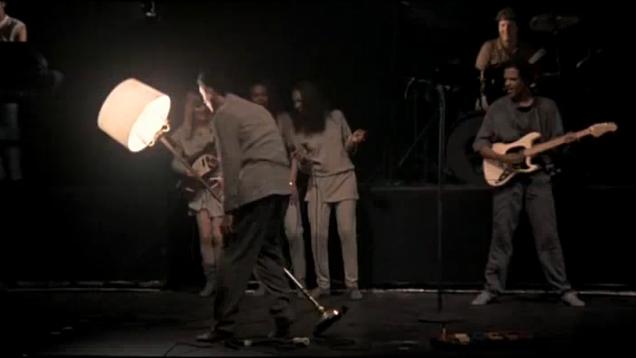
Towards the end of his performance of the Talking Heads' classic, This Must Be the Place (Naïve Melody) - during the song's extended coda/outro, to be precise - lead singer David Byrne breaks into an awkward, spontaneous piece of physical performance, in which he woos, seduces, dances with and, eventually, romances the prop lamp-stand that illuminates both singer and musicians. The lamp itself is an obvious symbol - a reminder of "home", as yearned for in the song's lyrics - as well as the primary lighting source for this particular performance; the perfect blending of content and form?
In taking this object and embracing it, physically - creating a performance or a role-play that one might generally expect to see acted out by two human beings - Byrne is illustrating, in a fairly imaginative fashion, the general role that inanimate objects (or indeed, consumer technology) play in satisfying the greater absence or nostalgia felt when disconnected from other human beings, or - in this particular instance - the home itself.
Home - is where I want to be
But I guess I'm already there
I come home - she lifted up her wings
I guess that this must be the place
I can't tell one from another
Did I find you, or you find me?
There was a time
Before we were born
If someone asks, this is where I'll be
The image of Byrne embracing this object, finding a certain physical and emotional expression through the personification of it, for me works on the same level as the image of Jacques Bonnaffé cradling the static of hotel room television set in Jean-Luc Godard's masterpiece Prénom Carmen (First Name: Carmen, 1983). In that particular film, the character's sense of loss, loneliness and the inability to express his broken-heartedness to the titular Carmen (Maruschka Detmers) is expressed through the substitution of the everyday, artificial "symbol" of the television; the invention, intended - supposedly - to bring us together.
In Stop Making Sense (1984), this performance, in which the lamp-stand is used to re-live - or fulfil the need for - a possible physical encounter, is likewise loaded with a particular loneliness or desperation; albeit, a desperation filtered through Byrne's characteristic childlike whimsy. This single moment in a film filled with amazing moments is further proof - as if it were needed - that Stop Making Sense is possibly the greatest film ever made.
In taking this object and embracing it, physically - creating a performance or a role-play that one might generally expect to see acted out by two human beings - Byrne is illustrating, in a fairly imaginative fashion, the general role that inanimate objects (or indeed, consumer technology) play in satisfying the greater absence or nostalgia felt when disconnected from other human beings, or - in this particular instance - the home itself.
Home - is where I want to be
But I guess I'm already there
I come home - she lifted up her wings
I guess that this must be the place
I can't tell one from another
Did I find you, or you find me?
There was a time
Before we were born
If someone asks, this is where I'll be
The image of Byrne embracing this object, finding a certain physical and emotional expression through the personification of it, for me works on the same level as the image of Jacques Bonnaffé cradling the static of hotel room television set in Jean-Luc Godard's masterpiece Prénom Carmen (First Name: Carmen, 1983). In that particular film, the character's sense of loss, loneliness and the inability to express his broken-heartedness to the titular Carmen (Maruschka Detmers) is expressed through the substitution of the everyday, artificial "symbol" of the television; the invention, intended - supposedly - to bring us together.
In Stop Making Sense (1984), this performance, in which the lamp-stand is used to re-live - or fulfil the need for - a possible physical encounter, is likewise loaded with a particular loneliness or desperation; albeit, a desperation filtered through Byrne's characteristic childlike whimsy. This single moment in a film filled with amazing moments is further proof - as if it were needed - that Stop Making Sense is possibly the greatest film ever made.
Subscribe to:
Posts (Atom)
Schalcken the Painter (1979)
Schalcken the Painter [Schalcken the Painter [Leslie Megahey, 1979]: This is a film I first saw around four years ago. At the time I found...
-
Beginning with a vague preamble on the use of digital video in achieving that contrast between the abstract and the real... One of the mos...
-
A short note on several films by Eric Rohmer I'm not entirely sure if this blog post constitutes a 'return' in the perman...
-
A Mystery? To talk about the cinema's present, one must first acknowledge its past. Roundhay Garden Scene (1888), one of the oldest...