Wednesday, 21 April 2010

The Book of Mary

On the soundtrack, a dialogue between a man and a woman plays out against an aural backdrop of exaggerated birdsong effects. An accompanying montage of images establishes the central location - an affluent, neatly furnished house overlooking Lake Geneva - and the more important presentation of the "home" in the purely traditional, theoretical sense of the word. By beginning the film with the argument at its most pitiless, establishing the discordance of the family relationship and the general disharmony of the central character's turbulent home life - and therefore personifying the dialogue through the particular iconography of the domestic milieu - writer/director Anne-Marie Miéville brilliantly cuts right to the very core of this subtle yet entirely enriching story; perfectly illustrating the very obvious notion that every home tells a story, specifically when such stories, like recollections of a certain event, are recalled from the memory of a child.

In The Book of Mary (Le livre de Marie, 1984), the effect of divorce on the life of a precocious young girl, who hides the trauma of her parent's separation by disappearing into the imagined worlds of books and music, is captured by Miéville with an uncompromising rigour that places the characters at a distance from the audience, stressing a kind of detached observation. Through the flat, locked-off compositions, in which the camera records, unobtrusively, often cutting between short conversational vignettes that establish the particular post-break-up mindset of the family as a whole, the director creates a sense of reality, closer to documentary than fiction, where these over-the-kitchen-table-top discussions between the family-unity have a feeling of unrehearsed, emotional spontaneity. However, through this approach, Miéville is able to extract a greater truth from the material without the usual manipulation or gimmickry that directors exploit when making films about family dysfunction or childhood in general; offering a feeling of empathy and understanding for her characters, simply by giving them the room to grow and develop naturally over the course of the film.


Through the opening sequence of shots, with the suggestion of time passing from night to early morning - while the camera picks out and focuses on these seemingly innocuous everyday domestic items of flower arrangements, vases and table-top ornaments - Miéville brings to mind, perhaps superficially, the opening sequence of director Michelangelo Antonioni's great masterwork L'eclisse (The Eclipse, 1962). Both films begin with the break-up of a couple in the early hours of the morning, where the discussion between the characters is framed by the iconography of the location and the relics of the home. However, whereas Antonioni has his camera explore this location, framing his characters within it in a way that both obscures and reveals the various push/pull dynamics of their central relationship, Miéville has her dialogue take place over mostly empty frames, further pointing towards that suggestion of the absentee family, and again the sense of the recollection of an event as seen through the eyes of a child.

As is often the case in life, the disagreements between husband and wife/father and mother aren't always seen by children, but are heard or felt; they're experienced from behind closed doors, or drowned out, partially, by the general cacophony of the radio or the television set. These static images of a house, largely vacant, suggest the power of these objects as subconscious recording devices. If these walls could talk, people say... referring to the story behind each accumulated piece of furniture, or the particular mark of time that clings to them. In any relationship, we gather shared objects and attach a meaning to them; a picture purchased on the morning of an argument, a keepsake bought on the night of the first kiss, etc. These objects/images hold a story. However, they also create a larger narrative: the story of the various human beings that inhabit this domestic space, and define it.


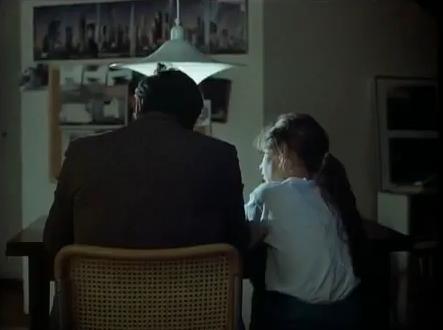
Miéville, like her more famous partner/collaborator Jean-Luc Godard, seems interested in the relationship between men and women and the roles that they play: in this instance, both as facilitators in their own happiness or unhappiness, as well as in the notion of parents with a shared responsibility. This idea runs throughout the film, complementing the more immediate story of the young girl, while also adding a psychological depth to the quiet anguish of the marital situation. The story, in this sense, is anchored by three sequences of family interaction. The first, a roundtable discussion, in which the notion of the "fatal truth" is suggested by a line of dialogue that recalls Woody Allen: "Nothing can stay the same. When a thing stops moving, it's dead!" The second and third of these scenes explore the relationship between the girl and her parents: first, lounging in the bathtub with her mother, attempting to recall the "strength of love", which is "impossible without going backwards", and later working on a homework assignment with her dad.

These scenes show that, despite the volatile situation with the couple, both mum and dad are committed to raising and looking after their child; that this relationship isn't just a caricature, or something like Varda's Le bonheur (Happiness, 1965), where the characters exist for the purpose of social commentary and little else, but something that is real and entirely believable. Therefore, these three people, the mother, father and daughter, become like the geometric shapes that Le Père draws on his daughter's homework assignment; the jagged lines that change direction by forming a new angle where two lines meet.


The 'battle of the sexes'-type call and response of the earlier scenes perhaps remind us, to some extent, of the work of Godard, despite the fact that these characters have a weight and a responsibility that his own characters often don't. In a Godard film, the central protagonists usually possess a youthful exuberance; a naivety that exaggerates the emotional spontaneity of people that exist on the knife's edge of a sensation, turning every embrace into the last embrace, every kiss into the kiss of death. In The Book of Mary, these characters, as a family, are real and convincing. We believe that this man and this woman have loved for long enough and that the responsibilities of the home and the cultivation of a comfortable middle-class existence has taken some of the initial shine and vitality off a relationship that Godard may have depicted through the chaos of l'amour fou. These are tired characters already at the end of something. Even when Godard depicts the decline of a relationship, as he does in nearly all of his films, he's still at the beginning of things. There's no end for his characters. Even if some kind of climax can be found in the romanticised self-destruction of his protagonists; Tis better to have loved and lost... et cetera.

Miéville herself acknowledges this connection in an early scene in which we see Mary, in a tableau-vivant composition, watching, on a small portable television set, a pan and scan copy of Godard's early masterpiece Le mépris (Contempt, 1963). The full 'scope of Godard's images torn apart by the home video restrictions of the early 1980s, dislocating the two characters even further from one another, reducing them to single figures in a 1.37:1 frame, while this bickering between rooms, both here and on the television, is once again soundtracked - this time less obviously - by the beautiful music of Georges Delerue. It draws a line, self-consciously, from one movie to the next, revealing the enormous if subtle differences between these two great filmmakers, whilst also, on a more important level, showing how the subtext of these arguments are changed from the playful to the destructive once the wellbeing of a child becomes at risk.


[The world turned upside-down]


In the film's most famous sequence, Mary, having spent the day in the company of her separated parents - first the mother, then the father - comes home to the empty house, with its open doors and its brightly lit spaces, and puts a record on. Almost immediately, she begins to act out the music, the sensation of it; the rush of feeling, overwhelming both the character and the audience, and giving us that burst of actual, physical expression that we so desperately needed. As a sequence, it functions on a similar level to the extraordinary scene in the Leos Carax film Mauvais sang (Bad Blood/The Night is Young, 1986), where the character played by Denis Lavant is compelled into action by the sound of David Bowie's then contemporary hit single Modern Love. The music burns a hole through this character, placing his feelings into a greater perspective, and turning his movements, both jubilant and terrifying, into a kind of expression.


Like Lavant in that subsequent film, the child cannot put into words the hurly-burly of this situation. This is what makes the experience of childhood so unusual; we can't always understand or appreciate the position we're in. Things might affect us on a profound level, either at the time or much later in life, but we can nonetheless escape into worlds, through words and music, or games of imagined fantasy. As the notes of Symphony No. 2 by Gustav Mahler start up on the stereo, the power of the music is enough to kick-start a spark of life that allows this young character to articulate her feelings of confusion or tragedy through the literal movements of the music. The sound of these instruments together, creating melodies that we can attach ourselves to, becomes a different kind of facilitator; a means of transcending the dreariness of her own reality. The character, wearing her emotions down to nothing, until there's no more expression; no more movement or emotion left to convey.

At this point, the character chooses to play dead (like Björk, "...it stops the hurting"), and we sense that the weight of feeling conveyed in this dance of death has been enough to exorcise those feelings of hopelessness and confusion. The child is reborn. The end of the film suggests, not so much the beginning of a new chapter - the family surrogated, rebuilt, again, as in the Varda film aforementioned - but in the sense that things will continue on, still fractured, still somewhat up in the air, but now these characters at least have a clarity enough to cope with the confusion. In describing The Book of Mary, one critic writes: "There is something of Rossellini in this project, which is modest and ambitious at the same time. The film attains a dry and pure emotion, and a new truth, about the end of childhood." The description perfectly explains the strengths of Miéville's presentation, which is absolutely to the point, and yet filled with subtle depths, textures and nuances, that transform a thing that could have easily been seen as rather distant and reserved, into something that is truly remarkable.

Saturday, 20 March 2010

Architecture in NYC

One of my favourite moments in Woody Allen's Academy Award Winning Hannah and Her Sisters (1986), is the scene in which Sam Waterston's character takes Dianne Wiest and Carrie Fisher on a whirlwind tour of New York City to visit some of his favourite architectural sights. The scene is notable because it illustrates, on a very basic level, what I love most about Allen's work. The seeming simplicity of it, the wit, the imagination, the sleight of hand, the effortless inventiveness and the ability to take moments and images that are present at any point in our daily lives - on any street, place or person - and transform them into moments of great cinema.

The scene in question is a delightful little moment that could have easily been included in the film for no other reason than to provide a brief interval or interlude between the more complicated or exhausting relationship dramas that occur throughout. Instead, it is a scene that communicates a great deal about the relationship between these two friends (the characters played by Wiest and Fisher) as they attempt to feign interest in this travelogue of buildings and places simply as a way of getting to know this dashing and successful young architect. Their reactions to these great buildings demonstrate a desperate attempt to agree or disagree with whatever Waterston's character is speaking of, while also offering a much more amusing insight into the dynamics of this relationship, as both women attempt to outdo one another for the offer of a ride home.

As with any great moment from the films of Woody Allen, this particular scene seems to me to offer a remarkable example of what cinema can achieve, precisely because it is something that could only be communicated through the cinematic form. This scene is further proof of Allen's obvious talent for expressing moments of immense depth and human emotion through incredibly simple though no less ingenious methods, and stands out, in my mind at least, as one single moment of invention from a film seemingly full of them.


Hannah and Her Sisters directed by Woody Allen, 1986:

Tuesday, 2 March 2010

Pauline at the Beach

Given the recent passing of the legendary filmmaker Éric Rohmer, it seems only fair to offer a few words of consideration on possibly my favourite of the director's films; the quietly observed and brilliantly performed ensemble drama, Pauline at the Beach (Pauline à la plage, 1983). As an introduction to Rohmer's incredibly rich and often surprisingly varied body of work, Pauline at the Beach is essential; perfectly illustrating the thoughtful, often leisurely and conversational approach that defines many of the director's greatest films, such as Love in the Afternoon (L'Amour l'après-midi, 1972) or Four Adventures of Reinette and Mirabelle (Quatre aventures de Reinette et Mirabelle, 1987), which for me reach beyond the mere pleasantries of the character study or the vague categorisations of dramatisation to offer something altogether more difficult to define.

In this sense, describing the typical Eric Rohmer experience can be daunting, especially since much of what stands out in Rohmer's work is the emphasis on character interaction, location and mood. Attempting to explain the appeal of such an approach, beyond the obvious personal appeal that resonates during the actual course of viewing, seems almost irresponsible. The work, as it stands, is best experienced, so that an audience can savour the subtle development of these dramas that occur around the narrative, developing naturally from the interactions between characters, or the natural charm or personality of a particular location.

In attempting to intellectualise or over-analyse such factors the reviewer can distract from the often simple pleasures that are presented to an audience when merely spending some time in the company of these characters; getting to know them, becoming privy to their innermost thoughts and feelings, or the often-complicated web of relationships that grow and develop as they stumble in and out of various social events; or simply pass the time on beaches, in cafés or in the garden, or huddled around a television set on a warm afternoon.


Pauline at the Beach directed by Éric Rohmer, 1983:

In Pauline at the Beach, this concept of being in the company of characters as they fumble around the edges of a social predicament is perfectly illustrated through the development of that always interesting narrative facilitator: the summer holiday. The great motivator in many of Rohmer's pictures, because (we assume?) it allows the audience the room to indulge in these scenarios; to take our minds off the more urgent concerns of narrative development, action and plot, and instead see the characters at their most relaxed and apparently carefree. This as an idea is in keeping with Rohmer's central ideology of "thoughts rather than actions", dealing "less with what people do than what is going on in their minds while they're doing it." So, with Pauline at the Beach, we have characters taking a break from the rat race of work or school (or whatever) and using the getaway as an excuse to seek out relationships, connections (meaningful or not) and moments of recreation. The film, both for the characters and for the audience, is therefore an escapist pursuit, where we disengage from our own lives and instead observe the comings and goings of this particular social circle as they wrestling with the complications of everyday life.

Keeping this particular approach in mind, Pauline at the Beach could, like many of Rohmer's other, contemporary-based character dramas, be defined by the literary term "in medias res"; meaning that the drama is already pre-established and in some respect without conclusion. Instead of presenting a clear and conventional three-act structure of beginning, middle and end, Rohmer instead cuts into a story where the characters are already clearly defined (amongst themselves, at least), and where we, as an audience, have to play catch up; teasing out even the most basic of information - including who these people are and what they're actually doing here - from their earliest interactions. What this does beyond allowing the drama to unfold naturally without the usual concessions to conventional narrative storytelling is make the audience feel as though we've been invited into this scenario, into these rooms and houses, and again, been allowed to spend a limited period of time with these characters, eavesdropping on their conversations, or gathering up information as they go about their daily routines.

Illustrating this idea of a story already in progress, the film begins with the arrival of Pauline (Amanda Langlet) and her older cousin Marion (Arielle Dombasle) at the Normandy summer house where the story plays out. Rohmer wastes no time in cutting to a conversation between these two characters as they settle in the garden; with the dialogue soon establishing the theme of romance and relationships, and in particular the contrasts between the two individuals in how they approach these specific concerns.


Pauline at the Beach directed by Éric Rohmer, 1983:

Marion, a recent divorcée, seems to crave intense relationships; relationships with the power to move, but also the power to destroy. Pauline on the other hand is far more pragmatic, viewing relationships in a realistic context, hopeful, but also somewhat cynical. The contrast between these two characters is immediately apparent, with Marion, the eldest of the two, really seeming to be the more naive and perhaps even more adolescent in her view of male and female courtship, while Pauline, still in puberty, already knows what she wants and what to expect. As the story progresses we're introduced to the various characters that exist within this world; chiefly, Henri (Féodor Atkine), a single father and womaniser who Marion begins a casual relationship with, and Pierre (Pascal Greggory), a wind-surf instructor who is besotted with Marion, but eventually ends up spending more time with Pauline as a kind of unintentional confidant.


Pauline at the Beach directed by Éric Rohmer, 1983:

Pauline at the Beach was the third instalment in Rohmer's highly acclaimed series of films grouped together under the collective banner of the Comedies and Proverbs; an otherwise unrelated series of films each based on (or inspired by) a specific proverbial phrase. In the case of Pauline at the Beach, it is the opening quote from Chrétien de Troyes that establishes the theme; 'A wagging tongue bites itself.' The quote introduces not only the conversational structure of Rohmer's film (or the broader conventions of his character dramas in general), but also the various he said/she said situations, where gossip and hearsay are motivators for the plot. To further illustrate this notion, Rohmer develops a story that is, on the one hand, a relationship drama - focusing on a complicated series of inter-relationships, including two couples of differing age-groups and at least two potentially inter-linking love triangles - and on the other, a coming of age story. In presenting both aspects of this dilemma, Rohmer is able to utilise the element of comic misunderstanding, as these characters distort truths and misinformation leading to the usual arguments and falling outs that are typical of the genre.

Through Rohmer's approach to his characters is at times distant - as they are positioned as fully realised human beings, independent of any potential manipulation of the filmmaker - there is nonetheless a very real feeling for these people; a warmth and a charisma that is obvious, even if the more apparent character traits, such as vanity, deceit or self-delusion offer less attractive aspects of their true personalities. Nonetheless, these people, already formed and well developed before the first introductory scene, are allowed to express themselves naturally as characters, revealing their thoughts, feelings and philosophies, either through dialogue or through the choices they make. The clothes they wear, the cars they drive, the people they choose to meet and hook up with all add texture to these characterisations, giving a greater weight to their creation as people that exist beyond the self-contained drama that takes place between the first scene and the last; reinforcing that particular idea frequent throughout Rohmer's work where we sense that these lives and these relationships will continue to thrive or stumble long after our experience with the film has come to an end.

In terms of the actually filmmaking approach, Pauline at the Beach is characteristic of Rohmer's visual approach to his character dramas, drawing mostly on a naturalistic look, with costumes, cars and architecture that is very much of the period, and a loose, observational style, where the camera, often in close-up or medium shot, examines the drama from a fixed perspective. As a contrast to the less well know but no less essential historical dramas that Rohmer directed, such as The Marquise of O... (Die Marquise von O..., 1976), Perceval (Perceval le Gallois, 1978) and The Lady and the Duke (L'Anglaise et le Duc, 2001), where the actual cinematic style was often more ornate, imaginative or deliberately artificial, the look and style of Pauline at the Beach is defined by its location and the natural mood and impression that it inspires. In collaboration with his crew, Rohmer perfectly capture the atmosphere of the seaside setting, from the sun-kissed beach where the blue of the ocean stretches out to meet a bright white sky, to the casual comings and goings of the characters' houses, where the doors remain unlocked (because there's nothing worth stealing) and where the flowers bloom brightly through windows or in the background of idyllic garden scenes.


The Marquise of O... directed by Éric Rohmer, 1976:


Pauline at the Beach directed by Éric Rohmer, 1983:

Through drawing our attention to these seemingly minute details, which define the time and the place and help to create a world for the characters that is entirely convincing, Rohmer is able to make the experience tangible enough for an audience no doubt experiencing this drama from the confines of a cinema seat, or at home, on DVD. So, although the drama might be observational, and the characters at something of a reserve, we're nonetheless able to fully immerse ourselves in the creation of this world made real by our own associations and memories of summer holidays or trips to the seaside with family and friends, where the ritual of walking back from the beach, later afternoon, with your shoes and socks off - bare feet on the gravel path or the grass of the garden - has a real sense of nostalgia.

Though Rohmer attempts with these films to be as unobtrusive as possible, there is still some clear element of stylisation. For example, the extraordinary use of natural sunlight in several scenes, capturing the sense of an endless summer day; from the blue wash of dawn, to the bright whites of high noon and the warming reds of just-before sunset, the lighting of the film, in both the interior and exterior scenes, is perfect. Likewise, the casting of the film and Rohmer's particular skill in creating these characters and allowing them the room to express and emote, is incredibly well defined, with the use of the dialogue and the effortless delivery of the performers, seeming very real and unrehearsed. The intentions of the dialogue and what it reveals about these characters as human beings is never improvisatory or meandering; every expression, no matter how seemingly trite on first experience, gives us some clue as to the purpose of these characters, their dreams and their desires.

Like the other films of the Comedies and Proverbs series - which includes The Aviator's Wife (La Femme de l'aviateur, 1981), A Good Marriage (Le Beau mariage, 1982), Full Moon in Paris (Les Nuits de la pleine lune, 1984), The Green Ray (Le Rayon vert, 1986) and The Boyfriend of My Friend Could Be My Boyfriend (L'Ami de mon amie, 1987) - Pauline at the Beach is crucial to defining the image of Rohmer as a complete artist. Not just as a filmmaker, but as a sometimes novelist, teacher, thinker and critic, able to point his camera at the supposedly ordinary, day after day activities that make up the inter-connected meetings and moments of everyday life and bring out the extraordinary colour and feeling of an actual human existence that many fail to appreciate.

Friday, 26 February 2010

This Must Be the Place

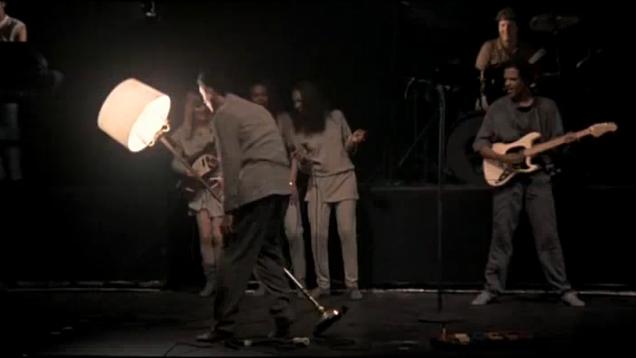
Towards the end of his performance of the Talking Heads' classic, This Must Be the Place (Naïve Melody) - during the song's extended coda/outro, to be precise - lead singer David Byrne breaks into an awkward, spontaneous piece of physical performance, in which he woos, seduces, dances with and, eventually, romances the prop lamp-stand that illuminates both singer and musicians. The lamp itself is an obvious symbol - a reminder of "home", as yearned for in the song's lyrics - as well as the primary lighting source for this particular performance; the perfect blending of content and form?

In taking this object and embracing it, physically - creating a performance or a role-play that one might generally expect to see acted out by two human beings - Byrne is illustrating, in a fairly imaginative fashion, the general role that inanimate objects (or indeed, consumer technology) play in satisfying the greater absence or nostalgia felt when disconnected from other human beings, or - in this particular instance - the home itself.

Home - is where I want to be
But I guess I'm already there
I come home - she lifted up her wings
I guess that this must be the place
I can't tell one from another
Did I find you, or you find me?
There was a time
Before we were born
If someone asks, this is where I'll be


The image of Byrne embracing this object, finding a certain physical and emotional expression through the personification of it, for me works on the same level as the image of Jacques Bonnaffé cradling the static of hotel room television set in Jean-Luc Godard's masterpiece Prénom Carmen (First Name: Carmen, 1983). In that particular film, the character's sense of loss, loneliness and the inability to express his broken-heartedness to the titular Carmen (Maruschka Detmers) is expressed through the substitution of the everyday, artificial "symbol" of the television; the invention, intended - supposedly - to bring us together.

In Stop Making Sense (1984), this performance, in which the lamp-stand is used to re-live - or fulfil the need for - a possible physical encounter, is likewise loaded with a particular loneliness or desperation; albeit, a desperation filtered through Byrne's characteristic childlike whimsy. This single moment in a film filled with amazing moments is further proof - as if it were needed - that Stop Making Sense is possibly the greatest film ever made.


Stop Making Sense directed by Jonathan Demme, 1984:

Friday, 12 February 2010

Inglourious Basterds


If the initial trailer and the subsequent promotional materials seemed to suggest a kind of ultra-violent, men on a mission style Nazisploitation picture - in which a group of revenge-seeking Jewish-American soldiers form a band of scalp-hunting executioners literally carving a path of vengeance through the forests of occupied France - then the eventual experience of Inglourious Basterds (2009), as a complete film, will no doubt be a surprising one. Far more rewarding than The Dirty Dozen (1967) meets Hostel (2005) approach that the studios seemed to be encouraging with their publicity images of bloodied knives, baseball bats and rifle butts, the actual thrill of Inglourious Basterds is never exclusive to the presupposed notions of carnage and retribution that such intentionally provocative images might normally suggest. Instead, it can be found in the film's particular emphasis on language. Not necessarily the languages that are spoken by the various characters - or how such languages are used (or not used) to further a possible plan of action - but the more important languages of fiction and film.

This, as an idea, is something that Tarantino has been refining for the majority of his career. From the seemingly meaningless but ultimately character-building pop culture-heavy chitchat of films like Reservoir Dogs (1992) and Pulp Fiction (1994), to the more self-aware, self-referential patter of the subsequent Kill Bill, Volumes 1&2 (2003-2004) - where the general form of the thing could potentially be seen as a filmed commentary or dissertation on the genre(s) being explored - the ability of dialogue to suggest multiple ways of looking at the film through the creation of stories within stories was always one of the director's greatest strengths. As an extension of this, Inglourious Basterds is perhaps the first film by Tarantino where the power of language is really looked at within a greater dramatic context. Only during The Second World War - the last real war in which the protagonists were, predominantly, Caucasian, and therefore more able to adopt a particular language in order to feign cover behind enemy lines - could the use of language be considered as deadly as the Walther PP or the Bowie knife. The notion of words as weaponry is therefore an important device in Tarantino's film; not only establishing the dramatic motivation of the later plot development (as in - the deliberately hackneyed plot to blow up Hitler?) but also the psychological aspects as well.

The words themselves may seem fairly innocuous, as various characters, largely unknown to one another, sit down to discuss work, or movies, or the benefits of cream with strudel, but through these quirks of conversation Tarantino is able to achieve the creation of a world, based in fact but defined by fiction, where one single, half-mumbled gesture from a previously anonymous dairy-farmer - a devoted husband and father no less - can result in the massacre of a sheltering Jewish family. These ideas, relating to language and the power of words, are made definite in the film's much talked about opening sequence; which, on a more obvious level, establishes the dramatic elements of loyalty, role-play, justice and retribution, and yet beyond this initial interpretation, seems to suggest the by now familiar Tarantino approach of postmodern appropriation: where the references to film, fiction and the general pop culture create a recognisable grammar for the film itself. Although the dialogue in Tarantino's work is often leisurely, idiosyncratic and arguably self-indulgent, revelling as it does in the awkward speech patterns, prose and anecdotal asides that his characters slip in and out of during a single conversation, it is nonetheless essential in developing these characters: not simply as people that we can relate to or care about, but as signifiers; where the subject matter discussed - or the particular way in which said discussions pan out - suggests hidden layers of interpretation and characterisation.


With an opening chapter title boldly announcing the location, "Once Upon a Time... in Nazi-Occupied France" - immediately followed by a suitably heroic widescreen composition depicting the abovementioned farmer chopping wood in a long-shot that frames his small house as if it were a studio recreation of some forgotten frontiers homestead (a literal 'little house on the prairie') - it becomes immediately obvious what Tarantino is attempting to achieve through the visual style alone. The iconography throughout is crucial, with at least three shorthand references to the work of Sergio Leone and a general nod to the work of John Ford creating a sense that this is a mythical story, again with ties to history, but somehow greater than the reality; a cinematic history, in the grand tradition of Young Mr. Lincoln (1939), Lawrence of Arabia (1962) and Once Upon a Time in the West (C'era una volta il West, 1968). However, the shorthand references to Ford and Leone aren't simply examples of Tarantino showing off his movie geek obsessiveness. On the contrary, both serve a definite purpose. These elements of obvious homage create a world for the viewer that is immediately recognisable; establishing the relationships between characters - or the ideas of loyalty and betrayal - and a certain logic (movie-logic?) that forewarns the viewer that there's something slightly more self-aware going on behind the violence, conflict and assassination attempts; something that plays on the more recognisable codes and conventions of the war movie, in the greater, historical sense.

This opening sequence, which introduces us to the literally larger than life character of SS Colonel Hans Landa (Christoph Waltz) - a "Jew hunter" who considers himself to be a serious detective, and applies a method-actor's logic to sniffing out his prey - seems designed to capture that sense of anticipation so evident in Leone's work: with the two most memorable scenes in the aforementioned Once Upon a Time in the West (the arrival of "Harmonica" by train, and the subsequent massacre of the McBain family by Frank and his gang) setting something of an obvious template. It also plays into the Leonian idea of the confrontation; where the build up to a moment of violence is often so prolonged and so focused on the personal, idiosyncratic rituals that make such sequences resonate on a deeper level of emotional investment, that the violence, when it does occur, seems all the more unexpected and cruel. The form of the film, in this respect, isn't merely an attempt to juxtapose the style of the Spaghetti Western with the political conventions of the Hollywood war drama - which, in itself, was already characteristic of the Italian Zapata Westerns of the 1970s: films such as Damiano Damiani's A Bullet for the General (El Chucho, quién sabe?, 1967), Sergio Corbucci's Compañeros (Vamos a matar, compañeros, 1970) and Leone's own Giù la testa (released as Duck, You Sucker! and A Fistful of Dynamtie respectively, 1971), which was a critique of the Zapata subgenre, as well as a perfect example of it. Instead, these juxtapositions and associations create something approaching stenography for the viewer; a kind of cinematic slang very much in keeping with the standard Tarantino dialogue - which plays on a kind of stylised conversational approach steeped in self-reference - making the passage of information between the director and his audience much more direct.


We can see an obvious example of this in the use of the film's title and its particular function in describing (or branding) the supporting characters (the aforementioned Nazi-scalp-hunters) through an accented misspelling: presenting the title as the characters themselves might pronounce it, therefore giving the notion of language within the film a recognisable voice. The title itself is by now obvious to most viewers as a direct reference to the Enzo G. Castellari film The Inglorious Bastards (Quel maledetto treno blindato, or literally That Damned Armoured Train, 1978). Through this, Tarantino establishes, briefly, a sense of the men on a mission, action adventure movie that Castellari's film attempts to replicate, while also self-consciously endearing itself to the Euro War, or "Macaroni Combat" subgenre; a sort of European (usually Italian, but not exclusively) pastiche of the Hollywood War Movies popular at the time. So, what we have in Tarantino's Inglourious Basterds is, on some level, a parody of a parody; which is perfect in its own way of illustrating the director's quite interesting idea of using the conventions of a film like The Eagles Over London (La battaglia d'Inghilterra, 1969) or Salt in the Wound (Il dito nella piaga, 1970) (and their own references to movies like The Dirty Dozen and Where Eagles Dare), to create his own commentary on the outlandishness of war and the ridiculousness of a conflict between two human beings, both from the same ethnic background, class and generation, conditioned into hating one another for the benefit of an abstract cause.

Of course, in Tarantino's work, the notion of conflict isn't simply restricted to the depiction of "war" in the real-life sense, but of the idea of a cinematic conflict: as in the conflict of various juxtaposing styles, ideas and philosophies. Although most critics and viewers are quick to point out the more obvious lifts from the work of Ford and Leone, the driving force behind Tarantino's intellectual experiments seems closer to his early idol, Jean-Luc Godard. There are some superficial though no less relevant Godardian touches littered throughout the film, with the particular references to real-life figures in a fictional framework, exaggerated for the purposes of satire. So we have the character of Joseph Goebbels (Sylvester Groth) presented as a would-be Hollywood film producer, full a would-be Hollywood film producer's bluster and bullshit, which, rather than simply creating a mockery out of the real-life Goebbels, manages to humanise him in a way that is a benefit to the film's actual creative intent. There is also the naming of certain characters in a way that is significant, culturally, to Tarantino's primary influences: names such as Hugo Stiglitz (the Mexican cult-actor) or Omar Ulmer (a play on the film director Edgar G. Ulmer), or the use of the alias Antonio Margheriti (the director of Cannibal Apocalypse, 1980), which would, in spirit at least, suggest the influence of a film like Alphaville (1965) or Made in U.S.A. (1966).


Though the reliance on the more obvious movie caricature of films like Death Proof (2007) and Kill Bill seems to be more subtle here, certain examples of it can still be found. Not necessarily in the previously discussed opening sequence, but in the smaller, seemingly throwaway moments, which seem handpicked in order to establish an underlining message that "violence begets violence". Such examples could include the shot of Aldo "The Apache" (Brad Pitt) and The Bear Jew (Eli Roth) staring down, into the camera (showing us the POV of one of their recent victims) in a manner that recalls the near-iconic shot of a masked Malcolm McDowell taunting the prone Patrick Magee in Stanley Kubrick's adaptation of A Clockwork Orange (1971); or perhaps through the later references to Brian De Palma's Scarface (1983), Elem Klimov's Come and See (Idi i smotri, 1985) and Lamberto Bava's Demons (Dèmoni, 1985), which all occur during the penultimate sequence set during the premier of the fictional propaganda film Nation's Pride, where the kaleidoscope of references seem deliberately chosen in order to illustrate the various potential presentations of violence on film (the lurid, to the surreal, to the pure exploitation).

Such suggestions can also be found in the general feeling of the war-time Parisian setting, the meeting between the displaced Jewish farm girl turned cinema owner Shosanna Dreyfus (Mélanie Laurent) and the German war hero Fredrick Zoller (Daniel Brühl), and the espionage film subplot of the Basterds and their double-agent Bridget von Hammersmark (Diane Kruger) attempting to formulate a plan. Each of these segments open out like the plot of a self-contained film; almost as if each instalment could carry its own independent narrative - be it a film about a noble family man struggling with his conscience and a loyalty to his children as he takes in a neighbouring family of sheltering Jews, or even a burgeoning war-time romance between two people from either side of the conflict (as just two single examples). Instead, Tarantino uses these short scenes to construct a much larger-tapestry of events; employing the literary use of chapter-points familiar from Pulp Fiction and Kill Bill, and therefore encouraging this idea of each element of the narrative becoming its own miniature drama, both self-contained mini-movie and an integral part of the actual film as a whole.


There are other examples too, like the introduction of Lt. Archie Hicox (Michael Fassbender), looking like a stunt double Sean Connery just walked off the set of Richard Attenborough's A Bridge Too Far (1977) and straight into a typically serious, stiff-upper-lipped, War-Time propaganda piece from the early 1940s (surprisingly no less distracting for featuring a ridiculous Mike Myers characterisation and an appearance from a stogie-puffing Winston Churchill), or the extraordinary "Putting Out Fire" sequence, in which the transformation of Shosanna from innocent country girl to 40s femme-fatale is presented as an 80s pop cinema cliché: with the use of David Bowie's title song from the Paul Schrader remake of The Cat People (1982) offering an anachronistic commentary of the central themes of the film. In this sequence in particular, the cultural reference points, and the way in which each element of the iconography can be interpreted by the viewer, is simply jaw-dropping. Through montage, Tarantino shows the metamorphosis of Shosanna as if she were an actress preparing for a role: choosing a costume, applying makeup, etc. He also further suggests that the exaggeration of the violence and the retribution still to come is in many ways filtered back through the general, recognisable symbols of the cinema itself.

In striping two lines of red lipstick across either side of her face Shosanna establishes an explicit connection with the Apache theme of the Basterds, while also further illustrating the film's continual quotation of the western genre (in this instance, the classic westerns of John Ford, or the spirit of Debbie from The Searchers). By the end of the sequence she is reborn, cinematically, as the archetypical Fassbinder heroine. As she adjusts a netted veil, framed by the infamous black, white and red of a distant Swastika, she could just as easily be Maria Braun or Veronika Voss; the great symbols of post-war Germany in Fassbinder's later work. What these moments do, besides maintaining the plot and illustrating Tarantino's individual approach to the genre (or the pastiche of it), is to set up a far greater thread of interpretation that runs throughout the film: specifically the depiction of a world, both contemporary and historical, that is entirely reflected through the magic of the silver screen.


In several interviews supporting Inglourious Basterds at the time of its initial release, Tarantino suggested that what his film was really about, beyond the more recognisable genre practicalities of war-time espionage and personal retribution, was the true, all conquering power of the cinema itself. It is here, in Tarantino's film, that we see the invention of a cinema that acts as a creative force somehow strong enough to bring down the Third Reich; not simply in the metaphorical sense, but in the realisation that film is a deadly weapon; an actual combustible celluloid, as well as a creative medium with the ability to offer a group-forum for the communication of ideas. In this sense, the ideology goes back to Godard's 60s belief that the cinema could be used to change the world, and although Tarantino seems less interested in changing the world in a contemporary sense, with any attempt to read the film as a critique of the current situations in Iraq or Afghanistan (or anywhere else for that matter) seeming somewhat limited, it is no less remarkable as a central idea.

In the final chapters of the film, Operation Kino and Revenge of the Giant Face respectively, the idea of a cinema that is about cinema (the creation and the viewing of it) is confirmed, not just through the self-reflexive chapter-titles, but through Tarantino's direction of the film's major scene. In the attack on the cinema, Tarantino creates an astounding sequence that works on at least several layers; offering the obvious thrill of the climax, in which various strands of the narrative converge in a kind of closure, but also intensifying his theme of the cinema as a force to be reckoned with. The juxtaposition between images of celluloid being loaded into film canisters (or projectors) with bullets being loaded into magazine-clips had already been made during the scene of Shosanna's Bowie-scored transformation. However, in the cinema massacre sequence, the cross-cutting between the endless machine gun fire of the on-screen soldiers and the shots of celluloid running through the projector seem designed to make such connections all the more explicit. There is also the pertinent image of Fredrick Zoller, larger than life on the frame-within a frame cinema screen, pointing his blazing machine gun out at the audience, and then the fantastic mirroring of this, life vs. art, as the real-world audience (the one that we saw the movie with) cheer the eventual slaughter of this Nazi audience, who themselves were previously cheering the massacre of the opposing forces in the film within a film. Could this particular presentation be seen as Tarantino quite radically flipping the film's creative purpose, turning it back against the audience - against an audience that had always embraced the violence of his earlier work, but failed to question his own creative intentions? - Possibly. In Tarantino's film, the violence is as unforgiving as that of his characters, resulting in a powerful anti-war commentary where the recognisable distinction between the heroes and the villains is completely removed.


[Ammunition]


[Spent shells]


[An attack on the audience?]


As the narrative develops, it is almost as if the initial plot - the two strands of revenge, from the Basterds to Shosanna - becomes less important; or at least, less important in the sense of paying off in the final act. Although the theme of revenge is carried right the way through the film, you could argue that this is really more of a study of vengeance, as an ideology, rather than simply a film about the character's pursuit of it. Like Richard Lester's cult classic How I Won the War (1967), the stylisations of Inglourious Basterds seem deliberately tailored to reduce the spectacle of war to a kind of comic book fodder; showing up the absurdity and irrationality of it, on a philosophical level, and lampooning it mercilously. So the end product is less an anti-war film than an "anti anti-war film" (Lester's classification); a riposte to the overly serious presentation of something like Saving Private Ryan (1999), where Spielberg attempted to produce a film that would place the audience right alongside his characters, so that we could experience, as close to first hand, the real horrors of combat, but instead made the whole thing rather exciting, and thrilling.

If Death Proof was essentially about transcending the casual misogyny of the horror film genre, then Inglourious Basterds could be seen as an attempt to strip away the supposed nobility of war; illustrating the conflict from numerous narrative and character perspectives - from the Americans, to the French, to the British and the Germans - and ultimately exposing the futility of it. That rather tragic notion that these people, who can (and do) hold conversations, show charm and charisma, sit side by side undetected, are conditioned into blowing each other away with bombs and machine gun fire. While many critics consider Tarantino to be nothing more than a shallow purveyor of hardcore violence - or worse, a sardonic hipster who glamorises cruelty and makes the thrill of bloodshed akin to a celebration - the actual brutality of Tarantino's work is never superficial. The violence of Inglourious Basterds is conspicuous, but never explicit. Perhaps because the film exists so far beyond the parameters of cinematic realism - rewriting history for its own satirical ends - so that these characters are ultimately robed of a recognisable humanity; reduced to symbols of status, religion, ethnicity or nationality; much like actual human beings during an extended period of war.


Inglourious Basterds is currently available on Region 2 DVD from Universal Pictures.

Schalcken the Painter (1979)

Schalcken the Painter [Schalcken the Painter [Leslie Megahey, 1979]: This is a film I first saw around four years ago. At the time I found...